The Ultimate Guide to Creating Powerful Backlinks That Transform Your Business in 2026
Master backlink creation with our comprehensive 2026 guide. Learn proven strategies to build high-quality links that boost rankings and drive traffic to your business.
 Written byPrithvi Jadwani
Table of contents
Summarize this article with AI
TL;DR
Backlinks are still the foundation of search authority in 2026, but the rules have changed. A high-quality backlink now does four jobs: passes authority, drives referral traffic, builds AI visibility, and establishes trust. Most businesses waste time chasing quantity. This guide shows you how to build backlinks that actually move the needle for your business.
- Quality Over Quantity. One backlink from a relevant, authoritative source beats 100 directory submissions
- AI Search Visibility. Backlinks now influence how ChatGPT, Perplexity, and Google AI Overviews reference your brand
- Real Business Value. The best backlinks drive referral traffic and conversions, not just rankings
- Proven Strategies. 10 actionable tactics you can start implementing today to build authority
- 90-Day Action Plan. A step-by-step roadmap to build a sustainable backlink system for your business
Why Backlinks Still Matter for Your Business in 2026 (And What's Changed)
"SEO is dead", they said. My agency just closed $130,000 in new business last quarter, and every single client came through organic search.
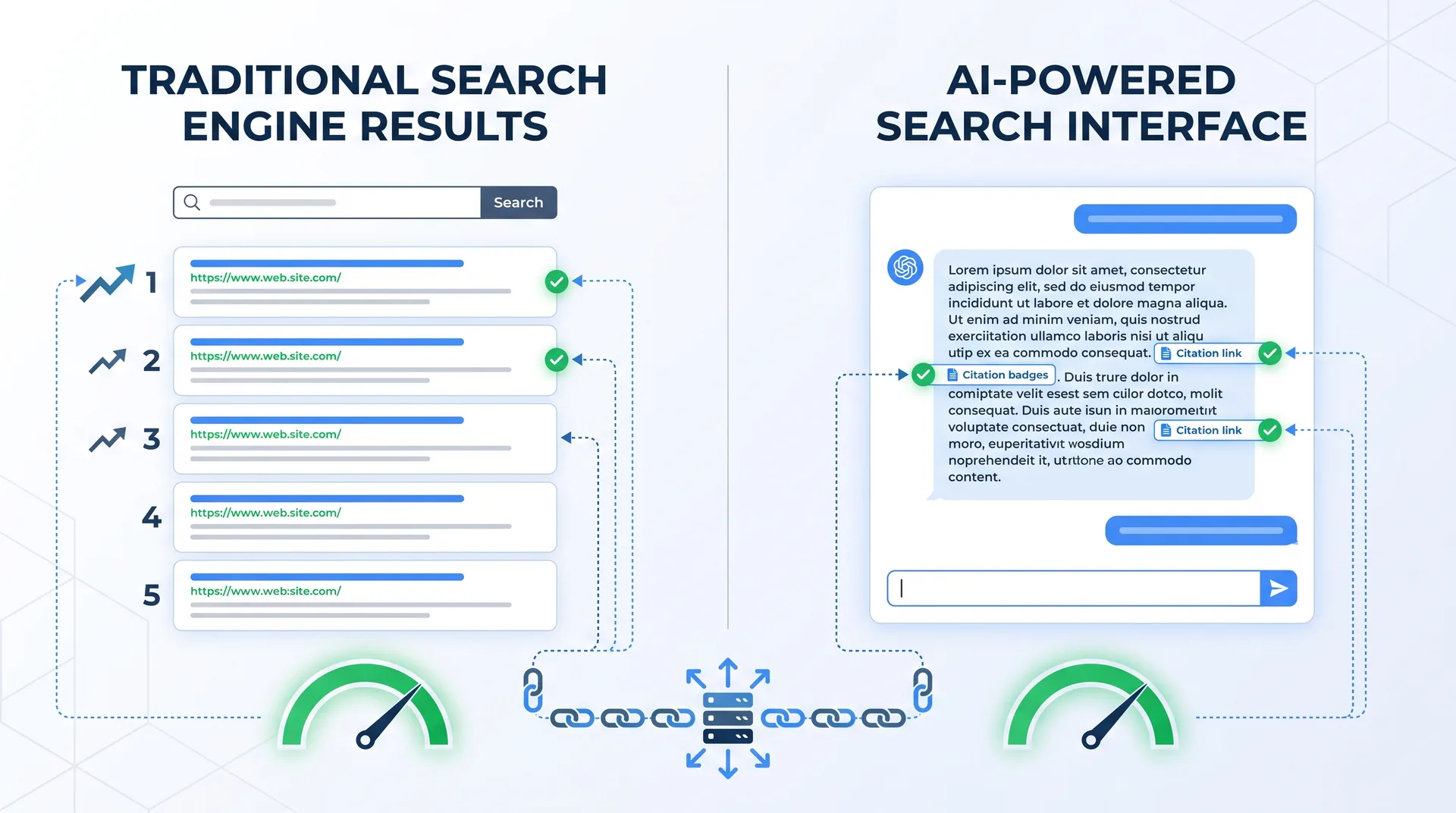
Backlinks are still a strong ranking signal for search engines. But here's what changed: they now do more than influence Google rankings. AI tools like ChatGPT, Perplexity, and Google's AI Overviews understand what's authoritative in part by looking at who credible sources reference.
I tested this. We built a backlink profile for a D2C brand in the fitness space. Within 90 days, they started appearing in ChatGPT responses when users asked for product recommendations. Not because we gamed the system. Because we built real authority that AI systems learned from.
The definition of a high-quality backlink has evolved. It's no longer just about the linking website's domain authority. Yes, that number still matters. But a high-quality backlink in 2026 has four jobs:
Passing Authority
Directly transferring trust and ranking power through to your page
Driving Referral Traffic
Bringing real, engaged visitors from an audience that cares
Building AI Context
Placing your brand in editorial context that AI systems learn from
Establishing Trust
Building credibility with readers encountering your brand for the first time
Understanding What Makes a Backlink 'High-Quality' in 2026
Most businesses waste 40% of their link building budget on backlinks that don't move the needle.
I see it every week. Companies paying for directory submissions, buying links from link farms, or chasing high domain authority sites that have nothing to do with their industry. They rack up hundreds of backlinks and wonder why their rankings haven't budged.
Quality is no longer determined solely by the linking website's domain authority. A link from a DA 90 site means nothing if it's buried in a footer, surrounded by 200 other links, and has zero relevance to your business.
The Four Non-Negotiables of a High-Quality Backlink
Authority Transfer: The link passes real ranking power (dofollow, from a trusted domain)
Engaged Audience: The linking site has real traffic and an audience that cares about your topic
AI Editorial Context: The link appears in quality editorial content that AI systems index and learn from
Reader Trust: The link is placed naturally in context where it genuinely helps readers
Relevance and topical alignment matter more than ever. Google's algorithms have gotten smarter at understanding semantic relationships. And AI systems? They're even better at it. A link from a fitness blog to your fitness app carries more weight than a link from a random tech directory with a higher DA.
Pros
Editorial placement in relevant, well-written content
Natural anchor text that flows with the surrounding context
From sites with real traffic and engaged audiences
Placed in content that AI systems will quote and reference
From domains in your industry or closely related niches
Cons
Footer or sidebar links with 200+ other outbound links
Over-optimized exact-match anchor text
From link farms, PBNs, or irrelevant directories
Surrounded by AI-generated slop that gets ignored
From unrelated industries just because the DA is high
The best backlinks are the ones you'd be proud to show a potential customer. If you wouldn't want someone to see where your link came from, it's probably not worth having.
Prithvi Jadwani, TechDevs
Here's the difference between links that move the needle and links that waste your time: the good ones drive actual business outcomes. When we build backlinks for clients, we track referral traffic, conversion rates, and ranking improvements. If a link doesn't contribute to at least one of those, it wasn't worth the effort.
How to Create Backlinks for Business: 10 Proven Strategies That Work
I've tested nearly every link building method over the past decade. Some work. Most don't. And a few will actively hurt your business.
The strategies below are the ones that still deliver results in 2026. I use them for TechDevs clients, and they've driven millions in revenue through organic search. Not theory. Real outcomes.
But here's the thing: not every strategy will work for every business. A B2B SaaS company needs a different approach than a local service business. An e-commerce brand has different opportunities than a consulting firm.
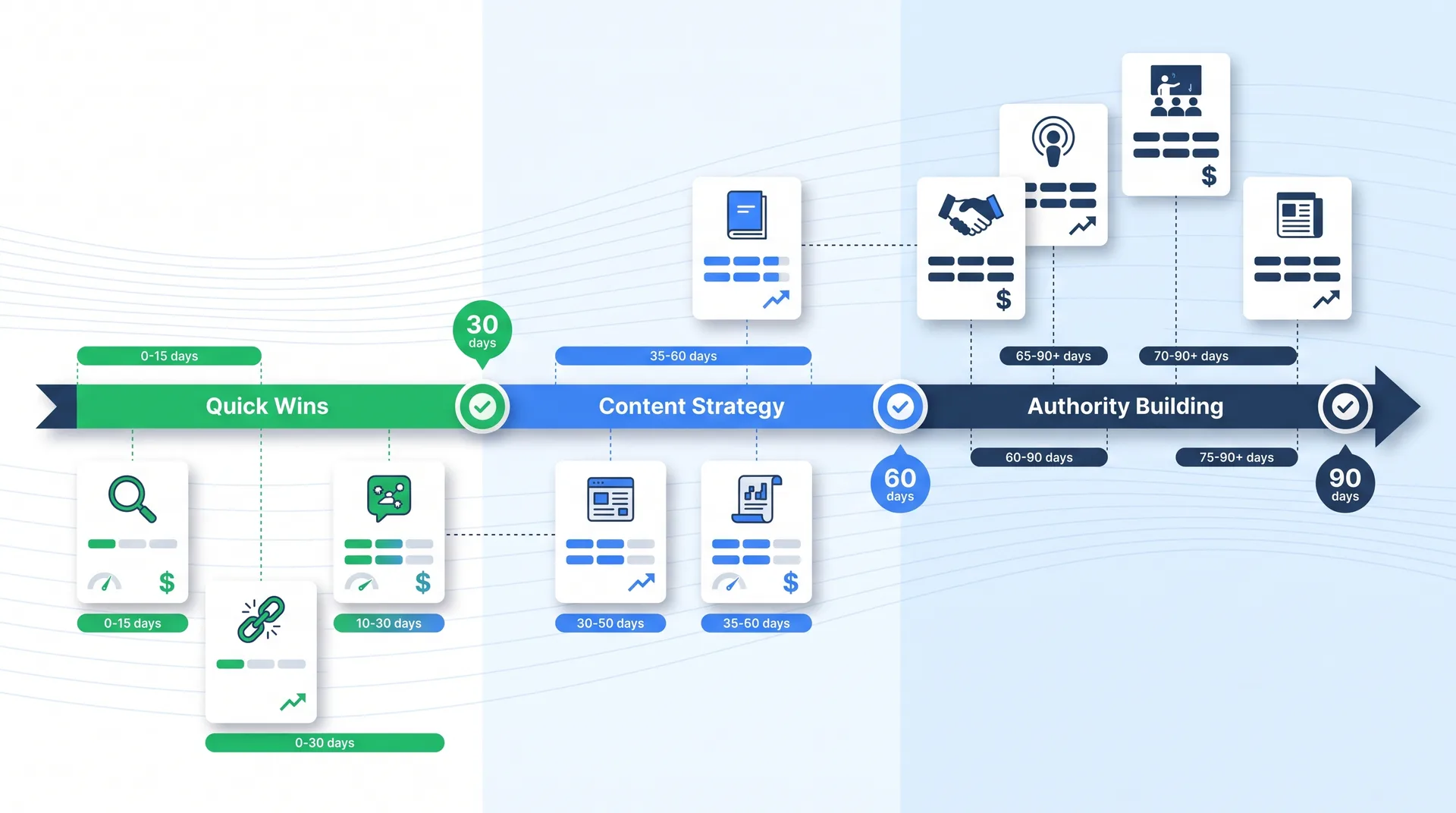
Quick Wins
Strategies 1-3 deliver results in weeks with moderate effort
Content-Driven
Strategies 4-6 require content creation but scale well
Relationship-Based
Strategies 7-10 take longer but build lasting authority
Your job is to pick 3-5 strategies that match your resources, timeline, and business model. Then execute them consistently for 90 days before you judge results. Link building is a long game. The businesses that win are the ones that show up every week, not the ones looking for overnight success.
Competitive Intelligence (1-3): Fastest path to your first 20-50 quality backlinks
Content-Driven (4-6): Best for building long-term authority and AI visibility
Relationship-Based (7-10): Highest quality links but require more time investment
Strategy #1-3: Competitive Intelligence and Quick Wins
Your competitors already did the hard work of finding sites that link to content like yours. Why start from scratch?
Competitive backlink analysis is the fastest way to build your first batch of quality links. You're pitching sites that have already demonstrated they're willing to link to content in your space. The hard part (finding relevant, linkable sites) is done.
Strategy #1: Replicate Competitors' Backlinks
Find sites linking to your competitors' content and pitch them your better version. Use tools like Ahrefs or SEMrush to export their backlink profile, filter for high-quality links (DA 40+, relevant niche, editorial placement), and create a personalized outreach campaign. I've seen response rates of 15-20% when you lead with genuine value and show how your content improves on what they already linked to.
Strategy #2: Reclaim Broken Backlinks
Identify broken links pointing to your competitors (404 errors, deleted pages, moved content) and offer your content as a replacement. This works because you're solving a problem for the site owner (they have a broken link) while earning a quality backlink. We've closed 30+ backlinks in a single month using this method for a client in the marketing space.
Strategy #3: Convert Unlinked Brand Mentions
Find places where your brand, product, or team members are mentioned online without a link. Then reach out and politely ask for the link to be added. This is the easiest ask in link building because they already mentioned you. According to research from Semrush, this is one of the most scalable strategies for established brands.
The beauty of competitive intelligence strategies is they're data-driven. You're not guessing which sites might link to you. You're targeting sites that have already linked to similar content.
Export competitor backlinks using your preferred SEO tool
Filter for high-quality links (DA 40+, relevant niche, editorial placement)
Group similar linking opportunities by type (guest posts, resource pages, mentions)
Create personalized outreach templates for each group
Track responses and follow up 2-3 times over 2 weeks
Strategy #4-6: Content-Driven Link Attraction
The best backlinks are the ones you don't have to ask for.
Content-driven link attraction is about creating assets so valuable that other sites naturally want to reference them. This is how we built TechDevs' backlink profile to over 500 referring domains. We publish original research, comprehensive guides, and tools that solve real problems.
And honestly? This is where most businesses fail. They create mediocre content and wonder why nobody links to it. You need to create content that's genuinely better than what already exists.
Original Research & Data
Surveys, industry reports, or proprietary data that journalists and bloggers can cite. Backlinko has 3.4 million backlinks largely because they publish data-driven content that others reference.
Comprehensive Resource Pages
Ultimate guides, curated lists, or tool directories that become go-to references in your niche. These attract links naturally because they save readers time.
Strategic Guest Posting
Writing for relevant, authoritative sites in your industry. Not for the link itself, but to position yourself as an expert and reach new audiences.
AI-Powered Content Creation
Use AI to accelerate research, outline creation, and first drafts. But always add your expertise, real examples, and unique insights. AI helps you create more, not replace your thinking.
Here's what works: pick one content type from above and commit to creating one high-quality asset per month. Not 10 mediocre pieces. One exceptional piece that's so good people naturally want to share and link to it.
We don't just deliver traffic. We deliver outcomes. And the best way to earn backlinks is to create content so good that linking to it makes the linker look smart.
Prithvi Jadwani, TechDevs
Strategy #7-10: Relationship-Based and Authority Building
The highest-quality backlinks come from relationships, not outreach templates.
I learned this the hard way. In 2022, I sent 500 cold emails asking for backlinks. Response rate? Less than 2%. Then I started building real relationships with journalists, industry experts, and other founders. Response rate jumped to 40%.
Relationship-based strategies take longer. But they build the kind of authority that compounds over years, not months. These are the links that drive referral traffic, establish trust, and get your brand mentioned in AI responses.
Digital PR and Journalist Outreach: Build relationships with journalists covering your industry. Offer yourself as an expert source, share data they can cite, and provide quotes for their stories. Tools like HARO (Help A Reporter Out) make this easier to scale.
Industry Influencer Partnerships: Connect with thought leaders in your space. Collaborate on content, co-host webinars, or participate in podcasts. The backlinks come naturally when you provide value to their audience.
Strategic Business Partnerships: Leverage existing business relationships for mutual link opportunities. Suppliers, partners, and complementary service providers often have relevant sites where a link makes sense.
Create Shareable Tools or Resources: Build calculators, templates, or free tools that solve specific problems. A well-designed tool can earn hundreds of backlinks organically as people discover and share it.
How do I start building journalist relationships?
Start by following journalists who cover your industry on Twitter and LinkedIn. Engage with their content genuinely (not just when you want something). Share their articles, provide thoughtful comments, and offer data or insights when relevant. When you do reach out with a pitch, you're not a stranger.
What makes a tool or resource linkable?
It needs to solve a specific problem better than existing solutions. Free, easy to use, and provides immediate value. Think ROI calculators, template libraries, or data visualization tools. The key is making it so useful that people naturally want to share it.
How long does it take to see results from relationship-based strategies?
Expect 6-12 months before you see significant results. But once those relationships are established, they become your most valuable link building asset. One strong relationship with a journalist can lead to dozens of high-authority backlinks over the years.
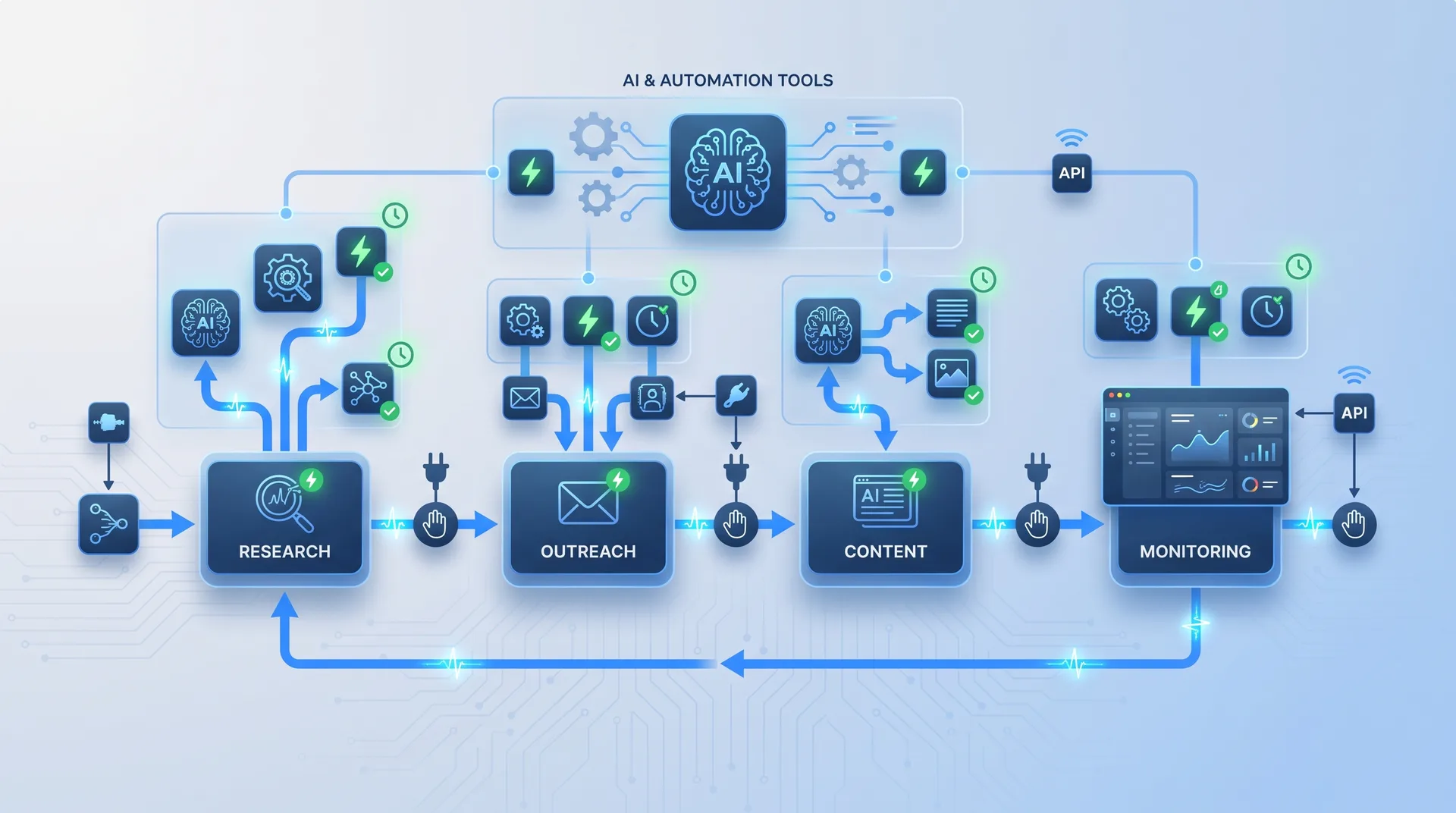
Automating Your Backlink Creation Process with AI and Smart Tools
Here's how we scaled TechDevs from 50 to 500+ referring domains without hiring an army of outreach specialists.
AI and automation tools let you identify opportunities, personalize outreach, and track performance at scale. But here's the critical distinction: using AI to make your link building faster is not the same as replacing the human relationship-building entirely.
We use AI for the repetitive, time-consuming parts. Research, initial outreach, follow-ups, and reporting. The strategic thinking, relationship building, and quality control? That's still human.
AI-Powered Opportunity Identification
Use AI to analyze competitor backlinks, find broken links, and identify unlinked mentions at scale. What used to take days now takes hours.
Personalized Outreach at Scale
AI helps customize email templates based on the recipient's content, recent articles, and interests. Response rates improve when outreach feels personal, even at scale.
Automated Follow-Up Sequences
Set up intelligent follow-up sequences that adapt based on recipient behavior. Most links come from the 2nd or 3rd follow-up, not the first email.
Performance Tracking Dashboards
Monitor backlink acquisition, referral traffic, and ranking improvements in real-time. Know what's working and double down on it.
At TechDevs, we built custom automation workflows that handle 80% of the manual work in link building. Our team focuses on strategy, relationship building, and creating the exceptional content that earns links. The AI handles the grunt work.
Common Backlink Building Mistakes to Avoid in 2026
I've made every link building mistake in the book. So you don't have to.
In 2022, I got scammed out of $2M and had to rebuild TechDevs from scratch. Part of that rebuild meant learning what actually works in link building vs. what sounds good but wastes money.
Here are the mistakes that will hurt your business, ranked from "annoying" to "genuinely dangerous for your rankings."
Pros
Building relationships with journalists and industry experts
Creating genuinely useful content that earns links naturally
Targeting relevant sites with engaged audiences
Tracking referral traffic and conversions, not just link counts
Being patient and consistent with outreach over months
Cons
Buying links from Fiverr, link farms, or PBNs
Targeting high DA sites that have nothing to do with your niche
Using exact-match anchor text for every backlink
Ignoring referral traffic and focusing only on rankings
Building 100 links in a month then stopping completely
The biggest mistake? Buying links. I see businesses spend thousands on link packages from sketchy vendors. They get 50 backlinks overnight from irrelevant sites, their rankings don't budge (or worse, drop), and they wonder what went wrong.
Red Flags to Watch For
Anyone promising "guaranteed rankings" or "100 backlinks in 30 days"
Link packages sold on freelance marketplaces for $50-200
PBNs (Private Blog Networks) that exist only to sell links
Directory submissions to irrelevant, low-quality sites
Links from sites with no traffic or engagement metrics
Over-optimized anchor text is another killer. If every backlink to your site uses your target keyword as anchor text, Google knows something's up. Natural backlink profiles have variety: branded anchors, naked URLs, generic phrases like "click here", and yes, some keyword-rich anchors. But the mix matters.
And here's one most people miss: ignoring the referral traffic and AI visibility aspects of backlinks. A link that drives zero traffic and appears in content that AI systems ignore is worthless, even if it's from a high DA site. Focus on links that deliver actual business value.
The best way to gain trust in business is radical honesty, even when it costs you revenue. I've turned down clients because their link building expectations weren't realistic. Those honest conversations led to referrals worth 10x what I would have made from the original deal.
Prithvi Jadwani, TechDevs
Measuring Success: Tracking Your Backlink Building ROI
If you can't measure it, you can't improve it.
Most businesses track backlink count and think they're measuring success. But backlink count is a vanity metric. What actually matters: domain authority growth, referral traffic, ranking improvements, and AI mentions.
At TechDevs, we track four key metrics for every client's link building campaign. These tell us if we're building real authority or just accumulating links that don't move the needle.
Domain Authority Growth: Track your overall domain rating (DR) or domain authority (DA) monthly. A healthy backlink strategy should show steady growth over 6-12 months.
Referral Traffic: Monitor traffic from backlinks in Google Analytics. If your links aren't driving visitors, they're not placed well or the audience isn't relevant.
Ranking Improvements: Track keyword rankings for your target terms. Quality backlinks should correlate with ranking improvements over time.
AI Search Visibility: Monitor how often your brand appears in ChatGPT, Perplexity, and Google AI Overviews. This is the new frontier of backlink value.
But here's the thing: these metrics lag. You won't see ranking improvements overnight. Referral traffic takes time to build. Domain authority updates monthly at best. You need leading indicators too.
Leading indicators include outreach response rates, content publication rates, and relationship development. If you're getting 15-20% positive responses to outreach, you're on track. If you're below 5%, your targeting or messaging needs work.
Ahrefs or SEMrush
Track backlink acquisition, domain authority, and referring domains over time
Google Analytics 4
Monitor referral traffic, user behavior, and conversion rates from backlinks
Google Search Console
Track ranking improvements and click-through rates for target keywords
AI Search Monitoring
Use tools like ChatGPT, Perplexity, and Google AI Overviews to track brand mentions
Calculate the actual business value of your link building by tracking leads and revenue from organic search. If you're spending $5,000/month on link building and it drives $20,000 in new revenue, that's a 4x ROI. That's the number that matters to your business.
Your 90-Day Action Plan to Create Backlinks for Business Success
Theory is worthless without execution. Here's your roadmap.
I've used this exact 90-day plan to help businesses go from zero backlinks to 50+ quality referring domains. It works because it balances quick wins with long-term authority building. And it's designed for businesses that don't have a full-time link building team.
Month 1: Foundation (Weeks 1-4)
Week 1: Audit your current backlink profile using Ahrefs or SEMrush. Identify toxic links to disavow and opportunities to reclaim. Week 2: Research 3-5 competitors and export their backlink profiles. Filter for high-quality opportunities. Week 3: Set up tracking systems (Google Analytics goals, Search Console monitoring, backlink tracking spreadsheet). Week 4: Create your first linkable asset (comprehensive guide, original research, or useful tool). This is what you'll pitch in Month 2.
Month 2: Execution (Weeks 5-8)
Week 5: Launch competitive intelligence outreach (Strategy #1-3). Target 50 sites with personalized emails. Week 6: Publish your linkable asset and promote it to your email list, social media, and relevant communities. Week 7: Start building journalist relationships. Engage with 10-15 journalists on Twitter, share their content, and offer value. Week 8: Follow up on Week 5 outreach (2nd and 3rd follow-ups). Launch a second round of outreach to 50 new sites.
Month 3: Optimization (Weeks 9-12)
Week 9: Analyze results from Month 2. Which strategies drove the most links? Which had the best response rates? Week 10: Double down on what worked. If competitive intelligence worked well, scale it. If content-driven attraction worked, create another linkable asset. Week 11: Set up automation workflows for outreach, follow-ups, and tracking. Use AI to scale the repetitive parts. Week 12: Plan your next 90 days. Set goals for backlink acquisition, referral traffic, and ranking improvements. This is now a system, not a one-time project.
The key to this plan? Consistency. You need to show up every week, not just when you feel motivated. Link building compounds over time. The businesses that win are the ones that execute consistently for months, not the ones looking for shortcuts.
Your Week 1 Action Items
Sign up for Ahrefs, SEMrush, or Moz (14-day free trials available)
Export your current backlink profile and identify toxic links
Create a list of 3-5 competitors to analyze
Set up a backlink tracking spreadsheet (outreach, responses, acquired links)
Block 2-3 hours per week on your calendar for link building work
Creating a sustainable, long-term backlink building system means treating it like a business function, not a one-time project. Allocate budget, assign ownership, and track results monthly. The businesses that dominate search in 2026 are the ones that started building their backlink foundation in 2025.
See you at the top.
Ready to Build a Backlink Strategy That Actually Works?
We've helped 250+ businesses build authority through strategic backlink acquisition. No black-hat tactics. No link farms. Just proven strategies that drive rankings, traffic, and revenue. Book a free discovery call and we'll show you exactly how to build a backlink system for your business.