How Canva's SEO Strategy Generated Millions of Visits (And How You Can Copy It)
Discover Canva's powerful SEO strategy that drives millions of organic visits. Learn their exact tactics and how to replicate them for your brand's growth.
 Written byPrithvi Jadwani
Table of contents
Summarize this article with AI
TL;DR
Canva didn't accidentally stumble into 270 million monthly organic visitors. They built a programmatic SEO machine that systematically maps every possible design intent to automated landing pages, turning search traffic into a $40 billion valuation. This isn't magic. It's a replicable strategy that any brand can adapt.
- Intent Mapping at Scale. Canva identified thousands of specific design searches and created pages for each one, not generic 'design tool' content
- Programmatic SEO Engine. Automated page generation creates millions of landing pages while maintaining quality and relevance
- Product-Led Content. Every template page doubles as both a functional tool and an SEO landing page that converts
- Real Business Impact. This strategy directly contributed to Canva's growth from startup to $40 billion valuation in 8 years
The $40 Billion SEO Machine: Understanding Canva's Dominance
Most companies treat SEO like a side project. Canva treated it like a core product feature. And that decision changed everything.
When Canva announced its $40 billion valuation in September 2021, the design platform had already cracked a code that most brands still don't understand. They weren't just building a better Photoshop. They were building a search engine acquisition machine that generates over 270 million monthly organic visitors.
Here's what they figured out: nobody searches for 'design tools.' People search for 'wedding invitation template,' 'Instagram story maker,' or 'business card creator.' Canva mapped every single one of these searches to a dedicated landing page with a working tool. Not a blog post about the tool. The actual tool.
Canva's SEO Strategy Foundation: Mapping Search Intent at Scale
Before Canva built a single template page, they did something most companies skip: they mapped the entire universe of design-related search queries.
This wasn't keyword research in the traditional sense. They weren't looking for high-volume terms to write blog posts about. They were identifying every specific design need a person might search for, then building a solution for it. 'Birthday card for mom.' 'Real estate flyer template.' 'YouTube thumbnail maker.' Thousands of them.
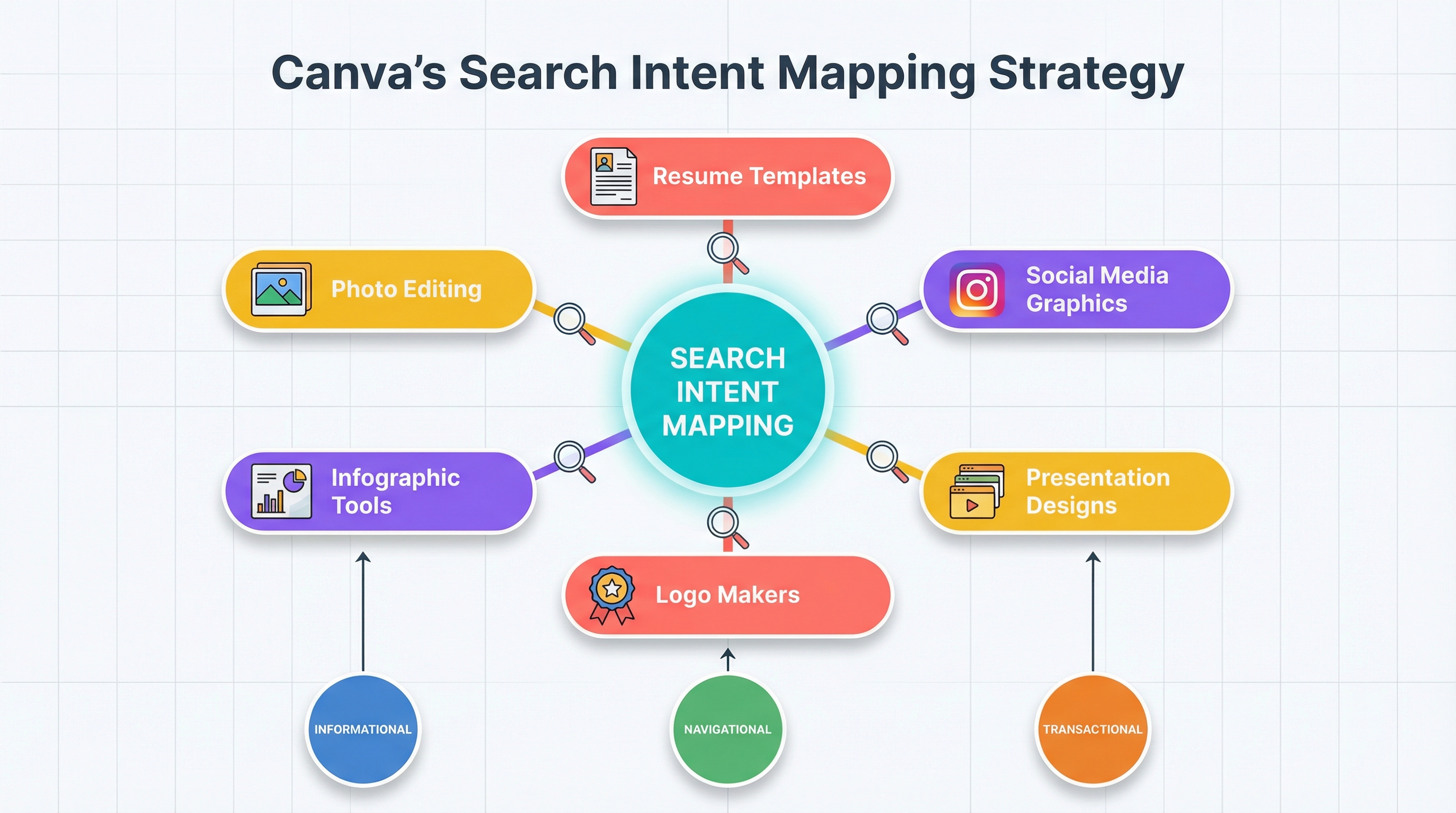
The strategy focused on both transactional and informational intent simultaneously. Someone searching 'how to make a poster' gets a tutorial. Someone searching 'poster maker' gets a tool. Canva built pages for both, then linked them together.
Template categories: Wedding invitations, business cards, social media posts, presentations, resumes, and hundreds more
Use case modifiers: Industry-specific variations like 'real estate business card' or 'restaurant menu template'
Format specifications: Size and platform-specific searches like 'Instagram story template' or 'A4 flyer'
Occasion-based searches: Holiday cards, birthday invitations, graduation announcements
Style variations: Minimalist, vintage, modern, elegant versions of each template type
This systematic approach meant Canva could cover search queries that competitors didn't even know existed. While Adobe was optimizing for 'graphic design software,' Canva was ranking for 10,000 variations of specific design needs.
SEO is not about gaming the system. It's about providing the best possible answer to the user's question. Canva understood that the best answer to 'business card template' is a working business card maker, not an article about business cards.
TechDevs SEO Team
The Programmatic SEO Engine: How Canva Automates Content at Scale
Here's where it gets interesting. Canva doesn't manually create 270 million pages. That would be impossible.
They built a programmatic system that automatically generates landing pages based on URL patterns and template categories. Look at their URL structure: canva.com/templates/[category]/[modifier]. Each combination creates a unique, functional page.
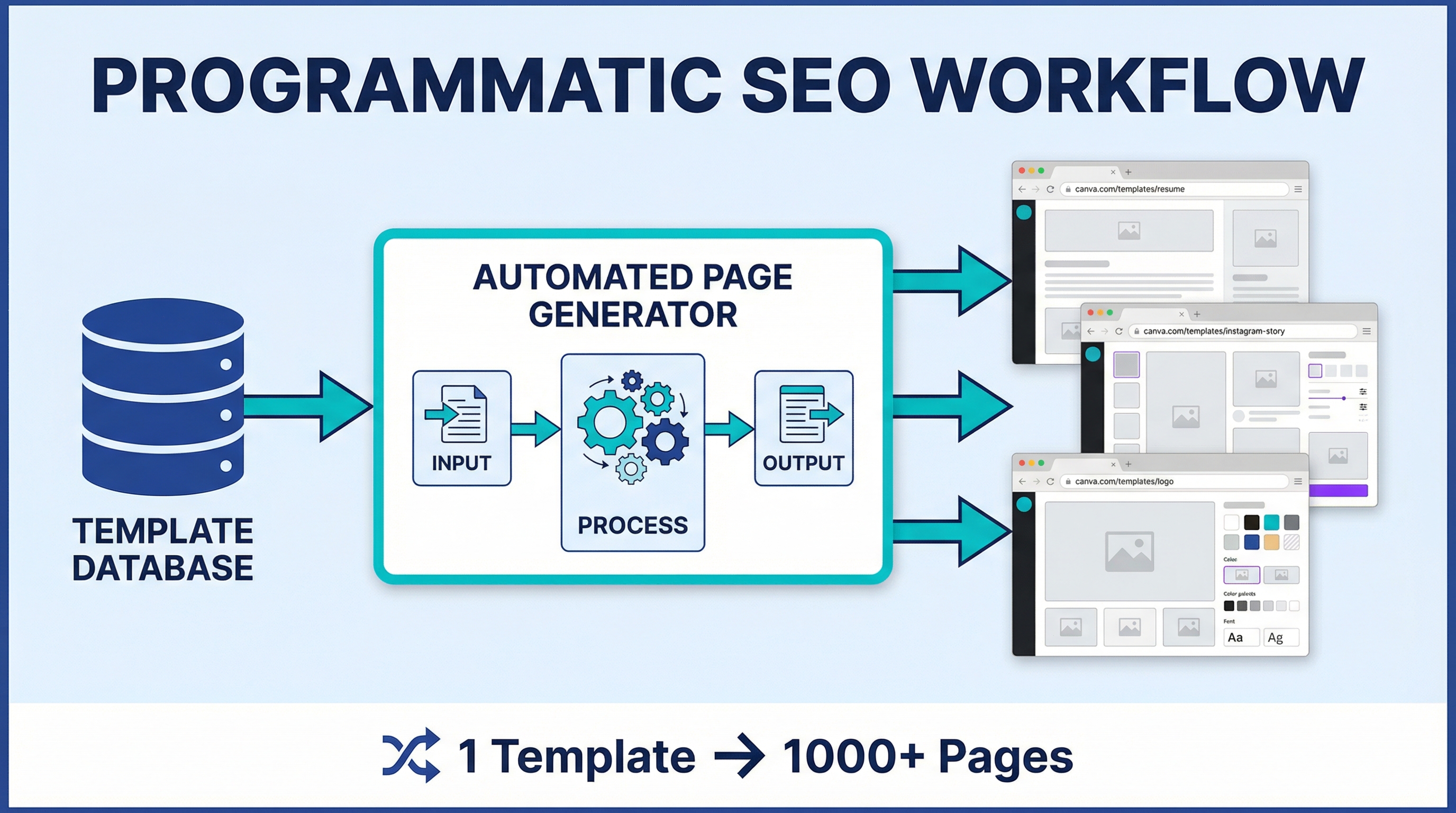
The template automation system works like this: Canva has a database of design elements, layouts, and categories. When someone searches for 'vintage wedding invitation,' the system pulls relevant templates, generates a landing page with that exact phrase in the title and headers, and serves it with working functionality. All automated.
Dynamic Page Generation
URLs follow predictable patterns that allow automatic creation of thousands of variations
Template Database
Centralized repository of design elements that can be recombined for different use cases
SEO-Optimized Structure
Each generated page includes proper meta tags, headings, and keyword placement automatically
User-Generated Expansion
Community templates feed back into the system, expanding coverage organically
But here's what most people miss: programmatic doesn't mean low quality. Canva maintains quality at scale by ensuring every page includes actual functionality, real templates users can customize, and relevant related content. The pages aren't thin. They're useful.
What is programmatic SEO and how does Canva use it?
Programmatic SEO is the practice of automatically generating thousands or millions of landing pages based on data patterns and templates. Canva uses this to create unique pages for every possible design search query, each with working functionality and relevant templates. Instead of manually creating pages, they built a system that generates them based on URL patterns and template categories.
How many pages does Canva have indexed in Google?
While the exact number fluctuates, Canva has millions of pages indexed. Their programmatic approach allows them to scale to cover virtually every design-related search query with a dedicated landing page. This massive index is what drives their 270 million monthly organic visitors.
How does Canva balance automation with content quality?
Canva ensures quality by making every programmatically generated page functional, not just informational. Each page includes working templates, customization tools, and related content. The automation handles page structure and SEO elements, but the core value (the templates) comes from their design team and user community. This means automated pages still provide genuine utility.
Product-Led SEO: Turning Templates Into Traffic Magnets
Most SEO landing pages are dead ends. You read the content, maybe click around, then leave. Canva's pages are different because they're not just pages. They're products.
Every template page serves dual purposes: it's an SEO landing page that ranks for specific searches, and it's a functional tool that lets users immediately start designing. This product-led approach changes the entire dynamic. Users don't bounce. They engage.
Think about the user journey. Someone searches 'business card template,' lands on Canva's page, sees dozens of customizable options, clicks one, and starts editing. Within 30 seconds, they're using the product. No signup required (initially). No sales pitch. Just immediate value.
Pros
Higher engagement: Users interact with the product immediately, reducing bounce rates
Natural conversion path: From search to product usage to signup happens organically
Sustainable competitive advantage: Harder to replicate than blog content
Compound growth: User-generated templates expand the library automatically
Cons
Higher initial investment: Building functional tools costs more than writing articles
Technical complexity: Requires product development, not just content creation
Slower to launch: Can't publish 50 product pages as quickly as 50 blog posts
The free access model is critical here. Canva lets you use templates without signing up, but to download or access premium features, you need an account. This converts search traffic into users at scale. And once someone's invested time customizing a design, they're likely to complete the signup.
User-generated content amplifies this strategy exponentially. When users create and publish templates, Canva gains new content without lifting a finger. Those templates become new landing pages, new search rankings, new traffic sources. It's SEO that scales itself.
The Technical SEO Framework Behind Canva's Success
Programmatic SEO at scale requires rock-solid technical foundations. Canva nailed this part.
Their site architecture is built for crawlability. Logical URL hierarchies, comprehensive internal linking, and XML sitemaps that update automatically as new pages are generated. Google's bots can discover and index new template pages within hours of creation.
Internal linking strategy connects related templates and categories intelligently. A wedding invitation page links to related wedding content (save-the-date cards, RSVP templates, thank you cards). This keeps users engaged and helps Google understand topical relationships.
Canva's Technical SEO Checklist
Logical URL structure that scales to millions of pages
Automated XML sitemap generation for new pages
Comprehensive internal linking between related templates
Page speed optimization despite image-heavy content
Mobile-responsive design with full functionality
Structured data markup for rich search results
Clean HTML and minimal render-blocking resources
Page speed deserves special attention. Canva serves thousands of template previews without destroying load times. They use lazy loading for images, CDN distribution, and aggressive caching. The first meaningful paint happens fast, even on mobile.
And mobile-first isn't just a buzzword for Canva. The entire editor works on phones and tablets. This captures the growing segment of users who search and design on mobile devices, a demographic competitors often ignore.
Content Strategy: Beyond Templates to Educational Authority
Templates alone wouldn't have gotten Canva to 270 million monthly visitors. They needed content that builds authority and captures informational searches too.
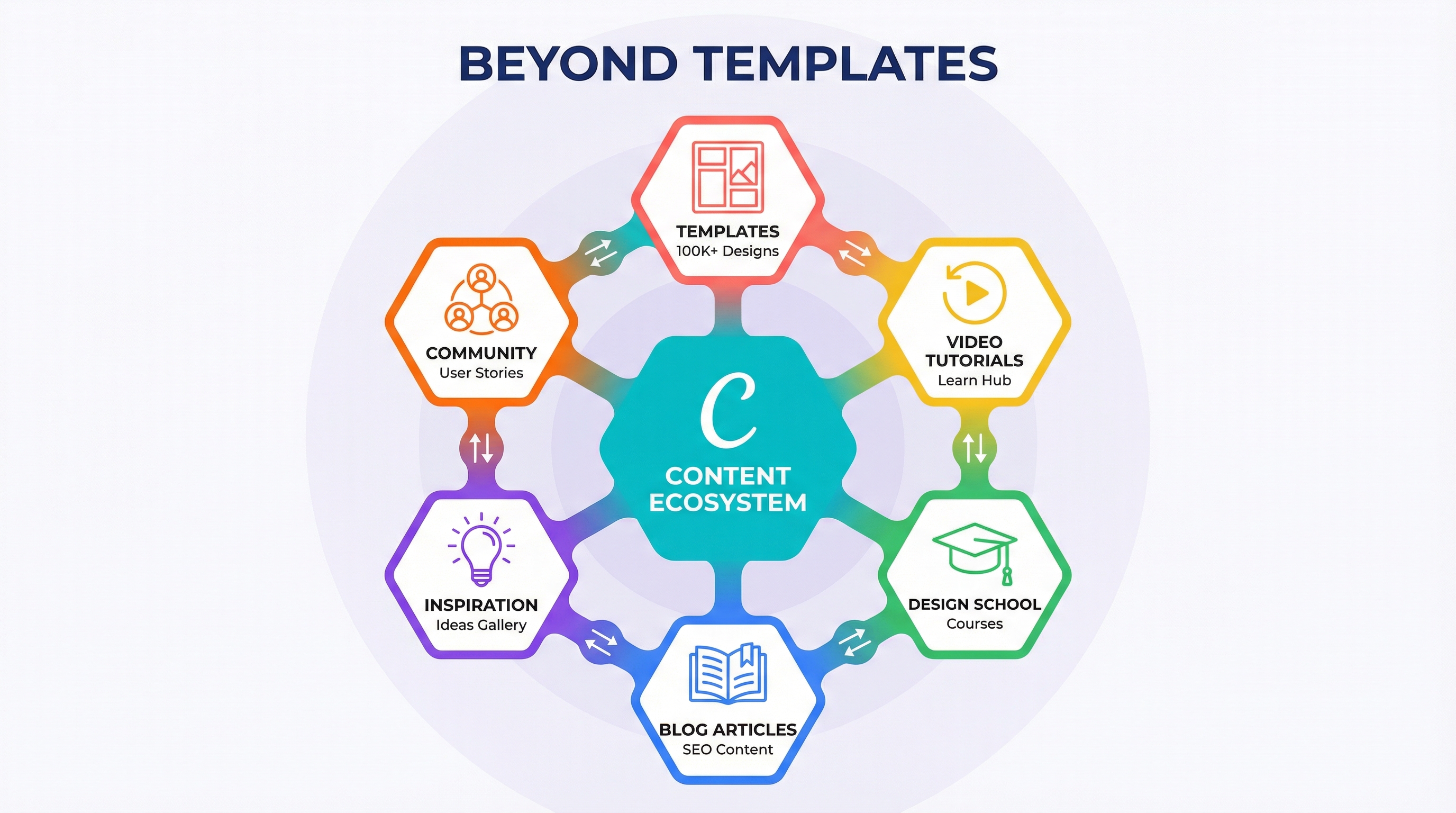
Canva Design School and their blog target informational queries that sit higher in the funnel. 'How to design a logo,' 'color theory basics,' 'typography tips.' These articles don't directly convert, but they build topical authority and capture users earlier in their journey.
The smart part? Every tutorial links to relevant templates. An article about logo design links to logo templates. A post about Instagram marketing links to Instagram post templates. The content ecosystem feeds the product ecosystem.
Educational Articles
Design tutorials and how-to guides that target informational searches
Video Content
YouTube tutorials that drive traffic and build brand awareness
Community Content
User-generated tutorials and showcases that expand reach organically
Multi-format content strategy matters here. Canva produces articles, videos, courses, and community showcases. Each format captures different audience segments and search intents. Someone might discover Canva through a YouTube tutorial, then land on a template page through search later.
Blog posts: Long-form tutorials and design guides optimized for informational keywords
Video tutorials: YouTube content that ranks in video search and drives brand awareness
Design courses: Structured learning paths that position Canva as an educational authority
Community showcases: User success stories and template galleries that provide social proof
Resource libraries: Downloadable guides, checklists, and tools that capture email leads
Community-generated content amplifies everything. When users share their Canva creations on social media or write about their design process, they create backlinks and brand mentions that boost domain authority. This organic advocacy is worth more than any paid campaign.
How to Replicate Canva's SEO Strategy for Your Brand
You don't need Canva's budget to use their strategy. You need their thinking.
Start by identifying your product's search intent opportunities. What specific problems do users search for that your product solves? Not generic category terms. Specific use cases. If you sell project management software, don't optimize for 'project management tool.' Optimize for 'sprint planning template,' 'client project tracker,' 'team capacity calculator.'
Can small businesses replicate Canva's SEO strategy?
Yes, but at a smaller scale initially. The principles work for any business with a product that solves specific user needs. Start by identifying 50-100 high-intent search queries your product addresses, build landing pages for each, and expand from there. You don't need millions of pages to see results. Even a few hundred well-optimized product pages can drive significant traffic.
What tools do you need to implement programmatic SEO?
You need a content management system that supports dynamic page generation (like Next.js, WordPress with custom templates, or Webflow CMS), a database of your product offerings or content, keyword research tools (Ahrefs, SEMrush), and some development resources to build the automation. Many no-code tools like Webflow or Framer now support programmatic SEO workflows without heavy coding.
How long does it take to see results from a Canva-style SEO strategy?
Initial results can appear in 3-6 months for lower competition keywords. Significant traffic growth typically takes 6-12 months as Google indexes your pages and builds trust in your domain. The advantage of programmatic SEO is that once the system is built, you can scale page creation quickly. But ranking those pages still requires time, quality content, and backlinks.
What is product-led SEO and why is it effective?
Product-led SEO means your landing pages don't just describe your product, they are your product. Instead of a blog post about a feature, you create a working tool that demonstrates the feature. This is effective because it reduces bounce rates, increases engagement, and creates a natural path to conversion. Users experience value immediately, which builds trust faster than any marketing copy.
Build scalable content infrastructure next. This doesn't mean hiring a team of 50 writers. It means creating templates and systems that let you generate relevant, useful pages at scale. Use databases, dynamic content insertion, and automation tools. Modern platforms make this accessible even for small teams.
Implementation Roadmap
Conduct comprehensive search intent research for your product category
Map specific user needs to product features or content types
Design URL structure and page templates for scalability
Build or configure CMS for dynamic page generation
Create initial batch of 50-100 landing pages manually to test
Implement internal linking strategy between related pages
Launch programmatic system to scale page creation
Build supporting content ecosystem (blog, tutorials, resources)
Monitor performance and iterate on page templates
Integrate product functionality into landing pages. This is the hardest part but also the most valuable. If you're a SaaS company, embed working tools or calculators. If you're ecommerce, make product pages interactive with configurators or size guides. The goal is to let users experience value before they commit.
Create a supporting educational content ecosystem around your product pages. Blog posts, tutorials, and guides that target informational searches and link to your product pages. This builds topical authority and captures users at different stages of awareness.
Use AI and automation tools to make implementation practical. Modern AI can help generate page variations, optimize content, and even create initial template designs. But keep humans in the loop for quality control. The best programmatic SEO strategies combine automation with human oversight.
Lessons from Canva: Key Takeaways for Modern SEO Success
Canva's SEO strategy isn't just about templates and automation. It's about fundamentally rethinking how SEO integrates with product development.
Product-led SEO creates sustainable competitive advantages because it's harder to replicate than content. Anyone can write a blog post. Building a functional tool that ranks and converts requires product development resources. That barrier to entry becomes your moat.
Search intent matters more than search volume: Canva ranks for thousands of low-volume, high-intent searches instead of fighting for a few high-volume generic terms
Programmatic approaches enable impossible scale: Manual content creation can't compete with automated systems that maintain quality
Product integration beats content marketing: Landing pages that provide immediate value convert better than pages that just describe value
Technical SEO is non-negotiable at scale: You can't rank millions of pages without solid site architecture and performance
Community amplification multiplies results: User-generated content and organic advocacy create compound growth effects
User intent mapping is more valuable than keyword volume. Canva proved you don't need to rank #1 for 'graphic design' to build a massive business. Ranking for 10,000 specific design needs is better.
Integration of SEO with product development drives exponential growth. When your product team and SEO team work together from day one, you build features that naturally rank and convert. This is what most companies miss. SEO isn't a marketing function. It's a product function.
The most successful SEO strategies in 2025 and beyond won't be about creating more content. They'll be about creating more value. Canva understood this before anyone else, and it's why they dominate a market that should have been Adobe's to lose.
TechDevs Strategy Team
AI and automation make sophisticated strategies accessible to all brands now. You don't need Canva's engineering team to implement programmatic SEO anymore. Modern tools and platforms have democratized these capabilities. The question isn't whether you can do this. It's whether you will.
Ready to Build Your Own SEO Growth Engine?
We've helped dozens of brands implement programmatic SEO strategies that drive real traffic and revenue. Whether you're starting from scratch or scaling an existing system, we can show you how to apply Canva's playbook to your business. Let's talk about what's possible.