The Ultimate Guide to Scaling Your Online Coaching Business with SEO in 2026
Master SEO for online coaching! Learn proven strategies to scale your coaching business in 2026. Get actionable tactics, tips & implementation steps. Start growing today!
 Written byPrithvi Jadwani
Table of contents
Summarize this article with AI
TL;DR
Most online coaches build their businesses through referrals and networking. But here's what nobody tells you: search drives 1000% more traffic than social media. SEO isn't just for e-commerce or SaaS. It's how you stop trading time for money and start building a marketing engine that works while you sleep. This guide shows you exactly how to rank, convert, and scale your coaching business in 2026.
- Search Intent Beats Social Scrolling. People searching for coaching solutions have intent to solve a problem. They're ready to invest, not just browsing.
- 90% of Internet Experiences Start with Search. Your ideal clients are searching for solutions right now. If you're not showing up, your competitors are.
- Longtail Keywords Are Your Competitive Edge. Half of all searches use 4+ words. Less competition, higher intent, better conversions for coaches.
- SEO Works 24/7, Referrals Don't. Build a sustainable client acquisition system that doesn't depend on your personal network or constant social posting.
- Technical SEO Matters More Than You Think. Google prioritizes mobile-first, fast-loading sites with great user experience. Get the basics right or lose rankings.
Why SEO Is Your Secret Weapon for Scaling Your Online Coaching Business in 2026
You built your coaching business on relationships. Referrals. Networking events. Maybe some organic social media if you're consistent. It worked to get you to five or six figures. But now you're stuck.
You can't take on more one-on-one clients without burning out. You've maxed out your personal network. And social media feels like shouting into the void half the time.
Here's what most coaches don't realize: search drives 1000% more traffic than social media. And 90% of internet experiences start with a search engine. That's not a small gap. That's a canyon.
So why do so many coaches assume SEO isn't for them? Because it feels technical. Mysterious. Like something that works for e-commerce stores and SaaS companies, but not service businesses built on trust and relationships.
Wrong.
SEO gives you something referrals and networking never will: a marketing funnel that works 24/7. People searching for coaching solutions aren't passively scrolling. They're actively seeking help. They have intent. They're ready to invest.
And if you're not showing up in those search results, your competitors are.
Understanding Online Coaching SEO: Essential Terms and Concepts (No Jargon, Promise)
Let's cut through the noise. SEO stands for Search Engine Optimization. That's it. It's the process of making your website more visible in Google and other search engines.
There are over 200 ranking factors. But here's the thing: you don't need to master all 200 to see results. You need to get the fundamentals right. Technical setup, content strategy, and authority signals.
Most coaches get stuck on terminology. So let's define the essentials in plain English.
Keywords
The terms people type into Google when looking for a solution. For coaches, this might be 'executive coach for tech founders' or 'life coach for career transitions'.
Longtail Keywords
Longer, more specific search phrases (4+ words). Less competition, higher intent. Example: 'how to scale online coaching business without burnout'.
Search Intent
What the searcher actually wants. Are they researching? Ready to buy? Looking for free resources? Match your content to their intent.
Backlinks
Links from other websites to yours. Google sees these as votes of confidence. Quality matters way more than quantity.
Here's what separates organic results from paid ads: organic rankings are earned through relevance, authority, and user experience. Ads disappear the second you stop paying. Organic traffic compounds over time.
And here's the part most guides skip: SEO for coaches is different than SEO for e-commerce. You're not optimizing for 'buy now' keywords. You're optimizing for trust, expertise, and transformation. People don't impulse-buy coaching. They research, evaluate, and decide.
Common SEO Questions from Coaches
Does SEO really work for online coaching businesses?
Yes. Search drives 1000% more traffic than social media. If your ideal clients are searching for solutions you provide, SEO works. The average coach makes $62,500/year because most never build scalable client acquisition systems. SEO changes that.
How long does it take to see results from SEO for coaches?
Realistic timeline: 3-6 months for initial traction, 6-12 months for consistent traffic. SEO is not a quick fix. But once it works, it compounds. A blog post you write today can bring clients for years.
What's the difference between SEO and paid advertising for coaching businesses?
Paid ads give you instant visibility but stop working when you stop paying. SEO takes longer to build but creates a sustainable traffic source that works 24/7. Most successful coaches use both, but SEO provides better long-term ROI.
Do I need technical skills to implement SEO for my coaching website?
Not for the basics. Keyword research, content creation, and basic on-page optimization are non-technical. Technical SEO (site speed, mobile optimization, structured data) benefits from expert help, but you can start without it.
Can I do SEO myself or should I hire an expert?
Start with DIY for content and keyword strategy. Hire help for technical optimization, link building, and scaling. Most coaches waste time trying to do everything themselves. Focus on your zone of genius (coaching), delegate the rest.
What are the most important SEO ranking factors for coaches in 2026?
User experience (mobile-first, fast loading), content quality and depth, search intent alignment, backlink quality, and E-E-A-T signals (Experience, Expertise, Authoritativeness, Trustworthiness). Google wants to see you're a real expert, not just churning out content.
The Foundation: Keyword Research Strategy for Online Coaches
Most coaches approach keyword research backwards. They think about what they want to rank for, not what their clients are actually searching.
Here's the shift: your ideal client is searching for solutions to their problems, not your services. They're not Googling 'hire a business coach'. They're searching 'how to scale my business without working 80 hours a week' or 'why my team isn't executing my vision'.
Start there. What struggles, pains, and challenges do your best clients have before they find you?
Once you have a list of potential keywords, validate them with data. Use Google's Keyword Planner tool. You'll need to set up a free Google Ads account, but you don't have to run ads. The tool shows you search volume and competition.
Here's what to look for:
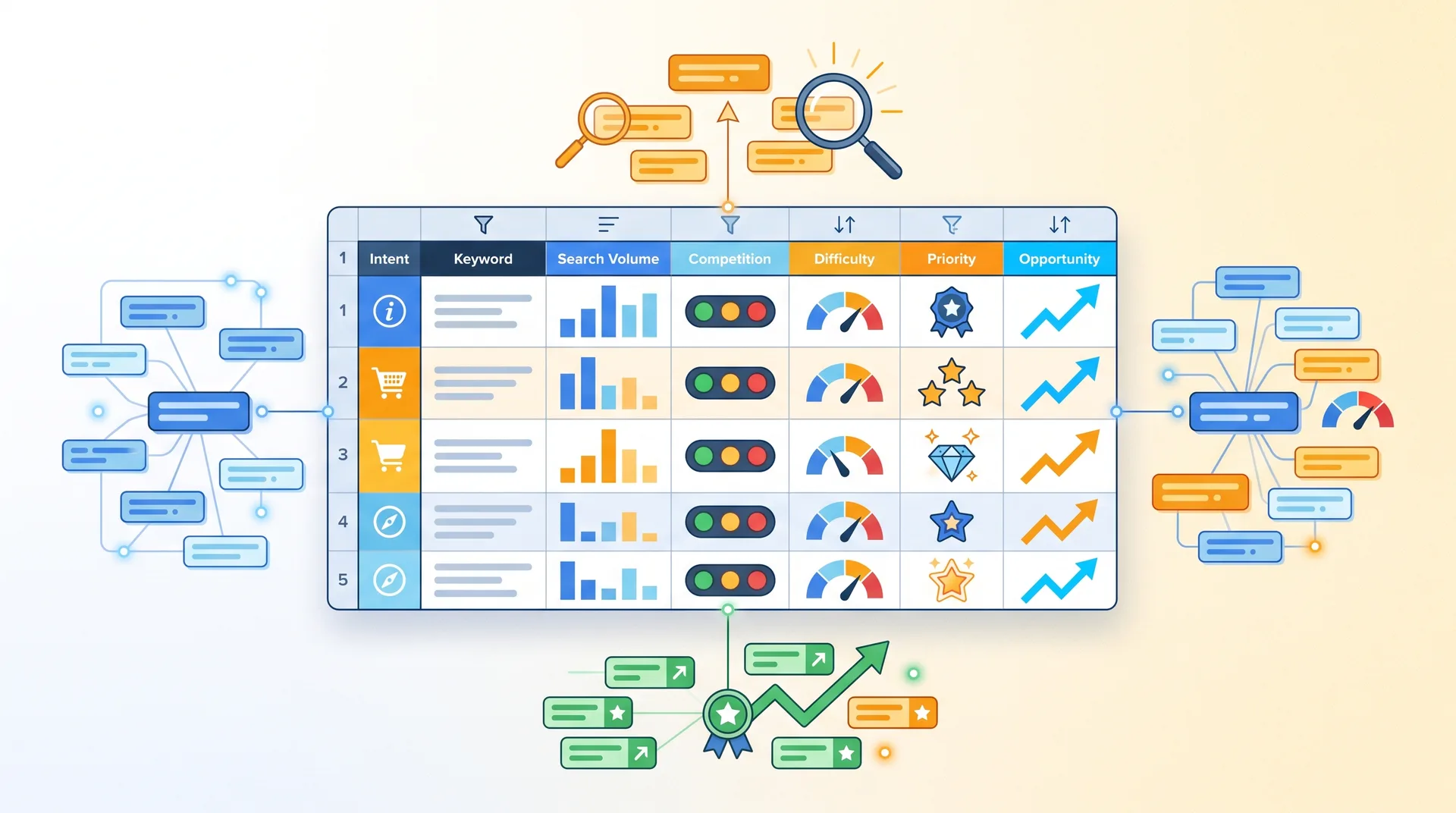
Search volume: How many people are searching this term monthly? For coaches, 100-1000 searches/month is often enough.
Competition: How hard is it to rank? Start with low to medium competition keywords.
Relevance: Does this keyword align with your coaching offer? High volume means nothing if the searcher isn't your ideal client.
Intent: Is the searcher researching, comparing, or ready to buy? Match your content to their stage.
Longtail keywords are your competitive advantage. Half of all searches use 4+ words. These phrases have less competition and higher intent. 'Business coach' is brutally competitive. 'Business coach for scaling service companies in Austin' is wide open.
Keyword Research Checklist for Coaches
List 10-15 problems your ideal clients have before finding you
Turn each problem into a search query (think like your client, not like a coach)
Validate search volume and competition in Google Keyword Planner
Identify 3-5 primary keywords for your homepage and service pages
Build a list of 20-30 longtail keywords for blog content
Include location-based keywords if you serve a specific geographic area
Map keywords to specific pages (one primary keyword per page)
And here's what not to do: keyword stuffing. Google's algorithm is smart enough to spot unnatural repetition. Write for humans first. Use your primary keyword in the title, first paragraph, and a few subheadings. Use variations and synonyms naturally throughout the content.
If it sounds robotic when you read it out loud, you've gone too far.
Content Optimization: Creating SEO-Friendly Coaching Content That Converts
Content is where most coaches either win or waste their time. You can have perfect technical SEO and a great backlink profile, but if your content doesn't satisfy search intent, you won't rank.
Here's the framework: write for humans first, optimize for search engines second. Google's algorithm is designed to reward content that genuinely helps people. If your content is thin, generic, or clearly written just to rank, you'll lose.
Start with strategic keyword placement. Your primary keyword should appear in:
Page title (H1 tag): Front-load your keyword when possible
First 100 words: Signal relevance to Google and readers immediately
Subheadings (H2/H3 tags): Use variations and related terms naturally
Image alt text: Describe what's in the image, include your keyword when relevant
Meta description: This doesn't directly impact rankings, but affects click-through rate
But here's where most guides stop. Keyword placement is table stakes. What actually moves the needle is depth, expertise, and usefulness.
Long-form content (2000+ words) consistently outranks short posts. Why? Because comprehensive content answers more questions, keeps readers on the page longer, and earns more backlinks. Google interprets this as authority.
This doesn't mean padding your content with fluff. It means going deep on one topic instead of surface-level on five.
Pros
2000+ word guides rank higher and earn more backlinks
Comprehensive content answers multiple related questions in one place
Longer time on page signals quality to Google
Positions you as an expert, not just another coach with a blog
Cons
Takes more time to create (solution: batch content creation)
Requires deeper research and expertise (but you have this already)
Can feel overwhelming to readers if not well-structured (use subheadings, lists, and visuals)
Content formats that work best for coaching businesses: in-depth guides, case studies with real client transformations, frameworks and methodologies, comparison posts (X vs Y), and resource roundups. Avoid generic listicles and surface-level advice.
And internal linking matters more than most coaches realize. Link to other relevant pages on your site. This helps Google understand your site structure, distributes page authority, and keeps visitors exploring your content. But don't overdo it. One or two contextual internal links per post is plenty.
SEO is not about gaming the system. It's about providing the best possible answer to the user's question. If you do that consistently, rankings follow.
Prithvi Jadwani, TechDevs SEO Philosophy
Technical SEO Essentials: Website Usability Google Actually Cares About
Technical SEO sounds intimidating. It's not. Most of what matters comes down to this: does your website load fast, work on mobile, and provide a good user experience?
Google prioritizes mobile-first indexing. That means the mobile version of your site is what Google uses to determine rankings. If your site is slow or broken on mobile, you're invisible to half your potential clients.
Test your site on your phone right now. Does it load in under 3 seconds? Are buttons easy to tap? Can you read the text without zooming? If the answer to any of these is no, fix it before you write another blog post.
Page speed is a direct ranking factor. But more importantly, it's a conversion factor. A 1-second delay in load time can reduce conversions by 7%. For a coaching business, that's real money.
Mobile Optimization
Google uses mobile-first indexing. If your site doesn't work perfectly on phones, you're losing rankings and clients.
Page Speed
Aim for under 3 seconds load time. Use tools like Google PageSpeed Insights to identify issues.
SSL Certificate
HTTPS is a ranking signal. If your site still uses HTTP, you're telling Google (and visitors) it's not secure.
User Experience Signals
Bounce rate, time on site, and pages per session all impact rankings. If visitors leave immediately, Google notices.
Here are the technical fixes most coaches can implement without a developer:
Technical SEO Quick Wins
Install an SSL certificate (most hosting providers offer this free)
Compress images before uploading (use TinyPNG or similar tools)
Enable browser caching through your hosting settings
Use a clean, simple site structure (homepage → service pages → blog posts)
Create a sitemap and submit it to Google Search Console
Fix broken links (use a tool like Screaming Frog to find them)
Add descriptive alt text to all images
And if you're using AI tools to build or manage your site, be careful. Most AI-generated websites are built on React-based stacks that Google can't crawl properly. I've seen this kill SEO performance for multiple clients. If you're going to use AI for speed, make sure the output is search-engine friendly.
At TechDevs, we've built automation systems that handle technical SEO optimization without sacrificing crawlability. The best AI implementations make your agency faster, they don't replace fundamental SEO principles.
Backlinking for Coaches: Building Authority and Trust Signals
Backlinks are votes of confidence from other websites. Google uses them as a proxy for authority. The more high-quality sites that link to you, the more Google trusts your content.
But here's what most coaches get wrong: they focus on quantity over quality. A single link from a reputable coaching publication or business site is worth more than 100 links from random directories.
So how do you earn quality backlinks as a coach?
Guest posting: Write for established coaching blogs, business publications, or industry sites. Include a link back to your site in your author bio.
Podcast appearances: Most podcast show notes include links to guests' websites. Bonus: you're building authority and visibility at the same time.
Partnerships and collaborations: Co-create content with other coaches or complementary service providers. Link to each other's work.
Local business directories: If you serve a specific geographic area, get listed in local business directories and chamber of commerce sites.
Coaching association memberships: Organizations like ICF, EMCC, or niche coaching associations often provide member directory listings with backlinks.
What doesn't work: buying links, participating in link schemes, or spamming comments on blogs with your URL. Google's algorithm is sophisticated enough to detect these tactics. Best case, the links don't help. Worst case, you get penalized.
The best backlinks come from creating content so valuable that other sites want to reference it. In-depth guides, original research, case studies, and frameworks are all link magnets. Write one piece of cornerstone content per quarter that's genuinely better than anything else out there on that topic.
Then promote it. Reach out to people who've written about similar topics. Share it in relevant communities. Make it easy for others to link to your work.

Scaling Your Coaching Business: Implementing Your SEO Strategy for Growth
You've got the strategy. Now let's talk execution. Because SEO without consistent implementation is just theory.
Start with an SEO content calendar. Plan your content 90 days in advance. Map each piece to a specific keyword, search intent, and stage of your client journey. Some content should target awareness (top of funnel), some should address evaluation (middle of funnel), and some should support decision-making (bottom of funnel).
Tracking matters. You can't optimize what you don't measure. Set up Google Analytics and Google Search Console. Track these metrics:
Organic traffic: How many visitors are coming from search?
Keyword rankings: Are you moving up for your target keywords?
Click-through rate (CTR): Are people clicking your results when they see them?
Bounce rate: Are visitors staying on your site or leaving immediately?
Conversions: Are search visitors booking discovery calls or downloading your lead magnet?
Here's the part most guides skip: automation. You're a coach, not a full-time content creator. Use AI tools to speed up research, outline creation, and first drafts. But don't publish AI-generated content without heavy editing. Google can spot AI slop, and so can your readers.
The best use of AI in SEO: keyword research, competitor analysis, content ideation, and technical audits. The worst use: generating thin, generic content that provides no real value.
Content Planning
Create a 90-day content calendar mapped to keywords and client journey stages.
Performance Tracking
Monitor organic traffic, rankings, CTR, and conversions in Google Analytics and Search Console.
Smart Automation
Use AI for research and ideation, but keep human expertise in content creation and editing.
When should you DIY vs hire help? DIY keyword research and content creation. Hire help for technical optimization, link building, and scaling. Most coaches waste time trying to do everything themselves. Focus on your zone of genius. Delegate the rest.
And integrate SEO with your other marketing channels. Use your best-performing blog posts as email newsletter content. Repurpose SEO content for social media. Drive paid ad traffic to your highest-converting SEO pages. SEO doesn't exist in a vacuum.
Expected timeline: 3-6 months for initial traction, 6-12 months for consistent traffic, 12-18 months for SEO to become a primary client acquisition channel. This is not a quick fix. But once it works, it compounds.
We don't just deliver traffic. We deliver outcomes. SEO for coaches isn't about rankings. It's about building a sustainable system that brings ideal clients to your door while you focus on transformation.
Prithvi Jadwani, TechDevs Client Philosophy
Your 90-Day SEO Action Plan to Start Scaling Today
Strategy without execution is worthless. So here's your 90-day roadmap to go from zero SEO to a functioning client acquisition system.
Month 1: Foundation
Month 1 Tasks
Complete keyword research (20-30 target keywords)
Run a technical SEO audit (use Screaming Frog or similar)
Fix critical technical issues (SSL, mobile optimization, page speed)
Set up Google Analytics and Google Search Console
Create a 90-day content calendar
Optimize existing service pages with target keywords
Month 2: Content Creation Sprint
Month 2 Tasks
Publish 4-6 in-depth blog posts (2000+ words each)
Optimize all new content for target keywords
Add internal links between related pages
Create and submit an XML sitemap to Google
Start building an email list from blog traffic
Month 3: Link Building and Promotion
Month 3 Tasks
Pitch 3-5 guest post opportunities to relevant sites
Reach out to 10-15 sites that could link to your best content
Get listed in 5-10 relevant directories and associations
Repurpose top blog posts for social media and email
Review analytics and adjust strategy based on what's working
Quick wins you can implement today: add your primary keyword to your homepage title, compress all images on your site, fix any broken links, and write one piece of in-depth content targeting a longtail keyword.
And if you want to accelerate implementation, we've built systems at TechDevs that handle the heavy lifting. Our SEO services combine technical optimization, content strategy, and AI-powered automation to help coaching businesses scale without the manual grind.
Ready to Scale Your Coaching Business with SEO?
Stop trading time for money. Build a client acquisition system that works 24/7. Book a discovery call and we'll show you exactly how to rank, convert, and scale your coaching business in 2026.