30 Day SEO Sprint: Transform Your Rankings with This Daily Action Plan
Master SEO in 30 days with our daily action plan. Get step-by-step tasks, proven strategies, and measurable results. Start your SEO sprint today!
 Written byPrithvi Jadwani
Table of contents
Summarize this article with AI
TL;DR
A 30-day SEO sprint is a focused, time-boxed approach to fixing technical issues, optimizing content, and building momentum in search rankings. You won't dominate competitive keywords in a month, but you'll establish a solid foundation, fix critical problems, and set up systems that compound over time.
- Sprint vs. Marathon. 30 days fixes technical debt and content gaps. Authority building takes months.
- Technical Wins Come First. Core Web Vitals, schema markup, and site speed improvements show results fastest.
- Daily Monitoring Matters. Consistent tracking of rankings, backlinks, and technical health prevents regression.
- Automation Scales Effort. Integrate SEO checks into your deployment pipeline and automate reporting.
- Momentum Beyond 30 Days. The sprint builds habits and systems that sustain long-term organic growth.
Why a 30 Day SEO Sprint Works (And What to Expect)
Most SEO advice treats optimization like a marathon with no finish line. That's not wrong, but it's also not helpful when you need results this quarter. A 30-day SEO sprint flips the script. It's a time-boxed, focused effort to fix critical issues, optimize existing assets, and build systems that keep working after the sprint ends.
Here's what you need to know upfront: you're not going to rank #1 for competitive keywords in 30 days. But you will fix technical debt that's been dragging you down, optimize content that's already close to ranking, and establish monitoring systems that prevent backsliding. The sprint methodology borrows from agile software development. You work in focused bursts, ship incremental improvements, and measure results daily.
The daily commitment is real but manageable. Plan for 30-60 minutes per day. Some days you'll audit and document. Other days you'll implement fixes or create content. The key is consistency. Missing a day here and there won't kill your progress, but skipping entire weeks will.
This sprint integrates with marketing automation and AI tools. You're not manually checking rankings every morning or running technical audits by hand. Set up automated dashboards, integrate SEO checks into your CI/CD pipeline, and use AI-powered tools for keyword research and content optimization. The goal is to build systems that scale beyond your 30-day effort.
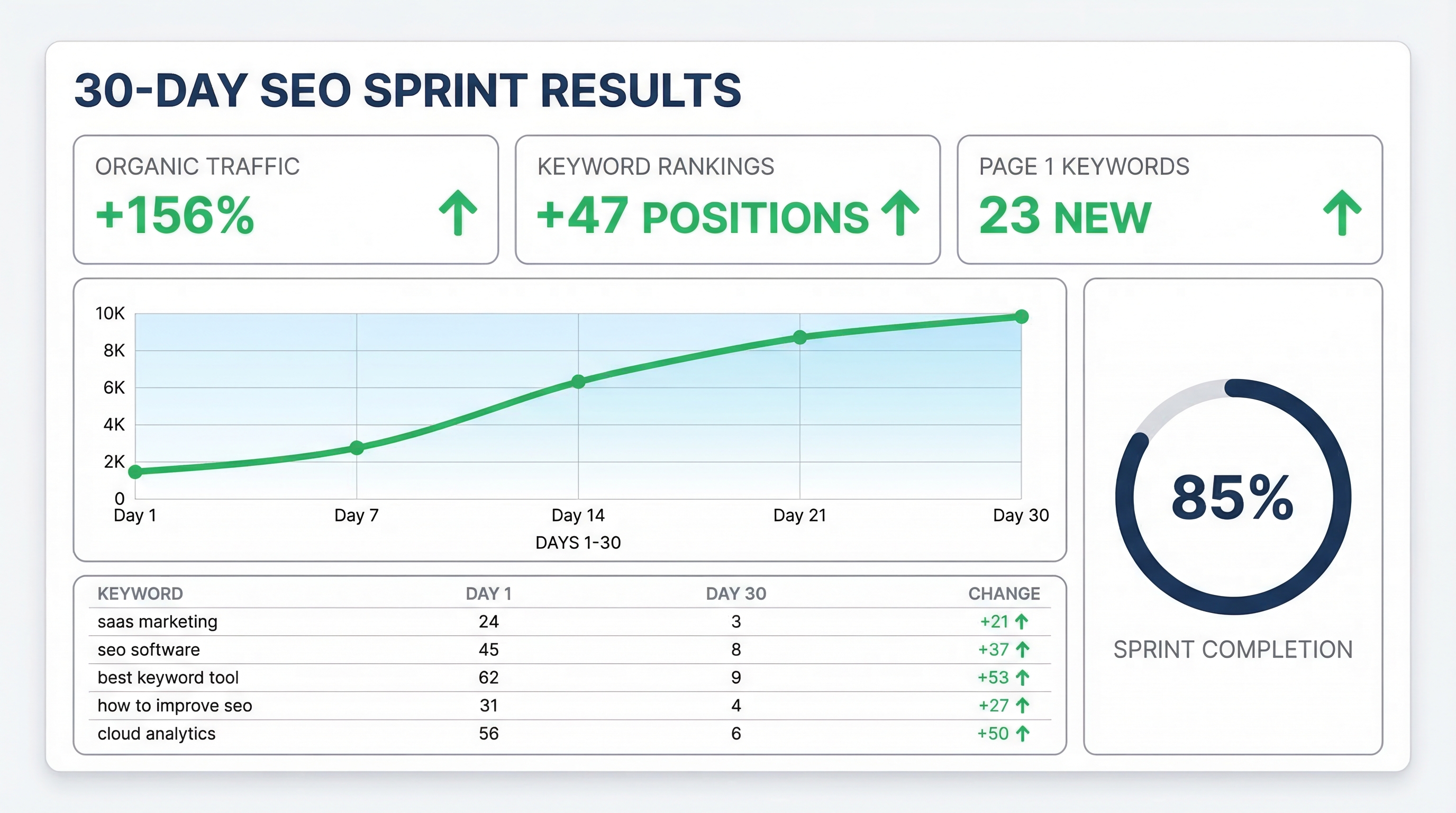
Organic traffic growth: Measure sessions from organic search, not just pageviews
Keyword ranking improvements: Track position changes for target keywords weekly
Core Web Vitals scores: Monitor LCP, FID, and CLS in Google Search Console
Backlink profile health: Use tools to track new links and disavow toxic ones
Conversion rate from organic: Tie SEO metrics to business goals like leads or sales
Week 1: Foundation & Baseline Assessment (Days 1-7)
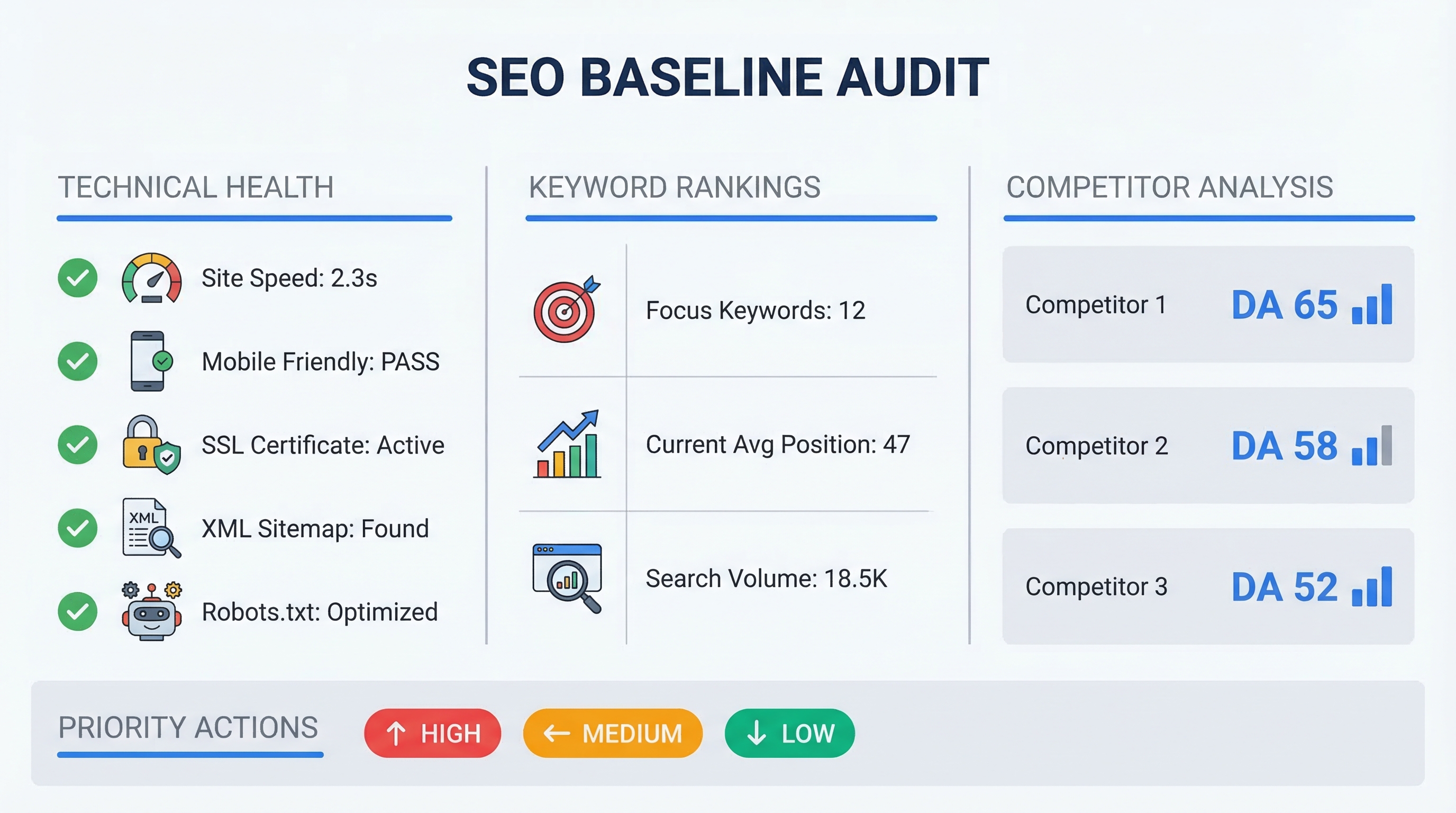
You can't improve what you don't measure. Week 1 is about establishing your baseline and identifying quick wins. Start with a comprehensive SEO audit that covers technical site health, keyword rankings, and competitor performance.
Days 1-2: Technical Site Health Audit
Run Google Search Console to identify crawl errors, indexing issues, and mobile usability problems
Use PageSpeed Insights to check Core Web Vitals (LCP, FID, CLS) on key landing pages
Crawl your site with Screaming Frog to find broken links, duplicate content, and missing meta tags
Document technical debt in a spreadsheet: prioritize by impact and effort required
Days 3-4 are for understanding your current keyword landscape. Export your existing rankings from Google Search Console or a tool like Ahrefs. Look for keywords where you're ranking on page 2 or in positions 4-10. Those are your quick wins. A small optimization push can move them into the top 3 spots, which is where most clicks happen.
Day 5 is competitor research day. Pick your top 3 competitors and analyze their keyword strategies. What are they ranking for that you're not? Where are their content gaps? Use this to inform your content strategy in Week 3.
Baseline Keyword Tracking
Document current rankings for 20-30 target keywords. Track weekly to measure sprint impact.
Competitor Benchmarking
Identify keyword and content gaps your competitors are missing. Find opportunities they've overlooked.
Technical Debt Prioritization
Not all issues are equal. Fix critical problems first: broken links, slow pages, mobile errors.
Automated Monitoring Setup
Set up dashboards that tie SEO metrics to business KPIs. Monitor daily without manual work.
Day 6 is about automation. Set up Google Search Console alerts for critical issues. Configure your analytics platform to track organic traffic, conversions, and goal completions. If you're using a tool like Ahrefs or SEMrush, set up automated reports that email you weekly ranking updates. The less manual work you do after the sprint, the more sustainable your SEO efforts become.
Day 7 is documentation day. Compile your findings into a single document or spreadsheet. List technical issues, keyword opportunities, and competitor insights. Prioritize quick wins (high impact, low effort) and long-term plays (high impact, high effort). This becomes your roadmap for the next three weeks.
Common Week 1 Questions
What if I find hundreds of technical issues in my audit?
You will. Don't panic. Prioritize issues that directly impact user experience or indexing: broken links, slow pages, mobile errors. Not every 404 needs fixing immediately.
Should I use free tools or paid ones for the audit?
Google Search Console and PageSpeed Insights are free and essential. For deeper analysis, tools like Screaming Frog (free up to 500 URLs) and Ahrefs or SEMrush (paid) give you more granular data.
How do I know which keywords to prioritize?
Focus on keywords where you're ranking in positions 4-15. These are within reach. Also prioritize keywords with clear commercial intent if your goal is conversions, not just traffic.
Week 2: Technical SEO & Performance Optimization (Days 8-14)
Technical SEO is where you see the fastest wins. Fix a slow page and you'll see ranking improvements within days, not months. Week 2 is all about addressing Core Web Vitals, implementing schema markup, and refining your site architecture.
Days 8-9 focus on Core Web Vitals. Google's algorithm prioritizes sites that load fast, respond quickly, and don't shift layout while loading. These metrics (Largest Contentful Paint, First Input Delay, and Cumulative Layout Shift) directly impact rankings and user experience. Use PageSpeed Insights to identify bottlenecks, then fix them: compress images, defer non-critical JavaScript, and eliminate render-blocking resources.
Largest Contentful Paint (LCP): Should be under 2.5 seconds. Optimize images and server response times.
First Input Delay (FID): Should be under 100ms. Minimize JavaScript execution and use web workers.
Cumulative Layout Shift (CLS): Should be under 0.1. Set explicit dimensions for images and ads.
Day 10 is schema markup day. Structured data helps search engines understand your content and display rich results in SERPs. Implement FAQ schema, Product schema, or Article schema depending on your content type. Google's Rich Results Test tool will validate your markup. This is one of those changes that can dramatically improve click-through rates without changing your ranking position.
Day 11 tackles URL structure and site architecture. Clean, descriptive URLs help both users and search engines understand your content. If you have URLs like example.com/page?id=12345, rewrite them to example.com/seo-services. Also review your internal linking structure. Important pages should be no more than 3 clicks from your homepage.
Day 12 is where automation meets SEO. If you're running a modern development workflow with CI/CD pipelines, integrate SEO checks into your deployment process. Tools like Lighthouse CI can automatically audit every build and block deployments that fail performance thresholds. This prevents regressions and keeps your site healthy long after the sprint ends.
Pros
Prevents performance regressions before they hit production
Catches broken links and missing meta tags during development
Scales SEO best practices across your entire team
Reduces manual auditing time and human error
Cons
Requires initial setup time and engineering resources
Can slow down deployment pipelines if checks are too strict
May flag false positives that need manual review
Day 14 wraps up Week 2 with real-time monitoring. Set up alerts for critical issues: sudden drops in rankings, crawl errors, or Core Web Vitals failures. Tools like Google Search Console and third-party platforms can notify you via email or Slack when something breaks. The goal is to catch problems before they cost you traffic.
Week 3: Content Strategy & On-Page Optimization (Days 15-21)
Content is still king, but only if it matches search intent and solves real problems. Week 3 is about identifying keyword opportunities, auditing existing content, and optimizing pages that are already close to ranking.
Days 15-16 are dedicated to keyword research. But this isn't about finding the highest-volume keywords. It's about finding keywords where you have a realistic shot at ranking and where the search intent aligns with what you offer. Focus on long-tail keywords and questions your target audience is actually asking. Tools like AnswerThePublic and Google's People Also Ask feature are goldmines for this.
Keyword Research Checklist
Identify 10-15 primary keywords with clear commercial or informational intent
Find 20-30 long-tail variations and question-based queries related to primary keywords
Analyze search intent for each keyword: informational, navigational, transactional, or commercial
Map keywords to existing pages or identify content gaps that need new pages
Day 17 is content audit day. Export all your existing pages and evaluate them for SEO performance. Which pages get traffic but don't convert? Which pages rank on page 2 and just need a refresh? Which pages have thin content or outdated information? Prioritize pages that are already getting some organic traffic. A small optimization can push them into the top 3 results.
Days 18-19 are optimization days. Take your high-potential pages and improve them. Add target keywords naturally into headings, meta descriptions, and body content. Improve readability by breaking up long paragraphs and adding bullet points. Strengthen internal linking by pointing to related content on your site. Update outdated statistics and examples. These small changes compound.
On-Page Optimization
Optimize title tags, meta descriptions, headings, and body content for target keywords without keyword stuffing.
Internal Linking Strategy
Link related pages together to distribute authority and help search engines understand site structure.
Content Gap Analysis
Identify topics your competitors cover that you don't. Create content that fills those gaps and targets underserved queries.
User Experience Improvements
Improve readability, add visuals, and structure content with clear headings and bullet points for better engagement.
Day 20 is where you build an SEO-as-Code framework. This means version-controlling your content templates, meta tag rules, and schema markup. If you're using a CMS, create templates that enforce SEO best practices by default. New pages should automatically include proper heading structure, meta tags, and internal links without manual intervention. This scales your SEO efforts beyond what one person can manage.
Day 21 wraps up Week 3 with editorial planning. Based on your keyword research and content gap analysis, create a calendar for new content. Don't just publish for the sake of publishing. Every piece should target a specific keyword, answer a real question, and provide value your competitors aren't offering. Quality beats quantity every time.
The best SEO content doesn't just rank well. It solves problems so effectively that people link to it naturally, share it on social media, and bookmark it for later. That's how you build authority.
TechDevs SEO Team
Week 4: Link Building, Local SEO & Advanced Tactics (Days 22-28)
Backlinks are still one of the strongest ranking signals. But earning quality links takes time and strategy. Week 4 focuses on auditing your existing link profile, implementing advanced link earning tactics, and optimizing for local search if applicable.
Days 22-23 are for backlink auditing. Export your current backlink profile from Ahrefs, SEMrush, or Google Search Console. Identify toxic links (spammy directories, link farms, irrelevant sites) and disavow them using Google's Disavow Tool. Also look for broken backlinks pointing to your site. If a high-authority site links to a page that no longer exists, set up a 301 redirect to preserve that link equity.
Digital PR outreach: Pitch stories to industry publications and journalists who cover your niche
Resource page targeting: Find "best tools" or "helpful resources" pages in your industry and request inclusion
Broken link building: Find broken links on high-authority sites and suggest your content as a replacement
Guest posting: Write for reputable sites in your industry, but only if they allow followed links and have real traffic
Day 24 is link earning strategy day. Forget buying links or participating in link schemes. Those tactics are risky and rarely work long-term. Instead, focus on creating content so valuable that people link to it naturally. This includes original research, comprehensive guides, free tools, or data visualizations. Reach out to people who've linked to similar content and let them know about yours.
Day 25 is local SEO day. If you serve a specific geographic area, optimize your Google My Business profile. Complete every field: hours, services, photos, and description. Build consistent NAP (Name, Address, Phone) citations across directories like Yelp, Bing Places, and industry-specific listings. Encourage happy customers to leave reviews. Local rankings heavily factor in review quantity and quality.
Day 27 shifts focus to conversion optimization. SEO isn't just about traffic. It's about traffic that converts. A/B test your CTAs, optimize landing pages for user experience, and ensure your site loads fast on all devices. Small improvements in conversion rate can have a bigger business impact than ranking one position higher.
Day 28 wraps up Week 4 with automated link monitoring. Set up alerts for new backlinks and competitor link activity. If a competitor earns a link from a high-authority site, you can reach out to that site with your own content. If you lose a backlink, investigate why and try to reclaim it. This ongoing monitoring keeps your link profile healthy and competitive.
Days 29-30: Measurement, Reporting & Sprint Retrospective
The final two days are about measuring results, documenting lessons learned, and planning your next steps. Day 29 is dashboard day. Build a comprehensive SEO performance dashboard that tracks the metrics that matter: organic traffic, keyword rankings, Core Web Vitals, backlink growth, and conversions from organic search.
Compare your baseline metrics from Week 1 to your current performance. Did your Core Web Vitals improve? Are you ranking higher for target keywords? Has organic traffic increased? Not every metric will show dramatic improvement in 30 days, and that's fine. The goal is progress, not perfection.
Sprint Retrospective Checklist
Document technical wins: Core Web Vitals improvements, schema markup implementations, site speed gains
List content optimizations: pages updated, new content published, keyword rankings improved
Track link building results: new backlinks earned, toxic links disavowed, outreach campaigns launched
Identify challenges: what took longer than expected, what didn't work, what needs more time
Plan next steps: transition from sprint mode to ongoing SEO maintenance and optimization
Day 30 is planning day. The sprint doesn't end your SEO efforts. It kickstarts them. Create a transition plan for ongoing maintenance: daily monitoring tasks, monthly content creation cycles, and quarterly comprehensive audits. Assign ownership for each task. SEO works best when it's integrated into your team's regular workflow, not treated as a one-time project.
Set up automated monthly reporting that connects organic metrics to revenue and business goals. Your CEO doesn't care about keyword rankings. They care about leads, sales, and ROI. Show them how organic traffic converts into customers and how SEO contributes to the bottom line.
Essential Tools & Automation for Your SEO Sprint
You can't execute a 30-day SEO sprint without the right tools. Some are free. Some are paid. All of them save you time and give you data you can't get manually.
Google Search Console
Free tool for monitoring crawl errors, indexing issues, keyword rankings, and Core Web Vitals. Essential.
PageSpeed Insights
Free tool from Google that measures Core Web Vitals and provides specific optimization recommendations.
Screaming Frog
Desktop crawler that audits your site for broken links, duplicate content, and missing meta tags. Free up to 500 URLs.
Ahrefs or SEMrush
Paid tools for keyword research, backlink analysis, competitor tracking, and rank monitoring. Worth the investment.
AI Content Tools
Tools like Clearscope or SurferSEO analyze top-ranking pages and suggest keywords and topics to include.
Lighthouse CI
Integrates performance audits into your CI/CD pipeline. Prevents regressions before they hit production.
Automation platforms are where the magic happens. Set up Google Search Console to email you weekly performance reports. Use Zapier or Make to connect your SEO tools to Slack or email for real-time alerts. If you're running a modern tech stack, integrate Lighthouse CI into your deployment pipeline to audit every build automatically.
AI-powered tools are getting better at content optimization. They analyze top-ranking pages for a keyword and suggest related terms, questions, and topics to include. But don't let AI write your content. Use it to inform your strategy, then write like a human. Real expertise and unique insights still win.
DevOps integration: Incorporate SEO checks into your CI/CD pipeline to catch issues before deployment
Analytics dashboards: Use Google Data Studio or similar tools to visualize SEO performance and tie it to business KPIs
Automated reporting: Set up monthly reports that email stakeholders with key metrics and progress updates
Alert systems: Configure alerts for critical issues like sudden ranking drops, crawl errors, or Core Web Vitals failures
At TechDevs, we use automation to scale SEO efforts across multiple clients without burning out our team. Every site has automated monitoring, every deployment includes performance checks, and every client gets monthly reports without manual data entry. That's how you sustain SEO momentum beyond a 30-day sprint.
Beyond the Sprint: Sustaining Your SEO Momentum
The sprint ends on Day 30. Your SEO efforts don't. The systems you built during the sprint need to become daily habits. Here's how to sustain momentum and keep improving long after the initial push.
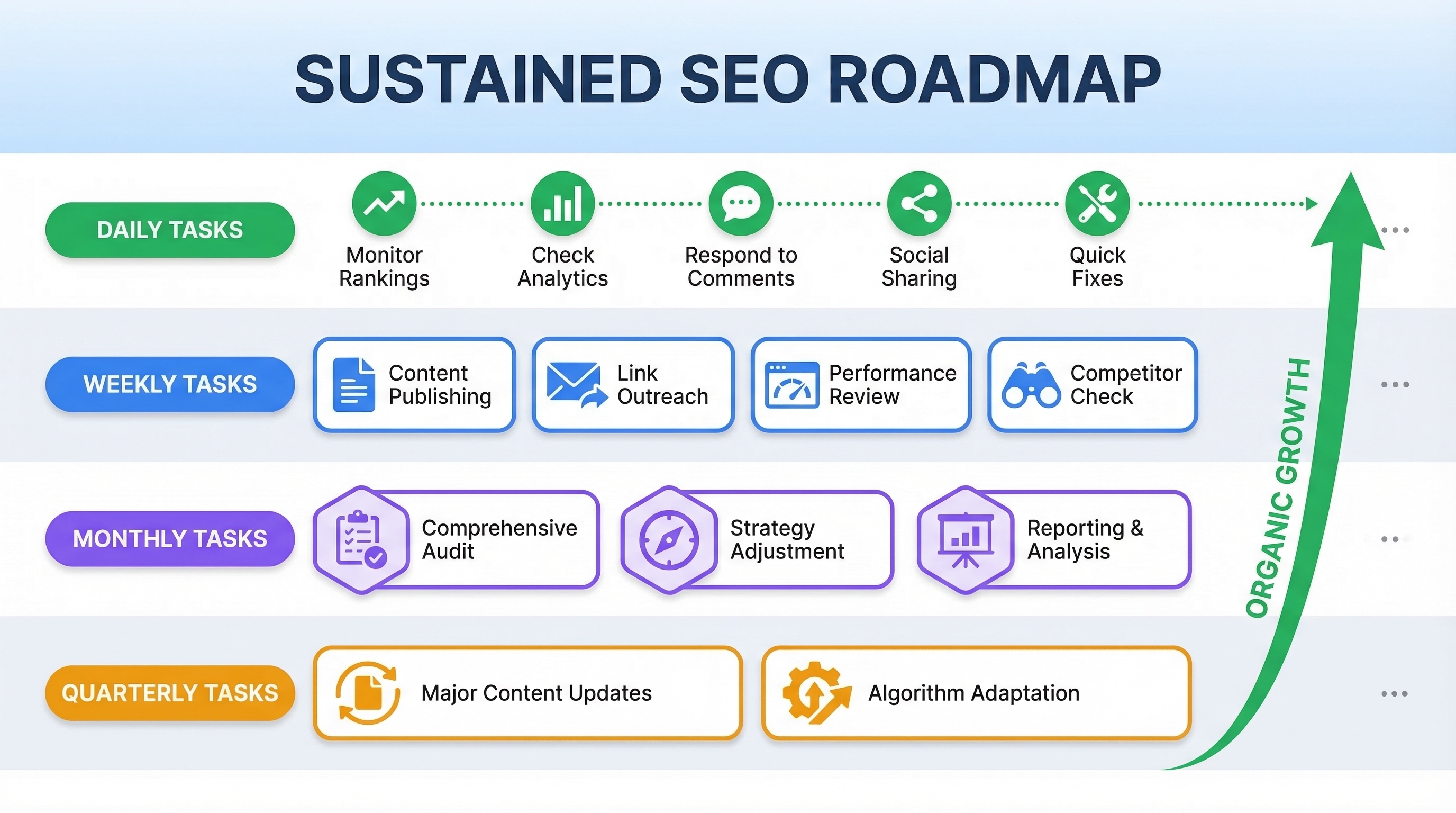
Establish daily SEO tasks that take 15-30 minutes. Check Google Search Console for new errors. Monitor keyword rankings for significant changes. Review your backlink profile for new links or lost ones. These small daily checks prevent problems from snowballing into major issues.
Daily: Check Google Search Console for errors, monitor keyword rankings, review new backlinks
Weekly: Analyze organic traffic trends, review Core Web Vitals, check competitor rankings
Monthly: Publish new optimized content, conduct mini content audits, review and update top-performing pages
Quarterly: Comprehensive SEO audit, strategy adjustments based on algorithm updates, backlink outreach campaigns
Monthly content creation cycles keep your site fresh and give you more opportunities to rank. But don't publish for the sake of publishing. Every piece should target a specific keyword, answer a real question, and provide unique value. One great article per month beats four mediocre ones.
Quarterly comprehensive audits catch issues that slip through daily monitoring. Re-run your technical audit, review your content strategy, and analyze competitor movements. SEO is a moving target. What worked six months ago might not work today.
Build an SEO culture within your team. Make it everyone's responsibility, not just one person's job. Developers should care about Core Web Vitals. Content writers should understand keyword research. Designers should optimize images for fast loading. When SEO is baked into your workflow, it scales effortlessly.
The best SEO strategies are the ones you can sustain long-term. Sprints kickstart momentum, but daily habits and automated systems keep you moving forward.
Prithvi Jadwani, CEO at TechDevs
Measure long-term ROI by connecting organic traffic to revenue. Track how many leads or sales come from organic search. Calculate the lifetime value of customers acquired through SEO. This data justifies continued investment and helps you optimize for business outcomes, not just rankings.
Frequently Asked Questions
How much time should I dedicate daily to this 30 day SEO sprint?
Plan for 30-60 minutes per day. Some days you'll spend more time (like during the initial audit or when implementing technical fixes). Other days you'll just monitor dashboards and make small tweaks. The key is consistency. Missing a day here and there won't derail your progress, but skipping entire weeks will.
Can I see ranking improvements within 30 days or does SEO take longer?
It depends on what you're fixing. Technical improvements like Core Web Vitals and schema markup can show results within days. Content optimizations for keywords where you already rank on page 2 can move you into the top 3 within weeks. But building domain authority and ranking for competitive head terms takes 6-12 months. Set realistic expectations based on your starting point.
What tools do I need to complete this SEO sprint successfully?
At minimum, you need Google Search Console (free) and PageSpeed Insights (free) for technical audits and performance monitoring. For deeper analysis, Screaming Frog (free up to 500 URLs) is essential. If budget allows, invest in Ahrefs or SEMrush for keyword research and backlink analysis. These paid tools save significant time and provide data you can't get elsewhere.
Should I focus on technical SEO or content first in my sprint?
Start with technical SEO in Week 2. Fix Core Web Vitals, broken links, and indexing issues first. These improvements benefit your entire site and show results faster. Once your technical foundation is solid, move to content optimization in Week 3. You can't rank great content on a slow, broken website.
How do I integrate SEO checks into my existing development workflow?
Use tools like Lighthouse CI to audit every build in your CI/CD pipeline. Configure it to fail deployments that don't meet performance thresholds. This prevents regressions and scales SEO best practices across your team without manual audits. It requires initial setup time but saves hours of manual work long-term.
What are the most important metrics to track during a 30 day SEO sprint?
Track organic traffic growth, keyword ranking improvements (especially for positions 4-15), Core Web Vitals scores (LCP, FID, CLS), new backlinks earned, and conversion rate from organic traffic. Don't just track vanity metrics like total pageviews. Focus on metrics tied to business outcomes like leads and sales.
Can small businesses with limited resources complete this SEO action plan?
Yes. The sprint is designed to be manageable with 30-60 minutes per day and mostly free tools. You don't need a big team or expensive software to see results. Focus on quick wins in Week 1, prioritize technical fixes in Week 2, optimize existing content in Week 3, and start simple link building in Week 4. Small consistent efforts compound over time.
Ready to Execute Your SEO Sprint?
A 30-day SEO sprint is a great start, but sustained organic growth requires ongoing strategy, automation, and expertise. TechDevs helps companies build SEO systems that scale beyond individual sprints. We integrate SEO into your development workflow, automate monitoring and reporting, and connect organic performance to business outcomes.