The Ultimate SEO ROI Calculator Guide for Indian Businesses
Calculate your SEO ROI with our comprehensive guide for Indian businesses. Track metrics, measure returns, and optimize your digital marketing investment effectively.
 Written byPrasad Iyer
Table of contents
Summarize this article with AI
TL;DR
Calculating SEO ROI is straightforward: take your organic revenue, subtract your SEO costs, divide by those costs, and multiply by 100. For Indian businesses, SEO consistently delivers 5x-10x returns over 12-18 months when measured correctly. The challenge isn't the math, it's tracking the right metrics and avoiding common attribution mistakes that make your SEO look less effective than it actually is.
- The Basic Formula Works. SEO ROI = ((Revenue from SEO - Cost of SEO) / Cost of SEO) x 100. A ₹6L investment returning ₹24L = 300% ROI.
- Patience Pays Off. SEO needs 6-12 months to show meaningful results. Measuring too early kills good strategies before they work.
- Attribution Is Everything. Last-click attribution undercounts organic impact. Use multi-touch models to see the full picture.
- Track Beyond Revenue. Brand awareness, thought leadership, and customer lifetime value matter even if they're harder to measure.
Why SEO ROI Matters for Indian Businesses in 2025
Most Indian businesses treat SEO like a black box. Money goes in, traffic hopefully comes out, and somewhere in between there's a vague hope that it's all worth it. That's a problem when you're competing for budget against paid ads that show results in days, not months.
Here's what changes when you actually measure SEO ROI: you stop guessing. You know which keywords drive revenue, which content types convert, and whether your agency is earning their retainer or just sending you feel-good traffic reports.
Unlike paid ads, SEO builds long-term organic assets that compound over time. A blog post you publish today can drive leads three years from now. Try that with a Facebook ad. The catch? You need to measure it correctly, or you'll kill winning strategies before they mature.

Understanding the SEO ROI Calculator Formula
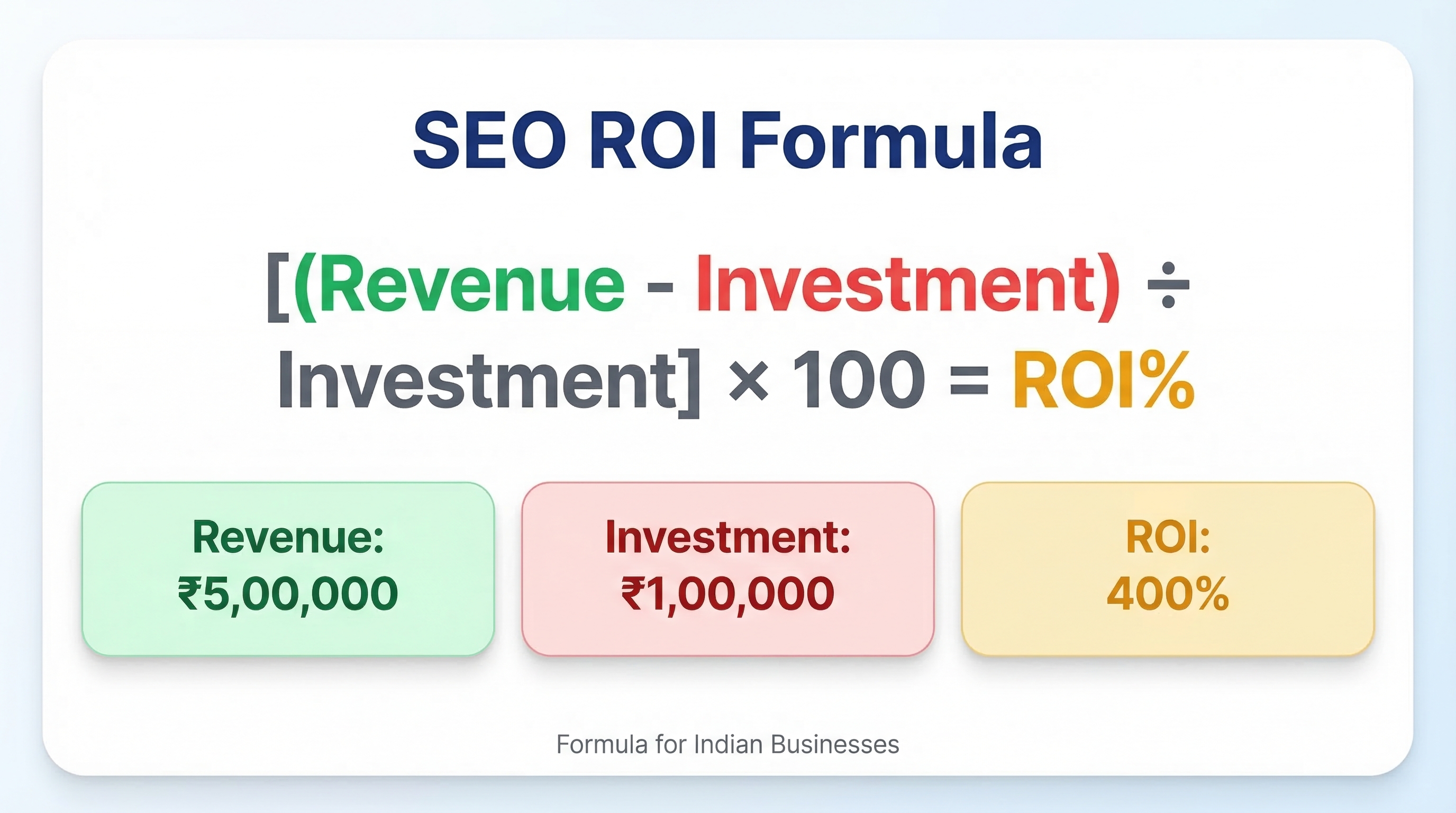
The formula is dead simple: SEO ROI (%) = ((Revenue from SEO - Cost of SEO) / Cost of SEO) x 100. That's it. No complex spreadsheets, no MBA required.
Let's say you spent ₹6,00,000 on SEO over 12 months (agency fees, tools, content). Your organic search drove ₹24,00,000 in revenue. Plug it in: ((24,00,000 - 6,00,000) / 6,00,000) x 100 = 300% ROI. For every rupee you invested, you got ₹4 back (₹3 net profit plus your original ₹1).
E-commerce
Direct revenue from organic transactions. Easiest to track because Google Analytics shows you the money.
SaaS
Trial signups, demo requests, or free-to-paid conversions from organic traffic. Assign a value per conversion.
B2B Lead Gen
Qualified leads from organic search measured by form fills, calls, or booked meetings. Track lead-to-customer rate.
The hard part isn't the formula. It's getting accurate numbers for revenue and costs, which most businesses mess up in predictable ways.
How to Use an SEO ROI Calculator: Step-by-Step Process
Most people skip straight to the calculator and get garbage results because they haven't done the groundwork. Here's the process that actually works.
Define your SEO goals and KPIs based on your business model. E-commerce tracks transactions. SaaS tracks trial signups. B2B tracks qualified leads. If you don't know what 'return' means for your business, the calculator is useless.
Calculate total SEO investment including agency fees, tool subscriptions (SEMrush, Ahrefs), content production costs, and internal team time. Most businesses forget the last one and undercount their real investment by 30-40%.
Track organic revenue through Google Analytics 4 goal completions and attribution models. Set up conversion tracking properly or your data will be fiction.
Apply the ROI formula and analyze results over 12-18 month periods, not month-to-month. SEO compounds. Short-term measurement kills long-term wins.
Use data-driven attribution models to accurately isolate organic revenue contribution across multiple touchpoints in the customer journey.
Step 2 is where most businesses screw up. They count the agency retainer but forget the ₹50,000 they spent on a content writer, the ₹15,000 monthly SEMrush subscription, and the 10 hours per week their marketing manager spends on SEO. Suddenly that 'cheap' SEO strategy isn't so cheap.
Common Questions About the ROI Calculation Process
What is a good SEO ROI percentage for Indian businesses?
Anything above 200% is solid. The best performers hit 400-600% over 18 months. If you're below 100%, something's broken in your strategy, tracking, or both.
How long does it take to see positive SEO ROI in India?
Expect 6-9 months before you see meaningful returns in competitive markets. Some businesses see results faster in niche industries with lower competition. Anyone promising ROI in 30 days is lying or doing something that'll get you penalized.
What should be included in SEO cost calculations?
Agency or consultant fees, tool subscriptions (analytics, rank tracking, backlink tools), content production (writers, designers, video), technical development work, and internal team time. If someone touched it and it cost money, count it.
How do I attribute revenue to organic search in Google Analytics 4?
Set up conversion tracking for your key actions (purchases, signups, leads). Use GA4's attribution models to see which channels contribute to conversions. Multi-touch attribution gives you the most accurate picture of organic's real impact.
Can small businesses with limited budgets still achieve positive SEO ROI?
Absolutely. Small budgets force you to focus on high-impact activities instead of trying to do everything. Target long-tail keywords with clear commercial intent, create genuinely useful content, and be patient. We've seen businesses with ₹25,000 monthly budgets hit 300% ROI.
What's the difference between SEO ROI and paid advertising ROI?
Paid ads stop working the moment you stop paying. SEO builds assets that keep generating returns long after you've stopped investing. Paid ads show results in days. SEO takes months. Both have their place, but SEO's long-term compounding effect usually wins for total ROI.
How often should I calculate and review my SEO ROI?
Monthly for tracking trends, but only make strategic decisions based on quarterly or semi-annual data. SEO is too volatile month-to-month. You'll panic over normal fluctuations and kill strategies that need more time to work.
Key Metrics to Track for Accurate SEO ROI Measurement
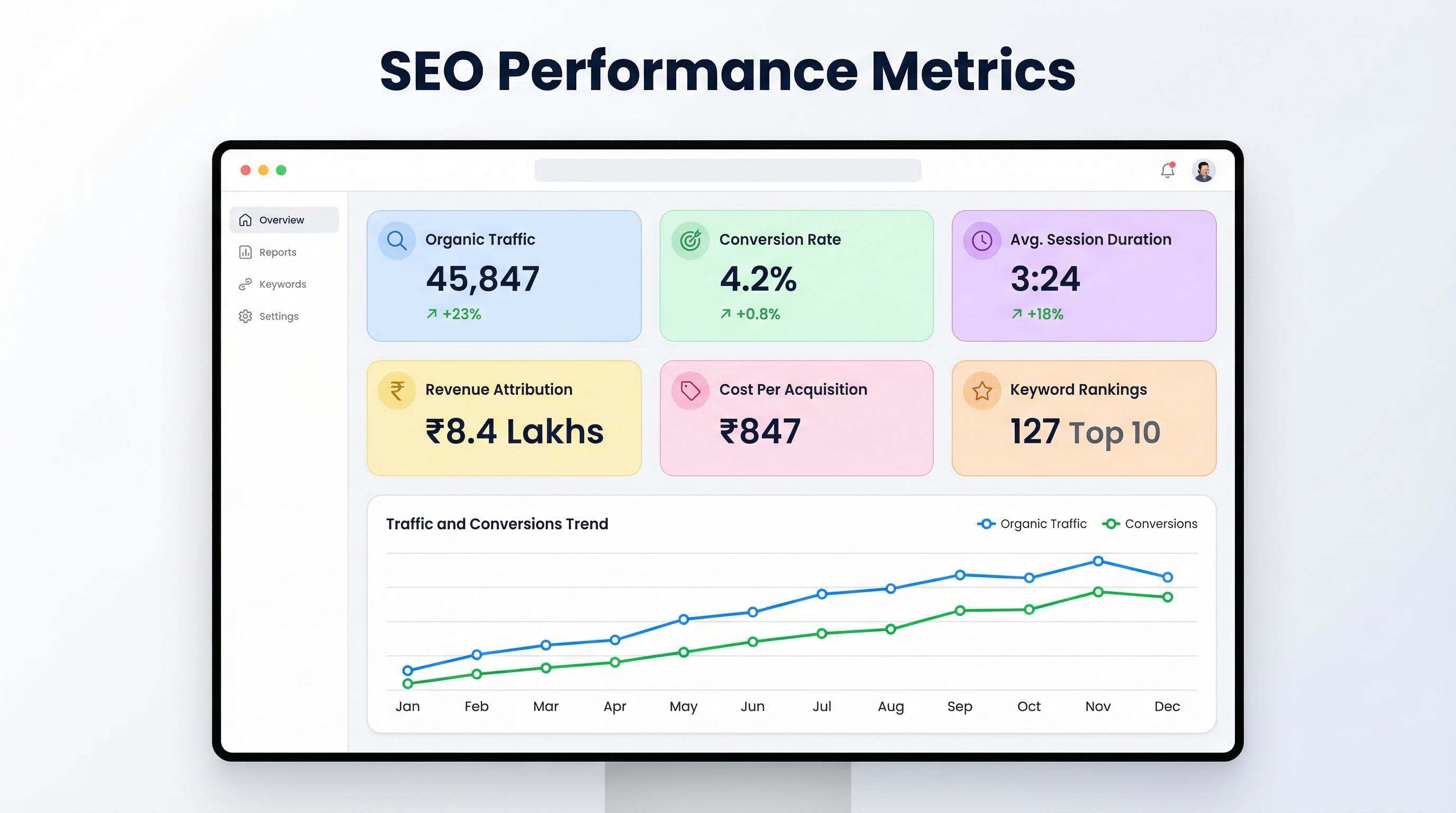
Revenue is the ultimate metric, but it's a lagging indicator. By the time revenue drops, you've already been losing ground for months. Track these leading indicators to catch problems early.
Essential SEO Metrics to Monitor
Organic sessions and unique visitors from Google Analytics 4, segmented by device and geography
Conversion rate from organic traffic compared to other channels (organic should outperform paid in most industries)
Lead generation metrics: form fills, demo requests, trial signups attributed to organic search
Engagement signals: time on page, pages per session, bounce rate from organic traffic
Customer lifetime value (LTV) from organic acquisition compared to paid channels
Revenue attribution across different touchpoints using multi-touch attribution models
Here's something most guides won't tell you: engagement metrics matter more than you think. A visitor who spends 4 minutes reading your content and visits 3 pages is worth way more than someone who bounces in 10 seconds, even if neither converts immediately. The first person is learning to trust you. The second person is gone forever.
And don't ignore customer retention. Measuring content marketing ROI means tracking repeat visits, email subscriptions, and how long customers stick around. Organic customers usually have higher LTV than paid customers because they found you by searching for a solution, not because you interrupted their Facebook scrolling.
Essential Tools for Measuring SEO ROI in India
You can't measure what you can't see. These tools give you the visibility you need, and most have pricing that works for Indian businesses.
Google Analytics 4
Free. Tracks organic traffic, conversions, and revenue attribution. Set up conversion tracking properly or your data is worthless. Most businesses never get past basic pageview tracking.
Google Search Console
Free. Shows you which keywords you rank for, how many impressions and clicks you get, and technical issues killing your rankings. Check it weekly, not monthly.
SEMrush or Ahrefs
Paid (₹8,000-15,000/month). Keyword tracking, competitor analysis, backlink monitoring. Pick one and learn it deeply. Switching tools constantly wastes time and money.
CRM Integration
Zoho, Salesforce, or HubSpot to track lead-to-customer conversion from organic sources. Without this, you're guessing at which leads actually closed and what they were worth.
Heat Mapping Tools
Hotjar or Crazy Egg (₹2,000-8,000/month) to understand user behavior from organic traffic. See where people click, how far they scroll, and where they get confused and leave.
For bootstrapped startups, start with Google Analytics 4 and Search Console. Both are free and give you 80% of what you need. Add paid tools only when you're confident in your strategy and need deeper insights.
But here's the thing: tools don't fix bad strategy. I've seen businesses with ₹50,000 monthly tool budgets get crushed by competitors using free tools and better thinking. The tool is not the strategy.
Common SEO ROI Calculation Mistakes Indian Businesses Make
These mistakes are so common that I'd bet money your business is making at least two of them right now.
Measuring ROI too early. SEO needs 6-12 months to show meaningful results. Checking ROI after 60 days and panicking is like planting a tree, digging it up after a week to check the roots, and wondering why it died.
Not accounting for all costs. You count the agency retainer but forget internal team time, tool subscriptions, and content production. Your 'profitable' SEO strategy is actually break-even when you count everything.
Using last-click attribution. This gives all credit to the last touchpoint before conversion, which massively undercounts organic's contribution. Someone might discover you through organic search, come back via direct traffic, and convert. Last-click says 'direct' gets credit. That's wrong.
Ignoring non-revenue metrics. Brand awareness and thought leadership have value even if they're hard to measure. The person who reads 10 of your blog posts before buying is a better customer than someone who impulse-clicked a paid ad.
Failing to segment by business model. E-commerce, SaaS, and B2B lead generation all work differently. Using the same benchmarks for all three is like comparing a sprinter's time to a marathon runner's and declaring one 'better.'
Not adjusting for seasonal variations. Indian markets have massive seasonal swings around festivals, financial quarters, and monsoons. Comparing Diwali month to February and panicking about a drop is amateur hour.
The worst mistake? Comparing your SEO ROI to paid ads ROI without accounting for time horizons. Paid ads show returns in days. SEO takes months but compounds over years. It's apples and oranges.
Maximizing Your SEO ROI: Strategies for Indian Markets
Knowing your ROI is pointless if you can't improve it. These strategies work specifically for Indian markets, where mobile-first behavior and multilingual audiences change the game.
High-Impact SEO Strategies for Indian Businesses
Target high-intent commercial keywords in Hindi and regional languages, not just English
Optimize for mobile-first indexing since 80%+ of Indian users browse on mobile devices
Create content addressing India-specific pain points, not generic global advice
Build quality backlinks from Indian domains and industry-relevant websites with real traffic
Use structured data markup to enhance search visibility and increase click-through rates
Implement conversion rate optimization to maximize value from the organic traffic you already have
Local SEO matters even if you're not a restaurant. If you serve specific Indian cities, optimize for 'best [service] in Mumbai' and similar geo-targeted keywords. Google's local pack shows up for tons of commercial searches, and most businesses ignore it.
Pros
Reaches 80%+ of Indian users who browse primarily on mobile
Faster page loads improve rankings and conversion rates
Better user experience reduces bounce rates from organic traffic
Google's mobile-first indexing makes this non-negotiable
Cons
Requires redesigning desktop-first websites
More complex to implement forms and long content on mobile
Testing and optimization takes longer across devices
And stop copying American SEO strategies. What works for a SaaS company in San Francisco doesn't necessarily work for a B2B business in Pune. Indian buyers have different research patterns, different trust signals, and different price sensitivities. Your SEO strategy needs to reflect that.
Real-World SEO ROI Calculator Examples from Indian Businesses
Theory is nice. Real numbers are better. Here's what actual Indian businesses achieved when they measured and optimized their SEO ROI properly.
Fashion E-commerce
Invested ₹4.5L over 14 months in content and technical SEO. Generated ₹22L in organic revenue. 389% ROI. Key: focused on long-tail product keywords and size guides that answered real shopping questions.
B2B SaaS Platform
Spent ₹3L on SEO over 12 months. Organic search drove 47 qualified demos worth ₹18L in closed revenue. 500% ROI. Key: targeted bottom-of-funnel comparison and alternative keywords.
Education Platform
₹6L investment over 18 months. Reduced cost-per-lead from ₹850 (paid ads) to ₹280 (organic). 67% reduction. Organic leads also converted 40% better than paid leads.
Content Publisher
Increased organic traffic 300% over 15 months with consistent publishing and technical optimization. Ad revenue grew proportionally from ₹2.5L to ₹10L monthly.
The businesses that win with SEO in India aren't the ones with the biggest budgets. They're the ones who track everything, test constantly, and have the patience to let compound growth work.
Prasad Iyer, CTO at TechDevs
Common thread across all these wins? They tracked their numbers religiously, they gave SEO enough time to work, and they focused on commercial intent keywords instead of chasing vanity traffic. No shortcuts, no hacks, just consistent execution and proper measurement.
Ready to Calculate and Improve Your SEO ROI?
Stop guessing whether your SEO is working. We'll help you set up proper tracking, calculate your real ROI, and build a strategy that delivers measurable returns for your Indian business. Book a free discovery call and we'll show you exactly where your SEO stands and how to improve it.