5 Search Shifts Making Businesses Invisible in 2026 (And How AI SEO Can Save You)
Search has evolved beyond Google. Learn the 5 critical AI SEO shifts happening in 2026 and how to optimize for Instagram, Reddit, YouTube, and AI answers. Stay visible.
 Written byPrithvi Jadwani
Table of contents
Summarize this article with AI
TL;DR
Search isn't dying. It's splintering into a dozen surfaces where your customers actually look for answers. Google's still there, but so are Instagram, Reddit, TikTok, and AI answer engines that don't send clicks at all. Most businesses are optimizing for a search world that stopped existing two years ago. Here's what changed and how to fix it.
- Multi-Surface Visibility Beats Rankings. Being #1 on Google means nothing if your customers search on Instagram first. Optimize where they actually look.
- Intent Alignment Is the New Ranking Factor. AI algorithms prioritize content that actually answers the user's underlying question, not keyword-stuffed pages.
- Entity Optimization Over Page Optimization. Search engines understand your brand as an entity across platforms. Build that presence, not just individual pages.
- AI Accelerates, Humans Strategize. AI tools speed up workflows, but human expertise and oversight determine whether content actually works.
- Track Visibility, Not Just Traffic. Measure brand mentions in AI answers, featured snippets, and platform discovery, not just organic clicks.
The New Search Reality: Why Traditional SEO Is Making You Invisible
Your SEO strategy is probably making you invisible. Not because you're doing it wrong by 2020 standards. Because 2020 standards don't work anymore.
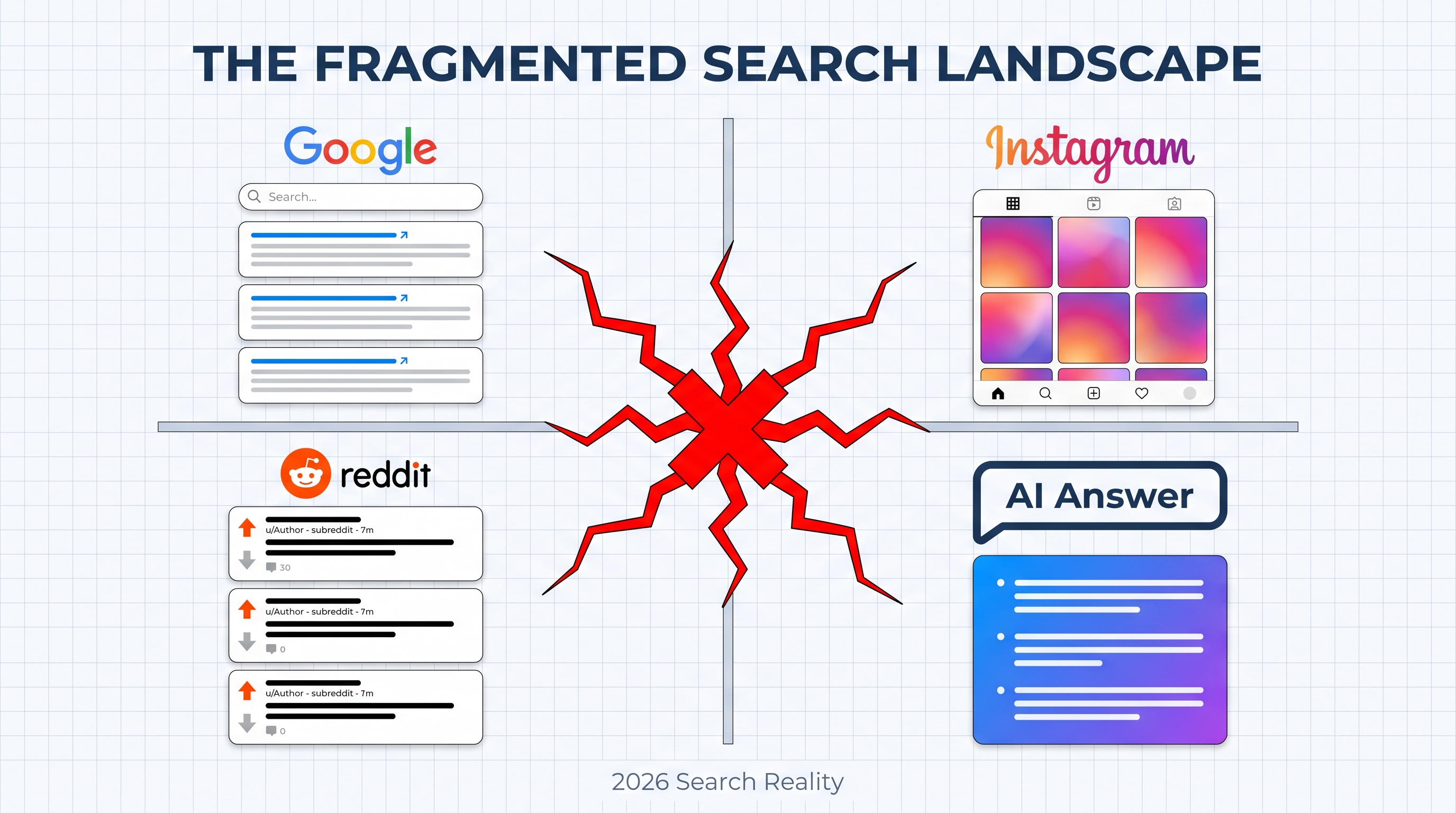
Search fragmented. Your customers don't just Google things anymore. They ask ChatGPT. They search Instagram hashtags. They scroll Reddit threads. They watch YouTube tutorials. And when they do use Google, they often get their answer in an AI Overview without clicking anything.
Ranking #1 no longer guarantees traffic. AI-generated answers, featured summaries, and multi-surface discovery mean your content needs to be extractable, structured, and trusted across platforms. Not just optimized for one search engine.
The Old Way
Optimize pages for Google. Target keywords. Build backlinks. Wait for rankings.
The New Reality
Build entity presence across platforms. Structure content for extraction. Optimize for intent. Show up where users actually search.
Shift #1: From Single Platform to Multi-Surface Visibility
Here's what nobody tells you about search in 2026: most searches don't start on Google anymore.
Your customers search Instagram for product recommendations. They ask questions in Reddit threads. They watch YouTube reviews before they ever type a query into Google. And when they do use Google, there's a decent chance they get an AI-generated answer that doesn't send them anywhere.
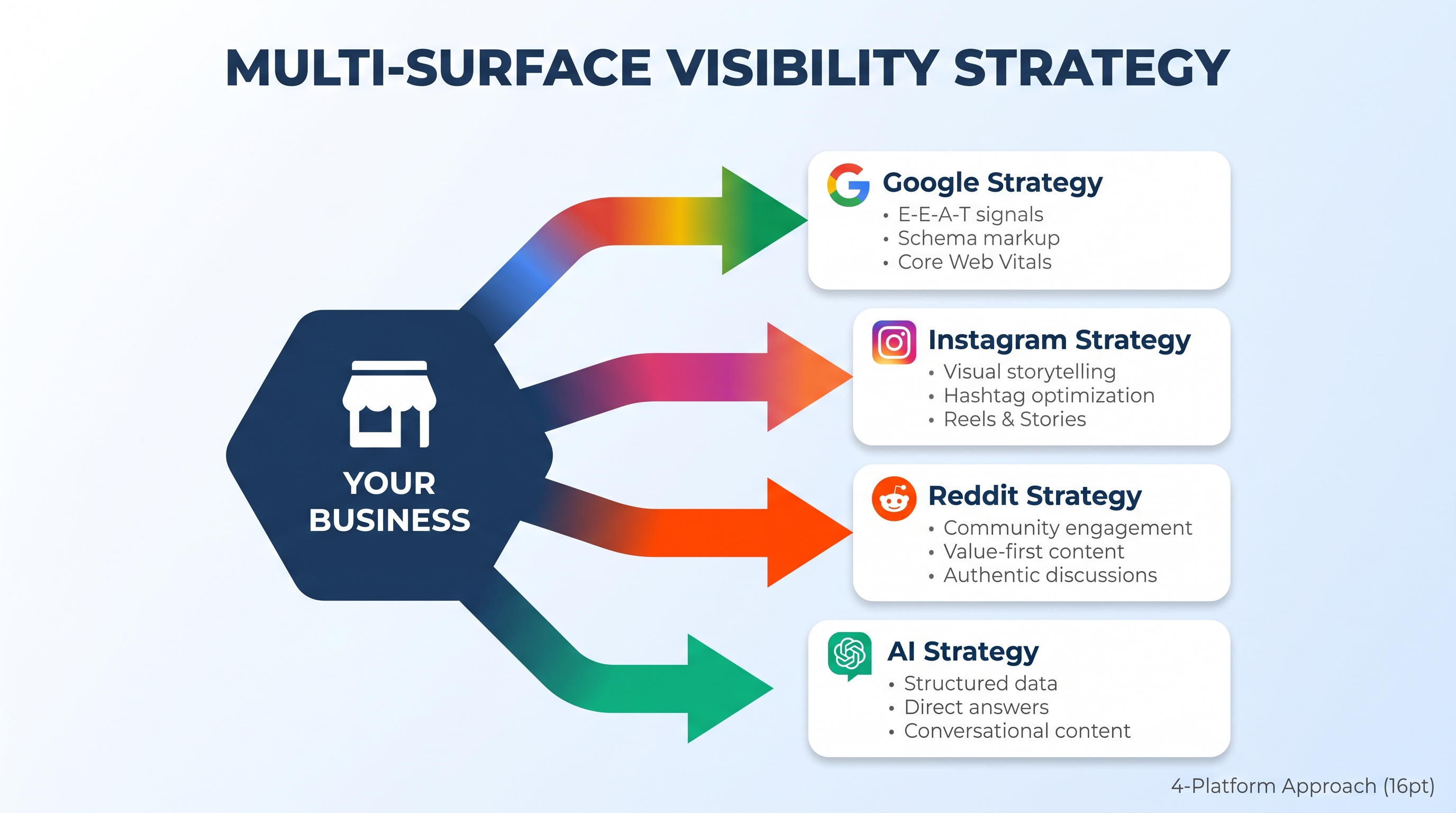
Each platform has its own discovery algorithm. Instagram prioritizes engagement and hashtags. Reddit values upvotes and community trust. YouTube ranks based on watch time and click-through rate. AI answer engines extract from sources they consider authoritative.
You can't optimize for all of them the same way.
Instagram: Visual content, hashtag strategy, engagement signals, location tags
Reddit: Community participation, authentic answers, upvote patterns, subreddit relevance
YouTube: Video SEO, transcripts, thumbnails, watch time optimization
AI Search Engines: Structured data, entity relationships, source authority, extractable answers
Google: Still matters, but now competes with AI Overviews that compress click opportunities
Platform-Specific Optimization Strategies
How do I optimize for Instagram search?
Focus on hashtag research, geotags, and high engagement rates. Instagram's algorithm prioritizes content that keeps users on the platform. Use descriptive alt text, location tags, and relevant hashtags. Post consistently and engage with comments quickly.
What makes content rank on Reddit?
Authenticity and community value. Reddit users can smell marketing from a mile away. Participate genuinely in relevant subreddits. Answer questions without always linking to your site. Build reputation before promoting. Upvotes and comment engagement drive visibility.
How is YouTube SEO different from Google?
YouTube prioritizes watch time, not just clicks. Optimize titles and thumbnails for click-through rate, but deliver on the promise to keep viewers watching. Use transcripts, closed captions, and detailed descriptions. Engagement signals (likes, comments, shares) matter more than backlinks.
What do AI search engines look for?
Structured, extractable content from authoritative sources. Implement schema markup. Build clear entity relationships. Provide direct answers to questions. AI engines prioritize sources they can confidently cite, so trust signals and factual accuracy are critical.
Visibility across multiple surfaces is the new standard. Ranking alone is no longer the goal.
Jason Pittock, AI Search Optimization Trends 2026
Shift #2: Intent Alignment Over Keyword Density
Most SEO losses today aren't because of bad backlinks or slow page speed. They're because of intent misalignment.
AI algorithms got good at understanding what users actually want. They can tell the difference between someone researching a topic and someone ready to buy. They detect when content answers the surface question but misses the underlying need.
Keyword density doesn't fool them anymore. Semantic relevance does. User satisfaction signals do. Content that genuinely solves the problem does.
Here's the shift: you're not optimizing for keywords. You're optimizing for the question behind the search.
Pros
Focuses on answering the actual user question, not just including keywords
AI algorithms reward content that satisfies intent with better visibility
Structured data and entity relationships signal topical authority
Content performs across multiple search surfaces, not just Google
Cons
Requires deeper research to understand user intent behind queries
Can't rely on keyword tools alone, need to analyze search behavior
Takes longer to create truly helpful content vs. keyword-stuffed pages
Intent Alignment Checklist
Analyze current top-ranking content for the query
Identify the underlying question users are really asking
Map content format to user intent (informational, transactional, navigational)
Include related questions and subtopics users care about
Structure content for easy extraction by AI systems
Test content against real user questions from forums and social
Shift #3: Entity-Based Optimization Replaces Page-Based SEO
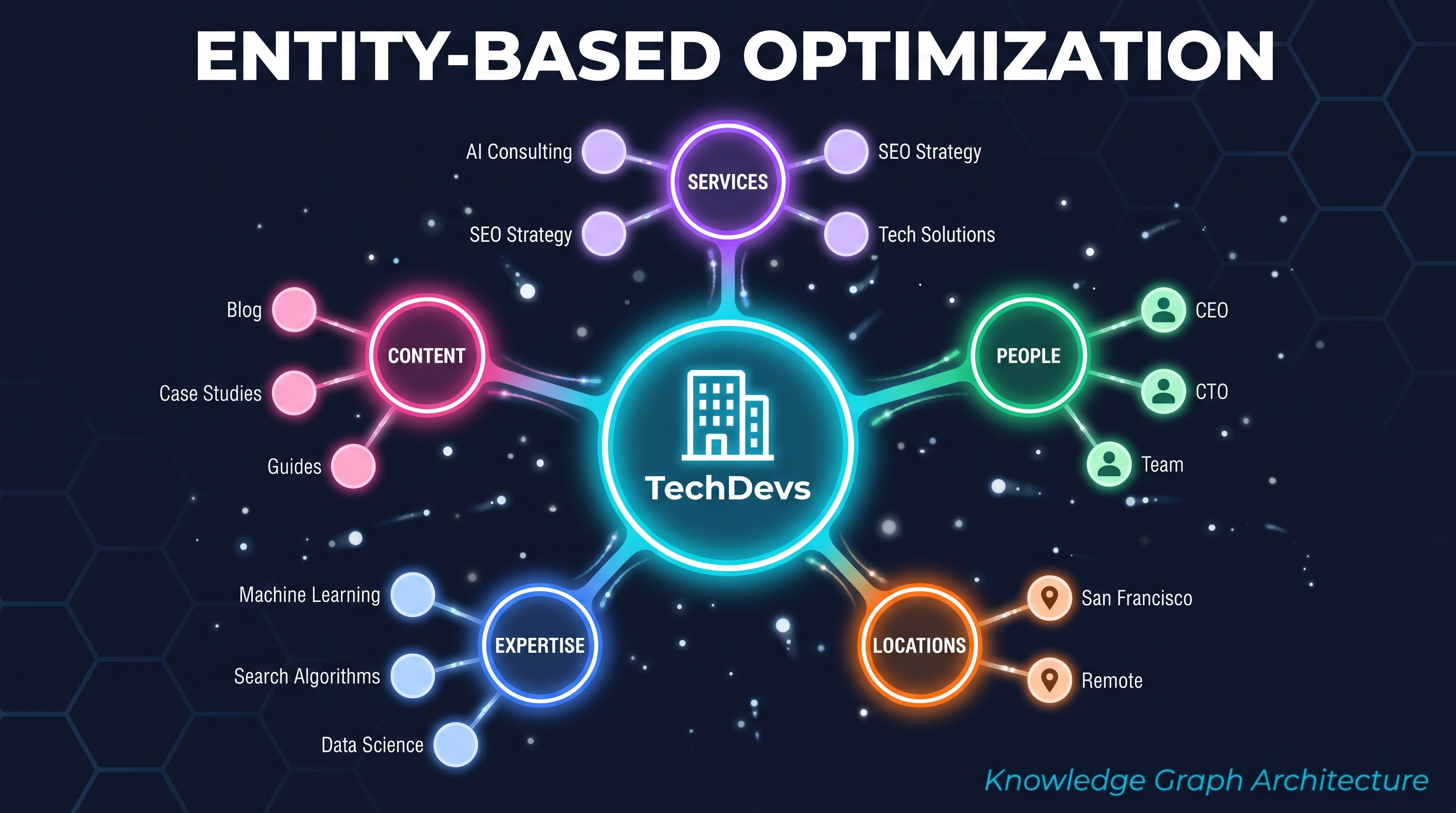
Search engines don't see your website as a collection of pages anymore. They see it as an entity with relationships to other entities.
Google knows that TechDevs is a company, located in a specific place, offering specific services, connected to specific people. It understands these relationships across its knowledge graph. When someone searches for something related to those entities, Google can surface your brand even if the exact keywords aren't on your page.
This is why Generative Engine Optimization (GEO) matters now. You're not just optimizing pages. You're building entity presence across knowledge bases.
Schema markup becomes critical. It's how you tell search engines what entities exist on your site and how they relate to each other. Person schema. Organization schema. Product schema. Service schema. Local business schema.
AI answer engines use these signals to decide whether to cite you.
Schema Markup
Structured data that defines entities and their relationships. Critical for AI extraction.
Entity Graphs
Networks of connected entities (people, places, concepts) that establish topical authority.
Knowledge Base Optimization
Consistent entity recognition across Wikipedia, Wikidata, Google Knowledge Graph, and platform-specific databases.
Common Entity Optimization Questions
What is an entity in SEO terms?
An entity is a distinct, well-defined thing or concept. It could be a person, place, organization, product, or idea. Search engines understand entities as nodes in a knowledge graph, connected by relationships. Your brand is an entity. Your CEO is an entity. Your services are entities. Entity-based SEO optimizes these connections, not just pages.
How do I build entity relationships?
Use schema markup to define entities on your site. Get listed in authoritative databases (Wikipedia, Wikidata, industry directories). Build consistent NAP (name, address, phone) citations. Create author profiles with E-E-A-T signals. Link related entities within your content. Earn mentions on high-authority sites that already have strong entity presence.
Does entity optimization work for small businesses?
Absolutely. Local businesses benefit hugely from entity optimization. Claim and optimize your Google Business Profile. Use local business schema. Build citations in local directories. Connect your business to local entities (neighborhoods, landmarks, events). Small businesses often have stronger local entity signals than national competitors.
Shift #4: AI-Powered Content Creation With Human Expertise
Let's be clear about something: AI won't save your SEO if you don't have strategy.
AI tools are incredible for speeding up workflows. They can draft outlines, research topics, generate variations, and handle repetitive tasks. But they can't replace the strategic thinking that comes from actually understanding your industry, your customers, and what works.
AI for SEO works best as a hybrid approach. AI handles research, drafting, and optimization. Humans add insight, validate accuracy, inject brand voice, and make strategic decisions.
Here's what AI does well and what it doesn't.
AI algorithms, equipped with machine learning capabilities, offer the only viable solution to keeping pace with the nuances of modern search engine algorithms.
Salesforce, AI for SEO: Your Guide for 2026
Hybrid AI Content Workflow
Use AI for keyword research and topic clustering
Let AI generate content outlines and first drafts
Human review for accuracy, brand voice, and strategic alignment
Add expert insights, real examples, and original perspectives
Implement bias detection and ethical content checks
Validate all statistics and factual claims
Final human edit for readability and engagement
The businesses winning with AI content are the ones who use it to scale their expertise, not replace it. They have subject matter experts who review, refine, and add the insights that only come from real experience.
Shift #5: Predictive Search and Voice/Visual Discovery
Search isn't just text in a box anymore. It's voice queries. Image searches. Video discovery. And increasingly, it's AI predicting what you'll search for before you even ask.
Voice search changed query patterns. People don't say 'best coffee shop near me' out loud. They say 'where can I get good coffee right now?' Natural language. Conversational. Question-based.
Visual search lets users upload a photo and find similar products or information. Google Lens, Pinterest Lens, Instagram visual search. Your product images, alt text, and image schema matter more than ever.
And AI can now forecast trending topics before they peak. Predictive analytics tools analyze search patterns, social signals, and content performance to identify what's about to blow up.
Voice Search Optimization: Use natural language, question-based headings, conversational content structure, featured snippet optimization
Visual Search Optimization: High-quality images, descriptive alt text, image schema markup, product image optimization
Video Discovery: Transcripts, closed captions, video schema, thumbnail optimization, chapter markers
Predictive Content: AI-powered topic forecasting, trend analysis, real-time content adjustment, proactive content creation
Voice and Visual Search FAQs
How do I optimize for voice search?
Focus on natural language and question-based content. Use conversational phrases people actually say out loud. Structure content to answer specific questions directly. Optimize for featured snippets, since voice assistants often read from them. Include FAQ sections with clear, concise answers.
What makes images rank in visual search?
High-quality, properly sized images with descriptive filenames and alt text. Use image schema markup to provide context. Ensure images are mobile-optimized and load quickly. Include relevant surrounding text that describes the image. For products, use multiple angles and lifestyle shots.
Can AI really predict trending topics?
Yes, with limitations. AI analyzes search volume patterns, social media signals, news trends, and historical data to forecast topic interest. It's not perfect, but it gives you a head start on creating content before competition peaks. The key is combining AI predictions with human judgment about what's actually relevant to your audience.
Building Your AI SEO Tech Stack: Integration and Automation
You can't run modern SEO with disconnected tools. Your content management system, CRM, analytics platform, and automation tools need to talk to each other.
End-to-end AI SEO platforms integrate with your existing tech stack. They pull data from Google Analytics, Search Console, social platforms, and CRM systems. They push optimized content to your CMS. They trigger workflows based on performance signals.
Marketing automation connects content creation to distribution. You create a piece of content, and automation handles social posting, email distribution, internal linking, and performance tracking. Real-time data feeds let you adjust content based on what's actually working.
API-first architecture means you can build custom workflows tailored to your specific business needs. Not every company needs the same automation. Build what matters for you.
Content Management Integration
Connect AI tools directly to your CMS for seamless publishing, updating, and optimization workflows.
Analytics and Reporting
Real-time dashboards that tie SEO performance to business outcomes and revenue, not just vanity metrics.
Marketing Automation
Automated content distribution, internal linking, social posting, and email campaigns triggered by performance data.
API-First Architecture
Custom integrations and workflows built specifically for your business processes and tech stack.
Tech Stack Integration Priorities
Connect AI SEO platform to CMS for content publishing
Integrate Google Analytics and Search Console for performance data
Link CRM to track SEO's impact on leads and revenue
Set up marketing automation for content distribution
Build custom dashboards for business-aligned KPIs
Implement real-time alerts for performance changes
Measuring Success: KPIs and ROI Frameworks for AI SEO in 2026
Traditional SEO metrics don't tell the full story anymore. Rankings and organic traffic are still important, but they're not the only measures of success.
You need to track multi-surface visibility. Are you showing up in AI answers? Featured snippets? Instagram search results? Reddit threads? YouTube recommendations?
Brand mentions matter. Even if someone doesn't click through to your site, appearing in an AI-generated answer or a Reddit thread builds awareness and trust.
Attribution gets complicated when customers interact with your brand across multiple platforms before converting. Your analytics need to account for cross-platform journeys, not just last-click attribution.
Visibility Metrics
Track appearances in AI answers, featured snippets, social search results, and platform-specific discovery feeds.
Brand Mention Tracking
Monitor how often your brand appears in AI-generated content, social discussions, and third-party reviews, even without direct links.
Revenue Attribution
Connect SEO efforts to actual business outcomes using multi-touch attribution models that account for cross-platform journeys.
Trust and Authority Signals
Measure entity authority scores, knowledge graph presence, and E-E-A-T indicators that influence AI answer inclusion.
Measurement and ROI Questions
What KPIs should I track for multi-surface SEO?
Track visibility across platforms (Google rankings, AI answer appearances, social search results). Measure brand mentions even without links. Monitor entity authority scores and knowledge graph presence. Track content extractability (how often your content gets cited). Measure cross-platform engagement and multi-touch conversions, not just organic traffic.
How do I measure ROI from AI SEO investments?
Connect SEO performance to revenue using multi-touch attribution. Track assisted conversions, not just last-click. Measure cost per acquisition across all channels influenced by SEO. Calculate customer lifetime value for SEO-sourced leads. Compare investment in AI tools and strategy against revenue growth from improved visibility.
What's the best way to track AI answer appearances?
Use specialized monitoring tools that track when your brand or content appears in AI-generated answers across ChatGPT, Google AI Overviews, Perplexity, and other AI search engines. Set up alerts for brand mentions. Manually audit key queries monthly. Track citation patterns and which content gets extracted most often.
The businesses that win are the ones who tie SEO directly to business outcomes. Not vanity metrics. Real revenue. Real leads. Real customer acquisition.
Your 2026 AI SEO Action Plan: What to Do This Quarter
You don't need to overhaul everything at once. Start with these priorities.
Q1 2026 Action Items
Audit current visibility across Google, Instagram, Reddit, YouTube, and AI answer engines
Implement schema markup on all key pages (Organization, Person, Product, Service, Local Business)
Build entity relationships and optimize knowledge base presence (Google Business Profile, Wikipedia, Wikidata)
Establish AI content workflows with clear human oversight and quality controls
Set up multi-surface performance dashboards tracking visibility, not just rankings
Test platform-specific content strategies on 2-3 priority channels
Review and align content to actual search intent, not just keywords
Implement voice and visual search optimization for key products/services
And look, this stuff changes fast. What works today might not work in six months. But the fundamentals stay the same: understand where your customers search, create content that actually helps them, structure it so AI can extract it, and build entity presence across platforms.
That's the game now.
Audit your current multi-surface visibility to identify gaps
Prioritize 2-3 platforms where your customers actually search
Implement schema markup and entity optimization on key pages
Build AI content workflows with human oversight
Set up performance tracking that measures visibility, not just traffic
Test, measure, adjust. Repeat.
Ready to Fix Your Visibility Problem?
Most businesses are optimizing for search patterns that stopped working two years ago. We help companies build multi-surface visibility strategies that actually drive revenue. Let's talk about what's broken and how to fix it.