The Exact AI SEO Framework to Dominate AI Search and Transform Your Lead Generation
Learn the exact AI SEO framework to dominate AI search results and diversify lead generation. Complete omni-channel marketing guide for businesses.
 Written byPrithvi Jadwani
Table of contents
Summarize this article with AI
TL;DR
AI is rewriting the rules of search. Google processes 8.5 billion searches daily, but the game has changed. AI-powered answer engines like Google's Search Generative Experience now serve up answers directly, bypassing traditional link lists. If you're still doing SEO the old way, you're invisible. This guide shows you how to build an AI SEO framework that captures leads across every channel, not just Google.
- AI Search Changes Everything. Traditional keyword tactics fail when AI evaluates context, intent, and behavior for personalized results
- Five-Pillar Framework. Content intelligence, governance, data orchestration, omni-channel optimization, and performance measurement
- Get Featured in AI Answers. Structure content with clarity, depth, and schema markup to increase AI citation probability
- Diversify Beyond Google. Optimize for voice search, visual platforms, and AI-powered discovery across YouTube, LinkedIn, and Amazon
- Scale With Governance. Balance AI automation with human oversight to maintain quality, accuracy, and brand authenticity
Why Traditional SEO Is Dead: The AI Search Revolution Reshaping Lead Generation
Every minute, 5.9 million searches happen on Google. That's 8.5 billion searches per day. But here's what most businesses miss: the way people find answers is fundamentally different now.
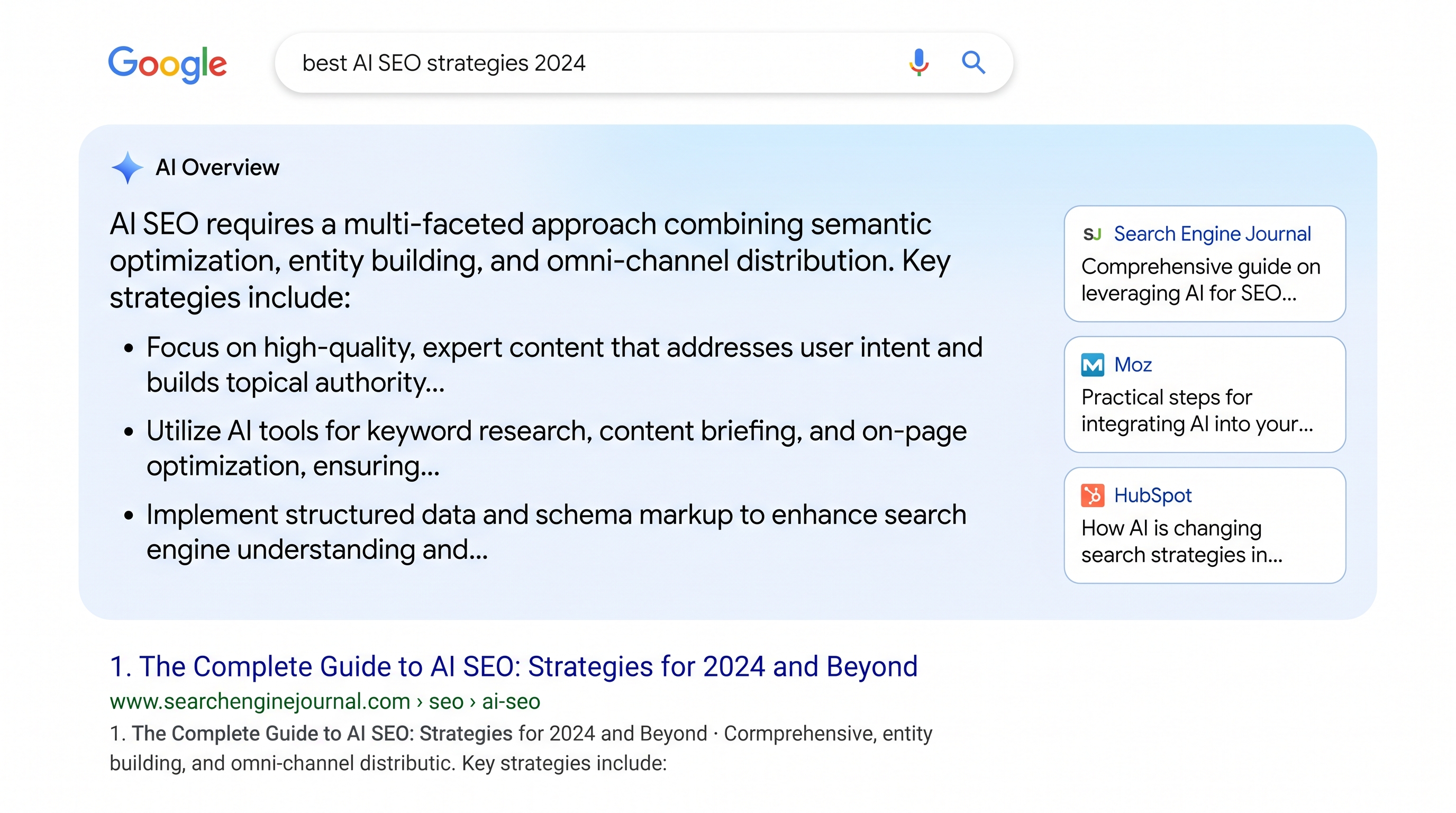
Google's Search Generative Experience doesn't show you ten blue links anymore. It gives you an AI-written answer at the top of the page, pulling from multiple sources, summarizing the key points, and often eliminating the need to click anything at all.
If your content isn't built for this, you're invisible.
The old playbook was simple: find keywords, stuff them into pages, build some backlinks, wait for rankings. That worked when search engines were dumb pattern-matchers. But AI doesn't work that way. It reads context. It understands what users actually want. It evaluates the quality of your content the way a human editor would.
And it's not just Google. ChatGPT, Perplexity, Bing Chat, and a dozen other AI tools are becoming primary research destinations. Your potential customers are asking questions in these tools, getting answers, and making decisions without ever landing on your website.
So what do you do? You build an AI SEO framework that spans every touchpoint where your customers search. Not just Google. Not just text-based queries. Voice. Visual. Multimodal. Omni-channel.
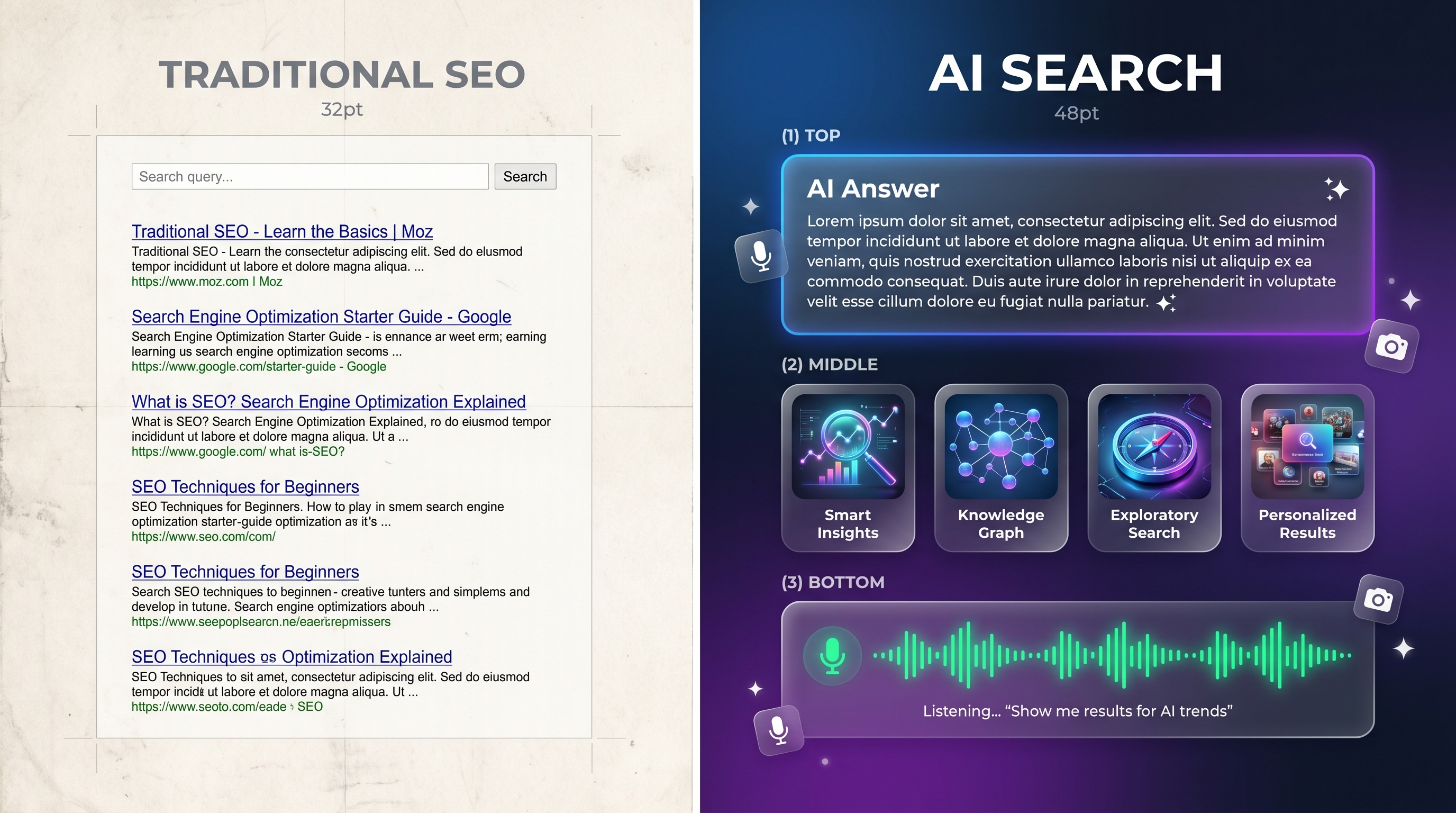
What's Broken
Keyword-stuffed content, link schemes, and surface-level blog posts that AI ignores
What Works Now
Deep, structured content that answers real questions with clarity and authority
The Old Way
Optimize for one search engine, hope for rankings, pray for clicks
The New Way
Build content that AI cites, users trust, and converts across all channels
The Complete AI SEO Framework: Your 5-Pillar Operating Model
Most companies treat AI SEO like a tool problem. They buy Semrush or Ahrefs, generate some content with ChatGPT, and call it a strategy. That's not a framework. That's chaos with better software.
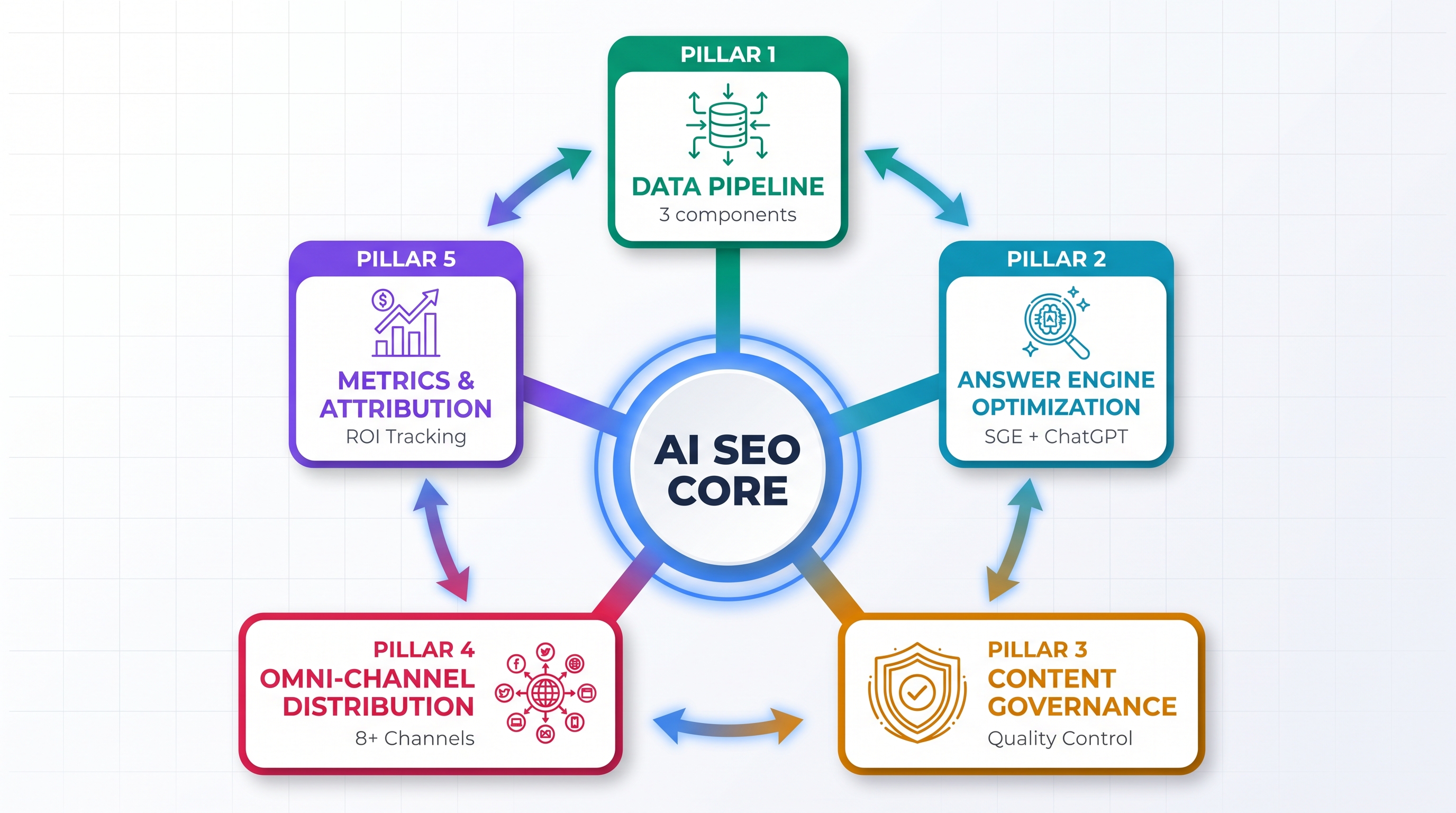
A real AI SEO framework has five pillars. Each one matters. Skip one, and the whole thing collapses.
The Five Pillars of AI SEO
Pillar 1: AI-Powered Content Intelligence
This is where you use tools like Semrush, Ahrefs, and ChatGPT to identify what people are actually searching for. Not just keywords. Intent. The questions behind the queries. The gaps in existing content. The emerging topics that competitors haven't covered yet. Tools like Surfer SEO and Frase analyze top-ranking pages and tell you exactly what semantic elements you're missing. This isn't guesswork anymore.
Pillar 2: Governance Layer
AI can write fast. Too fast. Without governance, you end up with generic slop that sounds like every other AI-generated blog post. You need editorial guidelines, brand voice standards, and fact-checking processes. Decide when AI assists and when humans lead. Set quality thresholds. Define what gets published under your name and what doesn't. This is the difference between scaling content and destroying your credibility.
Pillar 3: Data Orchestration
Your AI SEO insights need to flow into your CRM, your marketing automation platform, and your analytics stack. If SEO data lives in a silo, you're blind to how search behavior connects to customer journeys. Integrate AI SEO signals with your customer data platform so you can personalize content delivery based on where someone is in the funnel. This is how you turn search traffic into qualified leads.
Pillar 4: Omni-Channel Optimization
Google isn't the only game. Voice search on Alexa and Siri requires conversational content. Visual search on Pinterest and Google Lens needs optimized images and alt text. YouTube is the second-largest search engine. LinkedIn has its own discovery algorithm. Amazon's search drives billions in commerce. Your content needs to work across all of them. One piece of content, adapted for multiple modalities and platforms.
Pillar 5: Performance Measurement
Track traditional metrics like rankings and traffic. But also measure AI-specific KPIs: how often your content gets cited in AI-generated answers, your zero-click search performance, and lead attribution across channels. Calculate ROI by comparing AI tool costs against efficiency gains and incremental leads. Build dashboards that show the full picture, not just vanity metrics.
These five pillars work together. Content intelligence feeds governance decisions. Data orchestration powers omni-channel optimization. Performance measurement tells you what's working and what's not.
Framework Implementation Checklist
Audit current keyword research process and identify AI tool gaps
Document editorial standards and AI usage guidelines
Map data flows between SEO tools, CRM, and analytics platforms
Inventory all customer search touchpoints beyond Google
Define success metrics and build reporting dashboards
Building Your AI SEO Data Pipeline: From Research to Execution
Here's what separates the companies winning with AI SEO from the ones flailing: they built a data pipeline. Not a process. A pipeline. Automated, repeatable, and connected to execution.
Most teams do keyword research once a quarter, write some content, publish it, and hope. That's not a pipeline. That's a one-off project.
Set up automated keyword intelligence systems that monitor emerging search patterns, track competitor content gaps, and flag intent shifts in real time
Create AI-powered content briefs that analyze top-ranking pages, extract semantic elements, and identify SERP features you can capture
Use tools like Surfer SEO and Frase for real-time optimization scoring as you write, not after you publish
Build feedback loops between SEO performance data and your broader marketing analytics so you know which topics drive pipeline, not just traffic
Integrate AI SEO signals with your customer data platform to trigger personalized content delivery based on search behavior
The difference between a manual process and an automated pipeline is velocity. With a pipeline, you can identify an emerging topic on Monday, have a brief ready Tuesday, draft content Wednesday, optimize and publish Thursday, and start seeing results by the weekend.
Without a pipeline? That same cycle takes three weeks. By the time you publish, the opportunity is gone.
Keyword Intelligence
Automated monitoring of search trends, competitor gaps, and intent shifts
Content Briefs
AI-generated briefs with semantic analysis and SERP feature targeting
Real-Time Optimization
Live scoring and suggestions as you write, not after publication
What once took hours - keyword research, metadata creation, content structuring - can now be done in minutes with platforms like Semrush, Ahrefs, and Surfer SEO.
WSI World
But here's the catch: speed without quality is just noise. Your pipeline needs quality gates. Human review at critical decision points. Editorial oversight before anything goes live. AI can draft, but humans decide what represents your brand.
Optimizing for AI Answer Engines: Getting Featured in SGE and ChatGPT Results
Getting ranked on page one used to be the goal. Now? It's table stakes. The real prize is getting cited in the AI-generated answer at the top of the page.
When Google's SGE pulls content into its answer, or when ChatGPT references your article in a response, that's visibility you can't buy with ads. And it's not random. AI models have clear preferences.
How to Get Cited by AI
Write with clarity and depth - AI prefers content that directly answers questions without fluff
Use structured data and schema markup to help AI understand your content's purpose and context
Format with clear headings, short paragraphs, and concise answers that AI can easily extract
Create FAQ-style sections that match common question patterns in your niche
Build authority through citations, data, and links to credible sources
Target featured snippet opportunities - if Google shows it as a snippet, AI will likely cite it
Think of AI as an extremely efficient research assistant. It scans thousands of pages, identifies the clearest and most authoritative answers, and synthesizes them. If your content is vague, overly promotional, or buried under jargon, AI skips it.
Also, pay attention to People Also Ask boxes. Those questions are gold. Each one represents a micro-topic where you can create targeted content that AI will reference.
Pros
Clear, direct answers to specific questions
Well-structured content with descriptive headings
Data-backed claims with credible sources
FAQ sections matching common search patterns
Schema markup and structured data
Cons
Vague, meandering content without clear takeaways
Overly promotional language and sales pitches
Keyword-stuffed text that prioritizes SEO over clarity
Thin content that lacks depth or unique insights
Poor formatting with dense paragraphs and no structure
One more thing: AI models update constantly. What works today might not work in six months. Monitor which of your pages get cited, analyze why, and double down on those patterns.
Scaling AI-Generated Content: Enterprise Governance and Quality Control
AI can write 10,000 words in 10 minutes. That's powerful. It's also dangerous.
Without governance, you end up with a content library full of generic, soulless articles that sound exactly like every other AI-generated blog post on the internet. Google's algorithms can spot that. So can your readers.
Here's the truth: AI is a tool, not a replacement. The companies scaling content successfully use AI to draft, research, and optimize. But humans make the final decisions.
Building Your Content Governance Framework
When to use AI vs. human-first creation
Use AI for high-volume, data-driven content like product descriptions, FAQ pages, and listicles. Use human-first creation for thought leadership, case studies, and anything requiring nuanced opinion or brand voice. The rule: if it needs to sound like you, a human should lead.
Multi-layer review process
Layer one: AI fact-checking tools to verify claims and catch errors. Layer two: human editorial review for brand voice, tone, and strategic alignment. Layer three: compliance and legal review for regulated industries. Never publish AI-generated content without at least two human touchpoints.
Maintaining E-E-A-T signals at scale
Experience, Expertise, Authoritativeness, and Trustworthiness matter more than ever. Add author bios with real credentials. Link to credible sources. Update content regularly to keep it accurate. Show your work. AI can draft, but humans provide the expertise.
Standardized prompts and templates
Create a library of prompts that produce consistent output aligned with your brand voice. Include examples of good vs. bad AI-generated content. Train your team on how to edit AI drafts, not just accept them as-is. Consistency comes from process, not just tools.
Ethical considerations and disclosure
Be transparent about AI usage where appropriate. Avoid publishing AI-generated content that could spread misinformation or harm. Maintain editorial control over sensitive topics. Your brand reputation is on the line with every piece of content you publish.
The companies that get this right treat AI like an intern: capable, fast, but needing supervision. You wouldn't let an intern publish directly to your blog without review. Same rule applies to AI.
Define your content quality standards in writing - what's acceptable, what's not
Create a content review checklist that every piece goes through before publication
Assign clear ownership: who's responsible for AI-generated content quality?
Build feedback loops so your team learns what good AI editing looks like
Audit published content quarterly to catch quality drift before it becomes a problem
Omni-Channel AI SEO: Diversifying Lead Generation Beyond Google
If 100% of your lead generation depends on Google, you have a single point of failure. And in 2025, that's a huge risk.
AI search is happening everywhere. Voice assistants. Visual search platforms. Social media discovery. E-commerce search. Your customers are asking questions and finding answers across a dozen different channels.
Omni-channel AI SEO means optimizing for all of them. Not just Google.
Voice Search
Optimize for conversational queries on Alexa, Siri, and Google Assistant with natural language and question-based content
Visual Search
Tag images with descriptive alt text and structured data for Google Lens, Pinterest Lens, and Amazon's visual search
YouTube SEO
Optimize video titles, descriptions, and transcripts for the world's second-largest search engine
LinkedIn Discovery
Create thought leadership content optimized for LinkedIn's algorithm and professional search behavior
Amazon Search
Product content and category pages optimized for Amazon's A9 algorithm and shopping intent
Social Search
Short-form content optimized for TikTok, Instagram, and Twitter search and discovery features
The strategy isn't to create unique content for every platform. That's not scalable. The strategy is to create one core piece of content and adapt it for different formats and contexts.
Start with a long-form blog post optimized for Google and AI answer engines
Extract key points and create a LinkedIn article with professional framing
Turn the main insights into a script for a YouTube video with visual examples
Pull out quotable stats and create social media posts for Twitter and LinkedIn
Repurpose the content into an email newsletter for your subscriber list
Create a PDF guide or checklist as a lead magnet on your landing page
Each format serves a different part of your audience. Some people prefer reading. Others want video. Some discover content through social media. By being everywhere, you capture leads that would otherwise go to competitors.
And here's the kicker: AI makes this easier than ever. Tools can automatically generate video scripts from blog posts, create social media variants, and optimize content for different platforms. The hard part isn't production anymore. It's strategy.
Measuring AI SEO Success: Metrics, Attribution, and ROI Framework
You can't manage what you don't measure. And with AI SEO, the metrics that matter have changed.
Rankings and traffic still matter. But they're lagging indicators. By the time you see a drop in rankings, you've already lost visibility in AI-generated answers for weeks.
You need leading indicators. Metrics that tell you what's working before it shows up in your traffic reports.
Traditional SEO metrics like keyword rankings and organic traffic are still useful. But they only tell part of the story. If your content gets cited in 100 AI-generated answers but doesn't drive clicks, is that success or failure?
It depends on your goal. If you're building brand awareness, citations without clicks are valuable. If you need leads, you need to track conversions.
Essential AI SEO Metrics to Track
Traditional rankings and organic traffic for baseline performance
SERP feature inclusion rate (featured snippets, People Also Ask, AI Overviews)
AI citation frequency across ChatGPT, Perplexity, and other AI tools
Content production velocity and cost per published piece
Lead attribution from organic search to pipeline and closed revenue
Engagement metrics: time on page, scroll depth, and conversion rate
Omni-channel performance across Google, YouTube, LinkedIn, and other platforms
ROI calculation for AI SEO is straightforward: compare the cost of AI tools and human oversight against the value of incremental leads generated. If you're spending $5,000 a month on tools and producing 3x more content that drives 50% more qualified leads, the ROI is clear.
Dashboard Integration
Connect SEO data with CRM, marketing automation, and analytics platforms
A/B Testing
Compare AI-generated vs. human-created content performance
Continuous Optimization
Use performance data to refine prompts, processes, and content strategy
The companies winning with AI SEO review their metrics weekly, not monthly. They spot trends early, double down on what works, and kill what doesn't. Speed matters.
Future-Proofing Your AI SEO Framework: Emerging Trends and Next Steps
AI search is evolving fast. What works today might not work in six months. But some trends are clear.
Multimodal search is coming. Users will combine text, voice, and visual queries in a single interaction. "Show me running shoes like this [photo], under $100, with good reviews." Your content needs to work across all those modalities.
AI agents are gaining market share. Tools like ChatGPT, Perplexity, and Claude are becoming primary research destinations, not just Google alternatives. If your content isn't optimized for these platforms, you're invisible to a growing segment of searchers.
Prepare for multimodal search where users combine text, voice, and images in a single query
Adapt to AI agent behaviors as ChatGPT and Perplexity capture more search market share
Build flexible content systems that can quickly adapt to algorithm changes and new AI features
Invest in continuous learning to stay updated on AI tool capabilities and search engine developments
Create an implementation roadmap with quick wins, 90-day milestones, and long-term initiatives
Build internal competency through training, experimentation, and cross-functional collaboration
The companies that will win are the ones that treat AI SEO as a system, not a tactic. They experiment constantly. They measure everything. They adapt fast.
Your 90-Day AI SEO Roadmap
Week 1-2: Audit current SEO performance and identify AI optimization gaps
Week 3-4: Set up AI-powered keyword research and content intelligence systems
Week 5-6: Document governance standards and editorial processes
Week 7-8: Integrate SEO data with CRM and marketing analytics platforms
Week 9-10: Launch first omni-channel content campaign across 3+ platforms
Week 11-12: Build performance dashboards and establish review cadence
AI SEO isn't a project. It's an operating model. The sooner you start building it, the bigger your advantage over competitors still doing SEO the old way.
Frequently Asked Questions
What is an AI SEO framework and why do I need one?
An AI SEO framework is a structured approach to optimizing content for AI-powered search engines and answer engines. You need one because traditional SEO tactics no longer work when AI evaluates context, intent, and quality instead of just keywords. Without a framework, you're invisible in AI-generated answers and missing omni-channel lead opportunities.
How does AI-powered search differ from traditional Google search?
Traditional Google search shows a list of links ranked by relevance. AI-powered search generates direct answers by synthesizing information from multiple sources, often eliminating the need to click any link. AI evaluates content quality, context, and user intent more deeply than keyword matching ever could.
What tools should I use to implement AI SEO in my business?
Start with keyword research tools like Semrush or Ahrefs. Add content optimization platforms like Surfer SEO or Frase. Use ChatGPT or Claude for content drafting and ideation. Connect everything to your CRM and analytics platforms for attribution tracking. The specific tools matter less than having a complete pipeline from research to measurement.
How do I measure the ROI of AI SEO investments?
Compare the cost of AI tools and human oversight against the value of incremental leads generated. Track content production velocity, AI citation rate, lead attribution from organic search, and conversion rates. Calculate cost per lead from AI-optimized content vs. traditional methods. ROI becomes clear when you connect SEO efforts to pipeline and revenue.
Can AI-generated content hurt my search rankings?
Yes, if it's low-quality, generic, or lacks human oversight. Google's algorithms can spot thin AI-generated content. But AI-assisted content with proper governance, human editing, and quality control performs just as well as human-written content. The key is treating AI as a drafting tool, not a replacement for editorial judgment.
How do I optimize content for Google's Search Generative Experience?
Write clear, direct answers to specific questions. Use structured data and schema markup. Format with descriptive headings and short paragraphs. Create FAQ sections that match common search patterns. Build authority through citations and credible sources. Target featured snippet opportunities. AI prefers content that's easy to extract and cite.
What are the best practices for AI SEO governance and quality control?
Define when to use AI vs. human-first creation. Implement multi-layer review: AI fact-checking, human editorial oversight, and compliance checks. Maintain E-E-A-T signals with author credentials and credible sources. Create standardized prompts and content templates. Never publish AI-generated content without at least two human touchpoints.
Ready to Build Your AI SEO Framework?
Most companies are still doing SEO the old way. That's your opportunity. We help businesses implement AI-powered search strategies that capture leads across every channel. Book a discovery call and we'll show you exactly where your current SEO is failing and how to fix it.