The Real Reason ChatGPT Never Recommends You (And How to Fix It)
Learn why ChatGPT ignores your business and discover actionable AI search optimization strategies to rank higher in generative AI results. Start today!
 Written byPrithvi Jadwani
Table of contents
Summarize this article with AI
TL;DR
ChatGPT handles 50 million shopping queries a day, but your business probably isn't showing up in a single one. AI search engines don't work like Google. They don't crawl your site and rank it by keywords. They pull answers from structured, citation-worthy content that most businesses don't have. If you're not optimizing for AI visibility right now, you're invisible to 37% of your potential customers.
- AI Search Is Already Here. 37% of consumers start searches with AI platforms, not Google. That number is growing fast.
- Your Content Is Invisible. Traditional SEO doesn't translate to AI search. Most sites are completely ignored by ChatGPT and Gemini.
- Structure Beats Keywords. AI engines prioritize Q&A formatted content under 300 characters with transparent citations.
- GEO Is The New SEO. Generative Engine Optimization is how you rank in AI search. Schema markup, structured data, and citation-worthy content.
- The Window Is Closing. Brands optimizing now are locking in positions that will be hard to displace. Your competitors aren't waiting.
The Invisible Problem: Why AI Search Engines Ignore Your Business
I tested this last week. I asked ChatGPT to recommend the best SEO agencies in India. My agency didn't show up. Not once. Not in the top 10, not in the footnotes, not anywhere.
Here's the thing: we've served 250+ clients and generated $35M+ in client revenue. We rank #1 for dozens of SEO-related keywords on Google. But to ChatGPT? We don't exist.
You probably have the same problem.
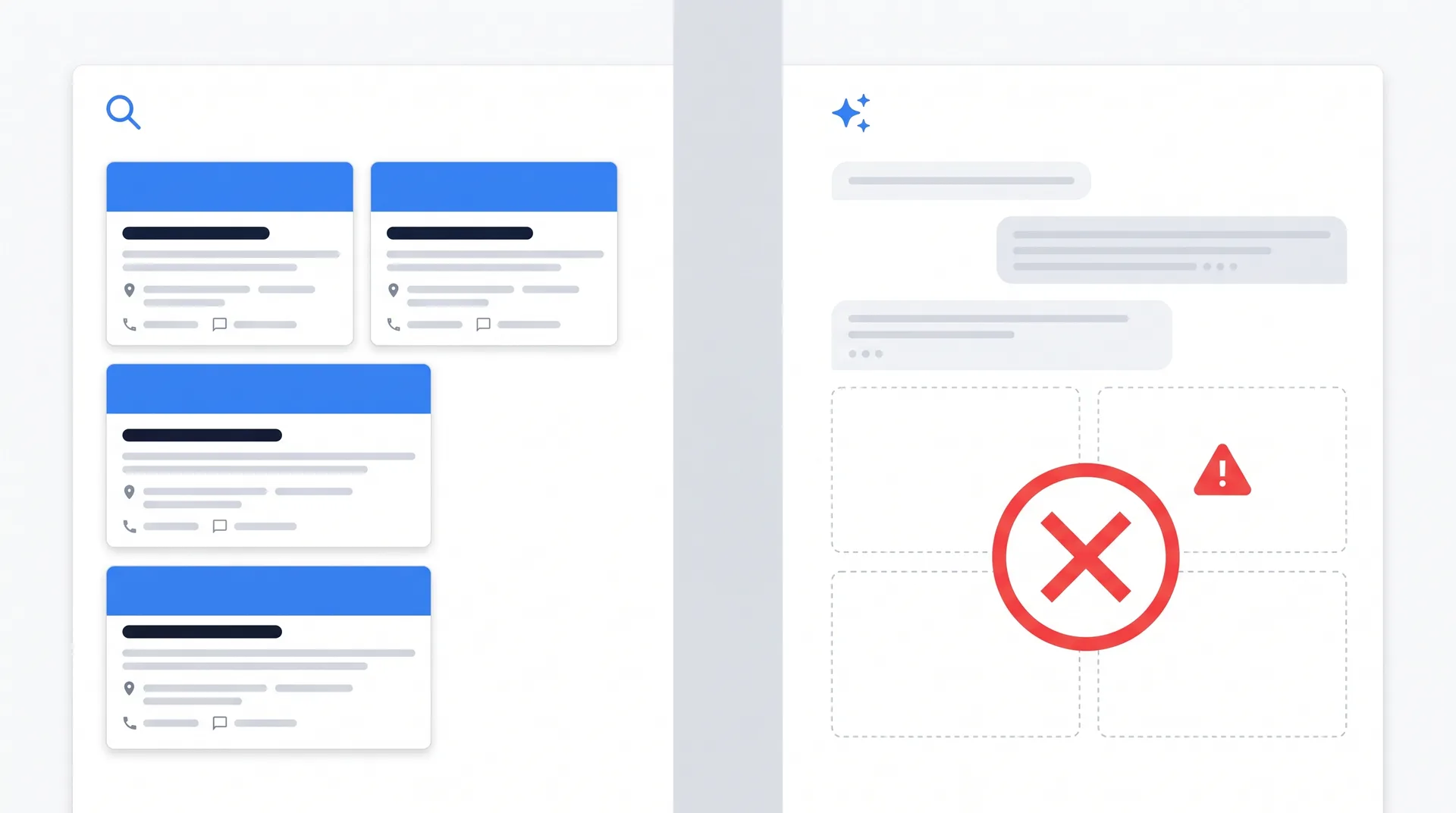
According to a study by Search Engine Land, as of January 2026, 37% of consumers start searches with AI. That's not replacing traditional search, but it is changing how customers discover brands and products. And if you're not visible in AI search, you're handing a third of your potential customers to competitors who figured this out six months ago.
Understanding How AI Search Actually Works (And Why It's Different)
Google crawls your site, indexes your pages, and ranks them based on keywords, backlinks, and user signals. You know this. You've probably spent years optimizing for it.
AI search engines don't work that way.
ChatGPT, Gemini, and Perplexity use large language models that retrieve information based on context, structure, and citation-worthiness. They don't rank pages. They extract answers. And if your content isn't formatted for extraction, you're invisible.
Traditional SEO
Crawls pages, indexes keywords, ranks based on backlinks and user signals. You compete for position 1-10.
AI Search
Extracts structured answers, prioritizes citation-worthy content, and recommends 1-3 sources max. You either show up or you don't.
Google's Goal
Send users to the best pages that match their query. Traffic flows to websites.
AI's Goal
Answer the query directly without sending users anywhere. Traffic stays inside the AI interface.
Gartner predicts that 40% of B2B queries will be satisfied inside an answer engine by 2026. Microsoft revealed at Build 2024 that Copilot's click-through rate on cited answers is 6× higher than classic organic links. That's not a small shift. That's a fundamental change in how digital visibility works.
The difference between being indexed and being recommended is everything. Google might index 10,000 pages on your topic. ChatGPT will recommend 3. Maybe.
The 3 Critical Reasons ChatGPT Doesn't Recommend You
I've audited hundreds of websites for AI visibility. The same three problems show up every single time.
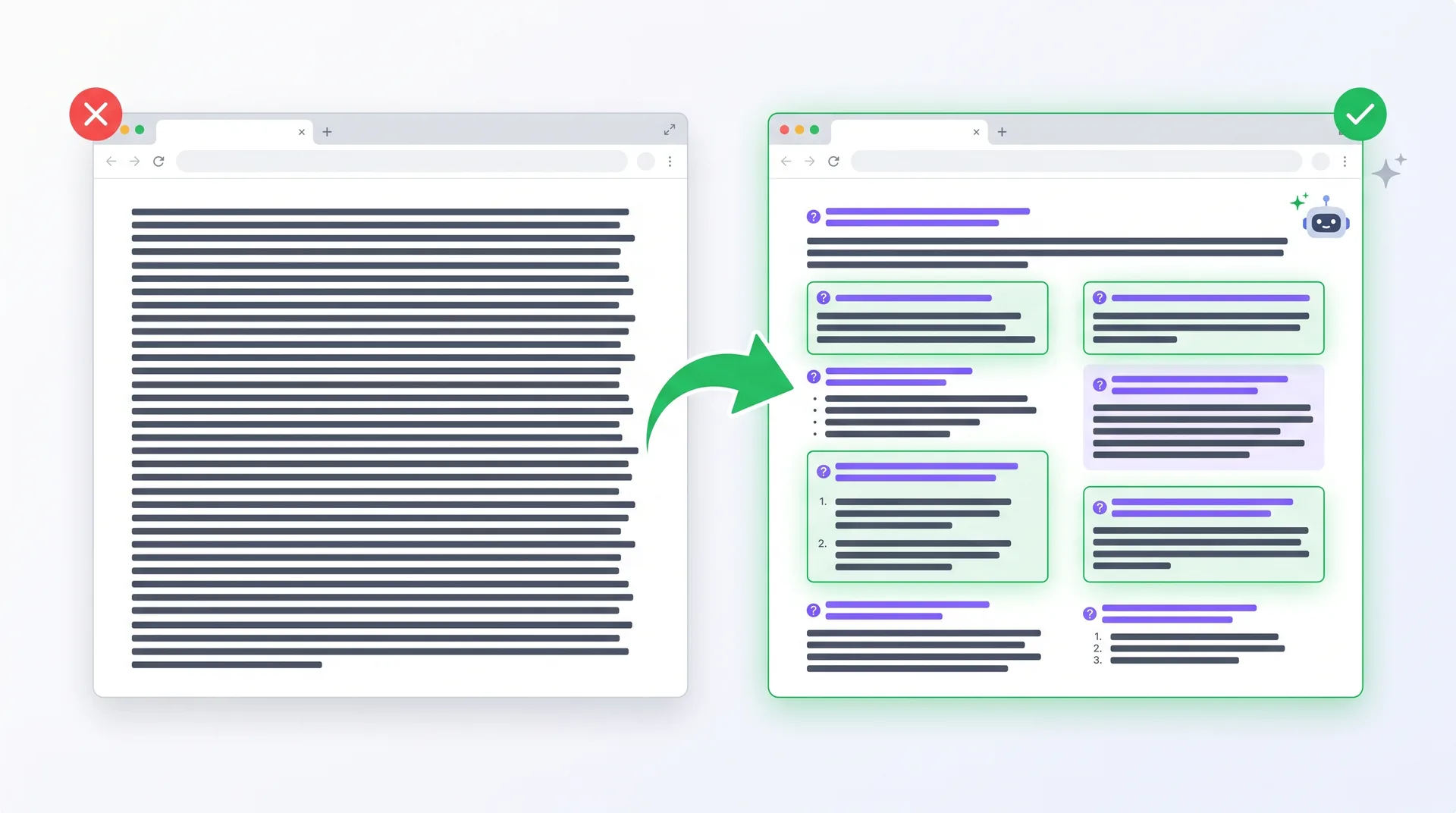
Your content isn't structured in Q&A format. AI engines look for clear question-answer pairs under 300 characters. Most business websites have long-form blog posts, service pages with marketing copy, and product descriptions that read like sales pitches. None of that is optimized for AI extraction.
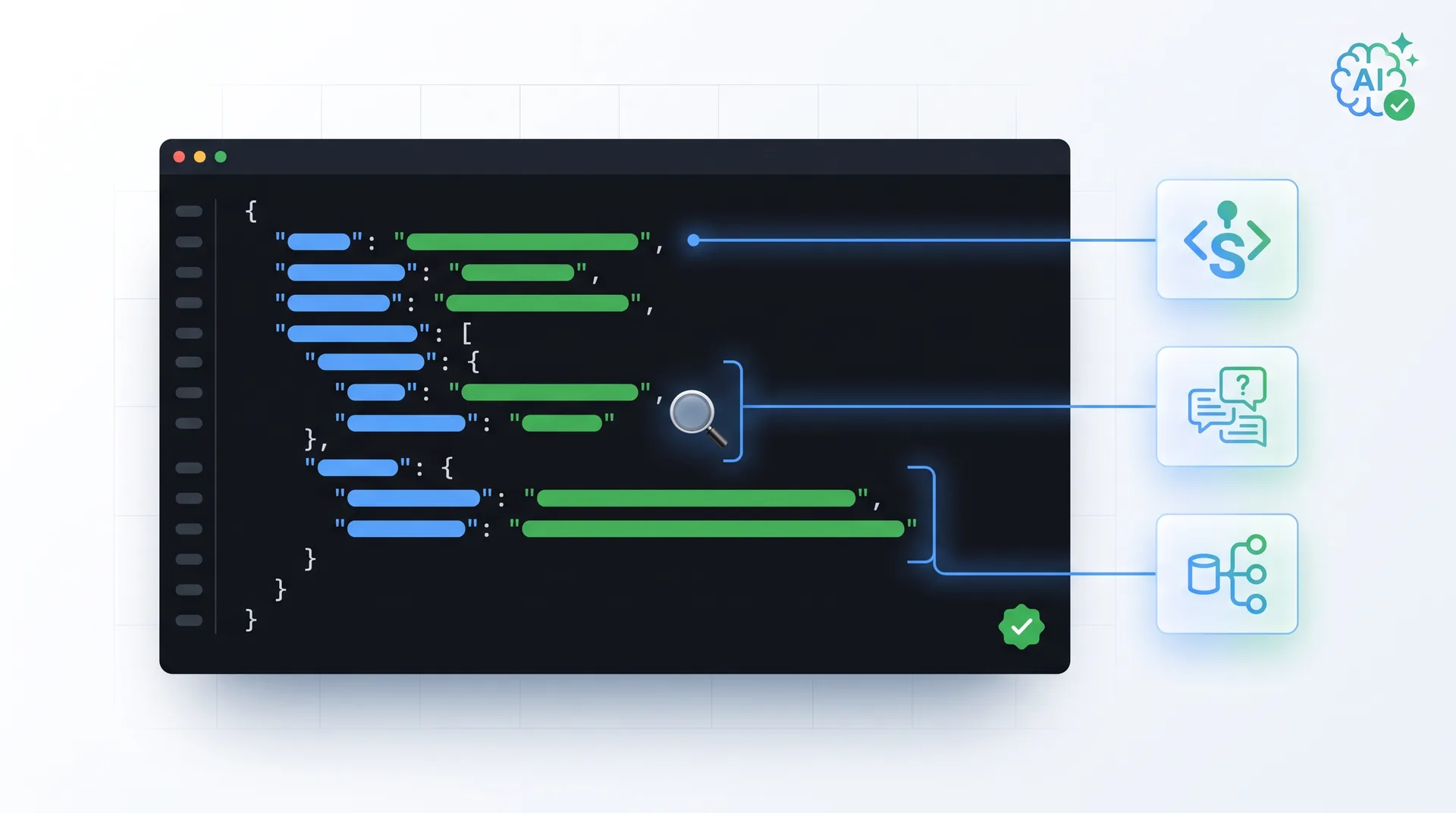
You're missing schema markup. FAQPage schema, HowTo schema, and structured data tell AI engines exactly what your content is about and how to cite it. Without it, you're asking ChatGPT to guess. It won't.
Your content lacks transparent citations. AI platforms reward content that cites sources with live URLs. If you make claims without backing them up, you're not citation-worthy. And if you're not citation-worthy, you don't get recommended.
But here's the fourth reason nobody talks about: your content is too promotional.
AI search engines prioritize helpful, informative content. If your service page reads like a sales pitch, ChatGPT will skip it. If your blog post is keyword-stuffed and shallow, Gemini won't cite it. The brands winning in AI search are the ones creating genuinely valuable content that answers real questions with real data.
Common AI Search Optimization Questions
What is the difference between SEO and AI search optimization?
Traditional SEO optimizes for keyword rankings on search engine results pages. AI search optimization (GEO) structures content so AI engines can extract and cite it directly in conversational answers. SEO gets you traffic. GEO gets you recommendations.
How long does it take to rank in AI search results like ChatGPT?
It depends on how fast AI platforms re-crawl and update their training data. Some brands see results in weeks if they implement proper schema markup and structured content. Others take months. The key is getting indexed correctly first, then testing regularly to see if you're showing up in AI recommendations.
Do I need to abandon traditional SEO for AI search optimization?
No. Traditional SEO and AI search optimization work together. Many of the same principles apply: authoritative content, proper structure, and user-focused answers. The difference is in formatting and schema implementation. You should be doing both.
What schema markup is most important for AI search visibility?
FAQPage and HowTo schema are the most critical for AI visibility. These tell AI engines exactly how to extract and cite your content. Product schema, Review schema, and Organization schema also help, but start with FAQPage if you're prioritizing AI search optimization.
How can I test if ChatGPT is recommending my business?
Ask it. Seriously. Query ChatGPT, Gemini, and Perplexity with the same questions your customers would ask. See if your brand shows up in the answers or citations. Do this weekly and track which content gets cited. That's your baseline for measuring AI visibility.
What content formats work best for generative engine optimization?
Short Q&A blocks under 300 characters, structured with clear headings and subheadings. Include context words like 'price,' 'timeline,' 'ROI,' and 'risk' in your answers. Embed your brand name early in the response. Use natural language that mirrors how people actually ask questions.
Can small businesses compete in AI search against larger brands?
Yes. AI search is less about domain authority and more about content structure and citation-worthiness. A small business with properly structured, helpful content can outrank a Fortune 500 company that hasn't optimized for AI visibility. The window is open right now.
Generative Engine Optimization (GEO): The New Framework for AI Visibility
Generative Engine Optimization is the evolution of SEO. It's not a replacement. It's the next layer.
GEO is how you optimize content specifically for AI-driven search engines like ChatGPT, Gemini, and Perplexity. It ensures your brand shows up when AI platforms answer purchase-intent queries. And it's built on three core layers.
Layer 1: Structured Content
Break evergreen content into Q&A blocks under 300 characters. Front-load context words. Embed your brand early in answers.
Layer 2: Schema & Citations
Add FAQPage and HowTo schema to every page. Footnote statistics with live URLs. Follow Google's AI Overviews markup guidelines.
Layer 3: Testing & Feedback
Query AI engines weekly. Track citation frequency. Re-submit updated pages in Search Console for faster re-crawl.
Most businesses skip Layer 3 entirely. They implement schema, restructure content, and then never test if it's actually working. That's like launching a Google Ads campaign and never checking if anyone clicked.
You have to test. Ask ChatGPT the same questions your customers ask. See if your brand shows up. If it doesn't, adjust your content and test again. This is not a one-time optimization. It's an ongoing process.
AI Search Optimization Strategy #1: Structure Content for Machine Reading
AI engines don't read like humans. They scan for structure. Clear headings. Short answers. Context words that signal relevance.
Here's what that looks like in practice:
Content Structuring Checklist
Break long-form content into question-answer pairs under 300 characters each
Use natural language that mirrors how people actually ask questions
Front-load context words: price, timeline, ROI, risk, benefit, cost
Embed your brand name in the first sentence of each answer
Include specific data points, not vague claims
Organize with clear H2 and H3 headings that AI can parse
Bad example: 'Our agency provides comprehensive SEO services designed to help businesses improve their online visibility through strategic optimization techniques.'
Good example: 'TechDevs delivers SEO audits in 7 days with a guaranteed 30% traffic increase in 90 days. We've served 250+ clients and generated $35M+ in revenue.'
See the difference? The second one has a brand name, specific numbers, a clear timeline, and a measurable outcome. That's what AI engines look for.
AI doesn't care about your marketing copy. It cares about whether your content can answer a user's question better than the other 10,000 pages on the same topic.
Prithvi Jadwani, TechDevs
AI Search Optimization Strategy #2: Implement Schema Markup That AI Understands
Schema markup is how you tell AI engines what your content is about. Without it, ChatGPT has to guess. And it usually guesses wrong.
The two most important schema types for AI visibility are FAQPage and HowTo. These tell AI platforms exactly how to extract and cite your content. If you're not using them, you're invisible.
FAQPage schema structures your Q&A content so AI engines can pull direct answers and attribute them to your site
HowTo schema formats step-by-step guides in a way that AI platforms prioritize for instructional queries
Product schema helps AI recommend your products when users ask shopping-related questions
Review schema adds credibility signals that increase your citation-worthiness
Organization schema establishes your brand identity and authority in AI knowledge graphs
But here's what most people get wrong: they add schema markup and stop there. They don't test it. They don't validate it. They don't check if AI engines are actually reading it.
And one more thing: include transparent citations with live URLs for every statistic and claim you make. AI platforms reward content that backs up its claims with real sources. If you're making bold statements without proof, you're not getting cited.
AI Search Optimization Strategy #3: Build Authority Through Citation-Worthy Content
AI engines don't cite mediocre content. They cite authoritative, well-researched, original content that provides real value.
That means you can't just rewrite what everyone else is saying. You have to create content that AI platforms want to cite.
Pros
Original research with real data and named sources
Specific examples with measurable outcomes
Transparent citations and footnotes for every claim
Expert insights that challenge conventional thinking
Regularly updated to maintain freshness signals
Cons
Regurgitated information from other blogs
Vague claims without data or proof
Keyword-stuffed content that reads like AI slop
Promotional copy disguised as helpful content
Outdated information that hasn't been refreshed in years
Think of it this way: if you were ChatGPT and you had to recommend one source to answer a user's question, would you recommend your own content? If the answer is no, fix it.
What AI Engines Cite
Content with original data, specific examples, transparent sources, expert insights, and regular updates. Helpful, not promotional.
What AI Engines Ignore
Thin content, keyword stuffing, vague claims, promotional copy, outdated information, and anything that reads like it was written by AI.
Testing and Measuring Your AI Search Optimization Success
You can't improve what you don't measure. And most businesses have no idea if their AI search optimization is actually working.
Here's how to test it:
AI Visibility Testing Checklist
Query ChatGPT, Gemini, and Perplexity weekly with the same questions your customers ask
Track which content gets cited and which gets ignored
Monitor knowledge-graph feedback to see how AI interprets your brand
Use AI governance guardrails to ensure content quality and compliance
Adjust your Q&A formatting based on what generates the most visibility
Re-submit updated pages in Google Search Console for faster re-crawl
I do this every single week for TechDevs. I ask ChatGPT and Gemini the same 10 questions my ideal clients would ask. I track which answers cite us and which don't. Then I adjust our content based on what's working.
This isn't optional. If you're not testing, you're guessing. And guessing doesn't work in AI search.
Getting Started: Your 30-Day AI Search Optimization Action Plan
You don't need to overhaul your entire website overnight. Start with the pages that matter most.
30-Day GEO Action Plan
Week 1: Audit your top 10 pages for AI visibility. Query ChatGPT to see if any of them show up in recommendations.
Week 2: Implement FAQPage and HowTo schema on your highest-traffic pages first.
Week 3: Reformat your best-performing blog posts into Q&A structure with sub-300-character answers.
Week 4: Test your changes. Query AI platforms again and track which content is now getting cited.
And here's the reality: most businesses won't do this. They'll read this post, nod along, and then go back to doing traditional SEO the way they've always done it.
That's fine. It means less competition for the brands that actually take action.
If you want help with this, we do it for clients every day. We've built an entire GEO service around making brands visible in AI search. But whether you work with us or do it yourself, the key is to start now.
Ready to Rank on AI Search?
We've helped 250+ brands optimize for AI visibility. Book a discovery call and we'll show you exactly where your business is invisible to ChatGPT, Gemini, and Perplexity right now. Then we'll fix it.