The Ultimate Framework to Dominate AI Search Rankings for Your Hospitality Brand in 2026
Master AI search optimization for your hospitality brand. Discover proven strategies to rank #1 in AI-powered searches in 2026. Get the complete framework now.
 Written byPrithvi Jadwani
Table of contents
Summarize this article with AI
TL;DR
Travelers don't Google hotels anymore. They ask ChatGPT, Perplexity, and Google's AI Overviews. And if your hotel isn't structured, verified, and trusted across the web, you won't be recommended. AI search readiness is the new baseline for direct bookings in 2026.
- AI Engines Are the New Front Desk. Conversational queries like 'best family hotel near the airport' now go to AI, not traditional search. If AI doesn't know you, guests won't either.
- Trust Signals Win Recommendations. AI cross-references structured data, reviews, and reputation patterns across the web. Inconsistent info = invisible brand.
- Schema Markup Is Non-Negotiable. Hotels that implement proper structured data get surfaced in AI answers. Hotels that don't get skipped.
- Natural Language Content Beats Keywords. AI understands intent, not just keywords. Write for real questions travelers ask, not SEO formulas from 2015.
- The Window Is Closing Fast. Early movers in AI search optimization are locking in visibility now. By Q3 2026, catching up will be exponentially harder.
Why AI Search Optimization for Hospitality Is Your 2026 Survival Strategy
Where should I stay tonight?
That question used to send travelers to Google. Now it goes to ChatGPT, Perplexity, or Google's AI Overviews. And the answer isn't a list of 10 blue links. It's a single, confident recommendation.
If your hotel isn't that recommendation, you don't exist.
Hospitality brands are feeling this shift faster than any other industry. Trust, proximity, and experience drive nearly every booking decision. And AI engines evaluate all three before they ever mention your name.
Traditional search gave you a fighting chance if you ranked on page one. AI search gives you one shot. Either you're the answer, or you're not in the conversation.
How AI-Powered Search Engines Actually Choose Which Hotels to Recommend
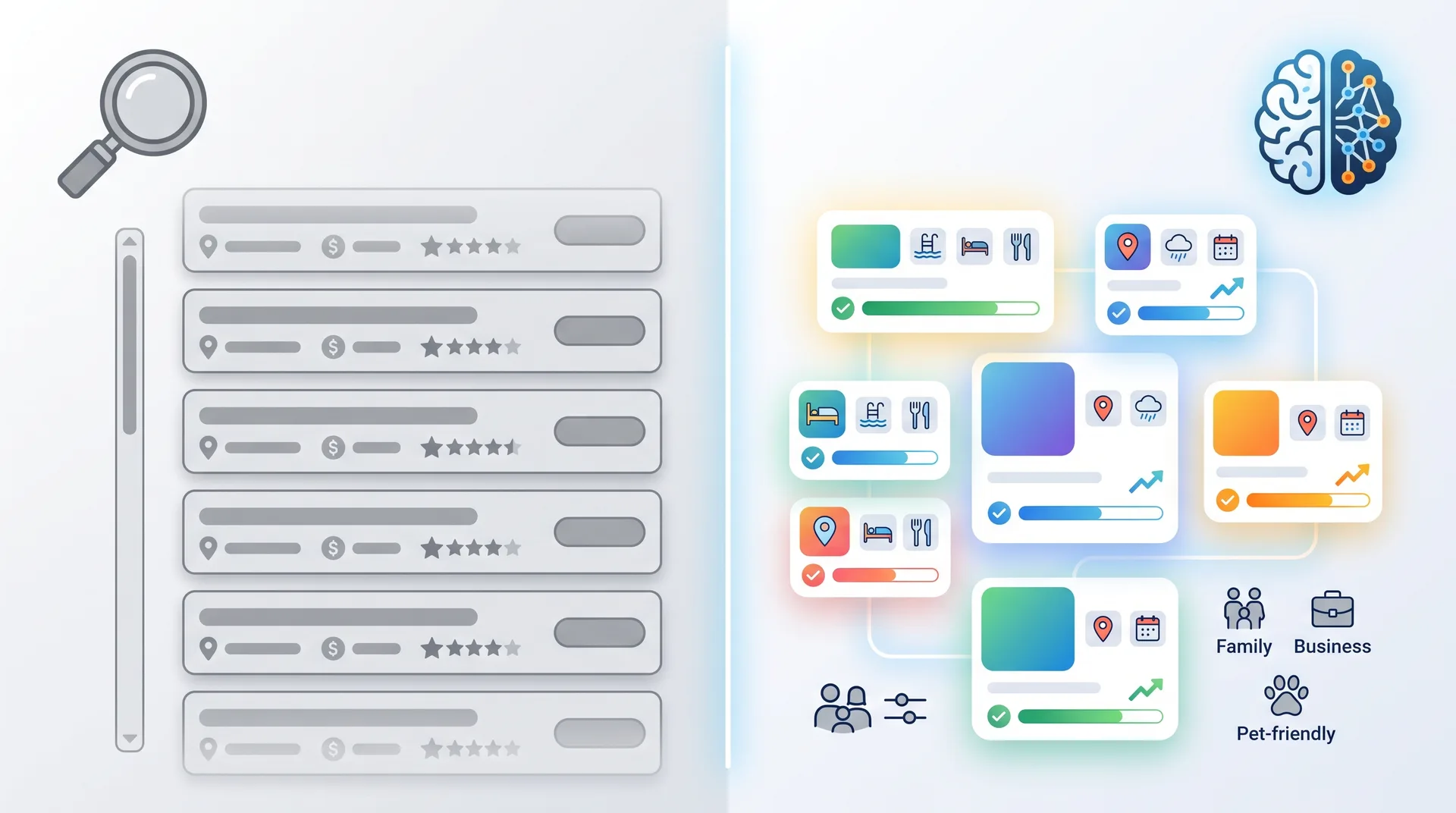
AI doesn't rank hotels the way Google used to. It evaluates thousands of signals to decide which brands deserve to be recommended. And it does this in milliseconds.
When someone asks 'best hotel near the airport' or 'family-friendly dining in Austin,' AI engines verify information, cross-reference structured data, and scan reputation patterns across the web. They're looking for consistency, completeness, and trust.
Here's what matters: location-specific data, time-sensitive availability, and reputation-driven factors. This aligns perfectly with how travelers make booking decisions. But most hotels aren't structured for AI to understand any of it.
Structured Data Verification
AI checks if your business information is consistent across Google, Yelp, TripAdvisor, and your own website. Mismatches = red flags.
Reputation Pattern Analysis
AI scans review sentiment, response rates, and mention frequency to gauge trust. Brands with active engagement win.
Intent Matching
AI interprets conversational queries and matches them to content that answers real questions, not just keyword-stuffed pages.
Real-Time Relevance
AI prioritizes time-sensitive factors like availability, seasonal offerings, and current promotions over static content.
The algorithm isn't a mystery. It's just ruthlessly efficient. If your hotel's data is incomplete, inconsistent, or buried in unstructured content, AI skips you. Simple as that.
Common AI Search Optimization Questions
What is AI search optimization and how is it different from traditional SEO?
Traditional SEO optimized for keyword rankings on search engine results pages. AI search optimization structures your brand data so AI engines can confidently recommend you in conversational answers. It's less about ranking #1 and more about being the only answer.
Which AI search engines should hospitality brands prioritize in 2026?
ChatGPT, Google's AI Overviews, Perplexity, and Google Gemini are the big four. But the real priority is making sure your data is structured and verified across all platforms, because AI engines cross-reference multiple sources before making recommendations.
How long does it take to see results from AI search optimization?
If you implement proper schema markup and fix data inconsistencies today, AI engines can start surfacing your brand within 2-4 weeks. But building reputation signals and content depth takes 3-6 months of consistent effort.
Do I need to abandon traditional SEO to focus on AI search?
No. Traditional SEO still drives traffic. But AI search is where discovery happens now. The best strategy is to layer AI optimization on top of solid SEO fundamentals. They complement each other.
What schema markup is most important for hotels and restaurants?
Hotel schema, Restaurant schema, and LocalBusiness schema are the foundation. Add Review schema, FAQ schema, and Event schema for specific pages. The goal is to give AI engines structured data they can parse and trust.
How can small independent hotels compete with large chains in AI search?
Chains have brand recognition, but independent hotels can win on local expertise, unique experiences, and personalized service. Focus on answering hyper-local queries, building strong review profiles, and creating content that showcases what makes you different.
What tools can help automate AI search optimization for hospitality brands?
Schema markup generators, review monitoring platforms, and AI auditing tools can automate the heavy lifting. But the real work is creating natural language content and maintaining consistent data across all platforms. Automation helps, but strategy still matters.
The 5 Core Pillars of AI Search Readiness for Hospitality Brands
Most hotels think AI search optimization is about keywords. It's not. It's about building a discovery infrastructure that AI engines can trust and recommend.
Here are the five pillars that separate hotels AI recommends from hotels AI ignores.
Pillar 1: Structured Data & Schema Markup
AI engines can't recommend what they can't understand. Schema markup translates your website into a language AI can parse. Without it, you're invisible.
Pillar 2: Natural Language Content
AI interprets conversational queries. Your content needs to answer real questions travelers ask, not just rank for keywords. Think FAQ sections, detailed amenity descriptions, and location-specific guides.
Pillar 3: Multi-Platform Reputation Signals
AI cross-references reviews, mentions, and sentiment across Google, TripAdvisor, Yelp, and OTAs. Inconsistent or missing data tanks your credibility.
Pillar 4: Complete, Verified Business Information
NAP consistency (Name, Address, Phone) across all platforms is non-negotiable. AI flags mismatches as red flags. Get this wrong and you're out.
Pillar 5: Mobile-First, Fast-Loading UX
AI prioritizes user experience signals. Slow sites, broken mobile layouts, and poor navigation hurt your chances of being recommended.
These pillars aren't optional. They're the baseline. And most hotels are failing at least three of them.
AI Search Readiness Audit Checklist
Implement Hotel or Restaurant schema markup on all relevant pages
Verify NAP consistency across Google, Yelp, TripAdvisor, and OTAs
Create FAQ sections that answer conversational traveler queries
Optimize page speed to under 2 seconds on mobile
Actively respond to reviews on all major platforms
Build location-specific content for 'near me' searches
Set up monitoring for brand mentions and sentiment

Optimizing Your Hotel Website Content for AI Search in 2026
Keyword stuffing is dead. AI doesn't care about keyword density. It cares about answering real questions.
Travelers now ask full questions. 'Is this hotel pet-friendly?' 'Does it offer senior discounts?' 'What's the onsite dining like?' Your content needs to answer these questions naturally, not force keywords into awkward sentences.
Here's what works: conversational content that mirrors how people actually talk. Long-tail queries like 'pet-friendly hotels near downtown Austin' instead of 'Austin hotels.' Detailed amenity descriptions that pre-answer objections. FAQ sections that address booking processes, policies, and common concerns.
Answer specific questions directly: Don't make travelers hunt for pet policies or parking details. Put it front and center.
Use natural language: Write like you're talking to a guest at the front desk, not optimizing for a 2015 SEO checklist.
Incorporate long-tail keywords naturally: 'Family-friendly hotel with pool near airport' beats 'hotel airport' every time.
Create location-specific content: Neighborhood guides, local attractions, and proximity to landmarks help AI match you to 'near me' searches.
Structure content for scanners: Use headings, bullet points, and short paragraphs so AI (and humans) can quickly extract answers.
The goal isn't to rank for keywords. It's to be the most complete, trustworthy, and relevant answer to a traveler's question. Do that, and AI will recommend you.
How do I optimize for voice search?
Voice search queries are longer and more conversational. Optimize by creating content that answers full questions naturally. Use FAQ schema to help AI engines extract and surface your answers directly.
Should I create separate pages for each amenity?
Only if the amenity is a major booking driver (like a spa, rooftop bar, or pet-friendly policy). Otherwise, create one comprehensive amenities page with clear headings and structured data.
How often should I update my website content?
Update time-sensitive content (seasonal offers, events, availability) monthly. Update evergreen content (amenities, policies, location guides) quarterly or when changes occur. Fresh content signals relevance to AI.
Technical AI Search Optimization: Schema, Speed, and Structure
Content gets you in the conversation. But technical optimization is what makes AI engines trust you enough to recommend you.
Schema markup is the foundation. It's how you tell AI engines 'this is a hotel, here's the address, here are the amenities, here's the price range.' Without it, AI has to guess. And AI doesn't guess, it skips.
But schema alone won't save you if your site is slow, broken on mobile, or structured like a maze. AI engines prioritize user experience signals. If your site fails on speed or mobile usability, you're out.
Technical AI Search Optimization Checklist
Implement Hotel, Restaurant, or LocalBusiness schema markup
Add Review schema to aggregate and display ratings
Use FAQ schema for common traveler questions
Optimize page speed to under 2 seconds on mobile
Ensure mobile-first responsive design
Create XML sitemap and submit to Google Search Console
Use proper heading hierarchy (H1, H2, H3) for semantic structure
Implement geo-targeted schema for local search signals
Speed matters more than most hotels realize. A 1-second delay in page load time can tank your conversion rate by 7%. And AI engines know this. They won't recommend slow sites because it hurts the user experience.
Schema Markup
Structured data that tells AI engines exactly what your business is, where it's located, and what it offers. This is non-negotiable.
Page Speed Optimization
Compress images, minify code, and use a CDN. AI engines prioritize fast sites because users do.
Mobile-First Design
Most travelers search on mobile. If your site doesn't work perfectly on a phone, you're invisible to AI.
Semantic HTML Structure
Use proper heading tags, alt text on images, and descriptive URLs. AI relies on semantic structure to understand your content.
Building Multi-Platform Reputation Signals That AI Engines Trust
AI engines don't just read your website. They cross-reference everything about your brand across the web. Reviews, mentions, ratings, social signals, and business listings all feed into the trust algorithm.
If your NAP (Name, Address, Phone) is inconsistent across Google, Yelp, TripAdvisor, and OTAs, AI flags it as a red flag. If you have 4.8 stars on Google but 3.2 on TripAdvisor, AI notices. If you don't respond to reviews, AI interprets that as low engagement.
Reputation management isn't optional anymore. It's the difference between being recommended and being ignored.
Maintain consistent NAP across all platforms: One typo in your address can tank your AI visibility. Audit everything.
Actively manage reviews on Google, TripAdvisor, Yelp, and OTAs: Respond to reviews (good and bad) within 48 hours. AI tracks response rates.
Earn mentions on authoritative travel sites: Guest posts, partnerships, and PR placements build trust signals AI can verify.
Monitor brand sentiment across the web: Set up alerts for mentions and track sentiment trends. Negative patterns hurt your AI ranking.
Encourage guests to leave reviews: More reviews = stronger trust signals. But never buy fake reviews. AI detects patterns and penalizes manipulation.
Pros
Responding to every review (even negative ones) within 48 hours
Encouraging satisfied guests to leave reviews on multiple platforms
Partnering with local tourism boards and travel bloggers for mentions
Monitoring and fixing NAP inconsistencies across all listings
Cons
Ignoring negative reviews or responding defensively
Buying fake reviews or incentivizing positive reviews with discounts
Having different business hours or phone numbers on different platforms
Letting review profiles go stale with no recent activity
Think of reputation management as building a web of trust. The more consistent, verified, and engaged your brand appears across platforms, the more confident AI engines are in recommending you.

Personalization and Local AI Search Optimization Strategies
AI search is hyper-local. When someone asks 'best hotel near me,' AI doesn't just look at your address. It evaluates proximity, availability, and relevance to the user's specific context.
This is where personalization and local optimization overlap. You need to create content that answers location-specific queries, time-sensitive needs, and preference-based searches.
Location-Specific Landing Pages
Create pages optimized for 'near me' and proximity searches. 'Hotels near Austin Airport' beats a generic homepage every time.
Time-Sensitive Content
Promote weekend getaways, last-minute bookings, and seasonal offers. AI prioritizes fresh, relevant content over static pages.
Neighborhood Guides
Write detailed guides about local attractions, restaurants, and events. AI surfaces this content when travelers ask 'what to do near [hotel]'.
Geo-Targeted Schema Markup
Use GeoCoordinates and LocalBusiness schema to strengthen local search signals. This helps AI match you to proximity queries.
Local partnerships matter too. If you sponsor local events, partner with nearby restaurants, or collaborate with tourism boards, make sure that's documented on your website and in structured data. AI picks up on these signals.
Measuring Success: AI Search Optimization KPIs and Tools for 2026
You can't optimize what you don't measure. But traditional SEO metrics (keyword rankings, backlinks, domain authority) don't tell you much about AI search performance.
Here's what matters now: AI engine visibility, brand mention frequency in AI responses, direct traffic from AI-generated recommendations, and conversational query rankings.
AI Search Optimization KPIs to Track
AI engine visibility: Are you being recommended in ChatGPT, Perplexity, and Google AI Overviews?
Direct traffic increases: Track spikes in direct visits after AI mentions
Brand mention frequency: How often does your brand appear in AI-generated answers?
Conversational query rankings: Track rankings for full-question queries, not just keywords
Review response rate and sentiment trends: AI tracks engagement and sentiment
Schema markup validation: Use Google's Rich Results Test to verify implementation
Page speed and mobile usability scores: Track Core Web Vitals in Google Search Console
Tools like Google Search Console, schema validators, and AI auditing platforms can automate most of this tracking. But the real insight comes from manually testing AI engines with your target queries and seeing if your brand shows up.
Ready to Own the AI Search Layer?
Most hospitality brands are waiting to see what happens. The smart ones are moving now. We help hotels and restaurants build AI search readiness from the ground up. Structured data, reputation management, content optimization, and technical SEO that actually works.
Let's talk about getting your brand recommended by AI engines before your competitors do.