The Ultimate Brand Recall Framework That Makes Your Brand Unforgettable
Master the brand recall framework with proven strategies to make your brand unforgettable. Learn psychological triggers and tactics that boost recognition.
 Written byPrithvi Jadwani
Table of contents
Summarize this article with AI
TL;DR
Most brands obsess over logo design and color palettes while ignoring the actual science of how humans remember things. The brain processes images in 13 milliseconds but meaning takes sustained attention. If your brand system exceeds cognitive capacity, customers disengage or misremember your key associations. Building unforgettable brand memory isn't about aesthetics. It's about applying cognitive psychology, emotional contagion research, and neural pathway science to every touchpoint.
- Cognitive Load is Everything. Working memory holds only 3-4 elements at once. Distinctive elements are remembered 70% more effectively.
- Emotions Drive Decisions. Emotionally connected customers have 306% higher lifetime value. Brands triggering specific emotions are 3x more likely to be recommended.
- First and Last Touchpoints Win. Serial position effect proves first and last brand interactions have 2x recall compared to middle touchpoints.
- Consistency Builds Trust. Consistent emotional messaging increases trust perception by 74%. Most brands fail here.
- Measure or Fail. Track aided vs unaided recall, top-of-mind awareness, and correlation with business outcomes.
What Is Brand Recall and Why Your Business Needs a Framework
When someone needs a tissue, they ask for a Kleenex. When they need to search something online, they Google it. That's not luck. That's brand recall working at the highest level.
Brand recall is the likelihood customers remember your brand either spontaneously or with a prompt. It's not just logo recognition. It's being the first name that comes to mind when someone thinks about your product category.
There are two types:
Aided brand recall: Someone asks, 'Do you know Microsoft?' You're being helped to remember.
Unaided brand recall: Someone asks, 'What's your favorite soft drink?' You say Pepsi without prompting. That's the gold standard.
Why does this matter so much? Because emotionally connected customers have a 306% higher lifetime value. Brands that trigger specific emotions are 3x more likely to be recommended. And most companies are leaving this on the table because they treat branding like an art project instead of a science experiment.
A brand recall framework is a systematic approach rooted in psychology, not guesswork. It applies behavioral science, cognitive psychology, and neuroscience research to every brand decision. Instead of asking 'Does this look good?' you ask 'Will this create lasting neural connections with our target audience?'
The Science Behind Memorable Brands: Psychology Meets Strategy
Your brain is not a hard drive. It doesn't store everything you see. It filters ruthlessly.
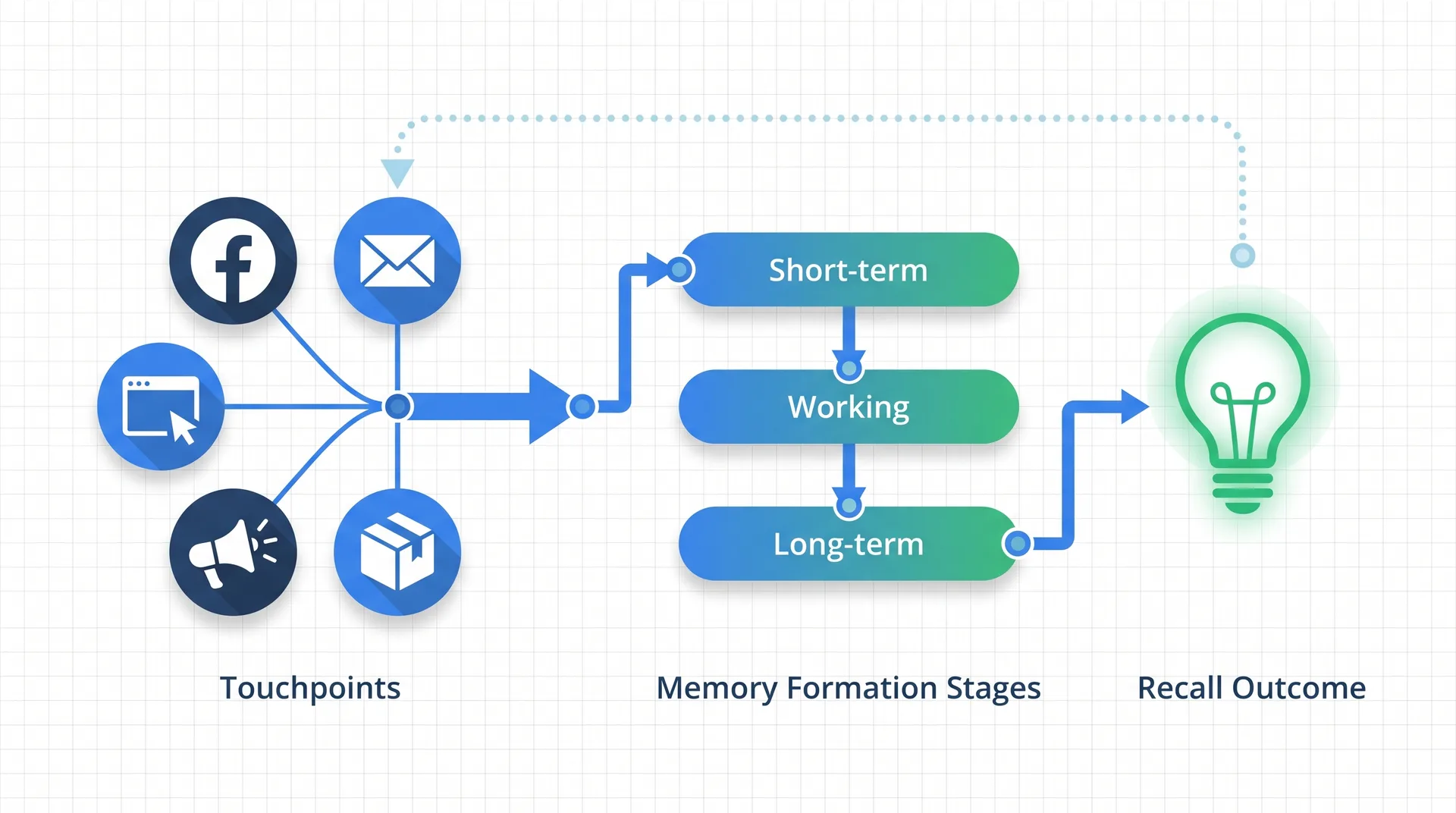
Cognitive load theory shows working memory can only hold 3-4 elements at once. When your brand system throws 7 different messages, 5 colors, and 3 taglines at someone, their brain just gives up. They remember nothing.
MIT researchers found the brain processes images in as little as 13 milliseconds. But here's the catch: extracting meaning requires sustained attention. Fast recognition doesn't equal memory formation. You need both immediate visual impact and semantic depth.
The Von Restorff effect proves distinctive elements are remembered 70% more effectively than generic ones. If your brand looks like everyone else in your category, you're fighting an uphill battle against basic neuroscience.
But cognitive science is only half the story. Emotional contagion research reveals something most brands completely miss: fMRI scans show brands activate the same neural pathways as human relationships.
Antonio Damasio's somatic marker hypothesis demonstrates emotions guide decision-making more powerfully than rational analysis. People don't choose brands based on spreadsheets. They choose based on how those brands make them feel.
Brands that trigger specific emotions are 3x more likely to be recommended. Consistency in emotional messaging increases trust perception by 74%.
Journal of Consumer Psychology
This is why archetypal branding works. Carl Jung's research on universal symbols and narratives taps into patterns already wired into human psychology. You're not creating something new. You're activating something that already exists in your customer's brain.
Key Psychology Principles for Brand Recall
What is cognitive load theory and why does it matter?
Cognitive load theory shows working memory can only process 3-4 elements simultaneously. When brands exceed this capacity with complex messaging, customers disengage or misremember key associations. Simplicity isn't dumbing down. It's respecting how the brain actually works.
How does the Von Restorff effect improve brand memory?
The Von Restorff effect proves distinctive elements are remembered 70% more effectively than generic ones. If your brand looks identical to competitors, you're fighting basic neuroscience. Strategic differentiation isn't about being weird. It's about being memorable.
What role do emotions play in brand recall?
fMRI research shows brands activate the same neural pathways as human relationships. Emotions guide decisions more powerfully than rational analysis. Emotionally connected customers have 306% higher lifetime value and brands triggering specific emotions are 3x more likely to be recommended.
What is the serial position effect?
The serial position effect proves first and last brand touchpoints have 2x recall compared to middle interactions. This means your onboarding experience and your last customer interaction are disproportionately important for memory formation.
How fast does the brain process brand visuals?
MIT research found the brain processes images in as little as 13 milliseconds. However, meaning extraction requires sustained attention. Fast recognition doesn't equal memory formation. You need both immediate visual impact and semantic depth for lasting recall.
The 5 Pillars of an Effective Brand Recall Framework
Most brand guidelines focus on logo usage rules and color hex codes. That's not a framework. That's a style guide.
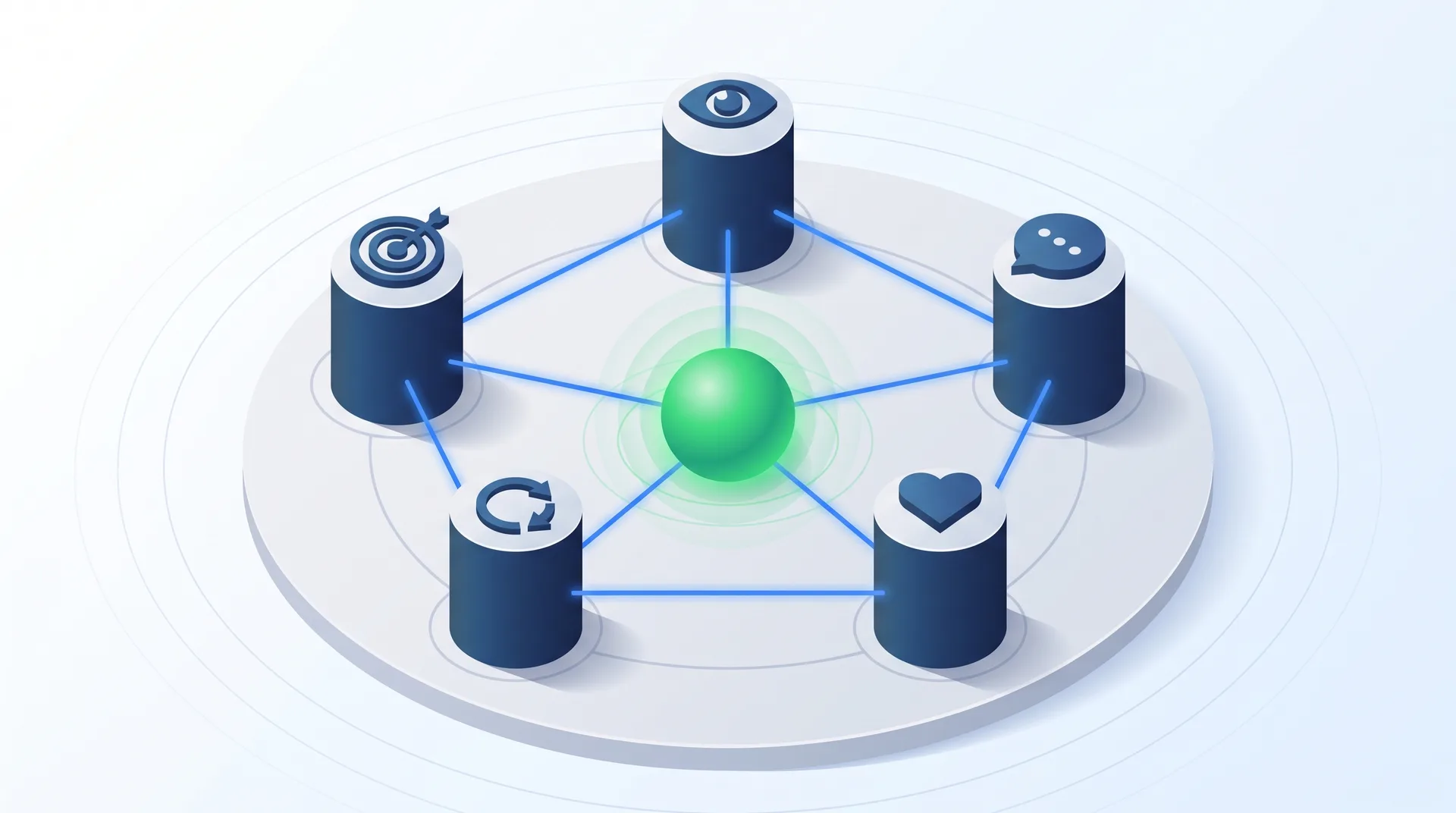
A real brand recall framework is built on five psychological pillars that work together to create lasting memory formation:
Visual Distinctiveness
Research shows 90% of snap judgments about products are based on color alone. But distinctiveness isn't just about picking a color. It's about owning visual territory your competitors aren't using. T-Mobile owns magenta. UPS owns brown. What do you own?
Emotional Consistency
Consistent emotional messaging increases trust by 74%. This doesn't mean every touchpoint feels identical. It means the core emotional promise stays the same whether someone sees your ad, visits your website, or talks to your support team.
Cognitive Simplicity
Working memory holds 3-4 elements max. Your brand needs to be simple enough to remember but distinctive enough to matter. Apple mastered this. Three core values, clean visual system, consistent messaging. No cognitive overload.
Strategic Repetition
The serial position effect shows first and last touchpoints have 2x recall. But you can't just spam people. Strategic repetition means showing up consistently at high-impact moments in your customer's journey, not everywhere all the time.
Sensory Integration
Brands that engage multiple senses create stronger neural connections. Think about Intel's audio logo or the smell of a new Apple product. Sensory branding isn't just for big companies. Even B2B brands can use consistent language patterns, visual rhythms, and interaction design.
Here's what most people get wrong: they think these pillars are separate tactics. They're not. They work together as a system.
Visual distinctiveness gets attention. Emotional consistency builds trust. Cognitive simplicity enables memory formation. Strategic repetition reinforces the connection. Sensory integration makes it stick.
Color psychology matters: 90% of snap judgments are based on color, but you need to own a specific shade in your category
Emotional triggers compound: Brands that maintain consistent emotional messaging see 74% higher trust perception
Simplicity wins: If your brand message can't fit in working memory (3-4 elements), you've already lost
Timing is everything: First and last touchpoints have 2x recall compared to middle interactions
Multi-sensory = multi-dimensional memory: Engaging multiple senses creates stronger, longer-lasting neural pathways
Building Your Brand Recall Framework: Step-by-Step Implementation
Theory is useless without execution. Here's how to actually build a brand recall framework that works.
Step 1: Audit current brand touchpoints and cognitive load
List every place a customer encounters your brand. Website, social media, emails, ads, packaging, customer service, invoices. Everything. Then for each touchpoint, count the number of distinct messages, visual elements, and emotional tones. If any single touchpoint exceeds 3-4 core elements, you're overloading cognitive capacity.
Step 2: Identify your brand's distinctive elements
Using Von Restorff principles, find what makes you genuinely different. Not 'better customer service' or 'quality products.' Everyone claims that. What visual, verbal, or experiential element do you own that competitors don't? If you can't name it immediately, you don't have one yet.
Step 3: Map emotional associations and choose archetypal positioning
What emotion do you want to trigger? Security? Excitement? Belonging? Accomplishment? Pick one primary emotion and one secondary. Then identify which Jungian archetype aligns with that emotional promise. Nike is the Hero. Apple is the Creator. Volvo is the Caregiver. You need to be something specific.
Step 4: Design first and last touchpoint experiences
Remember: first and last interactions have 2x recall. Your onboarding sequence and your offboarding or renewal experience matter more than everything in between. Most brands ignore this and wonder why customers forget them.
Step 5: Create consistency guidelines across all channels
This isn't a logo sheet. It's an emotional consistency playbook. What tone do you use in crisis situations? What visual rhythm appears in every piece of content? What language patterns reinforce your archetype? Document these patterns so anyone on your team can maintain consistency.
Step 6: Implement measurement systems
You can't improve what you don't measure. Set up quarterly brand recall surveys testing both aided and unaided recall. Track share of voice in your category. Monitor how often your brand is mentioned without prompting in customer conversations, reviews, and social media.
Brand Recall Framework Implementation Checklist
Complete cognitive load audit of all brand touchpoints
Identify 1-2 distinctive visual or verbal elements you own
Define primary and secondary emotional triggers
Choose archetypal positioning aligned with emotional promise
Redesign first touchpoint (onboarding) experience
Redesign last touchpoint (renewal/offboarding) experience
Create emotional consistency playbook for team
Set up quarterly aided and unaided recall measurement
Establish baseline metrics for brand recall performance
Leveraging AI and Automation to Strengthen Brand Recall
AI isn't replacing brand strategy. It's making consistent execution actually possible at scale.
I've watched brands spend six figures on brand guidelines that sit in a PDF nobody reads. The problem isn't the strategy. It's execution. You can't manually enforce emotional consistency across 50 customer touchpoints, 12 team members, and 3 time zones.
This is where automation and AI become force multipliers for brand recall:
AI-powered analytics track brand mention patterns: Tools like Brandwatch and Sprinklr monitor how often your brand is mentioned spontaneously vs. prompted across social media, reviews, and forums. This gives you real-time unaided recall data.
Automated messaging maintains emotional consistency: Use AI to analyze customer support tickets, email campaigns, and social responses for emotional tone. Flag anything that breaks your consistency guidelines before it goes live.
Personalization engines that preserve brand identity: Dynamic content doesn't mean random content. AI can personalize messaging for different segments while maintaining your core emotional promise and archetypal positioning.
Chatbots reinforce brand personality: Every automated interaction is a brand touchpoint. Well-configured chatbots don't just answer questions. They reinforce your distinctive language patterns and emotional associations.
Predictive analytics optimize touchpoint timing: Machine learning models can identify the optimal frequency and timing for brand interactions based on individual customer behavior patterns, maximizing the serial position effect.
The key is using AI to scale your framework, not replace it. The psychology stays the same. The execution becomes faster and more consistent.
Pros
Automates consistency enforcement across all touchpoints
Provides real-time data on aided vs unaided brand recall
Scales personalization without losing emotional consistency
Optimizes timing and frequency based on customer behavior
Reduces human error in brand guideline implementation
Cons
Can't replace strategic thinking about emotional positioning
Risk of over-automation making brand feel robotic
Requires clear framework first before AI can execute it
May miss subtle cultural or contextual nuances
Initial setup requires significant time investment
We use AI to make our agency faster, not to replace the agency entirely. Same principle applies to brand recall. Use automation to enforce your framework at scale. But the framework itself? That still requires human psychology expertise and strategic thinking.

Measuring and Optimizing Your Brand Recall Framework
If you're not measuring brand recall, you're just guessing.
Most brands track vanity metrics. Impressions, reach, engagement rate. None of that tells you if people actually remember you when it matters. Real brand recall measurement requires specific metrics tied to memory formation and spontaneous retrieval.
Establish baseline metrics for aided vs unaided recall
Start with quarterly surveys asking two types of questions. Aided: 'Have you heard of [Your Brand]?' Unaided: 'Name three brands in [Your Category].' The gap between these numbers tells you everything. If 80% know you when prompted but only 15% name you spontaneously, you have a recall problem, not an awareness problem.
Track top-of-mind awareness (TOMA)
TOMA measures what percentage of your target market names your brand first when asked about your category. This is the ultimate brand recall metric. If you're not first to mind, you're fighting for scraps.
Monitor share of voice and mental availability
Share of voice is how often your brand is mentioned compared to competitors. Mental availability is how many buying situations your brand comes to mind for. You want both numbers trending up. If share of voice grows but mental availability stays flat, you're just getting louder, not more memorable.
Conduct regular A/B tests on key touchpoints
Test different emotional messaging, visual distinctiveness approaches, and cognitive load levels. Measure which variations produce higher unaided recall 7 days after exposure. This is where you find what actually works vs. what you think should work.
Analyze correlation between recall and business outcomes
The point isn't just being memorable. It's driving revenue. Track how changes in brand recall metrics correlate with customer acquisition cost, lifetime value, referral rate, and purchase frequency. If recall is improving but business metrics stay flat, your framework is creating memory without value.
Brand Recall Measurement FAQ
What's the difference between brand recall and brand recognition?
Brand recognition is identifying your brand when you see it. Brand recall is remembering your brand without any visual prompt. Recognition is easier to achieve but recall drives actual purchasing decisions. When someone needs your product category, they won't see all the logos. They'll think of names. That's why recall matters more.
How long does it take to build strong brand recall?
Depends on touchpoint frequency and emotional consistency. With strategic repetition at high-impact moments, you can see measurable improvement in 90-120 days. But building top-of-mind awareness in a competitive category typically takes 12-18 months of consistent framework execution.
What are the most important metrics for measuring brand recall?
Top-of-mind awareness (TOMA), unaided brand recall percentage, aided brand recall percentage, and the gap between aided and unaided. Also track share of voice, mental availability, and correlation between recall metrics and business outcomes like customer acquisition cost and lifetime value.
How does cognitive load theory apply to brand recall?
Working memory holds 3-4 elements maximum. If your brand messaging exceeds this capacity, customers disengage or misremember. Every touchpoint should communicate no more than 3-4 core elements. Simplicity isn't dumbing down. It's respecting how memory actually works.
Can small businesses compete with established brands on recall?
Yes, but not by copying their playbook. Large brands win through repetition and reach. Small brands win through distinctiveness and emotional depth. Own a specific niche, trigger a specific emotion, and be radically consistent. You can't outspend them, but you can out-remember them in your specific category.
How often should I measure brand recall performance?
Quarterly surveys for aided and unaided recall. Monthly monitoring of share of voice and brand mentions. Weekly analysis of first and last touchpoint performance. Annual deep dives into correlation between recall metrics and business outcomes. Measurement frequency depends on how fast your market moves.
What role does emotional branding play in brand recall?
Emotions guide decisions more powerfully than rational analysis. fMRI research shows brands activate the same neural pathways as human relationships. Emotionally connected customers have 306% higher lifetime value and brands triggering specific emotions are 3x more likely to be recommended. Emotional consistency isn't optional. It's the foundation.
Common Brand Recall Mistakes and How to Avoid Them
I've seen brands waste millions on awareness campaigns that nobody remembers. Here are the mistakes that kill brand recall before it even starts:
Mistake 1: Inconsistent emotional messaging across channels
Your Instagram feels playful. Your website sounds corporate. Your customer service emails read like legal documents. Customers can't form a coherent memory when your emotional tone changes every touchpoint. Pick one emotional promise and maintain it everywhere. Consistency increases trust by 74%.
Mistake 2: Exceeding cognitive capacity with complex brand systems
Working memory holds 3-4 elements. Your brand has 7 core values, 5 differentiators, 3 taglines, and 12 sub-brands. Nobody is remembering any of that. Simplify until it hurts. Then simplify more. If you can't explain your brand positioning in one sentence, your customers definitely can't remember it.
Mistake 3: Prioritizing aesthetic trends over psychological principles
Flat design is trendy. Brutalist websites are cool. But if those choices increase cognitive load or reduce emotional clarity, they're killing your recall. Design for memory formation, not awards. The Von Restorff effect proves distinctive elements are remembered 70% more effectively. Being trendy makes you blend in.
Mistake 4: Neglecting the serial position effect
First and last touchpoints have 2x recall. But most brands put zero thought into onboarding and offboarding. They obsess over the middle of the customer journey and wonder why people forget them. Your welcome email and your renewal experience matter more than everything in between.
Mistake 5: Failing to measure and iterate
You launched a brand refresh six months ago. Have you measured if unaided recall improved? Most brands never check. They assume awareness equals recall. It doesn't. Set up quarterly measurement or you're flying blind.
Pros
Maintain consistent emotional tone across all touchpoints
Limit brand messaging to 3-4 core elements maximum
Design for distinctiveness using Von Restorff principles
Invest heavily in first and last customer touchpoints
Measure aided and unaided recall quarterly
Use psychology-based frameworks over aesthetic preferences
Create sensory integration across multiple channels
Cons
Don't chase design trends that reduce distinctiveness
Don't exceed cognitive load capacity with complex messaging
Don't assume awareness equals recall without measurement
Don't neglect onboarding and offboarding experiences
Don't change emotional positioning frequently
Don't rely on logo recognition as your recall strategy
Don't ignore the gap between aided and unaided recall
Putting Your Brand Recall Framework Into Action
Brand recall isn't magic. It's applied psychology.
The brain processes images in 13 milliseconds but meaning takes sustained attention. Working memory holds 3-4 elements maximum. Distinctive elements are remembered 70% more effectively. First and last touchpoints have 2x recall. Emotionally connected customers have 306% higher lifetime value.
These aren't opinions. They're research findings from MIT, neuroscience labs, and cognitive psychology studies. The brands winning on recall aren't the ones with the biggest budgets. They're the ones applying these principles consistently.
Most companies will read this and change nothing. They'll keep prioritizing aesthetic trends over psychological principles. They'll keep exceeding cognitive capacity with complex messaging. They'll keep neglecting first and last touchpoints. And they'll keep wondering why customers forget them the moment they leave the website.
But you're not most companies.
Your Brand Recall Quick-Start Action Plan
Audit all brand touchpoints and count distinct messages (must be ≤3-4 per touchpoint)
Identify 1-2 distinctive visual or verbal elements you can own in your category
Define your primary emotional trigger and choose aligned archetypal positioning
Redesign your first touchpoint (onboarding) for maximum memory formation
Redesign your last touchpoint (renewal/offboarding) for lasting impression
Set up quarterly aided and unaided brand recall surveys
Implement AI-powered consistency monitoring across all channels
Track correlation between recall metrics and business outcomes monthly
The window for building unforgettable brand memory is closing faster than most companies realize. AI search is changing how customers discover brands. Attention spans are shrinking. Competition is intensifying.
Brands that master recall now will own customer mindshare for years. Brands that wait will fight for scraps.
Remember: brands triggering specific emotions are 3x more likely to be recommended. Consistent emotional messaging increases trust by 74%. First and last touchpoints have 2x recall compared to everything in between.
The psychology is proven. The framework is clear. Now it's just execution.
Ready to Build a Brand Recall Framework That Actually Works?
Most brands guess at what makes them memorable. We use psychology-based frameworks, cognitive load optimization, and proven measurement systems to build brand recall that drives real business outcomes. Let's talk about your brand's memory problem and how to fix it.