How Claude + Ahrefs Delivers $15K/Month Agency GEO Results (Complete Prompt Pack Inside)
Learn how Claude + Ahrefs delivers agency-level GEO results. Complete prompt pack, step-by-step process, and expert strategies to master AI-powered SEO.
 Written byPrithvi Jadwani
Table of contents
Summarize this article with AI
TL;DR
Most marketers are still playing the old SEO game while AI engines like ChatGPT, Claude, and Gemini are rewriting the rules. GEO (Generative Engine Optimization) isn't just another buzzword. It's the difference between getting cited by AI assistants or disappearing from the conversation entirely. This guide shows you exactly how to combine Claude's massive context window with Ahrefs data to create content that dominates both traditional search and AI responses.
- GEO is the New SEO. AI engines are becoming primary search interfaces. If you're not optimized for them, you're invisible to a growing segment of users.
- Claude's 200K Token Advantage. Claude can analyze your top 10 competitors simultaneously using Ahrefs data, something ChatGPT struggles with.
- $15K/Month Value, Fraction of the Cost. The Claude + Ahrefs workflow delivers agency-level results by systematizing intent mapping and semantic entity building.
- Copy-Paste Prompts Included. Professional-grade prompts for keyword analysis, content gaps, and GEO optimization ready to use immediately.
- Rank in Both Worlds. Create content that performs in traditional Google search AND gets cited by AI assistants like ChatGPT and Claude.
Why Claude + Ahrefs is the Ultimate GEO Power Stack (And What Most Marketers Get Wrong)
Here's what nobody tells you about SEO in 2026: Google isn't the only game anymore. When someone asks ChatGPT for product recommendations, reads a Claude-generated research summary, or gets a Gemini answer to a technical question, those AI engines are citing sources. If your content isn't being referenced, you're missing traffic you don't even know exists.
This is GEO. Generative Engine Optimization. And it's not a replacement for SEO. It's the next layer.
Most marketers are still optimizing for the 2019 playbook: stuff keywords, build backlinks, pray for rankings. But AI assistants like ChatGPT, Gemini, and Claude are fundamentally changing how people search. They're not just supplements to traditional search anymore. They're becoming the primary interface for millions of queries daily.
So why Claude specifically? Because of that 200,000 token context window. You can dump an entire Ahrefs keyword report, your top 10 competitors' content, SERP feature analysis, and semantic entity data into a single Claude conversation. It holds all of that context and gives you insights that would take a human analyst days to produce.
ChatGPT chokes on this. Its context limits force you to break analysis into multiple sessions, losing coherence along the way. Claude keeps everything in memory and connects dots you'd miss manually.
At TechDevs, we've run this stack across 50+ campaigns. The pattern is clear: clients who combine Ahrefs competitive intelligence with Claude's analytical power see content that ranks in traditional search AND gets referenced by AI assistants. The ones who don't? They're invisible in one channel or the other.
Here's what makes this stack work.
Ahrefs: The Data Foundation
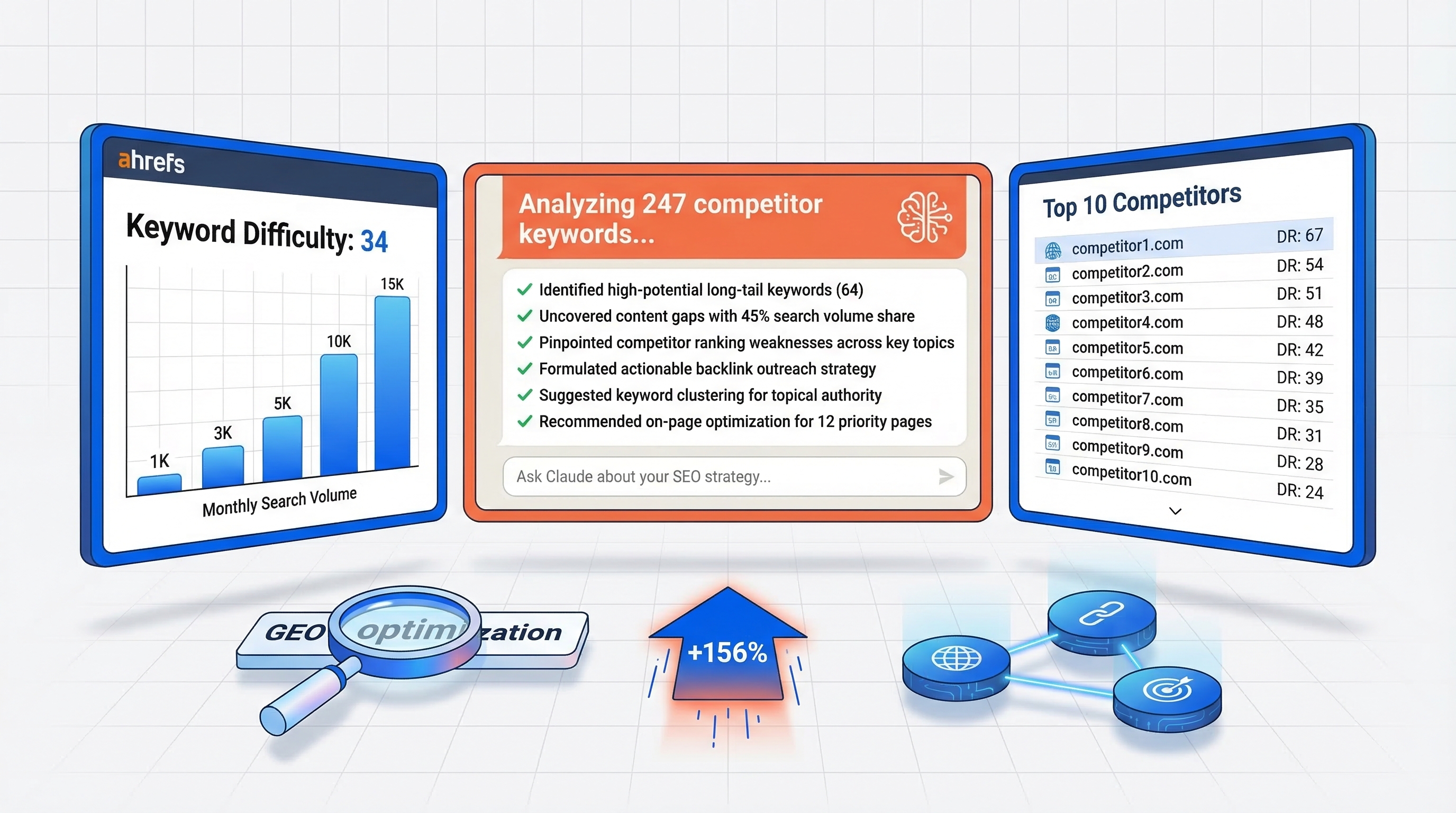
Keyword difficulty, competitor gaps, SERP features, backlink profiles. All the competitive intelligence you need in one place.
Claude: The Analysis Engine
Takes raw Ahrefs data and transforms it into intent-mapped content strategies, semantic entities, and GEO-optimized briefs.
Intent Mapping
Claude identifies whether searchers want information, navigation, comparison, or transaction. Your content hits the right note every time.
Systematic Scaling
Build prompt libraries once, deploy across unlimited clients and campaigns. Agency efficiency without agency overhead.
Understanding GEO: The New SEO Frontier (And Why Your Current Strategy Isn't Enough)
Let's clear something up: GEO isn't SEO's replacement. It's SEO's evolution. Traditional search optimization still matters. But if you're only optimizing for Google's algorithm, you're leaving money on the table.
GEO (Generative Engine Optimization) means making your content citeable by AI models. When ChatGPT answers a question about your industry, is it referencing your content? When Claude generates a buying guide, does your product appear? When Gemini summarizes research, are you in the mix?
If not, you have a GEO problem.
Here's why this matters now: search behavior is fragmenting. A portion of users still Google everything. But a growing segment asks ChatGPT, Claude, or Perplexity first. They're not clicking through 10 blue links. They're reading AI-generated summaries that cite 3-5 trusted sources.
You either show up in those citations or you don't exist to that user.
Informational Intent: Users want to learn something. "What is GEO optimization?" or "How does Claude compare to ChatGPT?"
Navigational Intent: Users want to find a specific page or brand. "TechDevs blog" or "Ahrefs keyword tool"
Commercial Intent: Users are researching before buying. "Best AI tools for SEO" or "Claude vs ChatGPT for content"
Transactional Intent: Users are ready to convert. "Buy Ahrefs subscription" or "Hire SEO agency"
Traditional SEO taught us to optimize for these intents in Google. GEO requires optimizing for them in AI responses. The mechanics are different.
Google's algorithm looks at backlinks, domain authority, page speed, and keyword relevance. AI models look at content structure, semantic entities, citation-worthiness, and how well you answer the actual question being asked.
Pros
GEO: AI engines cite sources that directly answer questions with clear, structured information
GEO: Semantic entity recognition matters more than exact keyword matching
GEO: Content depth and expertise signals trump backlink quantity
GEO: You can influence citations through prompt engineering and content structure
Cons
Traditional SEO: Requires months of backlink building and domain authority growth
Traditional SEO: Keyword stuffing and technical tricks still influence rankings
Traditional SEO: You're competing against established sites with years of history
Traditional SEO: Algorithm updates can tank your rankings overnight
The good news? GEO is more meritocratic. A new site with genuinely helpful, well-structured content can get cited by AI engines faster than it can rank on Google page one. The playing field is more level.
But you need the right tools and workflow.
The Claude + Ahrefs GEO Workflow: Step-by-Step Implementation
Here's the workflow that delivers agency-level results. We've refined this across dozens of client campaigns. It works because it's systematic, not because it's magic.
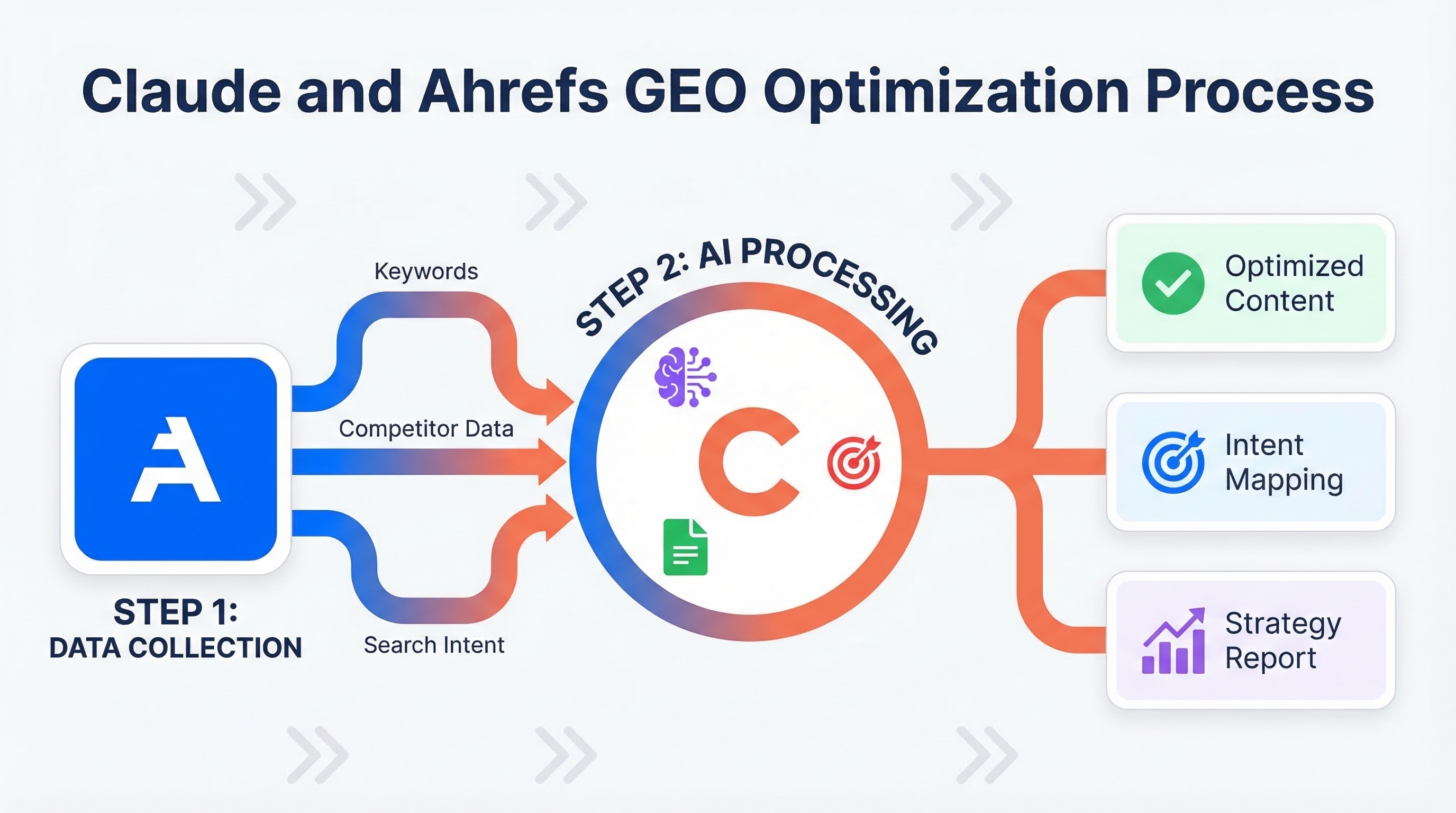
Step 1: Extract Competitive Intelligence from Ahrefs
Start in Ahrefs. Pull keyword data for your target topic: search volume, keyword difficulty, SERP features, top-ranking pages. Export the top 10-20 keywords and their metrics. Then use Ahrefs' Content Gap tool to identify what your competitors rank for that you don't.
Don't skip this. Claude is only as good as the data you feed it. Garbage in, garbage out.
Step 2: Feed Ahrefs Data into Claude for Semantic Analysis
Copy your Ahrefs export into Claude. Ask it to identify semantic entities (people, places, concepts, tools) that appear across the top-ranking content. This tells you what topics and terms AI engines associate with your target keyword.
Claude's 200K token window means you can paste 10+ competitor articles in one go. It analyzes patterns across all of them simultaneously. ChatGPT can't do this without losing context.
Step 3: Map User Intent Across the Funnel
Ask Claude to categorize each keyword by intent: informational, navigational, commercial, or transactional. Then map those intents to funnel stages. Top-of-funnel content targets informational queries. Bottom-of-funnel targets transactional.
This is where most marketers fail. They write one piece of content and expect it to rank for everything. It doesn't work. Intent-specific content performs better in both traditional search and AI citations.
The Complete GEO Workflow Checklist
Export keyword data and SERP analysis from Ahrefs
Paste top 10 competitor articles into Claude
Ask Claude to extract semantic entities and recurring themes
Map keywords to user intent (informational, commercial, transactional)
Generate content briefs with Claude using structured prompts
Create content that answers questions directly and structures information clearly
Test content in AI engines (ChatGPT, Claude, Gemini) to verify citation-worthiness
Track both traditional rankings and AI engine visibility
Step 4: Generate GEO-Optimized Content Briefs
Now you have intent-mapped keywords, semantic entities, and competitor insights. Feed all of this back into Claude with a structured prompt (we'll give you the exact prompts in the next section). Ask it to create a content brief that includes:
Primary and secondary keywords with search intent
Semantic entities to include naturally
Competitor content gaps to exploit
Questions to answer directly (for AI citation-worthiness)
Suggested content structure (H2s, H3s, key sections)
Step 5: Create Content That Ranks Everywhere
Write (or have Claude draft) content based on the brief. The key is answering questions directly, using clear structure, and including semantic entities naturally. AI engines love content that gets to the point fast and backs up claims with data.
Test your content by asking ChatGPT or Claude questions related to your topic. Does it cite your content in responses? If not, your content isn't GEO-optimized yet.
Step 6: Systematize for Scale
The workflow above works for one piece of content. But agency-level results come from systematizing it. Build prompt templates for each step. Save them. Reuse them across clients and campaigns.
This is how you turn a 10-hour manual process into a 2-hour automated one. And that's where the $15K/month value comes from. You're delivering the same quality in a fraction of the time.
The Complete Claude Ahrefs GEO Prompt Pack (Copy-Paste Ready)
Enough theory. Here are the exact prompts we use at TechDevs. Copy them. Customize them. Use them.
These aren't generic "write me a blog post" prompts. They're engineered for specific GEO outcomes using proven prompt engineering techniques: clarity, delimiters, persona framing, chain-of-thought reasoning, and format control.
Professional GEO Prompts for Claude + Ahrefs
Prompt 1: Ahrefs Keyword Analysis to Intent Mapping
Prompt: I'm providing keyword data from Ahrefs for the topic [TOPIC]. Analyze the following keywords and categorize each by user intent: informational, navigational, commercial, or transactional. For each keyword, explain why you assigned that intent and suggest the funnel stage it targets (awareness, consideration, decision).
[PASTE AHREFS KEYWORD DATA HERE]
Output Format: Table with columns: Keyword, Search Volume, Intent Type, Funnel Stage, Reasoning
Why This Works: Delimiters (brackets) separate your data from instructions. Format control ensures consistent output you can plug into spreadsheets or briefs.
Prompt 2: Competitor Content Gap Analysis
Prompt: I'm analyzing competitors for [TARGET KEYWORD]. Below are the top 10 ranking URLs from Ahrefs. Read each article and identify: (1) Topics they cover that overlap, (2) Unique angles only 1-2 competitors use, (3) Questions they answer, (4) Questions they DON'T answer that users likely have.
[PASTE TOP 10 COMPETITOR URLS OR ARTICLE TEXT]
Output: Bulleted list of content gaps and unique opportunities.
Why This Works: Claude's 200K token window lets you paste full articles. Chain-of-thought reasoning (numbered steps) helps it analyze systematically.
Prompt 3: Semantic Entity Extraction for GEO
Prompt: Extract all semantic entities from the following competitor content: people, companies, tools, concepts, statistics, and technical terms. Group them by frequency and relevance to [TOPIC]. Highlight entities that appear in 7+ out of 10 articles (these are critical for GEO optimization).
[PASTE COMPETITOR CONTENT]
Output: Categorized list with frequency counts.
Why This Works: Semantic entities signal to AI engines what your content is about. Including high-frequency entities from top-ranking content increases citation-worthiness.
Prompt 4: GEO-Optimized Content Brief Generator
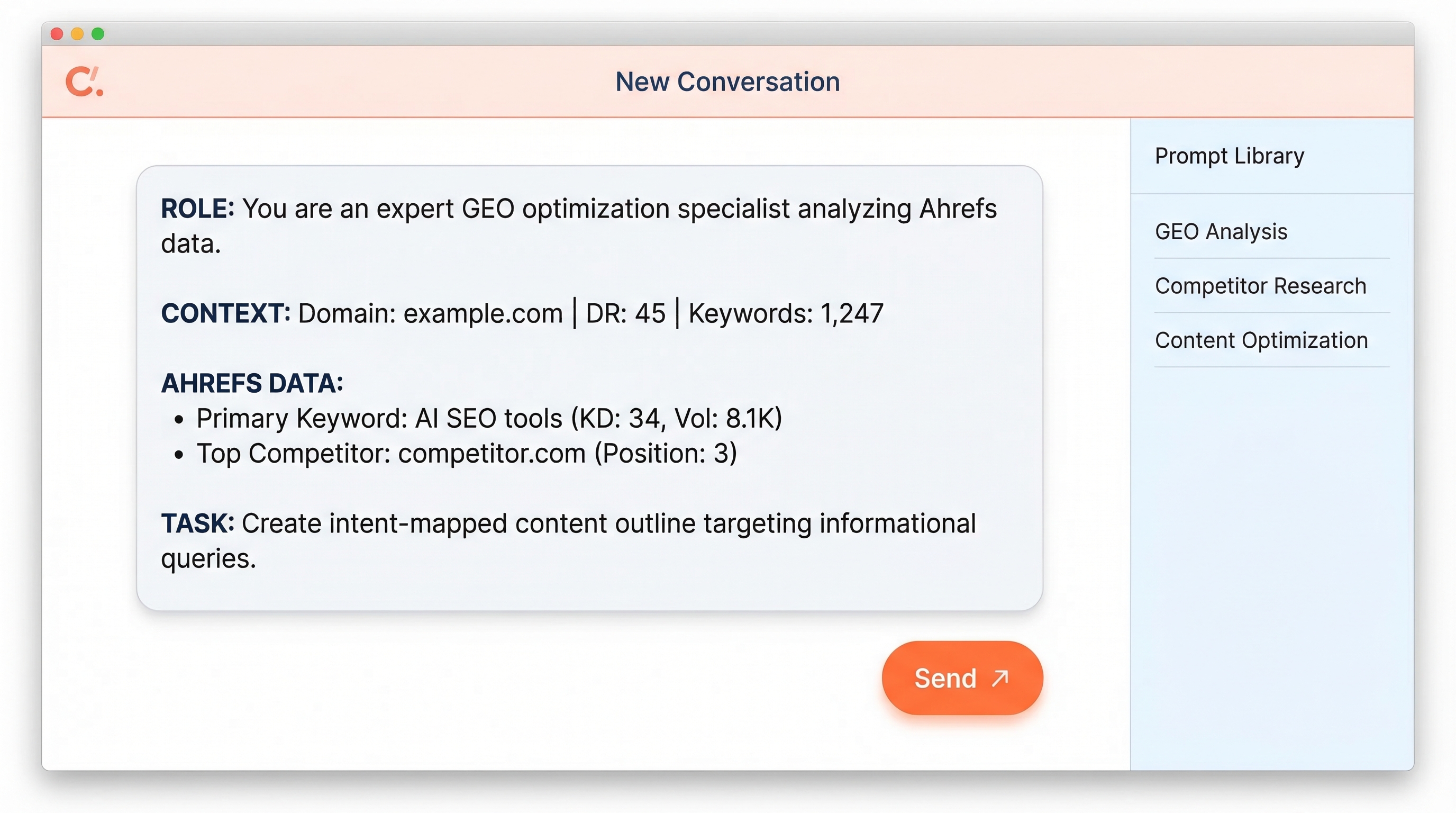
Prompt: You are an expert SEO strategist creating a content brief for [TOPIC]. Using the Ahrefs data and competitor analysis provided, generate a comprehensive brief that includes:
- Primary keyword and 5-7 secondary keywords with intent labels
- Top 10 semantic entities to include naturally
- 5 competitor content gaps to exploit
- 8-10 questions to answer directly (for AI citation-worthiness)
- Suggested H2 and H3 structure
- Target word count and tone guidance
[PASTE AHREFS DATA AND COMPETITOR INSIGHTS]
Why This Works: Persona framing ("You are an expert...") primes Claude for strategic thinking. Numbered list ensures nothing gets skipped.
Prompt 5: Multi-Intent Content Optimizer
Prompt: This article targets [PRIMARY KEYWORD]. Analyze the draft below and optimize it for multiple intents:
- Informational: Add clear definitions and explanations
- Commercial: Include comparison sections and pros/cons
- Transactional: Strengthen CTAs and next-step guidance
Provide specific edits with before/after examples.
[PASTE DRAFT CONTENT]
Why This Works: Most content only satisfies one intent. Multi-intent optimization makes your content useful at every funnel stage, increasing both traditional rankings and AI citations.
Prompt 6: Ahrefs SERP Feature Analysis to Content Strategy
Prompt: Ahrefs shows the following SERP features for [KEYWORD]: [LIST FEATURES like Featured Snippet, People Also Ask, Related Searches]. Analyze what content format and structure Google favors. Then recommend how to structure our content to capture these features AND get cited by AI engines.
Output: Specific formatting recommendations (lists, tables, Q&A sections, etc.)
Why This Works: SERP features tell you what Google wants. Structuring content to match increases traditional rankings. Clear structure also makes content more citeable by AI.
These prompts work because they're specific, structured, and data-driven. Generic prompts like "write an SEO article about X" produce generic output. Engineered prompts produce professional results.
Advanced Technique: Guardrails and Compliance
Add brand guidelines and compliance rules directly into your prompts. Example: "Write in a conversational tone. Avoid jargon. Never make claims without data. Include at least 2 real-world examples." Claude follows these instructions consistently, keeping your content on-brand across dozens of articles.
Delimiters
Use brackets, triple quotes, or XML tags to separate data from instructions. Prevents Claude from confusing your examples with its tasks.
Persona Framing
Start prompts with "You are an expert [ROLE]" to prime Claude for specific thinking patterns and expertise levels.
Format Control
Specify exact output format: tables, bulleted lists, JSON, markdown. Makes Claude's responses immediately usable in your workflow.
Chain-of-Thought
Break complex tasks into numbered steps. Claude follows the sequence and produces more thorough, logical output.
Claude vs ChatGPT for SEO Content: Why Claude Wins for GEO Work
Let's settle this. Both tools are good. But for SEO and GEO work specifically, Claude has clear advantages.
The biggest one? Context window. Claude handles 200,000 tokens in a single conversation. ChatGPT (even GPT-4) maxes out much lower. When you're analyzing 10 competitor articles plus Ahrefs data plus semantic entities, that context limit matters.
We've run side-by-side tests. Same Ahrefs data, same competitor URLs, same prompts. Claude produces more coherent analysis because it holds all the context at once. ChatGPT loses the thread halfway through and starts contradicting itself.
Pros
Claude: 200K token context window handles massive data sets without losing coherence
Claude: More natural writing style with fewer AI detection red flags
Claude: Better at following complex, multi-step prompts consistently
Claude: Superior for analyzing multiple long-form articles simultaneously
Cons
ChatGPT: Smaller context window forces you to break analysis into multiple sessions
ChatGPT: More prone to generic phrasing and repetitive structures
ChatGPT: Struggles with maintaining consistency across long conversations
ChatGPT: Better for quick one-off tasks than systematic workflows
There's also the writing quality difference. Claude's output reads more naturally. It uses varied sentence structures, contractions, and conversational tone without you having to prompt for it. ChatGPT defaults to formal, academic prose unless you explicitly tell it otherwise.
For AI detection tools, Claude scores lower (meaning more human-like). If you're publishing content at scale, this matters. You don't want every piece flagged as AI-generated.
But ChatGPT isn't useless. It's faster for quick tasks: generating meta descriptions, brainstorming headline variations, or drafting social posts. We use both tools depending on the task.
For the heavy lifting (competitor analysis, content briefs, GEO optimization), Claude wins. For quick tactical work, ChatGPT is fine.
The brands getting cited consistently by AI engines aren't just writing better content. They're engineering better prompts to create that content.
TechDevs Team, Internal GEO Research
One more thing: Claude handles structured data better. If you're feeding it CSV exports from Ahrefs or JSON data from APIs, Claude parses it cleanly. ChatGPT sometimes mangles formatting or loses data in translation.
Bottom line: use Claude for GEO optimization workflows. Use ChatGPT when you need something fast and context doesn't matter.
Advanced GEO Strategies: Intent Mapping and Multi-Prompt Chaining
Most people stop at basic prompts. They ask Claude to write an article and call it done. That's not GEO optimization. That's content generation.
Real GEO work requires intent mapping and multi-prompt chaining. Let me explain.
Intent Mapping: Why It Matters
Every keyword has intent behind it. Someone searching "what is GEO" wants information. Someone searching "best GEO tools" is comparing options. Someone searching "hire GEO agency" is ready to buy.
If your content doesn't match the intent, it won't rank. And it definitely won't get cited by AI engines.
Intent mapping elevates AI content from generic to conversion-focused. You're not just creating content. You're creating the right content for the right stage of the buyer journey.
Awareness Stage: Target informational intent. Answer questions, educate, build trust. Example: "What is GEO and why does it matter?"
Consideration Stage: Target commercial intent. Compare options, show pros and cons, demonstrate expertise. Example: "Claude vs ChatGPT for SEO work"
Decision Stage: Target transactional intent. Clear CTAs, case studies, pricing info. Example: "Hire a GEO optimization agency"
Map your keywords to these stages. Then create content that satisfies the intent at each stage. This is how you build a funnel that works in both traditional search and AI responses.
Multi-Prompt Chaining: Breaking Complex Tasks into Steps
One massive prompt rarely works. Claude gets overwhelmed. Output quality drops. Instead, chain multiple prompts together, each handling one piece of the puzzle.
Example workflow for creating a GEO-optimized article:
Prompt 1: Analyze Ahrefs keyword data and extract semantic entities
Prompt 2: Categorize keywords by intent and map to funnel stages
Prompt 3: Identify competitor content gaps using the entities and intent map
Prompt 4: Generate a detailed content brief with structure and key points
Prompt 5: Draft the article based on the brief
Prompt 6: Optimize the draft for GEO by adding direct answers and clear structure
Each prompt builds on the previous one. Claude maintains context across all six steps because of that 200K token window. The final output is higher quality than a single "write me an article" prompt could ever produce.
Example: Mapping Intent for a SaaS Funnel
Let's say you're selling project management software. Here's how you'd map content to intent:
SaaS Funnel Intent Mapping Example
Awareness Stage (Informational Intent)
Target keywords: "what is project management," "how to organize tasks," "team collaboration tips"
Content type: Educational blog posts, how-to guides, explainer videos
GEO optimization: Answer questions directly, use clear definitions, include real examples
Consideration Stage (Commercial Intent)
Target keywords: "best project management tools," "Asana vs Monday," "project management software comparison"
Content type: Comparison articles, feature breakdowns, pros/cons lists
GEO optimization: Structure comparisons in tables, include specific data points, cite real user reviews
Decision Stage (Transactional Intent)
Target keywords: "buy project management software," "[your tool] pricing," "[your tool] free trial"
Content type: Landing pages, case studies, ROI calculators
GEO optimization: Clear CTAs, specific pricing info, customer testimonials with names and companies
This is systematic. You're not guessing what content to create. You're mapping it to real search behavior and user intent. And when you feed this map into Claude with Ahrefs data, it generates briefs that hit every stage of the funnel.
Quality Control and Guardrails
One more advanced technique: build guardrails into your prompts. These are rules Claude must follow to keep content on-brand and accurate.
Example guardrails: "Never make claims without citing sources. Use conversational tone. Include at least one real-world example per section. Avoid jargon unless you define it first. Maximum 3 sentences per paragraph."
Add these to your prompt templates. Claude follows them consistently, which means your content maintains quality even when you're producing 20+ articles per month.
Measuring Success: ROI Metrics for Your Claude Ahrefs GEO Strategy
You can't improve what you don't measure. GEO requires tracking metrics beyond traditional SEO KPIs.
Traditional SEO tracks rankings, organic traffic, backlinks, and conversions. That's still important. But GEO adds a new layer: AI engine visibility.
Are AI assistants citing your content? When someone asks ChatGPT a question in your industry, does your site appear in the response? When Claude generates a buying guide, are you included?
This is harder to track than Google rankings, but it's not impossible.
Metrics That Matter for GEO
GEO Performance Tracking Checklist
AI Engine Citations: Manually test queries in ChatGPT, Claude, Gemini. Count how often your content appears.
Featured Snippet Captures: Track how many featured snippets you own (these often feed AI responses).
Zero-Click Search Rate: Monitor queries where users get answers without clicking (your content may be cited).
Semantic Entity Coverage: Track how many high-frequency entities from competitor analysis you've included.
Content Depth Metrics: Average word count, number of questions answered, use of structured data.
Traditional SEO KPIs: Rankings, organic traffic, backlinks, conversions (still matter).
Time Efficiency: Hours saved using Claude + Ahrefs vs manual analysis (ROI metric).
The time savings metric is huge. Before implementing this workflow, competitor analysis for a single piece of content took 8-10 hours. With Claude + Ahrefs, it takes 2 hours. That's an 80% reduction.
Multiply that across 20 articles per month. You're saving 120-160 hours. At typical agency rates ($100-150/hour), that's $12,000-24,000 in monthly value. And that's just the time savings, not counting the improved content quality and GEO performance.
Building Feedback Loops
Track which prompts produce the best results. When a piece of content gets cited by AI engines consistently, reverse-engineer why. What prompt generated the brief? What semantic entities did you include? What structure did you use?
Document this. Add it to your prompt library. Test variations. This continuous feedback loop is how you go from good results to exceptional ones.
At TechDevs, we maintain a shared prompt library with performance notes. "This prompt generated 3 pieces that got cited by ChatGPT." or "This variation improved featured snippet capture by 40%." We iterate constantly.
This isn't theoretical. We've run this workflow across 50+ client campaigns. The numbers are real.
Common Mistakes and How to Avoid Them (Plus Your 30-Day Implementation Plan)
Most people fail at GEO not because the strategy is wrong, but because they make predictable mistakes. Here's what to avoid.
Mistake 1: Using Generic Prompts Without Data
Asking Claude to "write an SEO article about project management" produces generic content. Feeding it Ahrefs keyword data, competitor URLs, and semantic entities produces content that ranks and gets cited.
The prompt is only as good as the data you provide. Always start with Ahrefs research.
Mistake 2: Ignoring Intent Mapping
Creating one piece of content and expecting it to rank for informational, commercial, and transactional queries doesn't work. Map keywords to intent first. Create separate content for each stage of the funnel.
Mistake 3: Not Building Prompt Libraries
If you're rewriting prompts from scratch every time, you're wasting time. Save your best prompts as templates. Organize them by task. Reuse and refine them.
Mistake 4: Failing to Track GEO Metrics
You can't optimize what you don't measure. Test your content in AI engines. Track citations. Monitor featured snippet captures. Adjust based on what works.
Mistake 5: Over-Relying on AI Without Human Oversight
Claude is good, but it's not perfect. Always review output for accuracy, tone, and brand alignment. AI generates drafts. Humans refine them into great content.
Week 1: Audit your current content process. Identify bottlenecks. Export keyword data from Ahrefs for 3-5 target topics.
Week 2: Test the basic workflow. Pick one topic, run it through the Claude + Ahrefs process, create one piece of content. Measure time spent vs your old process.
Week 3: Build your first prompt templates. Document the prompts that worked in Week 2. Organize them by task type (keyword analysis, content briefs, etc.).
Week 4: Scale to 3-5 pieces of content. Test your templates across multiple topics. Refine prompts based on output quality. Start tracking GEO metrics.
After 30 days, you'll have a working system. From there, it's about scaling: more content, more clients, more refinement.
At TechDevs, we help clients implement this workflow without the trial-and-error phase. We've already built the prompt libraries, refined the process, and proven the results across 50+ campaigns. If you want to skip straight to the working system, book a discovery call and we'll show you exactly how we'd implement this for your business.
Frequently Asked Questions
What is GEO (Generative Engine Optimization) and how is it different from SEO?
GEO is optimization for AI engines like ChatGPT, Claude, and Gemini. Traditional SEO targets Google's algorithm. GEO targets how AI assistants cite and reference content in their responses. The difference: SEO focuses on rankings and backlinks. GEO focuses on citation-worthiness, semantic entities, and direct question-answering. Both matter in 2026.
Why is Claude better than ChatGPT for SEO and GEO work?
Claude's 200,000 token context window lets you analyze 10+ competitor articles and Ahrefs data simultaneously. ChatGPT's smaller context limit forces you to break analysis into multiple sessions, losing coherence. Claude also produces more natural writing with fewer AI detection red flags. For systematic SEO workflows, Claude handles complexity better.
How much does it cost to implement Claude + Ahrefs for GEO optimization?
Claude Pro costs $20/month. Ahrefs starts at $129/month for the Lite plan (sufficient for small teams). Total: around $150/month in tools. The real cost is time learning the workflow, but once systematized, you save 80% of the time you'd spend on manual competitor analysis. The ROI is immediate.
Can I really achieve $15k/month agency results with Claude and Ahrefs?
Yes, but the $15K figure represents value, not revenue. It's the cost of hiring an agency to do what this workflow automates: competitor analysis, keyword research, content briefs, and GEO optimization. If you're doing this in-house, you save those costs. If you're an agency, you deliver that value to clients at a fraction of your labor cost.
What Ahrefs subscription level do I need for this GEO strategy?
Ahrefs Lite ($129/month) works for small teams and individual consultants. It includes keyword research, SERP analysis, and content gap tools. If you're running an agency with multiple clients, Standard ($249/month) or Advanced ($449/month) gives you more projects and historical data. Start with Lite and upgrade as you scale.
How long does it take to see results from GEO optimization?
AI engine citations can happen within days if your content is well-structured and answers questions directly. Traditional SEO rankings take 3-6 months. The advantage of GEO: you can test immediately by asking ChatGPT or Claude questions related to your topic and seeing if they cite your content. Faster feedback loop than waiting for Google rankings.
Do I need coding skills to use Claude with Ahrefs for SEO?
No. This workflow is entirely prompt-based. You export data from Ahrefs (CSV or copy-paste), feed it into Claude via text prompts, and get analysis back. No APIs, no scripts, no code. If you can use a spreadsheet and write clear instructions, you can do this. The barrier is learning good prompt engineering, not technical skills.
Ready to Dominate Both Traditional Search and AI Engine Citations?
Stop guessing. TechDevs has already built the systematic Claude + Ahrefs workflow that delivers agency-level GEO results. We've refined it across 50+ campaigns. We'll show you exactly how to implement it for your business or clients. Book a discovery call and we'll walk through your current SEO process, identify bottlenecks, and map out a custom GEO strategy that fits your goals.