Free vs Paid SEO Tools: The Ultimate 2026 Guide to What You Actually Need
Compare free and paid SEO tools for 2026. Learn which features matter, when to upgrade, and how to maximize ROI. Make smarter tool choices today.
 Written byPrasad Iyer
Table of contents
Summarize this article with AI
TL;DR
Most businesses waste money on premium SEO tools they barely touch. The truth? Free tools now deliver 70-80% of what paid options offered just two years ago. But here's the catch: knowing when to upgrade can 5x your organic ROI. We've spent $500K+ on SEO tools over the last decade, and this guide shows you exactly which investments actually move the needle.
- Free Tools Cover Most Needs. Google Search Console, Screaming Frog (500 URLs), and GA4 handle 80% of what small businesses need
- SEO Delivers 5x Better ROI. Real 2025 data shows 19.9x ROAS from SEO vs 4.4x from paid ads, at $126 vs $553 cost per customer
- AI Changed the Game. Tools like Frase at $14.99/mo now automate 90% of content research that used to take hours
- Upgrade at Revenue Thresholds. Invest in paid tools only when your organic traffic value exceeds 10x the monthly tool cost
The Real Question: Do You Need Paid SEO Tools at All?
Here's what nobody tells you about SEO tools: most companies are burning $200-500 per month on premium subscriptions they open maybe twice. I've watched startups sign up for Ahrefs, use it for the first week to audit their site, then let it sit unused while the charges keep hitting their credit card.
The real question isn't "free vs paid." It's "which features actually drive revenue?"
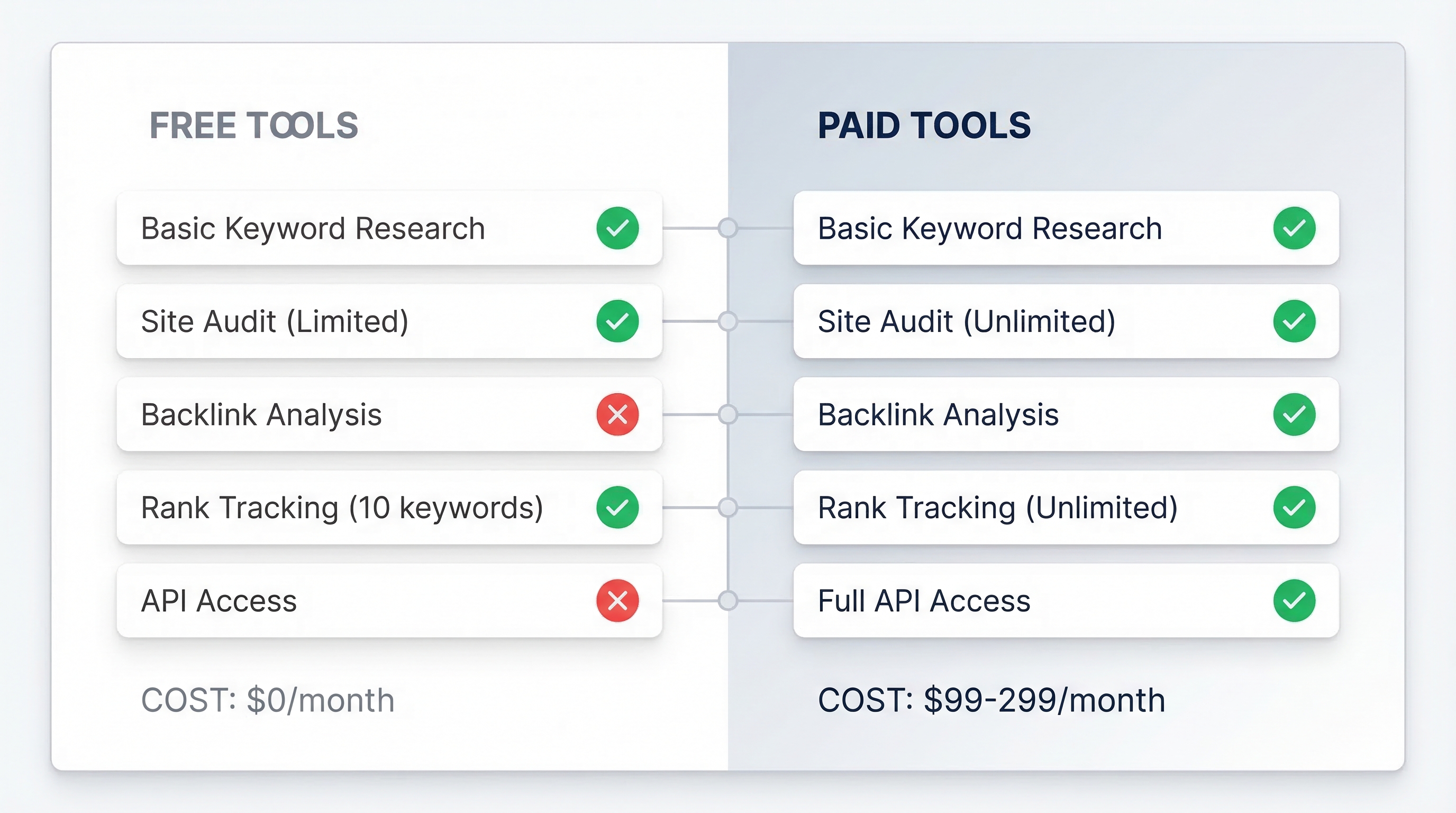
Free SEO tools in 2026 are shockingly good. We're talking 70-80% of the functionality that paid tools offered back in 2023. Google Search Console alone gives you direct pipeline to how Google sees your site. Screaming Frog's free tier crawls 500 URLs, which covers most small-to-medium websites. And Google Analytics 4 now has built-in AI insights that used to require separate analytics platforms.
Free SEO Tools That Actually Deliver in 2026
Let's cut through the noise. These free tools form the foundation of every SEO strategy we build at TechDevs, whether the client is a five-person startup or a mid-market SaaS company.
Google Search Console
The non-negotiable foundation. Direct data from Google on clicks, impressions, indexing issues, and Core Web Vitals. If you're not using this, you're flying blind.
Screaming Frog (Free Tier)
Crawls up to 500 URLs for technical audits. Finds broken links, duplicate content, and metadata issues. Most small businesses never hit the 500 URL limit.
Google Analytics 4
Free traffic analysis with AI-powered insights. Tracks user behavior, conversion paths, and engagement metrics. The 2026 version predicts user intent better than most paid tools from 2023.
Bing Webmaster Tools
Seriously underrated. Bing powers 30%+ of searches in certain demographics, and their webmaster tools are completely free with solid keyword data.
But here's where free tools break down. You can't reverse-engineer competitor backlink profiles. You can't track 500+ keywords across multiple locations. And you definitely can't automate content optimization at scale.
That's not a dealbreaker for most businesses starting out. It becomes a problem when you're trying to scale.
Pros
Zero cost to start, perfect for validating SEO as a channel
Direct data from search engines (GSC, Bing) is more accurate than third-party estimates
Covers technical SEO, basic analytics, and site health monitoring
No learning curve for switching between tools as you grow
Cons
No competitive intelligence or backlink analysis
Limited keyword tracking (can't monitor hundreds of terms)
Manual processes that don't scale past 10-20 pages of content
No content optimization or AI-assisted research features
When Paid Tools Become Worth the Investment
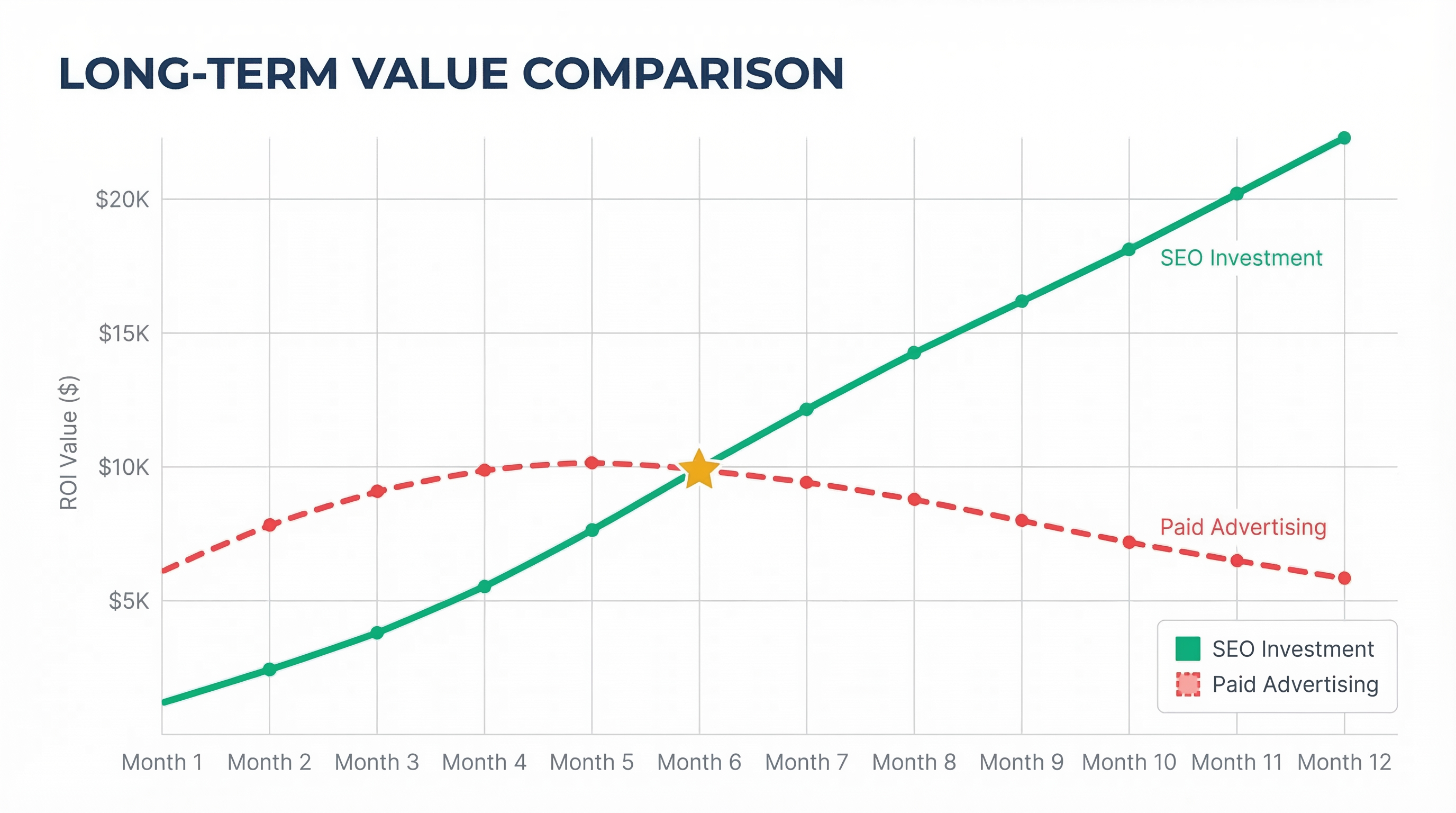
The ROI math on SEO tools is brutally simple. According to 2025 data from home service businesses, SEO delivers a 19.9x return on ad spend compared to 4.4x for paid ads. More importantly, the cost per paying customer is $126 for SEO versus $553 for paid advertising.
That gap is massive. And it compounds over time.
So when does a $99/month Ahrefs subscription make sense? When your organic traffic is already generating $1,000+ in monthly revenue. At that point, the tool pays for itself if it helps you increase traffic by just 10%. Ahrefs offers 7 billion+ keywords and the world's largest backlink index. That's not marketing fluff. It's the difference between guessing what your competitors rank for and knowing exactly which content gaps to fill.
Surfer SEO at $89/month is another smart investment once you're publishing 4+ pieces of content per month. It analyzes the top-ranking pages for your target keyword and tells you exactly how many words, images, and specific terms you need. We've used it to cut content revision cycles in half.
Upgrade Triggers: When to Invest in Paid Tools
Your organic traffic generates $1,000+ monthly revenue
You're publishing 4+ optimized articles per month
You need competitive backlink analysis to outrank specific competitors
Manual keyword research is taking 5+ hours per week
You're managing SEO for multiple domains or locations
Unlike paid ads that disappear the moment you stop paying, SEO tools help you build assets that keep working. A well-optimized page from 2024 still drives leads in 2026. That's the compounding effect most people miss.
Prasad Iyer, CTO at TechDevs
AI-Driven SEO Automation: The 2026 Game-Changer
AI tools have fundamentally changed what's possible at every price point. We're not talking about content mills that spit out garbage. We're talking about tools that predict algorithm changes 2-3 months before they hit, automate content gap analysis using machine learning, and cut manual research time by 90%.
Frase at $14.99/month is the best example of this shift. It uses GPT-4 to analyze the top 20 results for any keyword, extract common themes, and generate content briefs in minutes. What used to take an hour of manual research now takes five minutes. And the quality is better because it's pulling from actual ranking content, not guesswork.
But here's where it gets interesting for technical teams. You can build your own SEO automation using Python scripts and free APIs. Google Search Console has an API. So does Ahrefs (if you pay for it). You can set up automated monitoring, custom dashboards, and alert systems that trigger when rankings drop or competitors publish new content.
We reduced manual SEO tasks by 60% this way. Daily rank tracking, broken link monitoring, and content performance alerts all run automatically. The time savings add up fast.
Common Questions About AI SEO Tools
Can AI tools really predict algorithm changes?
Not with 100% accuracy, but modern ML models can spot patterns in ranking fluctuations across thousands of sites. They flag potential algorithm updates 2-3 months before official announcements by detecting correlation shifts in ranking factors. It's not magic, it's pattern recognition at scale.
Should I use AI to write my content?
Use AI to research and outline, not to write final drafts. The best approach is AI-assisted research (Frase, Surfer) plus human writing. Google's algorithms are good at detecting purely AI-generated content that lacks original insights or expertise.
What's the difference between AI tools and traditional SEO software?
Traditional tools show you data (rankings, backlinks, traffic). AI tools analyze that data and suggest actions. They identify patterns, predict outcomes, and automate repetitive tasks. Think of it as the difference between a spreadsheet and a data analyst.
Are free AI SEO tools any good?
Some are surprisingly solid. Google's AI-powered insights in GA4 are free and legitimately useful. ChatGPT can help with keyword clustering and content ideation at no cost. But the specialized AI tools (Frase, Surfer, Clearscope) are worth paying for if you're serious about content.
How do I avoid over-relying on AI recommendations?
Treat AI as a research assistant, not a decision-maker. Always validate suggestions against your own data and industry knowledge. If an AI tool recommends targeting a keyword that doesn't align with your product or customer intent, ignore it. Tools optimize for rankings, you optimize for revenue.
Building Your Custom SEO Toolchain (The TechDevs Method)
Most guides tell you to pick one all-in-one platform. That's expensive and limiting. The smarter approach is building a custom toolchain that evolves with your needs.
Here's how we do it:
Phase 1 (Months 1-3): Free Foundation. Google Search Console, GA4, Screaming Frog free tier, and Bing Webmaster Tools. Master these before spending a dollar. Track your baseline metrics: organic traffic, top landing pages, conversion rates, and technical issues.
Phase 2 (Months 4-6): Strategic Paid Additions. Once you know your bottleneck (content, technical, or backlinks), add one paid tool that specifically addresses it. Publishing lots of content? Add Surfer or Frase. Need competitive intelligence? Add Ahrefs or Ubersuggest. Struggling with local rankings? Invest in local SEO-specific tools.
Phase 3 (Months 7+): API Integrations and Custom Dashboards. Connect your tools via APIs. Build custom reports in Google Data Studio or Looker. Automate rank tracking, competitor monitoring, and alert systems. This is where you 10x your efficiency without 10x-ing your tool budget.
The open-source route is underrated. You can combine free APIs (Google Search Console, Bing, even scraped SERP data) with Python scripts to build enterprise-level monitoring. We've built clients custom SEO dashboards that pull data from six different sources and cost $0 in monthly subscriptions.
And if you're building a SaaS product, embed SEO into your development process from day one. Make your URLs clean, your metadata dynamic, and your content indexable by default. Most companies treat SEO as an afterthought. The ones that bake it into the product architecture win.
Phase 1: Foundation
Free tools only. GSC, GA4, Screaming Frog. Build your baseline and learn what metrics actually matter for your business.
Phase 2: Strategic Upgrades
Add 1-2 paid tools based on your specific bottleneck. Content, technical, or competitive intelligence. Not all three at once.
Phase 3: Custom Automation
API integrations, custom dashboards, automated monitoring. This is where you scale without ballooning costs.
Voice Search, Local SEO, and Semantic Optimization in 2026
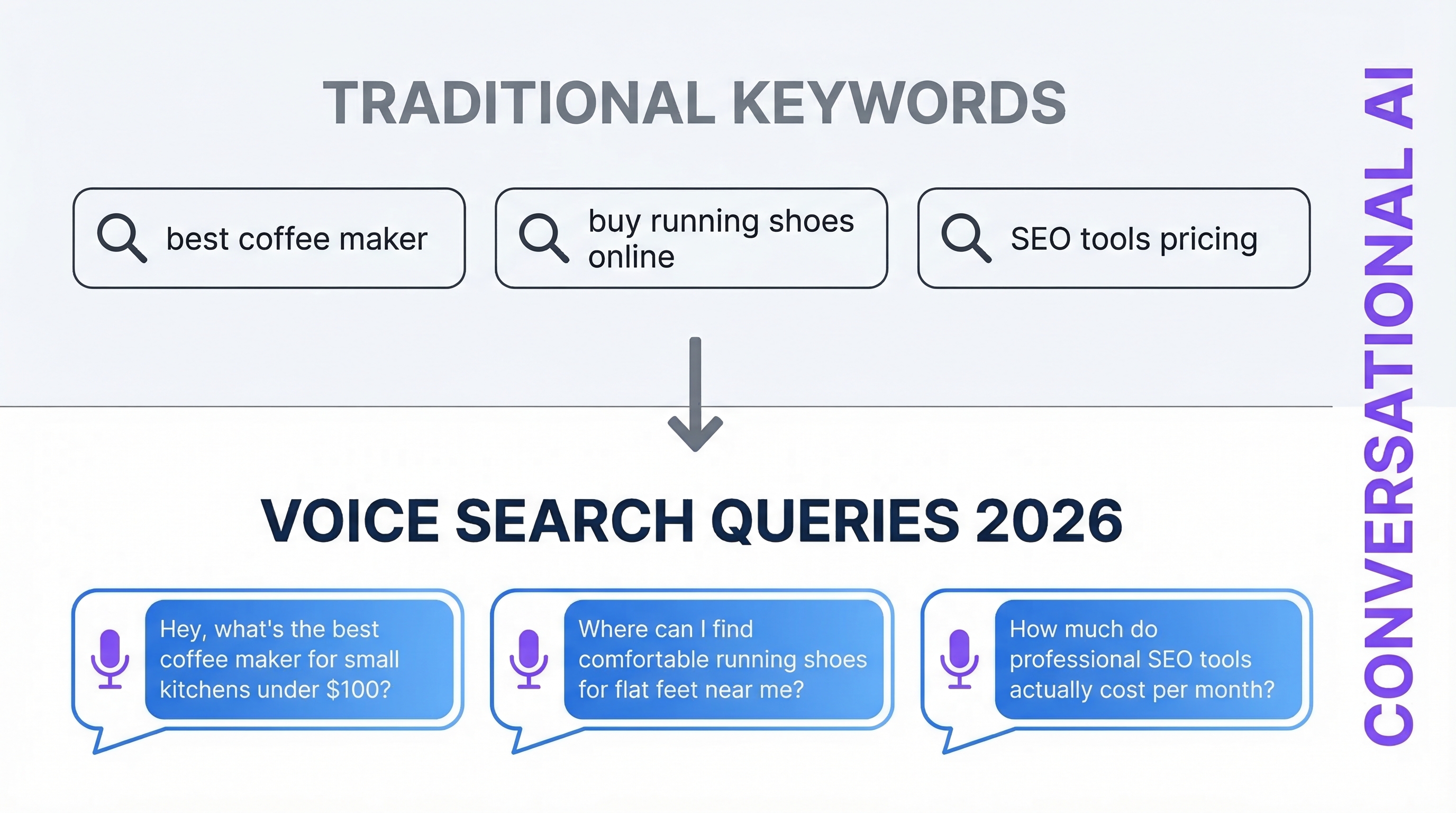
Voice search isn't the future anymore. It's 40% of all searches in certain demographics. And the optimization strategy is completely different from traditional keyword targeting.
People don't say "best coffee shop downtown." They say "where's the closest coffee shop that's open right now?" That's a conversational query with local intent and real-time context. Most SEO tools still optimize for the first query, not the second.
Google Business Profile optimization is still free and still crucial for local businesses. If you're not claiming and optimizing your GBP, you're invisible in local pack results. Add photos weekly, respond to reviews within 24 hours, and keep your hours updated. Basic stuff, but most businesses don't do it consistently.
Pros
Conversational queries often have lower competition than traditional keywords
Voice searchers have higher intent (they need something now)
Featured snippets and position zero are critical for voice results
Local voice searches convert at higher rates than typed searches
Cons
Harder to track and measure than traditional keyword rankings
Requires different content structure (Q&A format, natural language)
Voice results heavily favor established brands and local businesses
Most SEO tools don't have dedicated voice search features yet
Structured data markup is your secret weapon here. Schema.org markup tells search engines exactly what your content is about. FAQ schema, local business schema, product schema - these aren't optional anymore. You can use free schema generators or pay for all-in-one solutions that automatically add markup to your CMS.
Semantic SEO is about understanding entity relationships and topical authority. Google doesn't just look at keywords anymore. It maps the relationships between concepts, entities, and user intent. Tools like Ubersuggest at $29/month help with local keyword tracking and semantic clustering, but honestly, you can do a lot of this manually with topic mapping and internal linking strategies.
Voice search optimization: Structure content as Q&A, use natural language, target long-tail conversational queries
Local SEO: Claim and optimize Google Business Profile, build local citations, get reviews consistently
Structured data: Add schema markup for FAQs, local business info, products, and articles
Semantic clustering: Group related content by topic, not just keywords, and link them together internally
Entity optimization: Make sure Google understands what your business is, what you offer, and who you serve
The Cost-Benefit Framework: Making Smart Tool Decisions
Let's do the actual math. Say you're generating $5,000/month in revenue from organic search. A $99 Ahrefs subscription is 2% of that revenue. If Ahrefs helps you identify just two new keyword opportunities that increase your traffic by 20%, you've 10x'd your investment.
But here's the thing: most people never do this calculation. They either stay on free tools forever (leaving money on the table) or buy every premium tool they hear about (wasting money on features they never use).
The time-savings multiplier is real. If a $99/month tool saves you 10 hours of manual work, that's worth $500+ for most businesses (assuming a $50/hour value for your time or your team's time). And that doesn't include the opportunity cost of not working on higher-leverage tasks.
Tool Investment Decision Framework
Calculate your current SEO-driven monthly revenue
Identify your biggest time sink or growth bottleneck
Find a tool that specifically addresses that bottleneck
Estimate time savings and potential revenue increase
If ROI is 5x+ within 90 days, buy it. If not, stick with free tools.
Set a calendar reminder to audit tool usage quarterly
The upgrade trigger should be data-driven. Track these KPIs monthly: organic traffic, keyword rankings (top 10 positions), conversion rate from organic, and time spent on manual SEO tasks. When any of these metrics plateau or decline for 60+ days despite consistent effort, that's your signal to invest in better tools.
Your 2026 SEO Tool Strategy: A Practical Action Plan
Stop overthinking this. Here's the exact playbook we use with clients:
90-Day SEO Tool Roadmap
Month 1: Establish Your Baseline
Set up Google Search Console, GA4, and Screaming Frog. Run your first technical audit. Identify your top 10 organic landing pages and their conversion rates. Track keyword rankings manually in a spreadsheet for your 20 most important terms. This is your baseline.
Month 2: Identify Your Bottleneck
Look at your data. Are you getting traffic but not ranking for valuable keywords? That's a content problem. Are you ranking but not getting clicks? That's a title/meta description problem. Are you getting clicks but not conversions? That's a landing page problem. One bottleneck will be obvious.
Month 3: Test One Paid Tool
Pick one paid tool that addresses your specific bottleneck. If it's content, try Surfer or Frase. If it's competitive intelligence, try Ubersuggest or Ahrefs. Most tools have 7-day trials. Use the trial hard. If you don't see immediate value in the first week, it's not the right tool for you yet.
Month 4-6: Optimize and Automate
If the paid tool is working, keep it and start building automation around it. Set up automated rank tracking, weekly reports, and alert systems. If the tool isn't delivering ROI, cancel it and try a different approach. Don't fall for sunk cost fallacy.
Month 7+: Scale What Works
By now you know what works for your business. Double down on those tools and processes. Build custom integrations. Train your team. Set quarterly reviews to audit which tools you're actually using and which are just costing you money.
The TechDevs philosophy is simple: automate what you can, invest in what moves the needle, and ignore everything else. SEO tools are means to an end, not the end itself. The goal is revenue, not vanity metrics.
Your Next Steps (Do These This Week)
Set up Google Search Console if you haven't already
Run a Screaming Frog crawl and fix your top 5 technical issues
Calculate your current monthly revenue from organic search
Identify your single biggest SEO bottleneck (content, technical, or competitive)
If your organic revenue is $1,000+/month, trial one paid tool this week
Set a calendar reminder for 90 days from now to audit your tool stack
And look, if you're stuck on which tools to use or how to build a custom SEO stack for your business, we've done this hundreds of times. Sometimes the best tool is just talking to someone who's already made all the mistakes.
Need Help Building Your SEO Stack?
We've spent $500K+ on SEO tools over the last decade and built custom automation systems for dozens of clients. Book a free 30-minute call and we'll walk you through exactly which tools make sense for your business and how to avoid the expensive mistakes most companies make.