How to Rank Your Website Against Competitor Keywords in 2026
Master competitor keyword targeting in 2026. Learn proven SEO strategies to analyze, target, and outrank your competition. Start dominating search results today!
 Written byPrithvi Jadwani
Table of contents
Summarize this article with AI
TL;DR
Most brands waste months chasing the wrong keywords while their competitors quietly dominate search. I've helped 250+ clients close visibility gaps and steal market share from bigger competitors by targeting the right keywords with surgical precision. Here's the exact playbook we use.
- Your Business Competitors ≠ Your SEO Competitors. The brands ranking for your target keywords might surprise you. Identify who actually owns the search real estate you want.
- Low Competition Keywords Are Still Gold. Focus on winnable battles first. Target keywords with decent volume but weak competitor content to build momentum fast.
- Content Quality Beats Domain Authority. You can outrank sites with higher authority by creating genuinely superior content that matches search intent better.
- Visibility Goes Beyond Google Search. AI platforms, Reddit, YouTube, and TikTok now influence buying decisions. Your competitive analysis must cover all these channels.
- Monitor and Adapt Constantly. Competitor strategies shift. Algorithm updates happen. Set up automated tracking and run quarterly audits to stay ahead.
Why Competitor Keyword Analysis Is Your Secret Weapon in 2026
I see this pattern every week. A founder spends six months publishing blog posts, building links, and optimizing their site. Traffic barely moves. Then they run a competitor keyword analysis and discover they've been targeting keywords their competitors already own with content 10x better than theirs.
Here's what changed in 2026: competitive visibility isn't just about Google anymore. Your potential customers are typing prompts into ChatGPT, scrolling Reddit for product comparisons, and watching YouTube reviews before they ever hit a traditional search engine. If you're only tracking Google rankings, you're missing half the picture.
But here's the good news: most of your competitors still don't understand this. They're stuck in 2022, optimizing for Google while ignoring AI search, social platforms, and community-driven discovery. That's your window.

Step 1: Identify Your True SEO Competitors (They Might Surprise You)
Your biggest business competitor might not be your biggest SEO threat. I learned this the hard way in 2023 when a client kept asking why we weren't targeting the same keywords as their main competitor. Turns out, that competitor had zero search visibility. A completely different set of sites owned the rankings.
Your SEO competitors are the sites actually ranking for keywords you want to own. Sometimes that's a direct business rival. Often it's a media publication, a niche blog, or a SaaS tool you've never heard of.
How to Find Your Real SEO Competitors
Google your 5-10 most important target keywords and note which domains appear in positions 1-10
Look for patterns. If the same 3-5 sites keep appearing, those are your primary SEO competitors
Identify aspirational competitors (sites ranking for keywords you want but are currently out of reach)
Check who's ranking on Reddit, YouTube, and AI platforms like ChatGPT for your key topics
Document 3-5 direct competitors and 2-3 aspirational ones for comprehensive analysis
Once you have this list, you're ready to extract their keyword strategy. And trust me, what you find will surprise you.
Step 2: Extract Competitor Keywords Using Advanced Tools and Techniques
Manual competitor research is inefficient and unreliable. You need tools that show you not just what keywords competitors rank for, but which ones actually drive traffic and conversions.
I've tested every major SEO tool on the market. Here's what actually works in 2026.
Semrush Keyword Gap Tool
The gold standard. Shows you exactly which keywords competitors rank for that you don't. Export up to 10,000 keywords per analysis.
Ahrefs Site Explorer
Best for backlink analysis and content gap identification. Their 'Content Gap' feature is ridiculously good.
SpyFu
Specializes in paid search competitor analysis. Great for identifying keywords competitors are bidding on.
AI-Powered Alternatives
Newer tools like AlsoAsked and AnswerThePublic use AI to uncover question-based keywords competitors might be missing.
Here's my exact process using Semrush (you can adapt this to any tool):
Enter your domain and up to 4 competitor domains into the Keyword Gap tool
Filter for keywords where competitors rank in positions 1-20 but you don't rank at all
Sort by search volume and keyword difficulty to identify quick wins
Export the full list and tag keywords by topic cluster and priority level
Cross-reference with your existing content to identify true gaps vs. optimization opportunities
But tools only tell part of the story. Sometimes the best insights come from manual analysis.
Manual Competitor Keyword Research Techniques
How do I extract keywords from competitor content?
View the page source (right-click > View Page Source) and examine the title tag, meta description, and H1-H3 headers. These reveal their primary target keywords. Also analyze their URL structure and internal linking patterns.
Can I use AI to speed up keyword extraction?
Yes. Copy competitor content into ChatGPT or Claude and ask it to identify the primary keywords, semantic variations, and topic clusters being targeted. This works surprisingly well for pattern identification.
What about analyzing competitor backlink anchor text?
Use Ahrefs or Semrush to pull their backlink profile. Filter for dofollow links and examine the anchor text. This reveals which keywords they're actively building authority around.
How often should I refresh competitor keyword data?
Run a full analysis quarterly. Set up automated rank tracking for your top 50-100 target keywords so you can monitor competitor movements weekly without manual work.
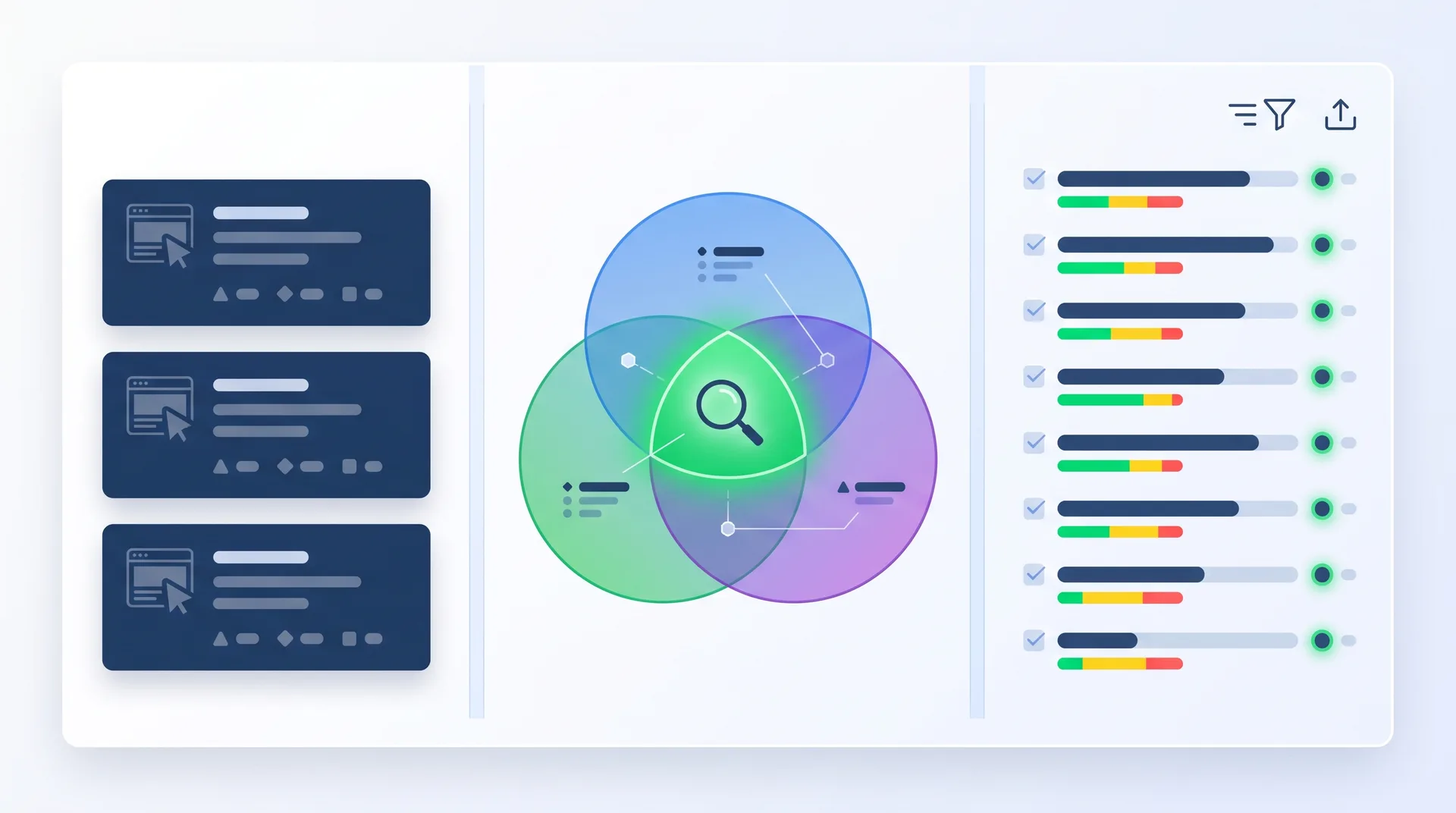
Step 3: Prioritize Keywords You Can Actually Win
I've seen too many brands waste months targeting keywords they have zero chance of ranking for. A startup with a Domain Authority of 15 going after keywords where the top 10 results all have DA 70+ and thousands of backlinks.
That's not strategy. That's wishful thinking.
Here's the truth: you need to balance short-term wins with long-term investments. Go after low competition keywords with decent search volume first. Build momentum. Earn links. Grow your authority. Then move upmarket.
Pros
Low competition keywords: Faster rankings, quicker traffic gains, builds confidence and momentum
Low competition keywords: Often have better conversion rates because they're more specific
Low competition keywords: Require fewer backlinks and less content depth to rank
Cons
Low competition keywords: Lower search volume means limited traffic ceiling
High value keywords: Take 6-12+ months to rank even with solid strategy
High value keywords: Require significant content investment and link building to compete
So how do you decide which keywords to target first?
Keyword Prioritization Framework
Check keyword difficulty score. Target keywords with difficulty 20-40 if your DA is under 30
Analyze the current top 10. If you see weak content, outdated info, or poor UX, that's your opportunity
Evaluate search intent. Can you create content that matches what users actually want better than what ranks now?
Consider your resources. Do you have the expertise and content budget to create something genuinely superior?
Look for SERP feature opportunities. Can you target featured snippets, People Also Ask, or video results?
Step 4: Analyze Competitor Content to Find Your Edge
Knowing which keywords competitors rank for is useful. Knowing why they rank is what actually wins you traffic.
I spend more time analyzing competitor content than I do on keyword research. Because once you understand what makes their content rank, you can build something better. Not just longer or more detailed. Actually better.
Here's what I look for when I audit competitor content:
Competitor Content Analysis Checklist
What topics are they covering that I'm not?
Run a content gap analysis. Export all their ranking pages, categorize by topic, and compare against your own content. The gaps you find are your roadmap for the next 6 months.
How deep is their content?
Check word count, number of subtopics covered, and level of detail. If they have 1,500-word posts, can you create 3,000-word comprehensive guides? But only if the extra depth adds genuine value.
How fresh is their content?
Look at publish dates and last updated dates. If their top-ranking content is 2+ years old, you have an opportunity to publish something current with 2026 data and examples.
What SERP features are they winning?
Are they ranking for featured snippets, People Also Ask boxes, or video carousels? Study how they structured their content to win those positions. Then do it better.
What's their content format?
Text-only blog posts? Video embeds? Interactive elements? Infographics? In 2026, multimedia integration and interactive experiences often outperform pure text.
How's their user experience?
Is the content easy to scan? Do they use short paragraphs, bullet points, and clear headers? Or is it a wall of text? Poor UX is a weakness you can exploit.
What weaknesses can I exploit?
Missing subtopics, outdated examples, no original research, weak internal linking, slow page speed, poor mobile experience. Every weakness is your opportunity.
The goal isn't to copy what competitors do. It's to identify gaps and weaknesses you can exploit to create something genuinely superior.
Comprehensiveness: Cover every subtopic and related question a user might have
Freshness: Include 2026 data, recent examples, and current best practices
Originality: Add unique insights, case studies, or research competitors don't have
Format: Make it easier to consume with better structure, visuals, and UX
Depth: Go deeper on technical details or strategic nuance where competitors stay surface-level
Step 5: Create Superior Content That Actually Ranks
You've identified the keywords. You've analyzed competitor weaknesses. Now you need to build content that doesn't just match what's ranking but genuinely outperforms it.
Here's where most brands fail: they create content that's technically optimized but doesn't actually satisfy search intent better than what already ranks. Google doesn't care if you checked all the SEO boxes. It cares if users prefer your result.
Content Optimization Checklist for 2026
Structure content to target the primary keyword plus 3-5 semantic variations naturally
Optimize title tag (include primary keyword, keep under 60 characters, make it clickable)
Write a compelling meta description that includes the keyword and a clear value proposition
Use H1 for the main title, H2s for major sections, H3s for subsections (include keywords naturally)
Add original images, diagrams, or screenshots (not just stock photos)
Embed relevant video content if it enhances understanding
Internal link to 2-3 related pages on your site (only if genuinely relevant)
Add schema markup (FAQ, How-To, Article) to increase chances of rich results
Optimize page speed (target under 2 seconds on mobile)
Ensure mobile-first design with easy navigation and readable text
But technical optimization is table stakes. What actually moves the needle is creating content that's genuinely better.
Comprehensiveness
Cover the topic more thoroughly than any competitor. Answer every related question. Leave no gaps.
Readability
Use short paragraphs, bullet points, and clear headers. Make it easy to scan and find information fast.
Multimedia Integration
Add images, videos, interactive elements, and data visualizations. Text-only content is losing ground in 2026.
Original Insights
Include case studies, original research, or unique perspectives competitors don't have. This is what earns links.
And here's the controversial take: AI-assisted content creation is fine. I use it. But if your content reads like every other AI-generated post out there, you won't rank. The brands winning in 2026 use AI to accelerate research and drafting, then add human expertise, real examples, and unique insights AI can't replicate.
SEO is not about gaming the system. It's about providing the best possible answer to the user's question. If you nail that, the rankings follow.
Prithvi Jadwani, TechDevs SEO Philosophy

Step 6: Build Authority Signals That Help You Outrank Competitors
Content alone won't get you to position 1. You need authority signals. Backlinks from reputable sites. Brand mentions. Social proof. E-E-A-T indicators that tell Google you're a legitimate source worth ranking.
The fastest way to build authority? Target the same sites linking to your competitors.
Pull competitor backlink profiles using Ahrefs or Semrush. Export all dofollow links from sites with DA 30+
Filter for relevant opportunities. Remove spammy directories and irrelevant sites. Focus on editorial links from real publications
Identify link-worthy content. What type of content earned them links? Original research? Comprehensive guides? Tools?
Create something better. If they got links with a 2,000-word guide, create a 4,000-word resource with original data
Outreach strategically. Reach out to sites that linked to competitors with a genuine reason why your content is more valuable
But link building is just one piece of the authority puzzle.
Building Authority Beyond Backlinks
How do I build topical authority?
Create content clusters. Pick 3-5 core topics relevant to your business. For each topic, publish a comprehensive pillar page (3,000+ words) and 8-10 supporting articles that dive deep into subtopics. Interlink them strategically.
Do social signals impact rankings?
Not directly. But social shares and engagement drive traffic, which sends positive user signals to Google. Plus, content that performs well socially often earns backlinks naturally.
What about brand mentions without links?
Google is getting better at recognizing unlinked brand mentions as authority signals. Being mentioned in reputable publications, podcasts, and industry discussions builds credibility even without a backlink.
How important is E-E-A-T in 2026?
Critical. Google wants to see Experience, Expertise, Authoritativeness, and Trustworthiness. Add author bios with credentials, cite sources, get expert reviews, display trust badges, and showcase real customer results.
If you want to rank for competitive keywords, you need a comprehensive authority-building strategy. Content + links + topical depth + E-E-A-T signals. Miss any piece and you're leaving rankings on the table.
Monitor, Measure, and Refine Your Strategy
Here's what separates brands that dominate search from those that plateau: relentless monitoring and adaptation.
I've seen companies publish great content, start ranking, then completely stop paying attention. Six months later, they've lost half their positions because competitors updated their content, algorithm updates shifted rankings, and they didn't adapt.
Your competitive SEO strategy isn't a one-time project. It's an ongoing process of measurement, learning, and refinement.
Key Metrics to Track
Ranking positions for target keywords (track weekly with automated tools)
Organic traffic by landing page (identify winners and losers)
Conversion rates from organic traffic (traffic without conversions is pointless)
Visibility share vs. competitors (are you gaining or losing ground?)
Backlink growth (both quantity and quality)
SERP feature wins (featured snippets, People Also Ask, video results)
Set up automated rank tracking for your priority keywords. I use Semrush Position Tracking, but Ahrefs Rank Tracker and SERanking work just as well. The key is having daily or weekly data so you can spot trends fast.
And here's the most important part: double down on what works. If you've gained 10 positions on a keyword in 3 months, invest more in that content. Update it. Build more links to it. Create supporting content around it. Scale your wins.
Frequently Asked Questions
How long does it take to rank against competitor keywords?
It depends on keyword difficulty and your site's authority. For low competition keywords, you can see movement in 3-6 months. For competitive terms, expect 6-12+ months of consistent effort. The key is targeting a mix of quick wins and long-term investments.
What's the best free tool for competitor keyword analysis?
Google Search Console shows you which keywords you already rank for and where you're losing to competitors. Combine it with manual Google searches and free versions of Ubersuggest or AnswerThePublic. But honestly, investing in Semrush or Ahrefs pays for itself fast if you're serious about SEO.
Can I rank for competitor brand keywords?
Legally, yes. You can create comparison content like 'Brand X vs Brand Y' or 'Brand X alternatives.' But ranking for a competitor's exact brand name as a commercial intent keyword is extremely difficult and often not worth the effort. Focus on non-branded keywords where you can actually win.
How many competitor keywords should I target at once?
Start with 10-15 high-priority keywords. Create content targeting each one, optimize it properly, and build links. Once those are ranking, add another batch. Trying to target 100 keywords at once spreads your resources too thin and dilutes results.
What if my competitors have much higher domain authority?
Target keywords they're not optimizing well. Look for long-tail variations, question-based keywords, and topics where their content is outdated or weak. You can outrank higher-authority sites by creating genuinely superior content that better matches search intent.
How has AI changed competitor keyword research in 2026?
AI platforms like ChatGPT now handle millions of searches daily. Your competitor analysis must include how they show up in AI search results, not just Google. Plus, AI tools can accelerate keyword extraction and pattern identification, but human strategy still wins.
Should I target the same keywords as my competitors or find different ones?
Both. Target competitor keywords where you can create better content and win. But also identify keyword gaps they're missing entirely. The best strategy combines stealing market share from competitors and claiming uncontested territory they haven't discovered yet.
Ready to Steal Market Share from Your Competitors?
We've helped 250+ brands close visibility gaps and dominate their competitive landscape. Book a free discovery call and we'll show you exactly which competitor keywords you should target first.