The Ultimate D2C Ecommerce Framework to 10X Your Business in 2026
Explore top D2C ecommerce frameworks for 2026. Learn how to scale your business using advanced CRO strategies and AI-powered SEO. Boost conversions today!
 Written byPrithvi Jadwani
Table of contents
Summarize this article with AI
TL;DR
Most D2C brands in 2026 are running 5-8 disconnected AI tools and wondering why they're not seeing results. The answer: fragmented systems don't talk to each other, feature volume doesn't equal business outcomes, and deflection isn't the same as resolution. The brands that win are consolidating to fewer, more capable platforms that actually take action across order management, payment, and fulfillment systems. This framework shows you how to build a scalable D2C operation using AI-powered CRO, omnichannel automation, and data-driven decision making.
- Resolution Rate Over Feature Count. Top ecommerce AI tools hit 67-84% resolution rates by taking backend actions, not just answering questions
- Consolidated Platforms Win. Replace 5-8 fragmented tools with integrated systems that deliver measurable ROI on cost per order and conversion lift
- Customer-Facing AI First. Support automation and lifecycle marketing deliver the fastest, most measurable returns compared to back-office tools
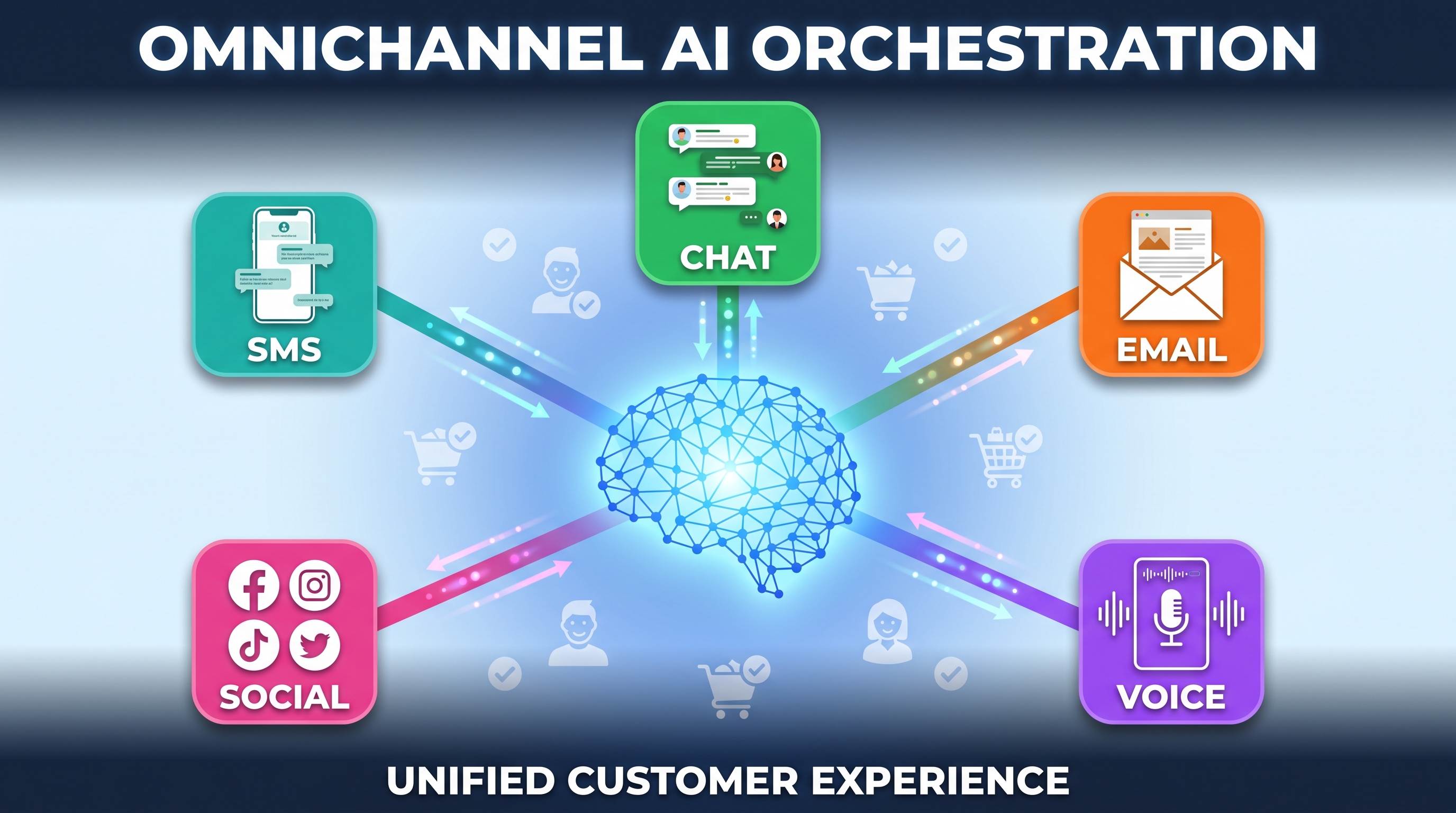
- Omnichannel Orchestration. Modern frameworks operate across chat, email, voice, WhatsApp, Instagram, Facebook, and SMS with unified data
Why Traditional D2C Ecommerce Frameworks Are Failing in 2026
Here's what nobody tells you about running a D2C ecommerce business in 2026: you're probably burning money on tools that don't talk to each other. Ecommerce teams are running five to eight AI tools across support, marketing, personalization, content, and analytics. And most of them can't tell you which ones actually move the needle on conversions.
The problem isn't AI. It's the fragmentation.
You've got one tool for customer support that deflects tickets but can't process a refund. Another for email marketing that doesn't know what happened in your chat conversations. A third for product recommendations that has no idea a customer just called about a damaged shipment. They all generate reports. None of them solve the actual problem: getting customers what they need, fast, so they buy again.
Customer expectations have changed faster than most tech stacks. People expect instant answers. They expect the AI chatbot to actually fix their order, not tell them to email someone. They expect the brand to remember their last three purchases when they ask a question on Instagram. And when you can't deliver that, they go to a competitor who can.
The 2026 D2C Ecommerce Framework: 4 Pillars for Scalable Growth
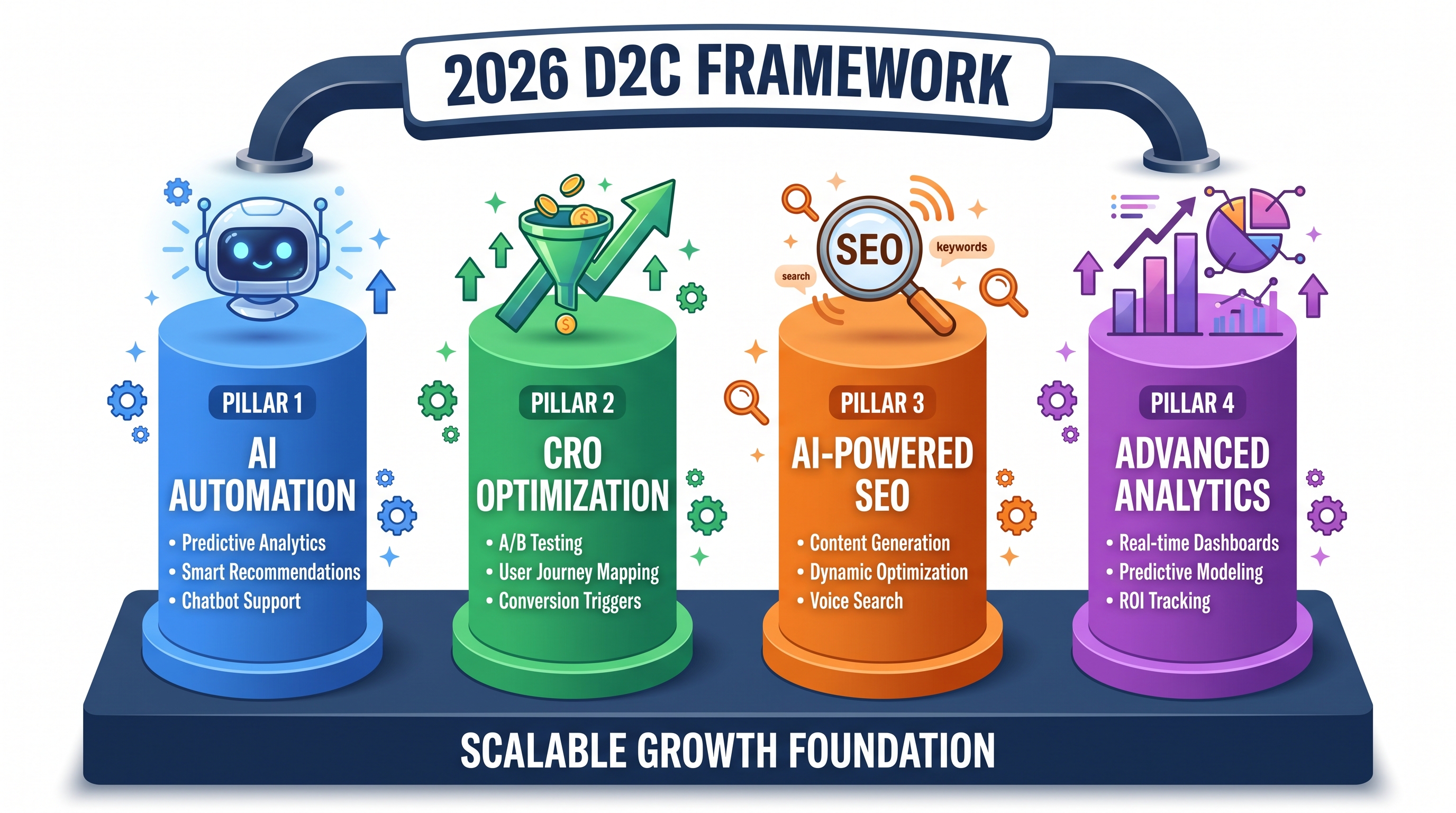
The brands scaling profitably in 2026 aren't using more tools. They're using smarter systems. This framework consolidates your tech stack around four pillars that actually compound returns when they work together.
AI-Powered Customer Experience Automation
Autonomous agents that resolve issues across every channel by connecting to your order management, payment, and fulfillment systems. Not chatbots that deflect. Agents that take action.
Conversion Rate Optimization with Backend Integration
CRO that goes beyond A/B testing landing pages. Real-time actions like processing refunds, updating shipping addresses, and modifying orders based on customer behavior and intent.
AI SEO and Content Generation at Scale
Dynamic product descriptions, category pages, and blog content optimized for search intent and user behavior. Not generic templates. Content that converts because it's built on real customer data.
Data-Driven Decision Making with Unified Analytics
One source of truth for customer interactions, conversion triggers, and revenue attribution across all channels. Track what actually drives repeat purchases, not just vanity metrics.
Here's why this works: each pillar feeds the others. Your AI customer service learns from support conversations to improve product descriptions. Your CRO data informs which content topics drive conversions. Your unified analytics show you exactly which AI investments deliver ROI and which ones are just burning budget.
Most frameworks fail because they treat these as separate initiatives. Marketing does their thing. Support does theirs. Tech builds in a vacuum. But the brands winning in 2026 are the ones that connected these systems so they learn from each other.
Customer service AI that processes refunds automatically teaches your CRO team which friction points kill conversions
Omnichannel data from chat, email, and social shows you which product questions need better SEO content
Resolution rate metrics reveal which backend integrations actually matter versus which are just nice-to-haves
Conversion attribution across the full customer journey shows you where to double down and where to cut budget
Building Your AI-Powered CRO Playbook: From Backend Actions to Conversion Triggers
Let's talk about what separates real AI automation from the chatbots that just frustrate customers. The difference is backend integration. The best AI tools don't just answer questions. They take action.
Think about the last time you contacted a brand's support. You wanted a refund, or you needed to change your shipping address, or you wanted to know why your order was delayed. Did the chatbot help? Or did it say 'let me connect you with a human' after three failed attempts to understand you?
That's deflection, not resolution. And it's expensive.
Pros
Resolution-focused AI connects to order management systems to process refunds instantly
Updates shipping addresses in real-time without human intervention
Checks inventory and fulfillment status across warehouses to give accurate ETAs
Handles returns, exchanges, and order modifications end-to-end
Achieves 67-84% resolution rate, meaning most customers never need a human agent
Cons
Deflection-focused chatbots only answer FAQs from a knowledge base
Can't take actions in backend systems, forcing customers to wait for human agents
Frustrate customers with 'I don't understand' responses
Require expensive human support teams to handle the actual work
Measure success by ticket deflection rate instead of customer satisfaction
The top ecommerce AI platforms in 2026 are hitting resolution rates between 67% and 84%. That means seven to eight out of every ten customer issues get fully resolved without a human touching them. The cost per resolution? $0.99. Compare that to traditional support costs of $5 to $15 per contact, and you see why customer-facing AI delivers the fastest, most measurable ROI.
Your CRO Integration Checklist
Connect AI to your order management system for real-time order data
Enable automated refund processing with configurable approval rules
Integrate payment systems for instant transaction updates
Link fulfillment and shipping APIs for accurate tracking and ETAs
Set up address modification workflows that update across all systems
Build multi-step procedures for complex scenarios like exchanges and returns
Track resolution rate, cost per resolution, and conversion impact as primary KPIs
But here's where it gets interesting for CRO: every automated action is a conversion trigger. When a customer gets an instant refund instead of waiting 3-5 business days, they're more likely to buy again. When they can modify their order in the chat without calling anyone, they complete the purchase instead of abandoning it. When they get a real answer about shipping delays, they don't leave a one-star review that kills your conversion rate for the next hundred visitors.
AI SEO Strategies for D2C Ecommerce: Content Generation, Dynamic Optimization & Omnichannel Orchestration
SEO for ecommerce in 2026 isn't about keyword stuffing product descriptions anymore. It's about using AI to generate content at scale that actually matches search intent and converts browsers into buyers. And it's about orchestrating that content across every channel where your customers show up.
The brands doing this well aren't just using AI to write blog posts. They're using it to dynamically optimize product pages based on what people are searching for right now. They're generating category descriptions that change based on seasonal trends. They're creating FAQ content pulled directly from real customer support conversations.
Product descriptions that highlight the features customers actually ask about in support chats
Category pages optimized for long-tail keywords from your search analytics
Blog content addressing the objections and questions that come up in sales conversations
FAQ sections built from the most common support tickets, with answers that convert
User-generated content integrated into product pages to boost social proof and search rankings
But the real power move in 2026 is omnichannel orchestration. Your customers don't just interact with you on your website. They message you on Instagram. They ask questions on WhatsApp. They email. They call. And if your AI isn't consistent across all those channels, you're losing sales.
This matters for SEO because Google isn't just ranking your website anymore. They're indexing your social content, your customer reviews, your support interactions. Brands with consistent, helpful information across all channels get rewarded. Brands with fragmented, contradictory messaging get buried.
Common AI SEO Questions for D2C Ecommerce
How do I use AI for product descriptions without sounding generic?
Feed your AI real customer language from support tickets, reviews, and chat transcripts. The best product descriptions don't use marketing speak. They use the exact words customers use when they're happy with a purchase. Train your AI on that data, not on competitor websites.
Can AI-generated content actually rank in 2026?
Yes, but only if it's good. Google's algorithms have gotten better at detecting thin, generic AI content. What works: AI that pulls from your unique data (customer conversations, sales insights, product specs) to create content that answers real questions. What doesn't work: AI that regurgitates the same information as everyone else.
How do I measure SEO ROI from AI content?
Track conversion attribution, not just traffic. Use your unified analytics to see which AI-generated pages drive actual purchases, not just pageviews. The best metric: revenue per visitor on AI-optimized pages compared to manually written ones. If the AI content converts better, scale it. If it doesn't, figure out why.
Should I use AI for blog content or just product pages?
Both, but prioritize based on your customer journey data. If your analytics show that blog readers convert at 2% and product page visitors convert at 8%, focus your AI efforts on product content first. Blog content is great for top-of-funnel traffic, but product pages are where you close deals.
The Decision Framework: Consolidated Platforms vs. Fragmented AI Tool Stacks
You're going to see a lot of AI tools promising to transform your ecommerce business. Most of them will show you a demo with impressive features. Some will have fancy dashboards. A few will drop names of big brands using them.
Here's what actually matters: resolution rate, cost per resolution, and integration depth. Not feature volume.
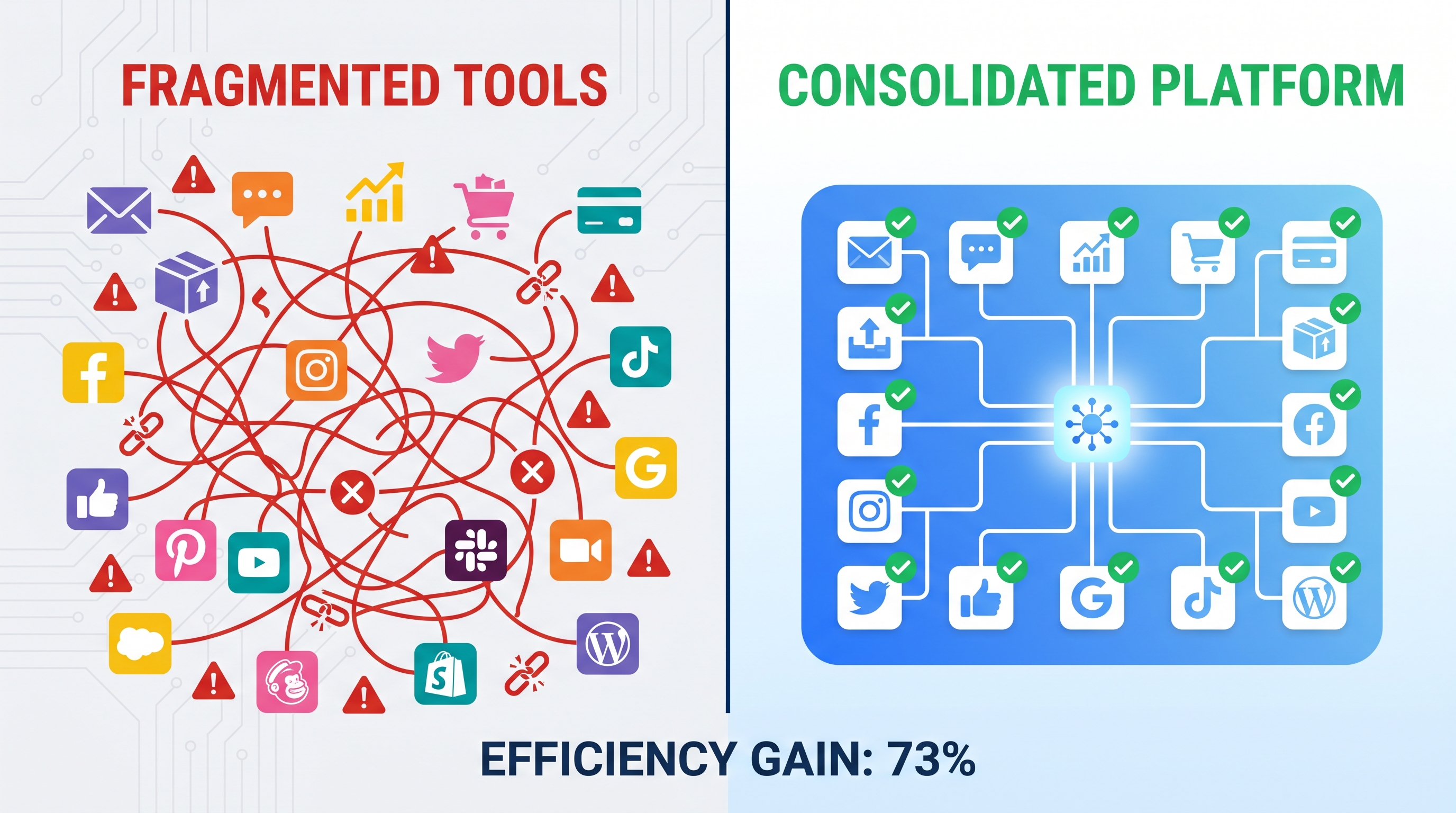
The consolidation trend in 2026 is real. Brands are replacing 5-8 specialized tools with fewer, more capable platforms that actually talk to each other. Why? Because managing integrations between eight different systems is expensive, error-prone, and slow. And because customers don't care about your tech stack. They care about getting their problem solved, fast.
Pros
Consolidated platforms share data across all functions automatically
Single source of truth for customer interactions and revenue attribution
Faster implementation with pre-built integrations to major ecommerce systems
Lower total cost of ownership compared to managing multiple tool subscriptions
Unified analytics showing ROI across support, marketing, and sales
Cons
Specialized tools may excel at one specific function
Can be cheaper upfront if you only need one capability
Sometimes offer niche features not available in broader platforms
May integrate with legacy systems that consolidated platforms don't support
So when do you choose specialized versus consolidated? If you're a small brand just starting out and you only need email marketing automation, a specialized tool might work. But if you're running a real D2C operation with support, marketing, content, and analytics needs, fragmentation will kill you. You'll spend more time managing integrations than actually serving customers.
Your AI Tool Evaluation Scorecard
Resolution rate: Does it fully resolve issues or just deflect to humans?
Cost per resolution: What do you actually pay when a customer problem gets solved?
Integration depth: Does it connect to your order, payment, and fulfillment systems?
Omnichannel support: Does it work across chat, email, voice, social, and SMS?
Data unification: Does it share context across all customer touchpoints?
Measurable ROI: Can you track impact on conversion rate and customer lifetime value?
Implementation speed: How long until you see results, not just until it's 'live'?
One more thing: customer-facing AI delivers faster ROI than back-office tools. Support automation and lifecycle marketing show measurable results in weeks. Inventory forecasting and supply chain optimization take months. Start with the tools that directly touch customers and drive revenue. Add the operational stuff later.
Fast ROI: Customer-Facing AI
Support automation, chat agents, lifecycle email, personalized recommendations. Measurable impact on resolution rate and conversion in 30-60 days.
Slow ROI: Back-Office AI
Inventory forecasting, supply chain optimization, fraud detection. Important but takes 6-12 months to show clear business impact.
AI Governance, Ethics & Data Privacy: Your Ecommerce Compliance Toolkit
Let's talk about the part most ecommerce brands ignore until they get fined: AI governance and data privacy. If your AI is accessing customer order data, payment information, and personal details to resolve issues, you're handling sensitive information. And that means you're subject to GDPR, CCPA, and a growing list of AI-specific regulations.
This isn't theoretical. Brands are getting hit with penalties for algorithmic bias in pricing, for using customer data without clear consent, and for AI-driven decisions that lack transparency. The 'move fast and break things' approach doesn't work when you're dealing with people's money and personal information.
AI Governance FAQs for D2C Brands
What AI regulations apply to my ecommerce business?
If you sell to EU customers, GDPR applies. California customers? CCPA. The EU AI Act is rolling out in 2026 with specific requirements for high-risk AI systems, which includes some pricing and credit decision algorithms. And more states and countries are passing AI-specific laws every quarter. Work with a lawyer who specializes in ecommerce and data privacy.
How do I address algorithmic bias in my AI tools?
Start by auditing your training data. If your AI learns from historical customer interactions, it might perpetuate biases in how you've treated different customer segments. Test your AI's decisions across demographic groups. If it's offering different prices or support quality to different groups without a legitimate business reason, you have a bias problem. Fix it before a regulator finds it.
Do I need to tell customers when AI is handling their support request?
In most jurisdictions, yes. But don't make it scary. A simple 'You're chatting with our AI assistant, which can help you with orders, returns, and tracking. Need a human? Just ask.' works fine. Transparency builds trust. Hiding that it's AI until the customer figures it out destroys it.
What data privacy practices should I follow when AI accesses order and payment info?
Minimize data access to what's actually needed. Your AI doesn't need full credit card numbers to process a refund. Use tokenization and encryption. Log every AI action for audit trails. Set up automatic data deletion for conversations after a reasonable retention period. And make sure your AI vendor has SOC 2 compliance and clear data processing agreements.
How do I build customer trust with AI deployment?
Be upfront about what your AI can and can't do. Don't oversell it. When it makes a mistake, own it and fix it fast. Give customers an easy way to reach a human when the AI isn't working. And use your AI to actually help people, not just to cut costs. Customers can tell the difference.
Your AI Governance Policy Template
Document what data your AI accesses and why it needs that data
Get explicit customer consent for AI processing of personal information
Implement audit logging for all AI decisions affecting customers
Create a human appeal process for AI-driven decisions customers disagree with
Test AI systems regularly for bias across customer demographics
Set up automatic data deletion policies for AI conversation logs
Verify your AI vendor's compliance certifications and data processing agreements
Train your team on when to escalate AI issues to legal or compliance
Dynamic Pricing & Inventory Forecasting: AI That Maximizes Margins
Dynamic pricing sounds great in theory: adjust prices in real-time based on demand, competition, and inventory levels to maximize margin. In practice, most brands screw it up by either changing prices so often that customers lose trust, or by not changing them enough to actually capture value.
The key is knowing when to optimize for margin and when to optimize for volume. If you're sitting on excess inventory of a seasonal product, you need volume. Price it to move. If you've got a hot seller that's going to sell out anyway, capture margin. Don't leave money on the table.
AI helps by analyzing patterns you'd never catch manually: which products are price-sensitive and which aren't, which customer segments will pay more, which times of day see higher conversion at premium prices, and which competitors are actually stealing your sales versus just making noise.
Real-time competitive monitoring to see when rivals drop prices on products you both carry
Demand forecasting that predicts stockouts before they happen so you can adjust pricing
Customer segmentation to offer different prices to different audiences without alienating anyone
Promotional strategy automation that protects margin while driving volume during slow periods
Inventory optimization that reduces overstock and stockout costs by 20-40%
But here's what most guides won't tell you: dynamic pricing only works if you have the operational discipline to act on it. If your AI says 'raise prices on Product X by 15%' and you're too scared to do it, you're wasting the tool. If it says 'you're going to stock out of Product Y in 8 days' and you don't expedite a reorder, you lose sales.
The brands that win with dynamic pricing aren't the ones with the fanciest algorithms. They're the ones that actually trust their data and move fast when the AI tells them to act.
Prithvi Jadwani, CEO at TechDevs
Implementation Roadmap: 90-Day Plan to Deploy Your D2C Ecommerce Framework
You've read the theory. Now let's talk about how to actually implement this framework in your business. Most brands fail not because they picked the wrong tools, but because they tried to do everything at once and got overwhelmed.
This 90-day roadmap breaks it into three phases: audit and plan, integrate and pilot, scale and optimize. Each phase has clear deliverables and success metrics. Stick to it.
90-Day Implementation Roadmap
Phase 1 (Days 1-30): Audit, Define, and Select
Week 1-2: Audit your current tool stack. List every AI and automation tool you're running. Document what each one does, what it costs, and what KPIs it's supposed to improve. Be honest about which ones are actually delivering ROI and which ones are just 'nice to have.'
Week 3: Define your KPIs. Pick 3-5 metrics that actually matter to your business: resolution rate, cost per order, conversion rate, customer lifetime value, and repeat purchase rate are good starting points. Everything else is a vanity metric.
Week 4: Evaluate consolidated platforms versus keeping your fragmented stack. Use the decision framework from earlier in this post. Get demos. Ask about integration depth, not feature count. Pick your platform and get executive buy-in on the budget.
Phase 2 (Days 31-60): Integrate, Train, and Pilot
Week 5-6: Integrate your chosen platform with backend systems. Connect order management, payment processing, and fulfillment APIs. This is where most implementations slow down, so allocate engineering time upfront.
Week 7: Train your AI models on your actual data. Feed it real customer conversations, support tickets, product information, and FAQs. Don't just use the vendor's default training. Customize it to your brand voice and your customers' language.
Week 8: Launch a pilot program. Start with one channel (usually chat) and one customer segment (maybe your most engaged customers or your highest-volume support issues). Measure resolution rate, customer satisfaction, and cost per resolution. Iterate based on what you learn.
Phase 3 (Days 61-90): Scale, Optimize, and Measure
Week 9-10: Scale across channels. Add email, then social, then voice. Don't rush this. Make sure each channel is working well before adding the next one.
Week 11: Optimize based on data. Look at which issues your AI resolves best and which ones still need humans. Adjust your procedures and training data. Look at which channels drive the most conversions and double down there.
Week 12: Measure ROI and present results. Calculate cost savings from reduced support costs, revenue gains from improved conversion rates, and customer lifetime value changes from better experiences. Present to leadership with a plan for continued optimization.
Common Implementation Pitfalls to Avoid
Trying to implement across all channels simultaneously instead of piloting one first
Using vendor default training data instead of customizing with your actual customer language
Measuring vanity metrics like 'number of conversations' instead of resolution rate and ROI
Not allocating enough engineering time for backend integrations
Launching without clear KPIs and success criteria defined upfront
Treating this as an IT project instead of a revenue and customer experience initiative
Giving up after the first week if results aren't perfect instead of iterating
Look, implementing a new ecommerce framework is hard. You're going to hit roadblocks. Your team is going to resist change. Your first pilot might not hit the numbers you hoped for. That's normal. The brands that succeed are the ones that keep iterating, keep measuring, and keep pushing forward even when it's messy.
Ready to Build Your D2C Ecommerce Framework?
We've helped dozens of D2C brands implement AI-powered frameworks that actually deliver ROI. Not just tools that look good in demos. Systems that resolve customer issues, boost conversions, and scale profitably.
Book a free discovery call and we'll audit your current stack, identify what's working and what's burning budget, and build you a custom 90-day implementation plan.