Nobody is Googling Your Business Name: Here's Why That's Destroying Your SEO
Relying on branded searches is killing your SEO. Learn why optimizing for what customers actually search matters more than your business name rankings.
 Written byPrithvi Jadwani
Table of contents
Summarize this article with AI
TL;DR
Most businesses rank #1 for their own name but get zero traffic because nobody knows to search for them. Branded search SEO is a vanity metric. The real opportunity is in non-branded keywords, the generic terms your customers actually type into Google when they need what you sell. If you're only optimizing for your business name, you're leaving 90% of your potential traffic on the table.
- Branded Search Is a Dead End. Ranking #1 for your business name means nothing if no one knows your name exists
- Non-Branded Keywords Drive Discovery. Generic search terms like 'plumber near me' have 100x the volume of your brand name
- The 80/20 Rule. Allocate 80% of SEO effort to non-branded discovery terms, 20% to brand protection
- Measure What Matters. Track non-branded rankings, organic discovery traffic, and conversion rate by keyword type
The Brutal Truth: Your Business Name Isn't a Search Strategy
You rank #1 for your business name. Congratulations. You're also invisible.
Here's what nobody tells you about branded search SEO: it only works after you've already built awareness through other channels. If people don't know your name, they can't search for it. And if they can't search for it, your perfect #1 ranking is worthless.
Think about it. When someone's kitchen sink is flooding at 2 AM, they don't open Google and type 'Johnson Plumbing Services.' They type 'emergency plumber near me' or 'plumber open now.' That's a non-branded keyword. That's where the actual traffic lives.
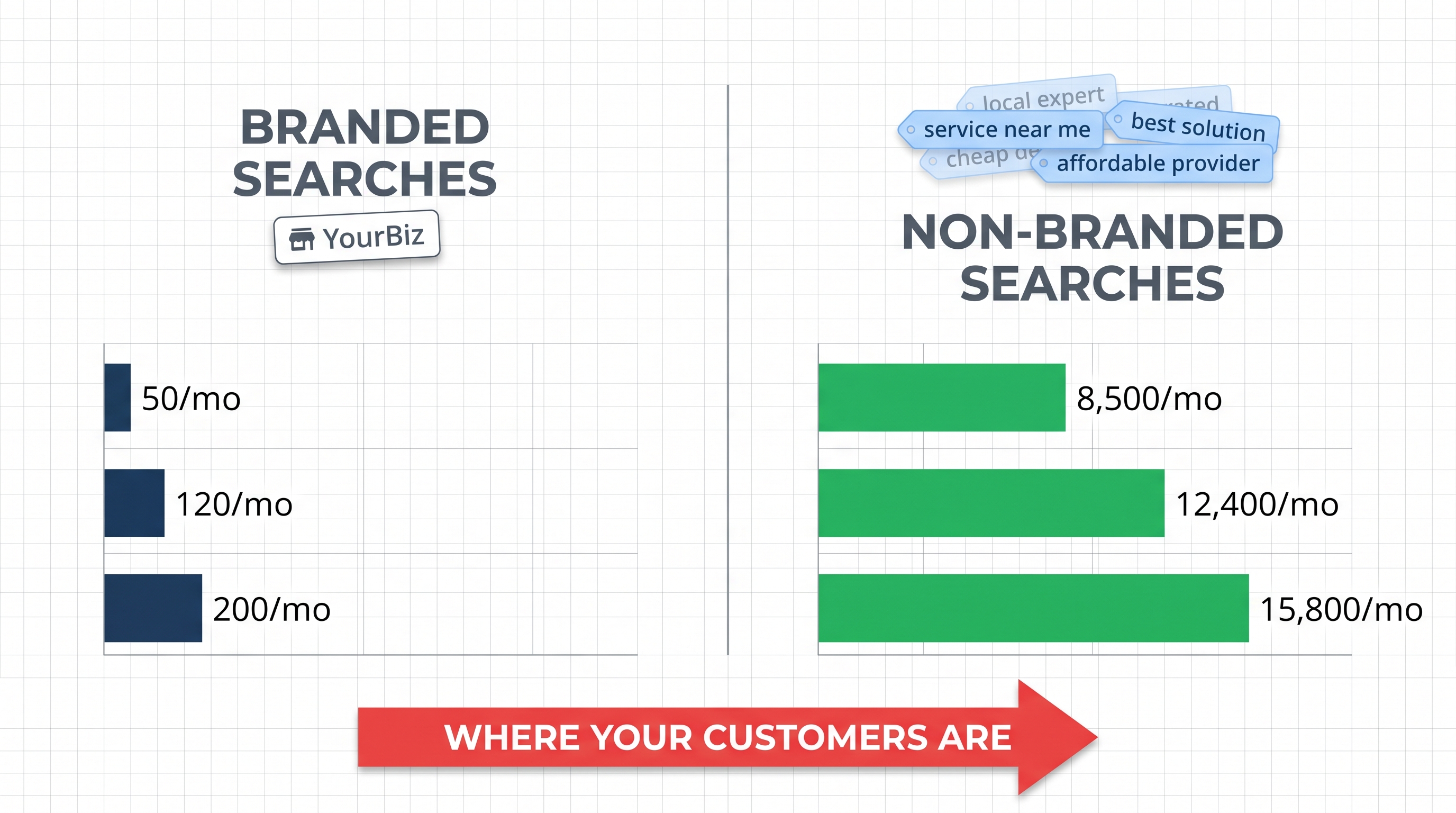
I've seen this play out dozens of times. A local service business comes to us, proud that they rank #1 for their company name. We pull their analytics. They're getting 50 visits a month from branded searches. Meanwhile, 'plumber near me' gets searched 12,000 times in their city every month, and they don't show up anywhere.
Understanding Branded vs Non-Branded Keywords (And Why It Matters)
Let's get clear on what we're talking about. Branded keywords include your company or product name. Someone searching 'Logitech keyboard' is using a branded term. They already know Logitech exists. Non-branded keywords are generic: 'bluetooth keyboard' or 'wireless keyboard for Mac.'
The difference isn't just semantic. It's strategic. Branded searches come from people who already have awareness. They've seen your ad, heard about you, or been referred. Non-branded searches come from people in discovery mode. They have a problem. They don't know you're the solution yet.
Branded Keywords
Include your company or product name. Low volume, high intent from existing awareness. Example: 'TechDevs SEO services'
Non-Branded Keywords
Generic terms customers use to find solutions. High volume, discovery-phase traffic. Example: 'SEO agency for tech companies'
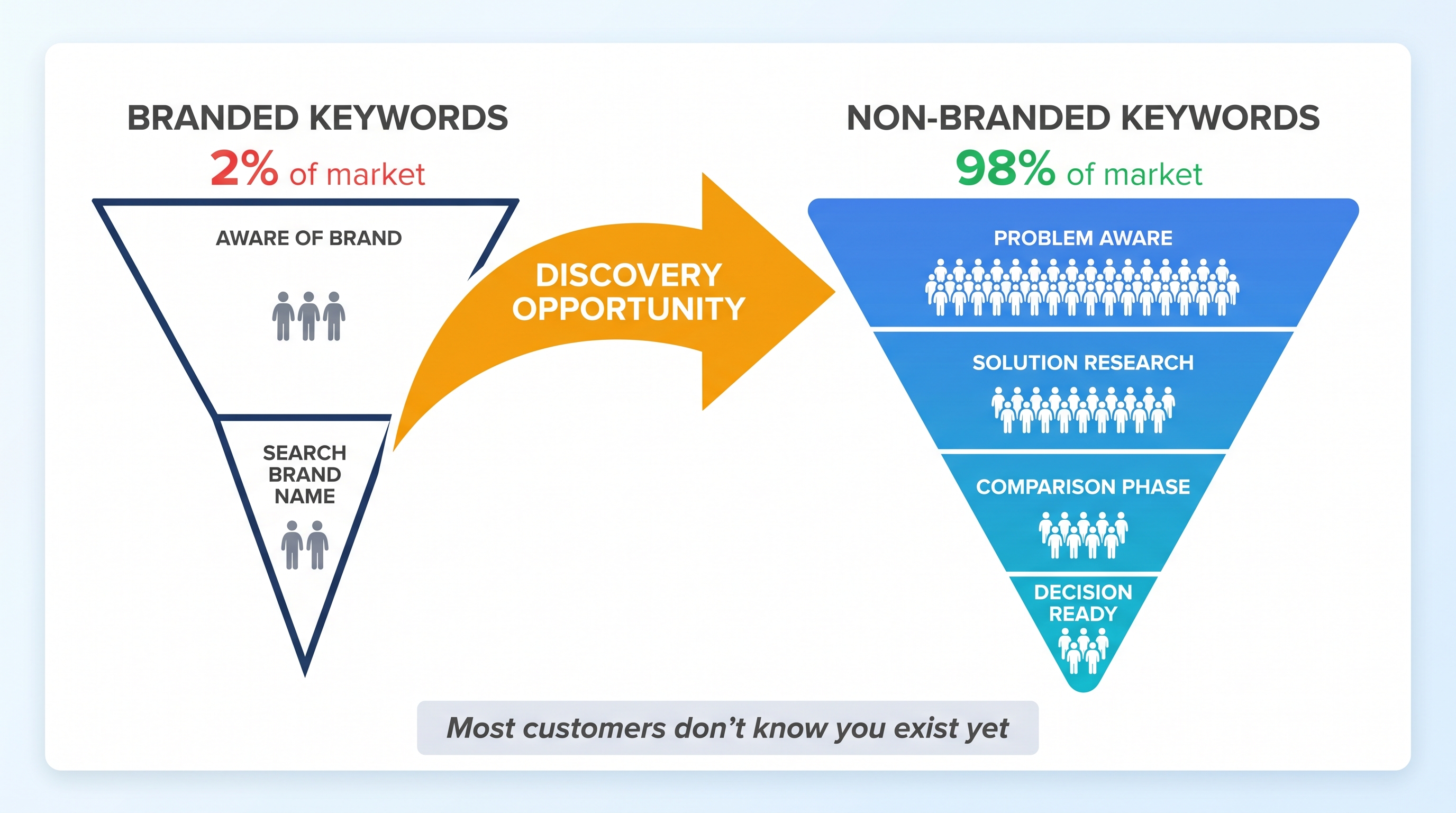
Non-branded keywords represent the entire market of people who need what you sell but don't know you exist. That's your growth opportunity. Branded keywords represent the tiny slice of people who already found you somewhere else and are now Googling your name to get your website or phone number.
Which one do you think has more volume? Which one actually grows your business?
Branded searches indicate existing awareness but limited growth potential
Non-branded searches reveal true market size and customer demand
Discovery-phase customers use non-branded terms and represent untapped revenue
Focusing only on branded SEO means you're fishing in a pond while ignoring the ocean
The Real Cost: What You're Losing by Focusing Only on Brand Terms
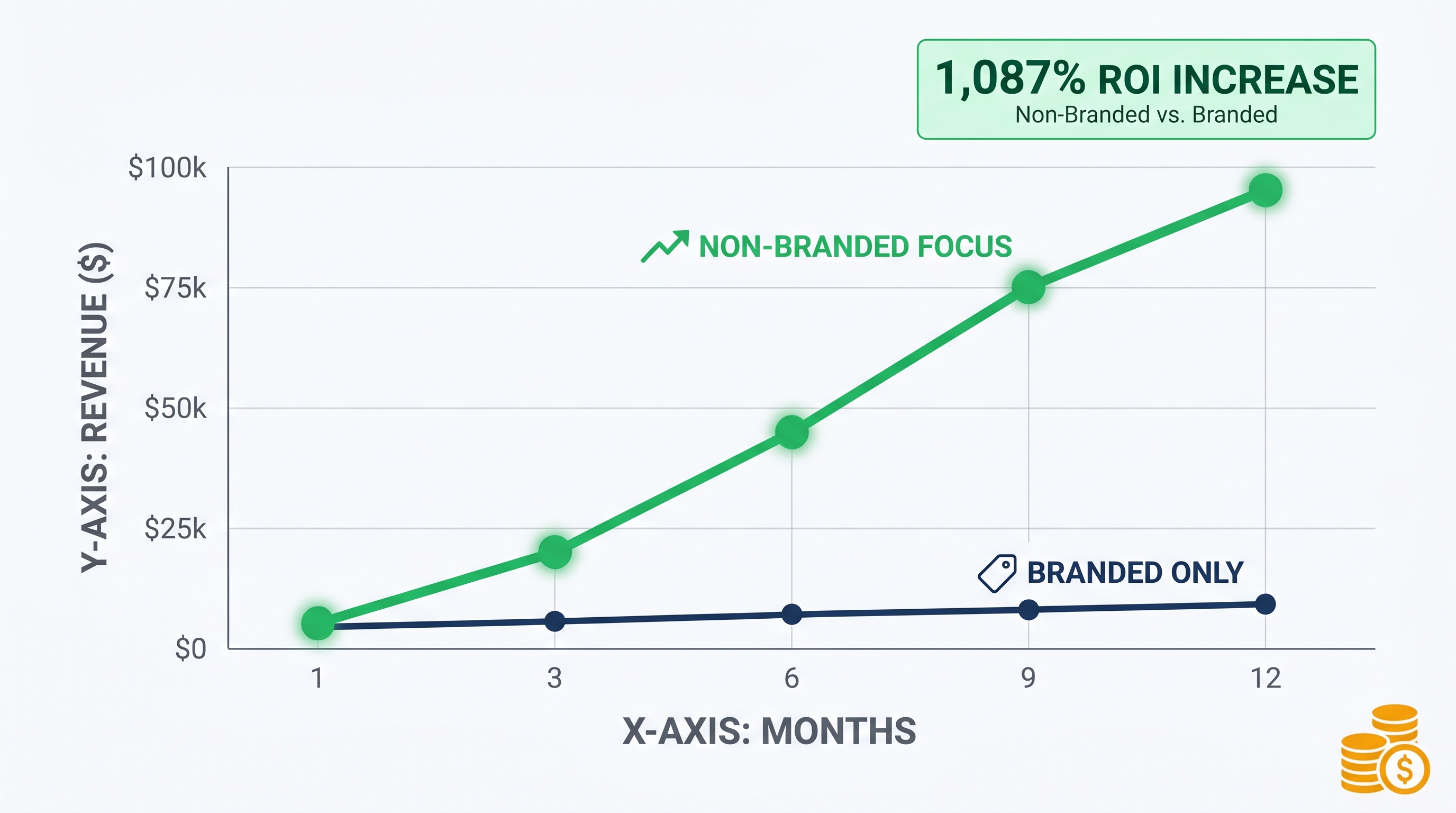
Let's talk numbers. I worked with two SaaS companies last year. Both had similar products, similar pricing, similar target markets. Company A obsessed over their branded search rankings. Company B built a content and SEO strategy around non-branded keywords.
After six months, Company A was getting 200 organic visits per month, almost all branded. Company B was getting 8,000 organic visits per month, 85% from non-branded discovery terms. Same industry. Wildly different results.
The cost isn't just traffic. It's revenue. When you show up for non-branded searches, you're capturing customers at the moment of intent. They're ready to buy. They just don't know who to buy from yet. That's where you want to be.
Pros
Non-branded: High search volume from discovery-phase customers
Non-branded: Lower cost-per-acquisition because you're not competing with yourself
Non-branded: Scalable growth as you rank for more generic terms
Branded: Easy to rank #1 (you're competing with yourself)
Branded: High conversion rate from people who already know you
Cons
Branded: Extremely low search volume limits growth potential
Branded: Only reaches people who already found you elsewhere
Branded: Doesn't expand your market or customer base
Non-branded: More competitive, requires real SEO work
Non-branded: Longer time to results compared to branded
Here's the thing most businesses miss: your competitors aren't wasting time on branded SEO. They're going after the non-branded terms your customers use. While you're celebrating your #1 ranking for your own name, they're scooping up all the 'plumber near me' traffic.
How to Find the Keywords Your Customers Actually Use
So how do you figure out what people are actually searching for? You can't just guess. And you definitely can't assume they're searching for your business name.
Start with the basics. What problem do you solve? What pain points do your customers have before they find you? Those pain points are your non-branded keywords. If you're a CRO agency, people aren't searching 'TechDevs conversion optimization.' They're searching 'why is my landing page not converting' or 'how to improve website conversion rate.'
Non-Branded Keyword Research Process
List 10 problems your product or service solves
Use Google Keyword Planner or Ahrefs to find search volume for problem-based queries
Analyze competitor content to see which non-branded terms they're targeting
Check Google autocomplete and 'People also ask' for related searches
Review your sales calls and customer emails for the exact language they use
Identify voice search variations (longer, conversational queries)
Prioritize keywords by search volume, competition, and business relevance
But here's where most guides stop. They tell you to do keyword research and call it a day. That's not enough. You need to understand search intent. Someone searching 'SEO tips' wants a blog post. Someone searching 'hire SEO agency' wants to buy. Both are non-branded. Only one converts.
We use AI-powered clustering to group keywords by intent. You're not just chasing volume. You're chasing the right volume. The searches that lead to revenue.
Common Questions About Non-Branded Keywords
What is the difference between branded and non-branded keywords in SEO?
Branded keywords include your company or product name (e.g., 'Nike running shoes'). Non-branded keywords are generic terms people use when they don't know specific brands yet (e.g., 'best running shoes'). Non-branded keywords have much higher search volume and represent discovery-phase customers.
Should I stop optimizing for my business name completely?
No. You need to protect your brand. But allocate your effort strategically: roughly 80% on non-branded discovery keywords and 20% on brand protection. Most businesses do the opposite and wonder why they're not growing.
How do I find non-branded keywords my customers are searching for?
Start by listing the problems you solve. Use keyword research tools like Ahrefs or SEMrush to find search volume for problem-based queries. Check competitor content, Google autocomplete, and review your sales conversations for the exact language customers use. Focus on high-intent keywords, not just high-volume ones.
What percentage of my SEO efforts should focus on branded vs non-branded terms?
A good rule of thumb is 80% non-branded, 20% branded. Non-branded keywords drive new customer acquisition and market expansion. Branded keywords protect your existing awareness but don't grow your business. Most companies waste 80% of their effort on branded terms and get 5% of the results.
How does voice search affect branded keyword strategy?
Voice search users tend to use longer, more conversational queries. Instead of typing 'plumber,' they ask 'who's the best plumber near me open right now?' These are non-branded, high-intent searches. Voice search makes non-branded optimization even more critical because people rarely speak brand names into their devices when searching.
Can I rank for non-branded keywords if I'm a small local business?
Absolutely. In fact, local businesses have an advantage with geo-modified non-branded keywords like 'plumber in Austin' or 'dentist near downtown Seattle.' These have lower competition than national terms and much higher conversion rates. Local SEO is all about non-branded discovery keywords.
How long does it take to see results from non-branded keyword optimization?
Typically 3-6 months for competitive terms, faster for long-tail or local keywords. Non-branded SEO takes longer than branded because you're competing with established sites. But the payoff is exponentially higher. Branded SEO might get you 100 visitors. Non-branded SEO can get you 10,000.
Building Your Non-Branded SEO Strategy (Without Abandoning Brand Protection)
Okay, so you're convinced. Non-branded keywords are where the money is. But you can't completely ignore your brand name either. You need a balanced strategy.
The 80/20 rule works here. Spend 80% of your SEO effort on non-branded discovery keywords. Spend 20% on brand protection. That means monitoring your branded SERP, claiming your Google Business Profile, and making sure competitors aren't bidding on your name in paid search.
Allocate 80% of content creation to non-branded topics your customers search for
Reserve 20% for brand-building content like company news, case studies, and thought leadership
Monitor branded SERP features to ensure you own the top results for your name
Set up alerts for competitor bidding on your branded terms in Google Ads
Build site architecture that supports both branded and non-branded keyword strategies
Here's what this looks like in practice. You create 10 blog posts. Eight of them target non-branded, high-intent keywords like 'how to reduce bounce rate' or 'best CRO tools for SaaS.' Two of them are about your company, your methodology, or your case studies.
The non-branded content brings in new traffic. The branded content converts that traffic once they know who you are. It's a funnel, not a coin flip.
Non-Branded Content (80%)
Problem-solving blog posts, how-to guides, comparison articles, and keyword-optimized service pages that answer customer questions
Branded Content (20%)
Case studies, company news, founder stories, methodology pages, and thought leadership that build trust after discovery
And don't sleep on technical SEO. Your site architecture needs to support this strategy. That means proper internal linking, clear service page hierarchies, and content clusters that group related non-branded topics together. We've built this infrastructure dozens of times. It works.
Automating Your Keyword Strategy for Scale
Manual keyword tracking doesn't scale. You can't check 500 keyword rankings every week in a spreadsheet. You need automation.
We build SEO dashboards that surface real-time visibility trends. You see which non-branded keywords are climbing, which are dropping, and where competitors are gaining ground. No manual exports. No stale data.
Set up alerts for branded keyword threats. If a competitor starts ranking for your business name or bidding on it in paid search, you need to know immediately. Automated monitoring catches this before it becomes a problem.
Automation Tactics for Scalable SEO
How do I automate keyword rank tracking?
Use tools like Ahrefs, SEMrush, or build custom dashboards with APIs. Set up daily or weekly rank checks for your target non-branded keywords. Configure alerts when rankings drop below a threshold or when competitors overtake you.
Can I automate content creation for non-branded keywords?
Partially. AI can help generate outlines and first drafts, but you need human oversight for quality and accuracy. We use AI to scale research and structure, then human writers to add expertise, examples, and personality. Pure AI content doesn't rank well long-term.
What's the best way to monitor branded keyword threats?
Set up Google Alerts for your brand name and variations. Use SEMrush or SpyFu to track competitor ad spend on your branded terms. Monitor your branded SERP weekly to catch negative results or competitor content creeping in.
Scaling across multiple markets or languages? Automation is mandatory. You can't manually manage keyword strategies in 10 countries. You need infrastructure that replicates your best practices automatically.
Measuring Success: KPIs That Actually Matter
Stop celebrating branded search rankings. They don't pay the bills.
Here are the metrics that actually matter: non-branded keyword rankings, organic traffic from discovery terms, and conversion rate by keyword type. If your non-branded traffic is growing and converting, you're winning. If your branded traffic is stagnant, who cares? You're still winning.
Essential Non-Branded SEO KPIs
Number of non-branded keywords in top 10 positions
Organic traffic from non-branded keywords (month-over-month growth)
Conversion rate by keyword type (branded vs non-branded)
Cost-per-acquisition from organic non-branded traffic
Share of voice for high-intent non-branded terms in your niche
Revenue attributed to non-branded organic traffic
Build a dashboard that compares branded vs non-branded performance side by side. You'll see the gap immediately. Branded traffic: 200 visits, 50 conversions. Non-branded traffic: 8,000 visits, 400 conversions. The numbers don't lie.
And track visibility across all platforms. Traditional Google search, AI search engines like Perplexity and ChatGPT, voice assistants. Non-branded keywords matter everywhere. Branded keywords only matter in traditional search.
Your Action Plan: From Branded Dependency to Discovery Dominance
You don't need a year-long roadmap. You need to start this week.
Here's your 30-day plan. Week 1: Identify 10 high-intent non-branded keywords in your niche. Week 2: Audit your existing content to see if any pages can be optimized for those keywords. Week 3: Create 2-3 new pieces of content targeting your top non-branded opportunities. Week 4: Set up tracking and measurement so you can see what's working.
30-Day Non-Branded SEO Sprint
Week 1: Research and list 10 high-intent non-branded keywords with search volume data
Week 1: Analyze top-ranking content for each keyword to understand what Google rewards
Week 2: Audit existing pages and identify 3-5 that can be optimized for non-branded terms
Week 2: Update meta titles, headers, and content on those pages with target keywords
Week 3: Create 2-3 new blog posts or service pages targeting your top non-branded opportunities
Week 3: Build internal links from high-authority pages to your new non-branded content
Week 4: Set up rank tracking and traffic monitoring for your target non-branded keywords
Week 4: Review results and double down on what's working
Quick wins matter. Pick 5-10 non-branded keywords where you're already ranking on page 2 or 3. Optimize those pages first. You'll see movement faster than starting from scratch.
Long-term, build content clusters around customer pain points. Not around your product features. Not around your brand. Around the problems people have before they know you exist. That's how you dominate non-branded search.
This isn't theory. We've done this for SaaS companies, local service businesses, and enterprise tech firms. The results are consistent: shift focus from branded to non-branded, and traffic grows 10x in 6-12 months.
Ready to Stop Relying on Branded Search and Start Capturing Real Traffic?
We'll audit your current keyword strategy, identify your highest-value non-branded opportunities, and build a plan to dominate the searches your customers actually use. No fluff. Just a clear roadmap to 10x your organic traffic.