You Don't Need 1000 Keywords to Rank on Google – Just 5 Strategic Ones
Stop chasing 1000 keywords. Discover how to identify the 5 right keywords that actually rank on Google and drive organic traffic to your website.
 Written byPrithvi Jadwani
Table of contents
Summarize this article with AI
TL;DR
Stop wasting time on keyword lists that go nowhere. Most businesses chase hundreds of keywords they'll never rank for, burning budget and energy. The truth? Five strategically chosen keywords will do more for your Google rankings than a thousand random ones. Focus beats volume every time.
- Quality Crushes Quantity. Five well-researched keywords with realistic ranking potential beat 1000 pipe dreams
- New Sites Can't Compete on Popular Terms. Established websites with years of backlinks will outrank you on high-competition keywords without serious budget
- Strategic Selection = Faster Results. Target niche, long-tail keywords you can actually rank for instead of generic terms everyone wants
- Focus Builds Authority. Google rewards topical depth over keyword volume, making concentrated efforts more effective
- Use Tools That Show Reality. AI-powered keyword research tools tell you what you can actually rank for, not just what has high search volume
The Keyword Myth That's Wasting Your Time (And Money)
Here's what nobody tells you about keyword research: that massive spreadsheet with 1,000 keywords you spent three weeks building? It's probably worthless.
Most businesses make the same mistake. They fire up a keyword tool, see big search volume numbers, and start targeting everything. Six months later, they're still on page seven of Google, wondering why their SEO strategy isn't working.
The problem isn't effort. It's focus.
You're competing against websites that have been around for a decade, building backlinks and authority the whole time. They've got domain strength you can't match overnight. And when you spread your resources across hundreds of keywords, you're guaranteeing you won't rank for any of them.
The shift from keyword stuffing to strategic keyword research happened years ago, but most people still act like Google in 2010. They think more keywords equals better rankings. It doesn't. Google's algorithm has evolved. It rewards depth, authority, and genuine value over keyword volume.
So what's the alternative? Instead of chasing 1,000 keywords you'll never rank for, identify the five that actually matter. The ones you can realistically dominate. The ones that will bring you traffic, leads, and revenue.
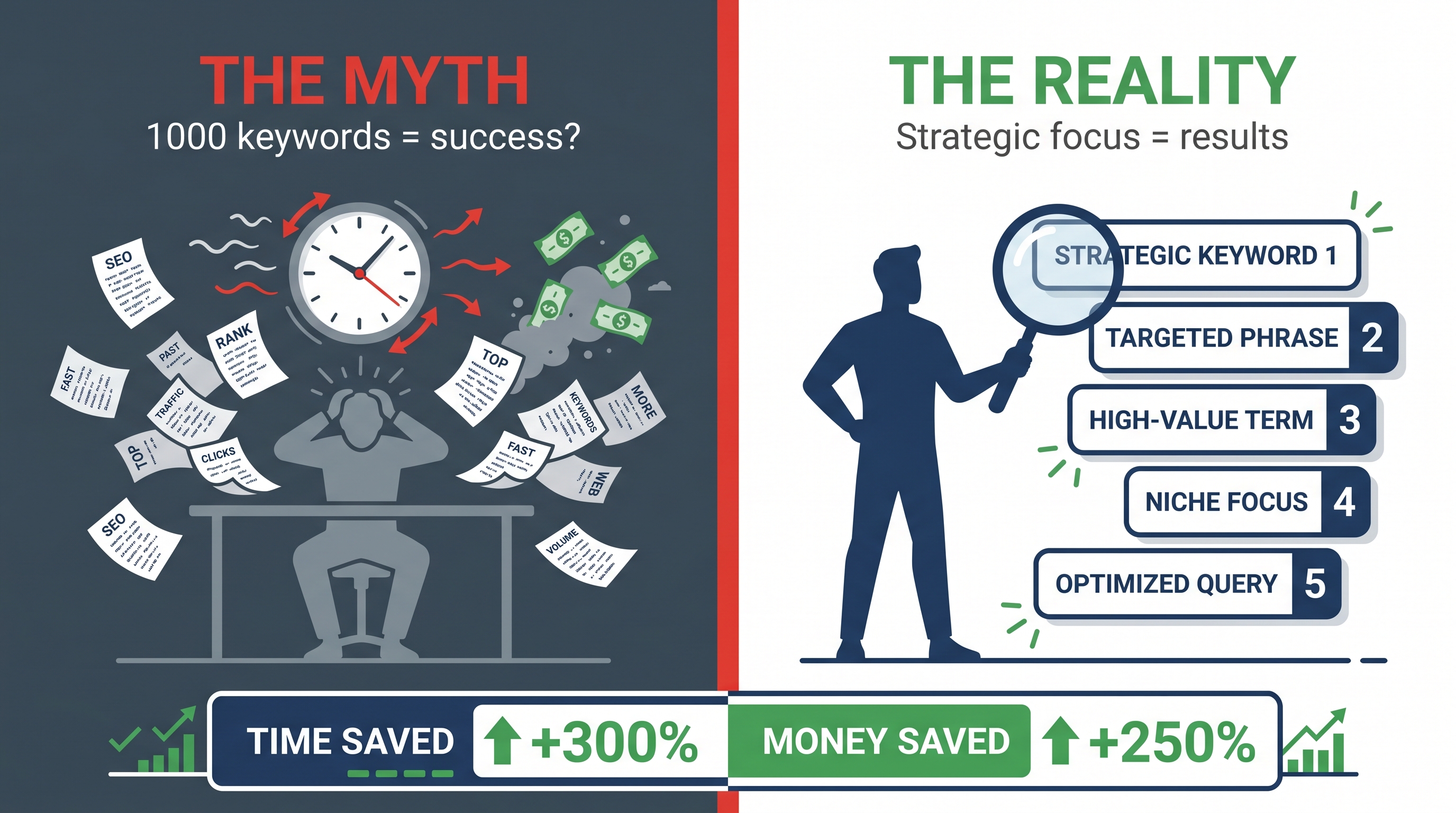
Why 5 Keywords Are More Powerful Than 1000
Focus changes everything. When you concentrate on five keywords instead of scattering across hundreds, you can create content that actually establishes authority.
Think about it. Would you rather write 100 mediocre blog posts targeting 100 different keywords, or create 10 comprehensive, deeply researched pieces that completely own five keyword clusters? Google's algorithm isn't dumb. It recognizes topical authority. When you consistently produce high-quality content around specific themes, you signal expertise.
Deeper content: You can write 3,000-word guides instead of 500-word fluff pieces
Better resource allocation: Your time, budget, and energy go toward what actually works
Easier tracking: You can monitor five keywords closely and adjust strategy based on real data
Faster results: Ranking #1 for five terms happens way faster than ranking #50 for 100
Compounding authority: Each piece of content reinforces the others, building momentum
And here's the thing about AI and automation in 2024: they make it easier than ever to dominate specific keyword clusters. You can use tools to generate content variations, track rankings in real-time, and identify opportunities faster than manual research ever allowed. But only if you're focused.
Spread across 1,000 keywords, automation just helps you fail faster. Concentrated on five strategic terms? It's a force multiplier.
It's better to rank first for five keywords that matter than fiftieth for a hundred that don't. Traffic from position one is exponentially higher than traffic from position fifty.
Prithvi Jadwani, CEO at TechDevs
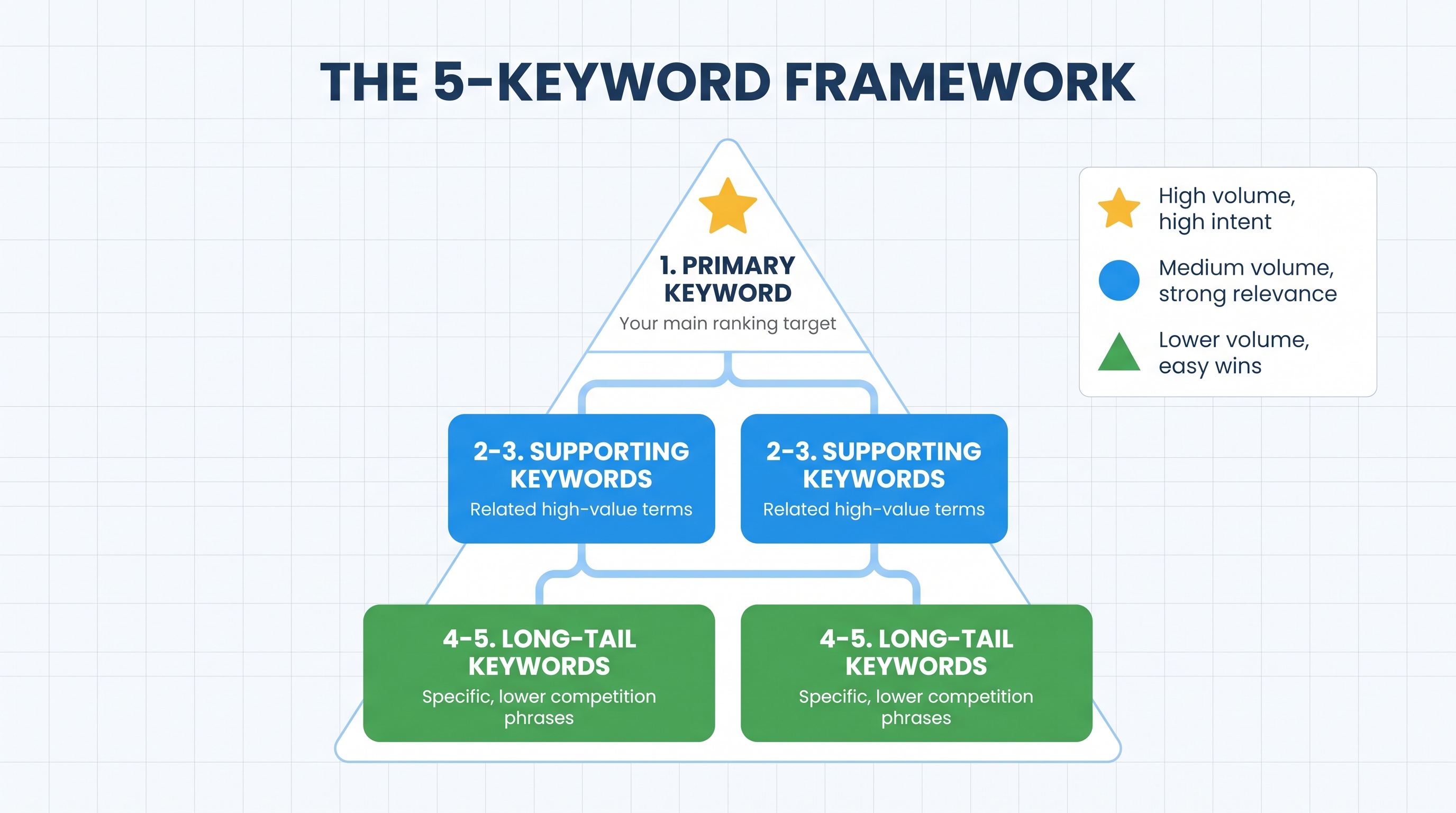
The 5-Keyword Framework: What You Actually Need
Not all keywords are created equal. Your five keywords should serve different purposes in your SEO strategy. Here's the breakdown that actually works:
1 Primary Keyword
Your main money term. The keyword that best describes what you do and has decent search volume. This is your north star.
2 Supporting Keywords
Related terms that build topical authority. They support your primary keyword and show Google you know your stuff.
2 Long-Tail Keywords
Specific, lower-competition phrases you can actually rank for quickly. These bring early wins and qualified traffic.
The balance between search volume and ranking potential is where most people mess up. They see a keyword with 10,000 monthly searches and think 'jackpot.' But if that keyword has a competition score of 95/100 and you're a new website, you're wasting your time.
Better approach? Target a keyword with 500 monthly searches and a competition score you can actually beat. Rank #1 for that, and you'll get more traffic than ranking #47 for the high-volume term.
Bad strategy: Target 'Seattle Photographer' (10,000 searches, impossible competition)
Good strategy: Target 'Seattle light and airy photographer' (200 searches, achievable ranking)
Why it works: You'll actually rank, get qualified traffic, and build authority to eventually compete for bigger terms
This isn't settling. It's being strategic. You're playing the long game. Start with keywords you can win, build authority, then move up the ladder. That's how every successful SEO strategy works.
How to Identify Your 5 Strategic Keywords
Picking your five keywords isn't guesswork. It's a process. And if you follow these steps, you'll end up with keywords you can actually rank for instead of a wishlist.
The 5-Step Keyword Selection Process
Start with what you actually do: Write down 20-30 phrases that describe your services, not what you wish you ranked for
Run them through an AI tool: Use tools that assess competition levels and give you realistic ranking probability scores
Analyze search intent: Are people searching to buy, learn, or just browse? Buying intent keywords convert better
Check if you can compete: Look at backlinks, domain authority, and content depth of current top-ranking pages
Validate with data: Use keyword research tools to confirm search volume, competition, and realistic timelines for ranking
Step one is critical. Most people skip it and jump straight to keyword tools. But if you don't start with an honest assessment of what you offer and who you serve, you'll end up targeting keywords that don't match your business.
Step three (search intent) separates amateurs from pros. A keyword might have great volume and low competition, but if everyone searching it is looking for free information and you're selling a service, it's the wrong keyword. You want terms where people are ready to take action.
Common Questions About Keyword Selection
How do I know if a keyword is too competitive for my website?
Look at the top 10 results. If they're all massive brands with domain authority scores above 70, thousands of backlinks, and comprehensive content, you probably can't compete yet. Use a tool that shows keyword difficulty scores and aim for terms with difficulty under 40 if you're a new site.
What's the difference between short-tail and long-tail keywords?
Short-tail keywords are 1-2 words ('SEO', 'marketing') with high volume and brutal competition. Long-tail keywords are 3+ words ('how to do keyword research for small business') with lower volume but way better conversion rates and realistic ranking potential. Start with long-tail, win there, then expand.
Can I change my 5 keywords later or am I stuck with them?
You can absolutely change them. In fact, you should review every 90 days. As you rank for your initial keywords and build authority, you can start targeting more competitive terms. This is a progression, not a prison sentence.
Do I need expensive tools to do keyword research?
No. Most tools offer free trials that give you enough data to identify your five keywords. Tools like INK, SEMrush, and Ahrefs all have trial periods. Use them strategically, get your data, and make your decisions. You don't need a year-long subscription to pick five keywords.
Should I target different keywords for each page on my website?
Yes, but they should be related. Each page should have one primary keyword and 2-3 supporting keywords. The key is topical clustering: all your pages should support the same overall themes. Don't have one page about SEO and another about plumbing unless you're in both businesses.
Tools That Tell You What You Can Actually Rank For
The right tools make all the difference. But here's what matters: you need tools that tell you the truth about your ranking potential, not just show you search volume numbers.
AI-powered tools like INK have changed the game. They assess whether a keyword is worth your time based on your website's current authority. They'll tell you 'don't waste your time on this one' or 'you have a shot at ranking for this in 6 months.' That's the kind of honesty you need.
And you don't need to pay a fortune. Most keyword research tools offer free trials. Use them. Get your data. Make your decisions. Then cancel if you want. You're not doing keyword research every day, so a free trial is often enough to identify your five strategic keywords.
INK: AI-powered tool that assesses your actual ranking potential, not just search volume
SEMrush: Industry standard with comprehensive competition analysis and ranking difficulty scores
Ahrefs: Excellent for backlink analysis and understanding why competitors rank where they do
Google Keyword Planner: Free but basic, good for search volume estimates but weak on competition analysis
AnswerThePublic: Great for finding long-tail question-based keywords people actually search
Pros
Paid tools show realistic ranking difficulty based on your domain authority
They include competitor analysis and backlink data you can't get for free
AI-powered suggestions save hours of manual research
Most offer free trials, so you can get what you need without long-term commitment
Cons
Free tools show search volume but not whether you can actually compete
They lack the depth needed to make strategic decisions
You'll waste time targeting keywords you have no chance of ranking for
No competitor analysis means you're flying blind
Bottom line: use a paid tool's free trial to identify your five keywords. That's all you need. Don't overthink it.
Where to Use Your 5 Keywords (Implementation Strategy)
You've got your five keywords. Now what? This is where most people either stuff them everywhere (bad) or forget to use them strategically (also bad).
The goal is natural integration. Google's algorithm is smart enough to detect keyword stuffing. If you jam your keyword into every sentence, you'll get penalized. But if you ignore SEO best practices entirely, you won't rank either.
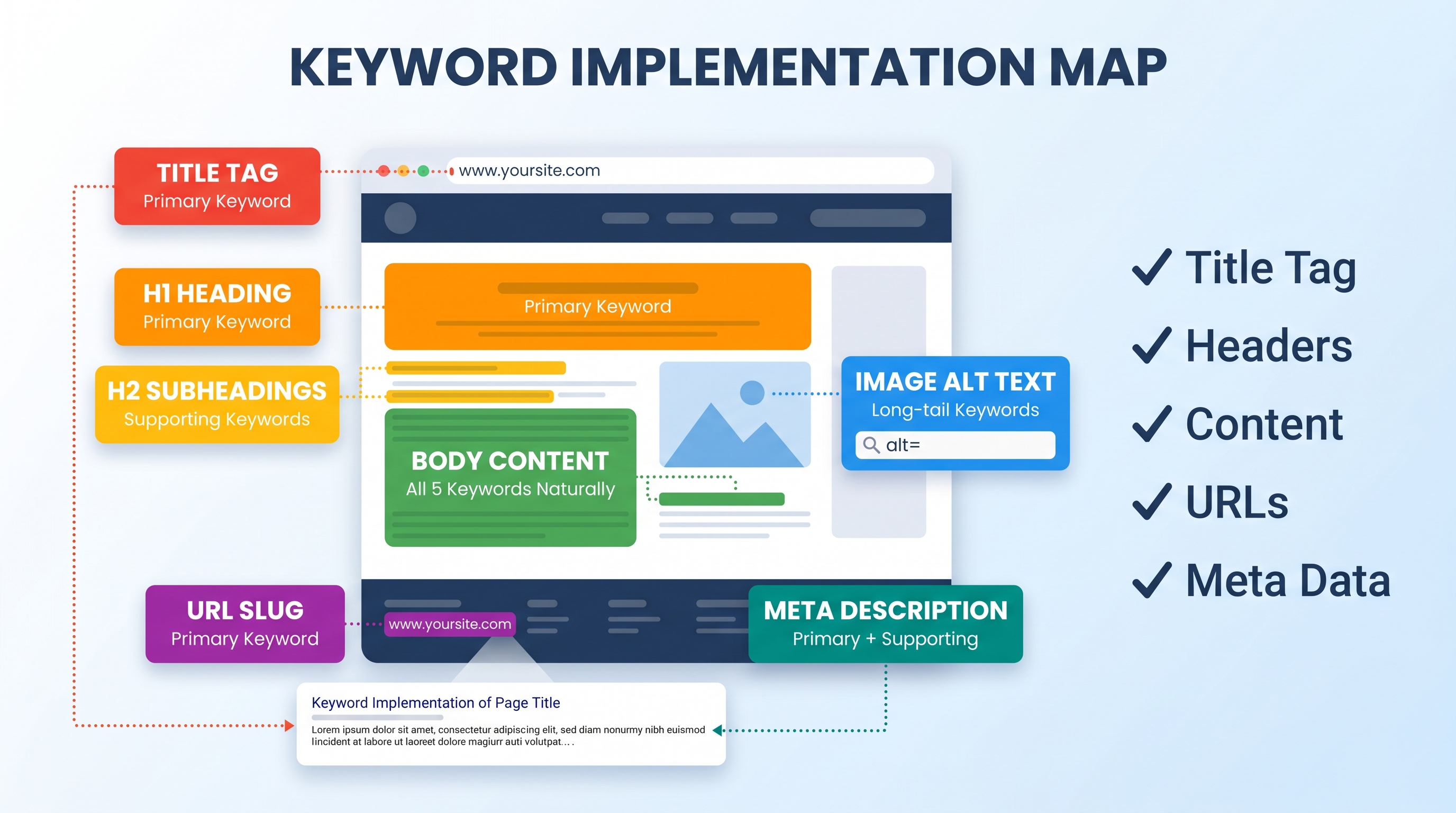
Where Your Keywords Need to Appear
Page titles and H1 tags: Your primary keyword should appear in your main headline and page title
First 100 words: Include your primary keyword naturally in your opening paragraph
Subheadings (H2, H3): Use variations of your keywords in subheadings throughout the content
Meta descriptions: Write compelling meta descriptions that include your keyword and drive clicks
URL structure: Keep URLs short and include your primary keyword when possible
Image alt text: Describe images accurately and include relevant keywords where it makes sense
Internal links: Link to related pages using keyword-rich anchor text naturally
Here's what natural integration looks like: if your keyword is 'conversion rate optimization,' you don't write 'conversion rate optimization is important for conversion rate optimization success.' That's garbage. Instead, you write 'improving your conversion rate takes more than A/B testing. You need a systematic optimization strategy that addresses user experience, messaging, and technical performance.'
See the difference? The keyword appears once naturally. Variations and related terms appear throughout. Google understands context now. You don't need to repeat the exact phrase ten times.
The Reality Check: When to Pay vs. When to Rank Organically
Let's talk money. Because here's the truth: some keywords require budget, and pretending otherwise is a waste of time.
If you're a new website trying to rank for 'digital marketing' or 'CRM software,' you're competing against companies that have spent millions on content and links. You can't beat them organically in any reasonable timeframe. You either pay for ads or you pick different keywords.
This isn't failure. It's strategy. Paid ads work great for high-competition terms where you need immediate visibility. Organic SEO works great for niche terms where you can build authority over time. Most successful companies use both.
Pros
Organic: Free traffic once you rank, compounds over time, builds long-term authority
Organic: Higher trust from users, better click-through rates than ads
Paid: Immediate visibility, works for high-competition terms, precise targeting
Paid: Scalable and predictable, easy to test and optimize
Cons
Organic: Takes 6-12 months to see results, requires consistent content creation
Organic: Nearly impossible for new sites to rank on competitive terms
Paid: Expensive for competitive keywords, traffic stops when budget stops
Paid: Lower trust from users, ad blindness is real
The smart play? Start niche with organic SEO. Target those five strategic keywords you can actually rank for. Build authority. Create content. Get backlinks. Then, as your domain strength grows, you can start competing for bigger terms.
Meanwhile, if you need traffic now for high-competition terms, run paid ads. Just don't expect to rank organically for those same terms anytime soon. That's a long-term play.
The companies that win at SEO are the ones that understand this isn't an either/or decision. You use paid ads for immediate results on competitive terms while building organic authority on niche terms you can actually rank for. Over time, your organic presence grows and your paid ad costs decrease.
Prithvi Jadwani, CEO at TechDevs
Your Next Steps: From Keywords to Rankings
You've got the framework. Now it's time to execute. Here's your 90-day action plan to go from keyword research to actual Google rankings.
Your 90-Day Keyword Strategy
Week 1: Identify your five strategic keywords using the process outlined above
Week 2: Audit your current website content against these keywords and identify gaps
Week 3-4: Create or update your most important pages to target your primary and supporting keywords
Month 2: Publish 4-6 long-form blog posts targeting your long-tail keywords
Month 3: Build internal links between related pages and start tracking your keyword rankings weekly
Ongoing: Monitor performance, adjust strategy based on what's working, and expand to new keywords as you build authority
The biggest mistake you can make is analysis paralysis. You've read this far. You understand the strategy. Now pick your five keywords and start creating content. Imperfect action beats perfect planning every time.
And if you want help? That's what we do. TechDevs specializes in automating keyword research and tracking so you can focus on running your business instead of obsessing over rankings. We use AI to identify opportunities, monitor performance, and adjust strategy in real-time.
Ready to Stop Wasting Time on the Wrong Keywords?
Let's identify your five strategic keywords and build an SEO strategy that actually drives rankings, traffic, and revenue. Book a free discovery call and we'll show you exactly which keywords you should target and why.