Indian SEO Industry Report 2026: The Complete Market Analysis
Discover the Indian SEO Industry Report 2026 with comprehensive market analysis, growth trends, and strategic insights. Essential reading for digital marketers.
 Written byPrithvi Jadwani
Table of contents
Summarize this article with AI
TL;DR
India's SEO industry is hitting a growth spurt in 2026. The global SEO services market jumped from $92.74 billion in 2025 to $108.28 billion in 2026, and India's grabbing a bigger slice every quarter. Companies aren't asking if they need SEO anymore. They're asking when and how fast they can get it running.
- Market Exploding at 16.8% CAGR. SEO services growing faster than most tech sectors, projected to hit $203.83B globally by 2030
- Startups Driving Demand. Fintech, healthtech, and edtech companies flooding the market, all fighting for page-one visibility
- AI Reshaping the Game. Machine learning and automation making regional language SEO actually scalable for the first time
- Local Search = Untapped Gold. Tier-2 and tier-3 cities showing highest conversion rates as internet penetration spreads
- ROI Becoming Measurable. Attribution models finally connecting organic traffic directly to revenue, not just vanity metrics
The State of the Indian SEO Industry in 2026: A Market Overview
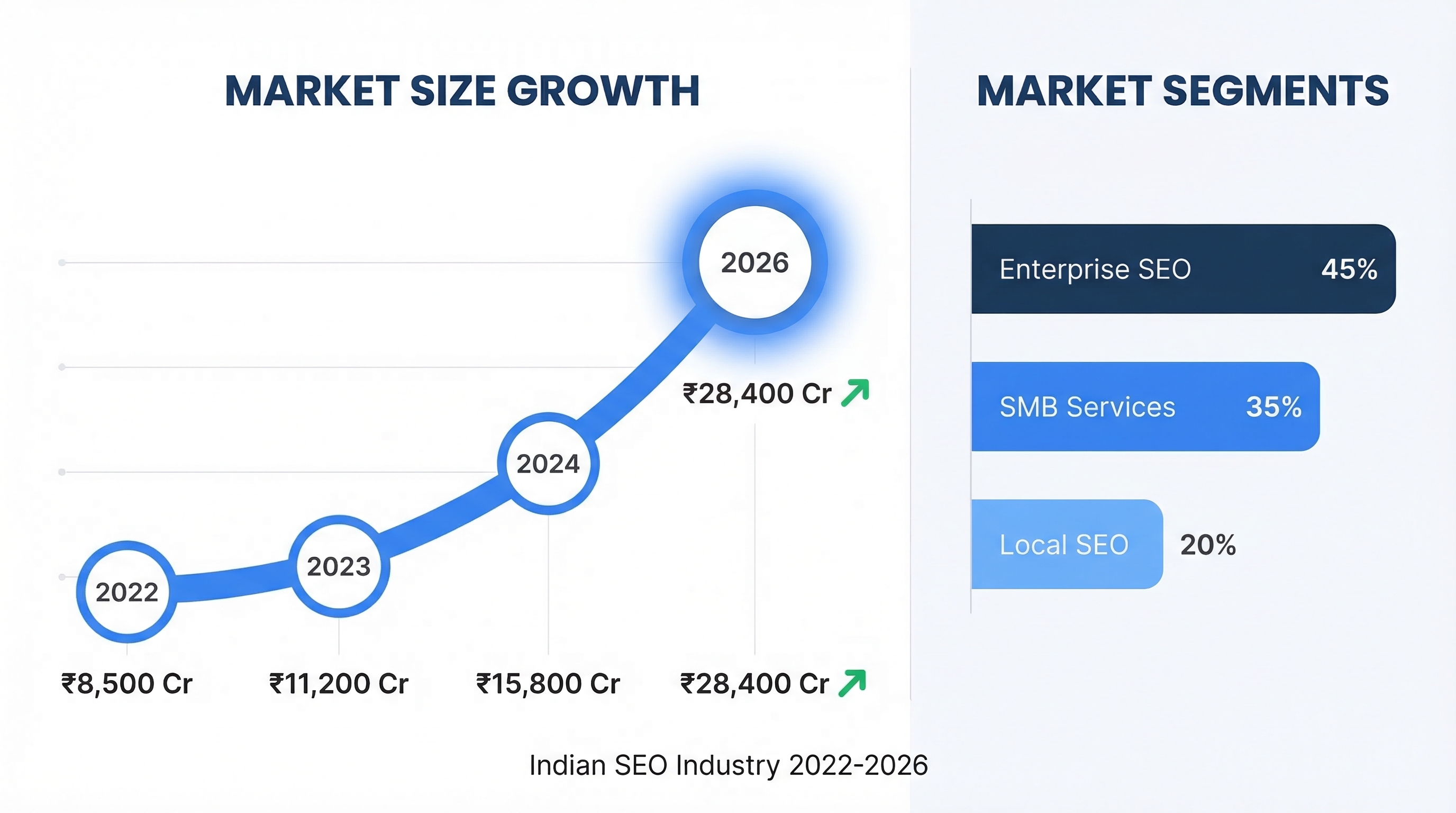
The global SEO services market grew from $92.74 billion in 2025 to $108.28 billion in 2026, posting a 16.8% compound annual growth rate. India's not just riding this wave. It's helping build it.
Five years ago, SEO was a nice-to-have. Something you'd get around to after the product launch, the funding round, the next quarter. Not anymore. In 2026, companies treat search visibility like they treat cloud infrastructure or payment gateways. It's essential, not optional.
And the shift is visible everywhere. Startups launching with SEO baked into their go-to-market strategy from day one. Legacy businesses scrambling to catch up after watching competitors steal traffic. Agencies turning away clients because demand outpaces supply of skilled practitioners.
What's Driving the Explosive Demand for SEO Services in India
The demand spike isn't random. Three forces are colliding at once, and they're all pushing companies toward the same conclusion: you can't build a sustainable business in India without owning your organic search presence.
First, the startup boom. Fintech companies, healthtech platforms, edtech startups. They're launching every week, and they're all internet-native. These aren't businesses trying to figure out digital marketing. They were born digital. And they know that paid ads alone won't get them to profitability.
Second, traditional businesses finally moving online. Not just building a website and calling it done. Actually competing. A textile manufacturer in Surat wants to sell direct to consumer. A coaching institute in Jaipur wants students from across India. A restaurant chain in Mumbai wants online orders from neighborhoods they don't have locations in yet.
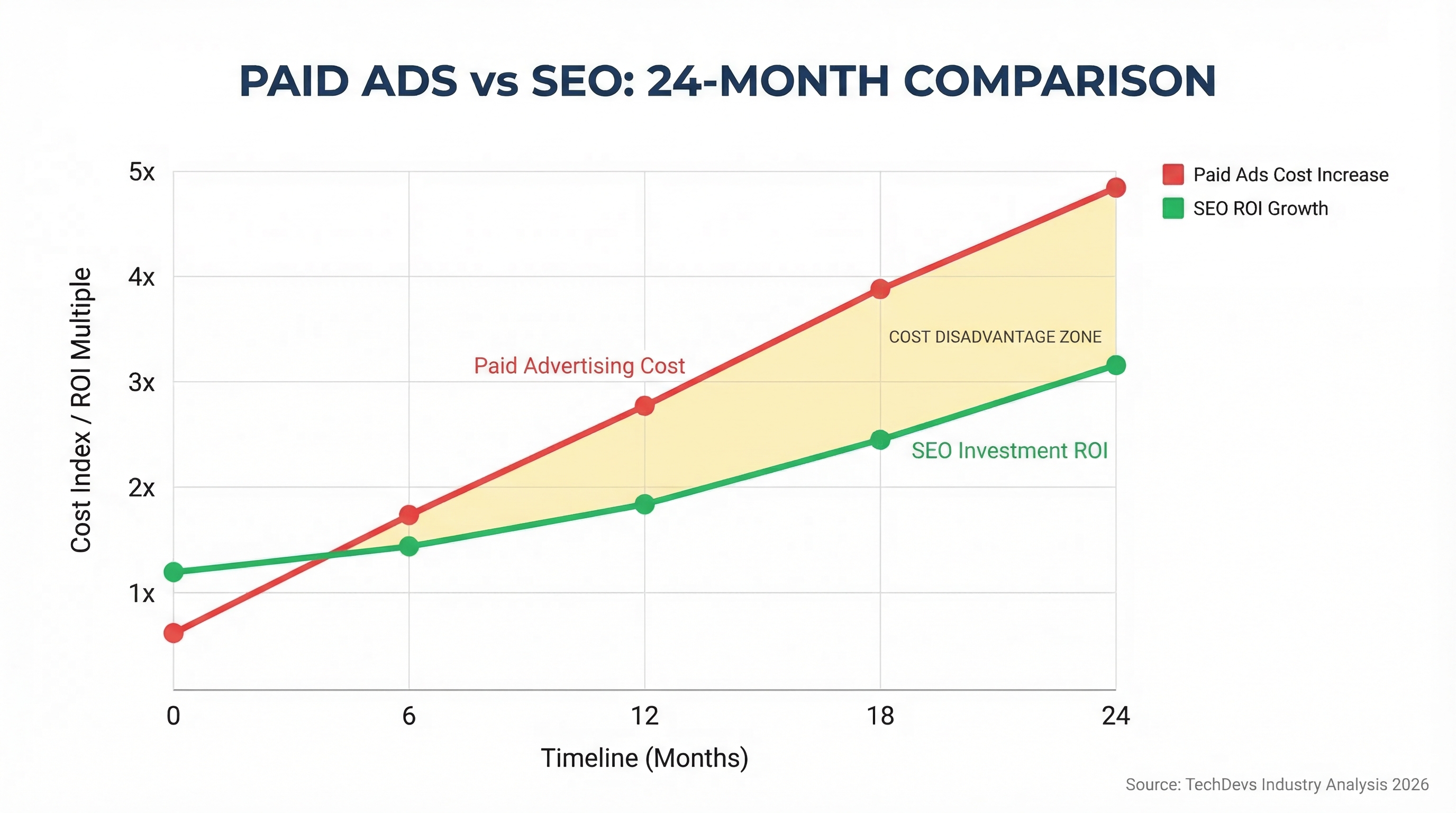
But here's the kicker: paid advertising costs are climbing. Fast. What used to cost ₹20 per click now costs ₹80. Your customer acquisition cost doubles, then triples. Suddenly, SEO stops looking like a long-term investment and starts looking like the only way to keep margins above water.
Startup explosion: Thousands of internet-native companies launching every quarter, all needing search visibility from day one
Traditional business migration: Legacy companies realizing their competitors are stealing customers through Google while they're still relying on word-of-mouth
Ad cost inflation: Paid channels becoming unsustainable as CPC rates climb 3-4x in competitive sectors
Internet penetration growth: 200+ million new internet users in India over the past three years, most on mobile-first platforms
E-commerce maturation: Online shopping becoming default behavior, not alternative behavior, across tier-2 and tier-3 cities
Fintech & Healthtech
New-age startups treating SEO as core infrastructure, not marketing afterthought
Digital Transformation
Traditional sectors going online faster than anyone predicted three years ago
Sustainable Growth
Companies choosing organic channels over paid ads to protect long-term margins
Market Growth Projections and Investment Trends
The numbers tell a clear story. The SEO services market is projected to reach $203.83 billion globally by 2030, growing at 17.1% annually. India's share of that pie is expanding faster than the global average.
Investment patterns are shifting too. Three years ago, most Indian companies allocated maybe 10-15% of their digital marketing budget to SEO. The rest went to paid ads, social media, influencer marketing. Now? The smart ones are flipping that ratio. SEO gets 40-50% of the budget because it's the only channel that gets cheaper over time instead of more expensive.
And the money's flowing into new areas. AI-powered SEO tools that can handle multilingual optimization at scale. Machine learning platforms that predict which keywords will drive revenue, not just traffic. Automation systems that free up strategists to focus on high-leverage work instead of manual reporting.
Voice search is another investment magnet. Not just English voice search. Hindi, Tamil, Telugu, Bengali. Regional language voice queries are growing faster than anyone expected, and the companies building optimization strategies for them now will own those markets for years.
Common Questions About SEO Investment in India
What is the current size of the Indian SEO industry in 2026?
While India-specific figures aren't published separately, the country represents a rapidly growing share of the global $108.28 billion SEO services market. Indian companies are increasing their SEO budgets by 30-40% year-over-year as they shift from paid advertising to organic growth strategies.
How much does SEO cost for small businesses in India?
Basic SEO packages start around ₹15,000 per month for small businesses with limited scope. Mid-market companies typically invest ₹50,000-₹1,00,000 monthly. Enterprise-level SEO programs run ₹2,00,000+ per month. The ROI usually justifies the investment within 6-12 months if executed properly.
Should Indian businesses hire an SEO agency or build an in-house team?
It depends on scale and timeline. Agencies deliver faster results and bring cross-industry expertise. In-house teams offer better long-term knowledge retention and brand alignment. Many successful companies use a hybrid model: agency for strategy and specialized tasks, in-house team for execution and content.
What ROI can Indian businesses expect from SEO investments?
Well-executed SEO typically delivers 3-5x ROI within the first year, with returns improving over time as organic rankings compound. The key is measuring beyond traffic: track organic revenue, customer lifetime value, and conversion rates. Companies that connect SEO directly to revenue metrics see the clearest returns.
How is AI changing SEO strategies in the Indian market?
AI is making regional language SEO scalable for the first time. Tools can now optimize content across Hindi, Tamil, Telugu, and other languages without requiring native speakers for every piece. Machine learning also improves keyword research, content recommendations, and performance forecasting, letting smaller teams compete with larger ones.
Emerging Technologies Reshaping the Indian SEO Industry
AI isn't just changing SEO. It's making strategies possible that were science fiction three years ago. Regional language optimization used to require hiring native speakers for every language you wanted to target. Expensive. Slow. Limited scale.
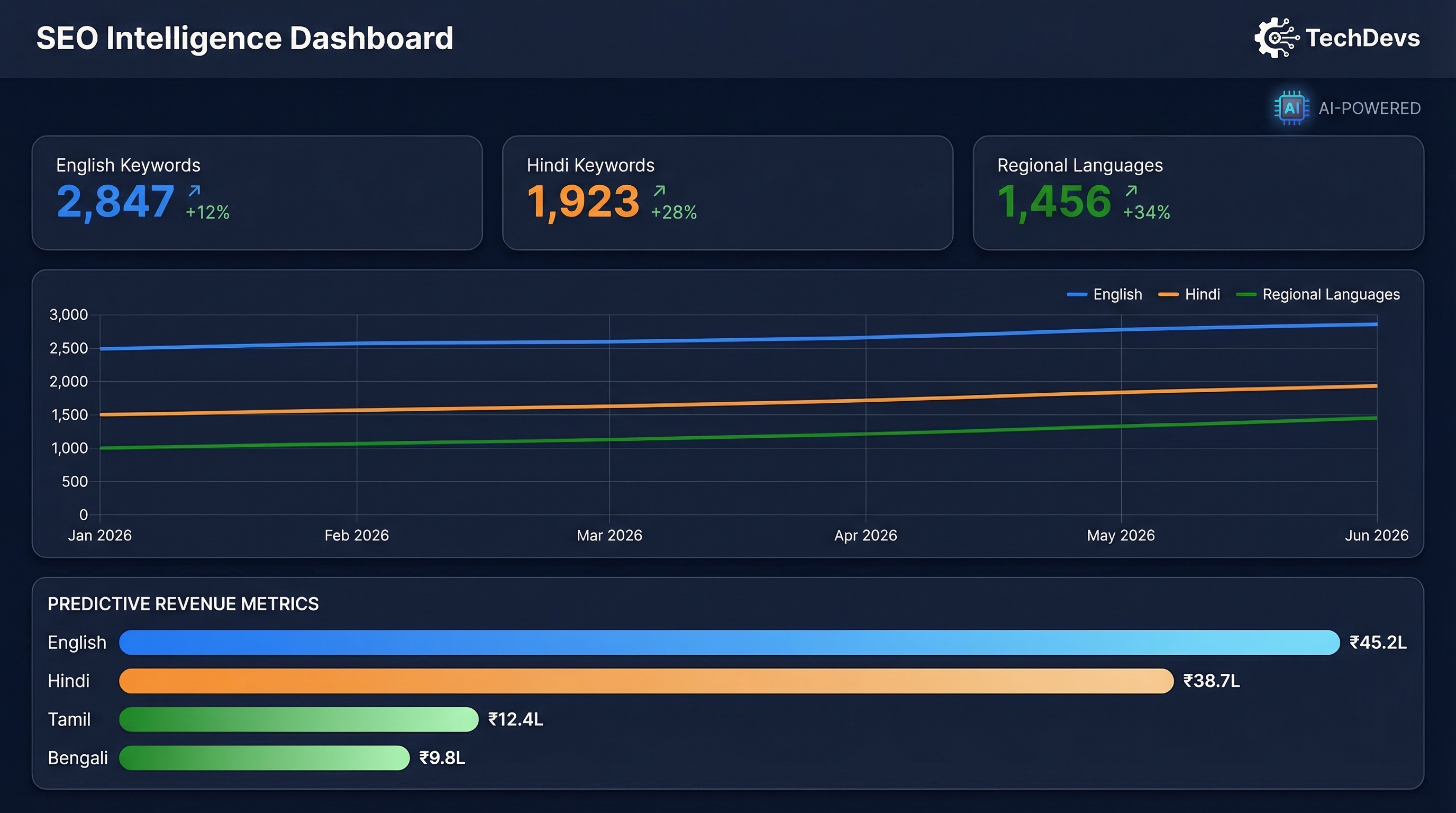
Now? AI-powered tools can optimize content across Hindi, Tamil, Telugu, Bengali, and a dozen other languages simultaneously. They understand context, cultural nuances, and regional search patterns. A company in Bangalore can target customers in Lucknow, Coimbatore, and Kolkata with localized content that actually works, all managed by a single team.
Machine learning is fixing the keyword research problem too. Traditional tools show you search volume and competition. ML platforms predict which keywords will actually drive revenue for your business. They analyze your conversion data, customer behavior, and market position to recommend terms that match buyer intent, not just traffic potential.
AI-Powered Multilingual SEO
Regional language optimization at scale, handling Hindi, Tamil, Telugu, and more without massive translation teams
Predictive Analytics
ML models forecasting which keywords will drive revenue, not just traffic, based on your specific business data
Voice Search Optimization
Natural language processing for conversational queries in regional languages, capturing the next wave of search behavior
Visual Search Technology
Image recognition SEO for e-commerce and product-based businesses, especially powerful in fashion and home goods
Visual search is the sleeper hit. Product-based businesses are starting to optimize images the way they optimize text. A customer takes a photo of a chair they like, searches for similar items, and lands on your product page. The companies building visual search optimization now will dominate product discovery in their categories.
Regional Language SEO and Local Search Strategies
Here's what most companies miss: India isn't one market. It's 15 markets with different languages, search behaviors, and buying patterns. A strategy that works in Mumbai won't work in Patna. Content that converts in Bangalore flops in Bhopal.
Regional language SEO is the unlock. But it's not just translation. It's understanding how people search in Hindi versus how they search in English. It's knowing that voice search queries in Tamil are structured completely differently than text queries. It's recognizing that local intent signals vary wildly across geographies.
The real opportunity? Tier-2 and tier-3 cities. Everyone's fighting over Delhi, Mumbai, and Bangalore. But Indore, Nagpur, and Coimbatore are wide open. Internet penetration is exploding in these cities, and the competition for search visibility is a fraction of what it is in metros.
Multilingual content strategy: Creating native-quality content in Hindi, Tamil, Telugu, Bengali, and other regional languages, not just translating English content
Local search optimization: Targeting tier-2 and tier-3 cities where competition is lower and conversion rates are often higher than metro markets
Google My Business mastery: Local SEO for service businesses, especially critical in cities where word-of-mouth still drives most decisions
Hyperlocal targeting: Neighborhood-level optimization for businesses serving specific areas, from restaurants to home services
Regional cultural context: Understanding festival timing, local events, and cultural nuances that affect search behavior and buying patterns
Most businesses think regional language SEO means translating their English content into Hindi. That's like thinking you can win in Japan by translating your American ads into Japanese. The language is just the start. You need to understand the culture, the search patterns, the way people make decisions. That's where the real advantage comes from.
Prithvi Jadwani, TechDevs
Google My Business optimization is criminally underrated in India. Service businesses, local retailers, restaurants. They're leaving money on the table because they treat GMB as an afterthought. A properly optimized GMB profile with regular posts, customer reviews, and accurate information can double your local traffic in 90 days.
Cost Structures and Pricing Models for Indian SEO Services
SEO pricing in India is all over the map. You'll find agencies charging ₹10,000 a month and others charging ₹5,00,000. The difference? Scope, expertise, and what you're actually getting.
Basic packages start around ₹15,000 monthly. You get keyword research, on-page optimization, maybe some content. It works for small businesses with limited competition and modest goals. But if you're in a competitive space, you'll outgrow this tier fast.
Mid-market companies typically invest ₹50,000-₹1,00,000 per month. This gets you comprehensive strategy, regular content creation, technical optimization, and link building. Most businesses in this range see positive ROI within 6-9 months if the execution is solid.
Enterprise SEO runs ₹2,00,000+ monthly. You're talking multiple team members, advanced technical work, large-scale content production, and sophisticated analytics. Companies at this level are usually managing hundreds of thousands of pages and competing in brutally competitive spaces.
Pros
Agency: Faster time to results with experienced team ready to execute immediately
Agency: Cross-industry expertise and proven playbooks from working with multiple clients
Agency: Access to premium tools and technologies without separate investment
In-house: Better long-term knowledge retention and deep brand understanding
In-house: More control over strategy and faster iteration on ideas
In-house: Lower long-term cost once team is trained and productive
Cons
Agency: Higher monthly cost, though often justified by faster results
Agency: Less control over day-to-day execution and priorities
Agency: Knowledge walks out the door when you stop the contract
In-house: Slower ramp-up time as team learns and makes inevitable mistakes
In-house: Limited perspective without cross-industry experience
In-house: Higher upfront cost for hiring, training, and tools
What to Look for in SEO Pricing
Transparent deliverables: Know exactly what you're paying for each month, not vague promises of 'optimization'
Performance metrics tied to revenue: Rankings are nice, but organic revenue and conversion rates actually matter
Realistic timelines: Anyone promising page-one rankings in 30 days is lying or using tactics that'll get you penalized
Clear communication: Monthly reports you can actually understand, with insights not just data dumps
Flexibility to scale: Pricing that can adjust as your needs grow or shrink
Performance-based pricing is gaining traction. You pay based on results: ranking improvements, traffic growth, or revenue generated. It sounds great, but read the fine print. Make sure the metrics actually align with your business goals and that you're not paying for traffic that never converts.
Building In-House SEO Capabilities: The Talent Development Approach
More companies are asking a smart question: should we just build this ourselves? The answer isn't simple, but the trend is clear. Businesses that invest in developing internal SEO expertise end up with a sustainable competitive advantage that agencies can't match.
The talent gap is real though. India has thousands of people who call themselves SEO professionals. But finding someone who can actually build and execute a comprehensive strategy? That's harder. Most have learned from outdated courses or YouTube videos. They know tactics but don't understand strategy.
Smart companies are running talent incubation programs. Hire junior people with the right mindset, train them properly, and build a team that understands your business inside out. It takes 12-18 months before they're fully productive, but once they are, you've got an asset that compounds in value.
Hybrid Model Wins
Agency handles strategy and specialized tasks, in-house team executes daily work and owns content production
Knowledge Transfer
Structured programs ensuring expertise stays with the company even when team members leave
Long-Term Cost Advantage
Higher upfront investment, but 3-5 year cost per result drops below agency pricing
Brand Alignment
In-house teams develop deep understanding of product, customers, and market that agencies can't replicate
The three-year math is interesting. An in-house SEO manager costs ₹8-12 lakhs annually plus tools and training. An agency providing similar work costs ₹6-10 lakhs annually. But by year three, your in-house person is 3x more productive because they know your business cold. The agency is still ramping up new account managers who don't know your history.
Measuring Success: ROI Attribution and Performance Frameworks
Most companies are measuring the wrong things. They track rankings, organic traffic, maybe time on site. Those metrics are fine for monitoring health, but they don't tell you if SEO is actually making you money.
The right framework connects SEO directly to revenue. Track organic revenue as your primary metric. Then layer in customer lifetime value, because a visitor who becomes a repeat customer is worth 10x more than a one-time buyer. Finally, measure conversion rates by landing page and traffic source.
Attribution is tricky in India because customer journeys are complex. Someone might discover you through organic search, research on social media, get retargeted with an ad, then convert three weeks later. Which channel gets credit? Most companies use last-click attribution, which massively undervalues SEO.
Better attribution models give SEO credit for assisted conversions. If organic search was anywhere in the customer journey, even if they converted through a different channel, SEO gets partial credit. This is closer to reality and helps justify continued investment.
Key Performance Indicators Beyond Rankings
What are the most important SEO trends in India for 2026?
Regional language optimization, AI-powered content tools, voice search for vernacular queries, and hyperlocal targeting for tier-2/tier-3 cities. The companies winning are the ones treating SEO as a revenue channel, not a traffic channel, and measuring accordingly.
How does regional language SEO work in India?
It's not just translation. You need native-quality content that understands how people search in each language, cultural context that affects buying decisions, and technical implementation that handles multiple languages without duplicate content issues. Voice search adds another layer since spoken queries differ from typed ones.
Real-time dashboards matter more than monthly reports. You need to see what's working now, not what worked last month. Tools that connect your analytics to your CRM give you the full picture: which keywords drive customers, what content converts, and where you're wasting effort.
Strategic Opportunities and Future Outlook for 2026-2030
The next four years will separate winners from everyone else. Rising demand for SEO services means the companies that move fast on emerging opportunities will build moats that are hard to cross.
First-mover advantage is real in new sectors. AI companies, Web3 projects, sustainable tech startups. These categories are forming right now, and the search landscape is wide open. Be the first to own the top rankings in an emerging category, and you can hold that position for years with less effort than it took to get there.
Regional markets are the biggest opportunity most companies ignore. Everyone's fighting over the same English-speaking, metro-based audience. But there are 100 million+ internet users in tier-2 and tier-3 cities who search primarily in regional languages. The competition there is 10% of what it is in metros, and the conversion rates are often higher.
Emerging sector dominance: Be first in AI, Web3, or sustainable tech categories before competition floods in
Vernacular content leadership: Build the definitive Hindi, Tamil, or Telugu resource in your category while it's still possible
Privacy-first SEO: Adapt to cookie deprecation and new privacy regulations before they become mandatory
Social commerce integration: Connect SEO with Instagram Shopping, WhatsApp Business, and other social commerce platforms
Next-gen search: Prepare for AI-powered search experiences that go beyond traditional Google rankings
The companies that will dominate Indian search in 2030 are the ones making strategic bets today. Not just optimizing for Google as it exists now, but building for the search landscape that's coming. Voice, visual, AI-powered discovery. The fundamentals don't change, but the execution does.
Prithvi Jadwani, TechDevs
Data privacy and compliance are coming whether you're ready or not. Cookie deprecation, stricter data regulations, user consent requirements. These changes will reshape how we track and attribute SEO performance. The companies building privacy-first measurement frameworks now will have a massive advantage when regulations tighten.
And honestly? This is the best time to be building SEO capability in India. The market is growing fast, tools are getting better, and the competitive landscape in many categories is still relatively open. Five years from now, the cost of entry will be 3x higher and the difficulty 5x greater.
Ready to Build a Winning SEO Strategy for Your Business?
The Indian SEO landscape is moving fast. Companies that build sustainable organic growth strategies now will dominate their categories by 2030. We help businesses develop SEO programs that drive real revenue, not just traffic. Whether you need strategic direction, full execution, or help building an in-house team, we've done it before.