How to Use Long-Tail Keywords to Beat Giant Competitors and Skyrocket Your Sales in 2026
Learn how to use long-tail keywords to grow your business, boost online sales as a new brand, and outrank industry giants in search results. Proven 2026 strategies.
 Written byPrithvi Jadwani
Table of contents
Summarize this article with AI
TL;DR
Most new brands waste time fighting giants for broad keywords like 'running shoes' or 'CRM software.' But here's what they miss: over 91% of all searches are specific, conversational phrases. Long-tail keywords like 'best CRM for real estate teams under 50 people' have lower search volume but convert at a higher rate because the searcher knows exactly what they want. In 2026, with AI search and voice queries exploding, these specific phrases are your competitive edge.
- 91% of Searches Are Long-Tail. Most web searches are specific, multi-word phrases that signal high buyer intent
- AI Engines Love Specificity. ChatGPT and Google AI Overviews thrive on conversational, long-tail queries
- Lower Competition, Higher Conversions. Bypass the giants dominating broad terms and capture ready-to-buy customers
- Mine Your Customer Language. Your best keyword source is reviews and customer conversations, not tools
- Topic Clusters Beat Single Posts. Build authority with pillar content and targeted cluster pages
Why New Brands Are Winning with Long-Tail Keywords in 2026
Let's talk about the search result page for 'running shoes.' Spot one: Nike. Spot two: Adidas. Spot three: Amazon. If you're a new brand with a $10,000 marketing budget, you're not touching that first page. Not this year. Probably not next year either.
But what about 'best trail running shoes for wide feet with ankle support under $150'?
Now we're talking.
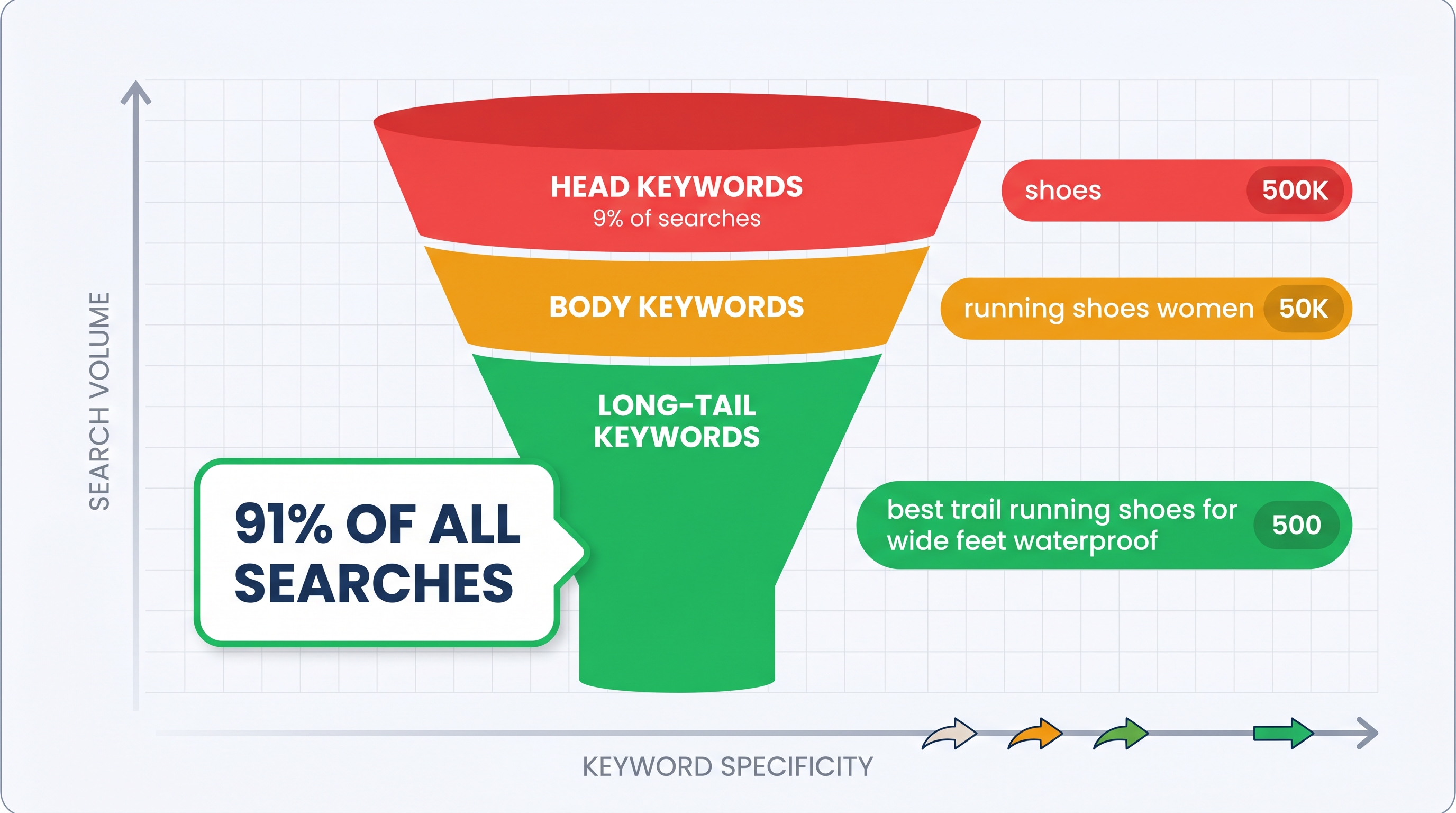
That's a long-tail keyword. And according to research from Backlinko, these specific, multi-word phrases account for over 91% of all web searches. The giants ignore them because the individual search volume looks tiny on a spreadsheet. But here's what the data doesn't show: the person typing that query has their credit card ready.
AI search engines like ChatGPT and Google's AI Overviews have made this even more pronounced. They don't just match keywords anymore. They understand natural language, conversational queries, and specific intent. When someone asks their phone 'What's the best CRM for a five-person marketing agency that integrates with HubSpot,' they're not window shopping. They're solving a problem right now.
What Are Long-Tail Keywords (And Why Giants Ignore Them)
A long-tail keyword is a search phrase that's specific, usually three or more words, and reflects how real people actually talk. 'Shoes' is a head term. 'Best waterproof hiking boots for wide feet' is long-tail.
The difference isn't just length. It's intent. Someone searching 'shoes' could be looking for anything. Someone searching 'best waterproof hiking boots for wide feet' knows what they want, has probably already done research, and is close to buying.
Head Terms (What Giants Target)
Broad, high-volume keywords like 'software' or 'marketing.' Massive competition, vague intent, low conversion rates.
Long-Tail Keywords (Your Opportunity)
Specific phrases like 'email marketing software for Shopify stores under $100/month.' Lower volume, clear intent, higher conversions.
Big brands focus on head terms because they look impressive in reports. 'Running shoes' gets 500,000 monthly searches. That's a number you can show your CEO. But the cost to rank for it? Astronomical. The conversion rate? Mediocre at best.
Long-tail keywords are the opposite trade-off. 'Best trail running shoes for flat feet under $120' might only get 200 searches per month. But you can rank for it in weeks, not years. And when someone lands on your page, they're not browsing. They're buying.
Think of your database index like a book's table of contents. Long-tail keywords are the chapter titles that tell you exactly where to find what you need. Head terms are just the book cover.
Prithvi Jadwani, TechDevs CEO
The 2026 Long-Tail Advantage: AI, Voice Search, and Buyer Intent
Voice search changed everything. When you type a search query, you might abbreviate: 'best CRM small business.' But when you ask Siri or Alexa, you speak naturally: 'What's the best CRM for a small business with less than 10 employees that integrates with Gmail?'
That's a long-tail keyword in its purest form. And it's how most people search now.
Google's AI Overviews and ChatGPT don't just match keywords. They understand context, intent, and nuance. They prioritize content that answers specific questions with depth and clarity. A 500-word generic blog post on 'SEO tips' won't cut it. But a 2,000-word guide on 'how to optimize product pages for voice search in Shopify stores selling handmade jewelry'? That's gold.
Informational long-tail keywords: 'How to choose running shoes for marathon training' (top of funnel, building trust)
Comparison long-tail keywords: 'Asana vs Monday.com for remote teams' (middle of funnel, evaluating options)
Transactional long-tail keywords: 'Buy waterproof hiking boots size 11 wide online' (bottom of funnel, ready to purchase)
Map your content to intent. If you're only targeting transactional keywords, you're missing 80% of the journey. But if you only write informational content, you're not converting.

How to Find Your Money-Making Long-Tail Keywords: A Step-by-Step System
Forget keyword tools for a minute. Your best source for long-tail keywords is sitting in your inbox, your review section, and your customer support tickets.
Real customers use real language. They don't say 'footwear solutions for athletic performance.' They say 'shoes that don't hurt my arches after a 10K.' That's your keyword.
Long-Tail Keyword Research System
Read 50 customer reviews and highlight phrases that describe problems or benefits
Type your main keyword into Google and screenshot the autocomplete suggestions
Scroll to 'People Also Ask' and 'Related Searches' at the bottom of the results page
Use a tool like AnswerThePublic or AlsoAsked to find question-based queries
Analyze competitor content and identify gaps where they're not targeting specific variations
Create a spreadsheet with columns: keyword, search volume, difficulty, intent, priority
Filter for keywords with difficulty under 30 and clear transactional or comparison intent
Here's the matrix that matters: plot keyword difficulty on one axis and buyer intent on the other. You want the sweet spot in the bottom-right corner. Low difficulty, high intent. That's where new brands win.
Common Long-Tail Keyword Questions
How long does it take to rank for long-tail keywords as a new brand?
Most new brands see traction in 8-12 weeks if the content is solid and the keyword difficulty is under 30. Compare that to 12-24 months for competitive head terms. The key is publishing consistently and building internal links between related long-tail pages.
What's the ideal keyword difficulty score for new websites targeting long-tail keywords?
Aim for difficulty scores under 30 (on a 0-100 scale) when you're just starting. As you build domain authority, you can target keywords in the 30-50 range. Anything above 50 is a multi-year play for a new brand without serious backlink firepower.
How many long-tail keywords should I target per blog post?
One primary long-tail keyword and 2-3 related variations. Don't keyword stuff. Write naturally and let semantic variations happen. Google is smart enough to understand that 'best CRM for small teams' and 'top CRM software for small businesses' are the same intent.
Can long-tail keywords work for local businesses competing with national chains?
Absolutely. Local modifiers are natural long-tail keywords. 'Best pizza delivery in downtown Austin' beats 'pizza delivery' every time for a local shop. Combine long-tail with local SEO tactics and you can dominate your area.
What's the difference between long-tail keywords and semantic keywords?
Long-tail keywords are specific phrases. Semantic keywords are related terms and concepts that support the main topic. For example, if your long-tail keyword is 'best running shoes for marathon training,' semantic keywords include 'cushioning,' 'heel drop,' 'pronation,' and 'race day performance.'
How do I balance long-tail keyword optimization with natural, readable content?
Write for humans first. Use the exact long-tail phrase in your title, first paragraph, and one subheading. After that, use natural variations. If it sounds forced, it is. Google's algorithm rewards content that reads naturally over keyword-stuffed garbage.
Should I use the exact long-tail keyword phrase or variations in my content?
Both. Use the exact phrase 2-3 times (title, intro, one heading). Then use natural variations throughout. 'Best project management software for remote teams' can become 'top PM tools for distributed workforces' or 'remote team collaboration platforms.' Google understands synonyms.
The Topic Cluster Strategy: How to Structure Content That Dominates
Publishing random blog posts is a losing strategy. You need architecture.
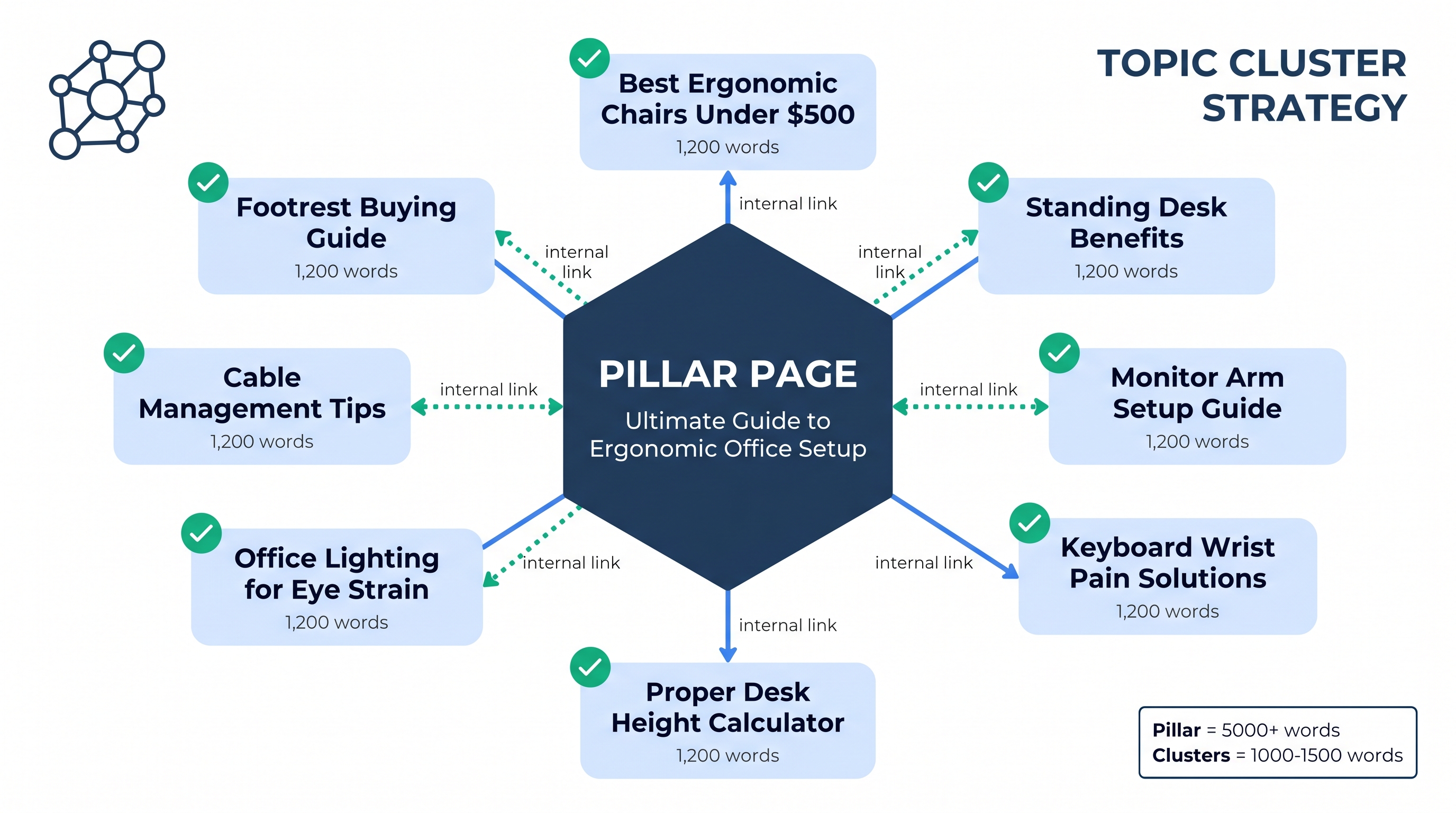
The topic cluster model works like this: create one comprehensive pillar page on a broad topic (like 'Email Marketing for E-commerce'), then build 10-15 cluster pages targeting specific long-tail variations ('How to write abandoned cart emails for Shopify stores,' 'Best email subject lines for Black Friday sales,' etc.).
Each cluster page links back to the pillar. The pillar links to all clusters. This internal linking structure tells Google you're an authority on the entire topic, not just one angle.
Pillar Page
Comprehensive 3,000+ word guide covering the broad topic. Targets a medium-difficulty keyword.
Cluster Content
10-15 focused articles targeting specific long-tail variations. Each 1,500-2,000 words.
Internal Links
Every cluster links to the pillar. Pillar links to all clusters. Builds topical authority fast.
This structure lets you compete against established domain authority. You're not trying to outrank a giant with one article. You're building a content ecosystem that demonstrates depth and expertise across an entire topic.
AI-Powered Content Creation: Scaling Long-Tail Keywords Without Burning Out
Here's the problem with long-tail keywords: you need a lot of content. If you're targeting 50 specific phrases, that's 50 articles. Writing all that manually will take years.
This is where AI becomes your research assistant, not your ghostwriter. At TechDevs, we use AI to identify content opportunities, generate outlines, and pull relevant data. But the actual writing? That's still human.
The workflow looks like this: AI analyzes search data and identifies long-tail opportunities we're missing. It generates a content brief with target keywords, competitor analysis, and suggested structure. A human writer takes that brief and creates the actual article with real examples, opinions, and personality.
Pros
Speeds up keyword research and opportunity identification by 10x
Generates content briefs and outlines in minutes instead of hours
Analyzes competitor content gaps at scale
Helps maintain consistent publishing schedules
Cons
AI-generated content without human editing reads like generic slop
Lacks the opinions, personality, and real examples that build trust
Can't replicate industry experience or battle scars
Google is getting better at detecting purely AI-written content
Use AI for research and structure: keyword analysis, content briefs, competitor gaps
Use humans for writing and opinions: actual content, examples, personality, editing
Use AI for optimization: meta descriptions, title variations, internal linking suggestions
Use humans for quality control: fact-checking, brand voice, final polish
The brands winning with long-tail keywords in 2026 aren't choosing between AI and humans. They're using both strategically. AI handles the scale. Humans handle the quality.
Long-Tail Keywords for E-commerce: Turning Searches Into Sales
Product pages are where long-tail keywords print money. But most e-commerce brands waste the opportunity.
Instead of optimizing for 'running shoes' (impossible to rank for), optimize each product page for a specific long-tail variation. 'Women's trail running shoes with wide toe box and arch support' is a real search phrase. And if your product page matches that exact intent, you'll rank.
The trick is using customer language from reviews. If five customers mention 'perfect for wide feet,' that phrase goes in your product description. If three people say 'great arch support for long runs,' that goes in too. You're not keyword stuffing. You're reflecting how real customers describe the product.
For PPC campaigns, long-tail keywords are even more powerful. The cost-per-click is 40-60% lower than broad terms, and the conversion rate is higher because the intent is specific. Someone searching 'buy waterproof hiking boots size 11 online' isn't comparison shopping. They're ready to purchase.
E-commerce Long-Tail Optimization Checklist
Mine customer reviews for specific phrases describing benefits and features
Optimize each product page title for a unique long-tail variation
Include long-tail keywords naturally in product descriptions (not stuffed)
Create category pages targeting broader long-tail phrases ('men's waterproof hiking boots')
Use long-tail keywords in image alt text and file names
Build blog content targeting informational long-tail queries that link to products
Set up PPC campaigns with long-tail keywords for lower CPC and higher conversions
Measuring Success: KPIs That Actually Matter for Long-Tail Strategy
Most brands measure the wrong things. They obsess over search volume and keyword rankings while ignoring revenue.
Here's what actually matters: conversion rate, revenue per visitor, and customer lifetime value. A long-tail keyword that brings 50 visitors per month but converts at 10% is worth more than a head term that brings 5,000 visitors at 0.5% conversion.
Track rankings for keyword clusters, not individual terms. If you're targeting 15 long-tail variations around 'email marketing for e-commerce,' measure how many of those 15 are ranking in the top 10. That's your cluster performance score.
Conversion Rate by Keyword Type
Compare conversion rates for long-tail vs head term traffic. Long-tail should convert 2-5x higher.
Revenue Per Visitor
Track how much revenue each keyword cluster generates per visitor, not just total traffic.
Customer Lifetime Value
Customers from long-tail searches often have higher LTV because they found exactly what they needed.
Time to First Page
Measure how long it takes to rank on page one for new long-tail content (should be 8-12 weeks).
Use Google Search Console to identify emerging opportunities. Filter by impressions (not clicks) and look for queries where you're ranking 11-20. Those are low-hanging fruit. A few internal links or a content update can push you to page one.
Ready to Outrank the Giants?
Most new brands waste months targeting the wrong keywords. We help you identify high-intent long-tail opportunities, build topic clusters that rank fast, and turn search traffic into revenue. Book a free strategy call and we'll show you exactly which keywords you should be targeting.