The Ultimate Guide to Dominating SEO and CRO for Your Coffee Brand in 2026
Master SEO and CRO strategies for your coffee brand in 2026. Boost rankings, traffic, and conversions with proven tactics tailored for the coffee industry.
 Written byPrithvi Jadwani
Table of contents
Summarize this article with AI
TL;DR
Most coffee brands are losing 60% of their potential customers before checkout. The ones winning in 2026 aren't just getting more traffic. They're building discovery infrastructure that captures buyers at the exact moment they're searching for their next bag, and they're converting those visitors at rates that would make most ecommerce brands jealous. Here's how to do both.
- AI Search Is Your New Storefront. Coffee shoppers are discovering brands through ChatGPT and Perplexity before they ever hit Google. If you're not optimized for AI search, you're invisible.
- SEO Without CRO Is Wasted Money. Ranking #1 means nothing if your product pages can't convert. The brands printing money are obsessing over both simultaneously.
- Subscription Models Need Different Tactics. One-time buyers and subscribers require completely different conversion strategies. Most coffee brands get this wrong.
- Technical Excellence Isn't Optional. Page speed, mobile optimization, and structured data are the foundation. Skip these and nothing else matters.
Why SEO and CRO Matter More Than Ever for Coffee Brands in 2026
The coffee ecommerce space is more competitive than it's ever been. Every specialty roaster, every D2C brand, every subscription service is fighting for the same customers. And most of them are losing.
Here's what changed: AI search tools now handle millions of shopping queries every single day. People are asking ChatGPT for coffee recommendations before they even open Google. If your brand isn't structured to be quoted by these AI systems, you're handing customers to competitors who figured this out six months ago.
But getting traffic is only half the battle. I've seen coffee brands rank #1 for high-intent keywords and still struggle to break even because their product pages convert at 0.8%. The brands that win in 2026 understand that SEO and CRO aren't separate initiatives. They're two sides of the same strategy.
The synergy is simple: SEO brings qualified traffic to your site. CRO turns that traffic into revenue. Do one without the other and you're either invisible or broke. Do both right and you rank, convert, and print money.
Foundation: Understanding Your Coffee Brand's SEO and CRO Starting Point
You can't optimize what you don't measure. Before you touch anything, you need a complete picture of where your coffee brand stands right now.
Most coffee brands skip this step. They jump straight into content creation or A/B testing without understanding their baseline. That's like trying to navigate without knowing your starting point.
SEO and CRO Audit Checklist for Coffee Brands
Run a technical SEO crawl to identify indexing issues, broken links, and site speed problems
Analyze current organic rankings for your core product categories and informational content
Map your conversion funnel from landing page to checkout and identify drop-off points
Review competitor coffee brands: what keywords they rank for, what their product pages look like, how they structure their checkout
Set baseline KPIs: current organic traffic, conversion rate by traffic source, average order value, customer acquisition cost
Audit your existing content for keyword targeting, user intent match, and conversion potential
Here's what I've learned from working with coffee brands: the ones that succeed are brutally honest about their starting point. They don't sugarcoat the data. They look at a 1.2% conversion rate and say 'this needs to be 3%' instead of making excuses.
SEO Benchmarks
Track organic traffic growth, keyword rankings in top 10, domain authority, and backlink profile quality. Compare against direct competitors monthly.
CRO Benchmarks
Monitor conversion rate by device, average order value, cart abandonment rate, and time to purchase. Test changes against these baselines.
Competitive Intelligence
Study what top coffee brands are doing right. Look at their content strategy, product page structure, and checkout flow. Steal what works.
Iteration Cadence
Set up monthly reviews of both SEO and CRO metrics. What's working gets doubled down. What's not working gets killed or fixed.
Once you have this foundation, you know exactly where to focus. No guessing. No wasted effort.
Advanced SEO Strategies for Coffee Brands in 2026
SEO in 2026 isn't what it was two years ago. AI-powered search has changed the game completely. Google's Search Generative Experience, ChatGPT's shopping features, Perplexity's direct answers... these aren't future trends. They're how your customers are finding coffee right now.
The coffee brands winning in this new landscape are the ones that optimized for AI search six months ago. They're getting quoted in AI responses. They're showing up in ChatGPT recommendations. They're owning the AI search layer while their competitors are still debating whether to start.
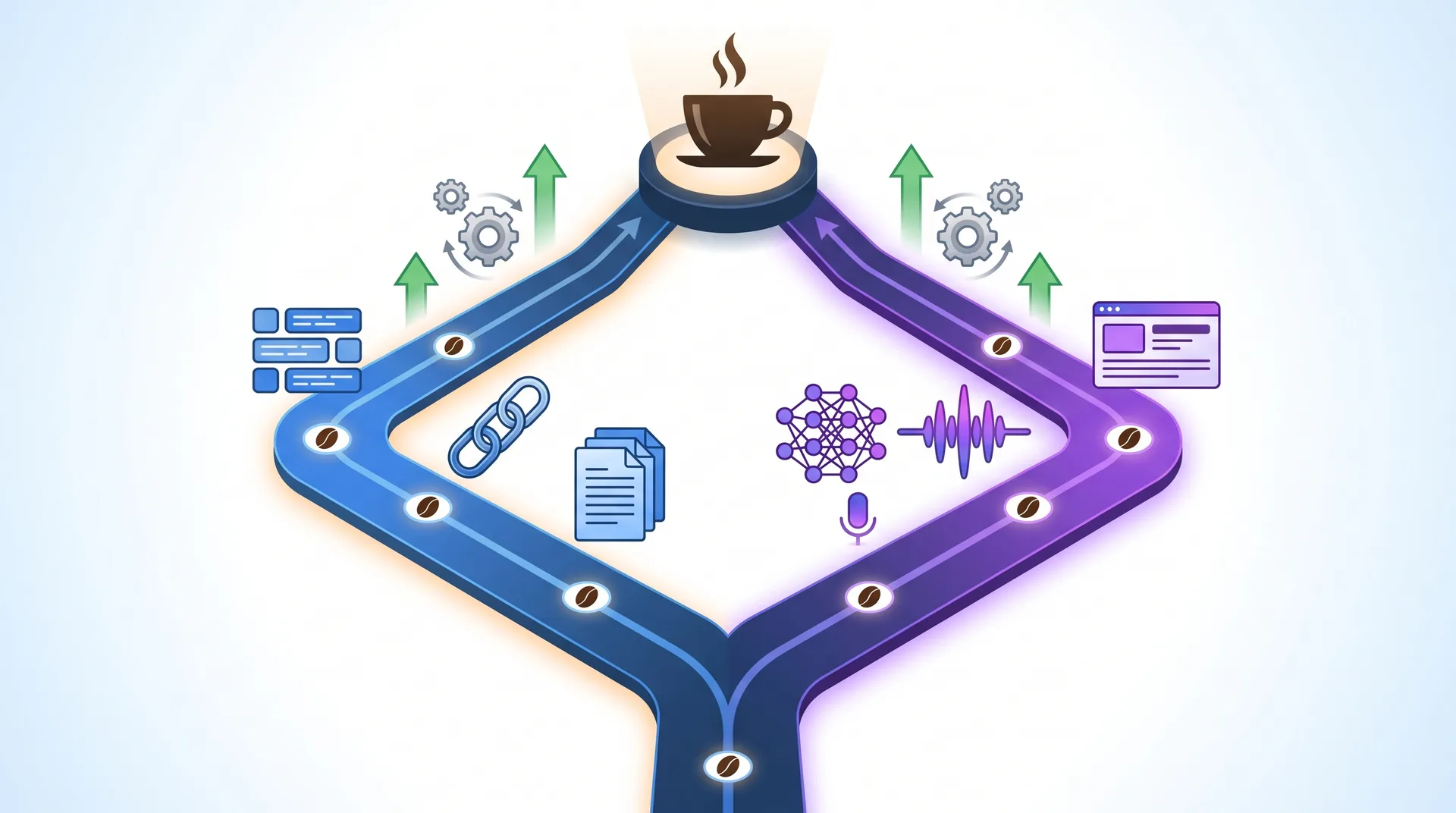
Here's what actually works:
Core SEO Strategies for Coffee Brands
How do you optimize for AI-powered search engines?
Structure your content for direct quoting. Use clear, definitive statements about your products. Include specific details like roast profiles, origin stories, and tasting notes in a format AI can extract and cite. Add structured data markup to your product pages so AI systems understand exactly what you're selling. Most importantly, create content that answers questions completely. AI search tools prioritize comprehensive, authoritative answers.
What local SEO tactics work for coffee roasters?
Claim and optimize your Google Business Profile with high-quality photos, accurate hours, and regular posts about new roasts or events. Build location-specific landing pages if you have multiple cafes. Get reviews aggressively because they impact both local rankings and conversion rates. Create content around local coffee culture and community events. Build citations in local directories and coffee industry listings.
What content actually ranks for coffee brands?
Educational content wins. Brewing guides that teach people how to make better coffee at home. Origin stories that explain where your beans come from and why it matters. Comparison content that helps buyers choose between different roasts or brewing methods. The key is depth. A 500-word fluff piece about 'best coffee beans' won't rank. A 2,000-word guide that covers varietals, processing methods, and flavor profiles will.
What technical SEO issues kill coffee sites?
Slow page speed is the biggest killer. Coffee brands love high-res product photos, but if those images aren't optimized, your site loads like molasses. Mobile optimization is non-negotiable since most coffee purchases happen on phones. Implement proper structured data for products, reviews, and FAQs. Fix your internal linking so search engines can crawl your entire catalog. And for the love of good espresso, make sure your site is indexable. I've seen React-based coffee sites that Google literally can't crawl.
How do you build authority in the coffee industry?
Strategic partnerships with coffee publications, industry blogs, and complementary brands. Guest posts on established coffee sites. Get featured in coffee industry roundups and buying guides. Sponsor or participate in coffee events and competitions. Build relationships with coffee influencers and content creators. The goal isn't just backlinks. It's becoming a recognized name in the specialty coffee space.
One thing most coffee brands miss: technical SEO isn't sexy, but it's the foundation everything else sits on. You can have the best content in the world, but if Google can't crawl it properly or your pages take 8 seconds to load, none of it matters.
Structured data tells search engines exactly what your products are, what they cost, and what customers think about them
Page speed directly impacts both rankings and conversions (every 100ms delay costs you customers)
Mobile-first design isn't optional when 70% of coffee purchases start on a phone
Internal linking helps search engines understand your site structure and passes authority to important pages
XML sitemaps and proper robots.txt configuration ensure your entire catalog gets crawled and indexed
The brands that nail technical SEO early get a compounding advantage. They rank faster, convert better, and scale easier.
Keyword Strategy: Targeting the Right Coffee Shoppers
Here's what nobody tells you about keyword research for coffee brands: most of the obvious keywords are traps.
'Best coffee beans' gets 40,000 searches a month. It's also dominated by massive review sites with domain authority you'll never compete with. You'll spend six months trying to rank for it and get nowhere.
The coffee brands printing money are targeting keywords that their competitors ignore. Long-tail searches with clear buying intent. Niche terms that attract exactly the customers they want. Informational queries that capture people early in their buying journey.
High-Intent Transactional Keywords
Terms like 'buy ethiopian yirgacheffe coffee' or 'single origin coffee subscription'. Lower volume, but these searchers are ready to buy right now.
Informational Keywords That Build Trust
Searches like 'how to brew pour over coffee' or 'difference between light and medium roast'. Capture early-stage buyers and build authority.
Long-Tail Niche Opportunities
Specific combinations like 'organic fair trade guatemalan coffee' or 'best coffee for cold brew concentrate'. Less competition, higher conversion rates.
Seasonal and Trending Keywords
Terms that spike at specific times: 'cold brew coffee beans summer' or 'holiday coffee gift sets'. Plan content 2-3 months ahead of the season.
Voice search is changing keyword strategy too. People don't type 'best medium roast coffee beans'. They ask their phone 'what's a good medium roast coffee for espresso?' Optimize for natural language questions, not just short keyword phrases.
I tested this with a specialty roaster last year. We shifted from chasing high-volume generic terms to targeting 50+ long-tail keywords with clear buying intent. Organic traffic went up 40%. Revenue from organic went up 180%. The math is simple: fewer visitors who actually want what you're selling beats tons of traffic that bounces.
CRO Optimization: Converting Coffee Lovers into Loyal Customers
You can have all the traffic in the world. If your product pages don't convert, you're just burning money.
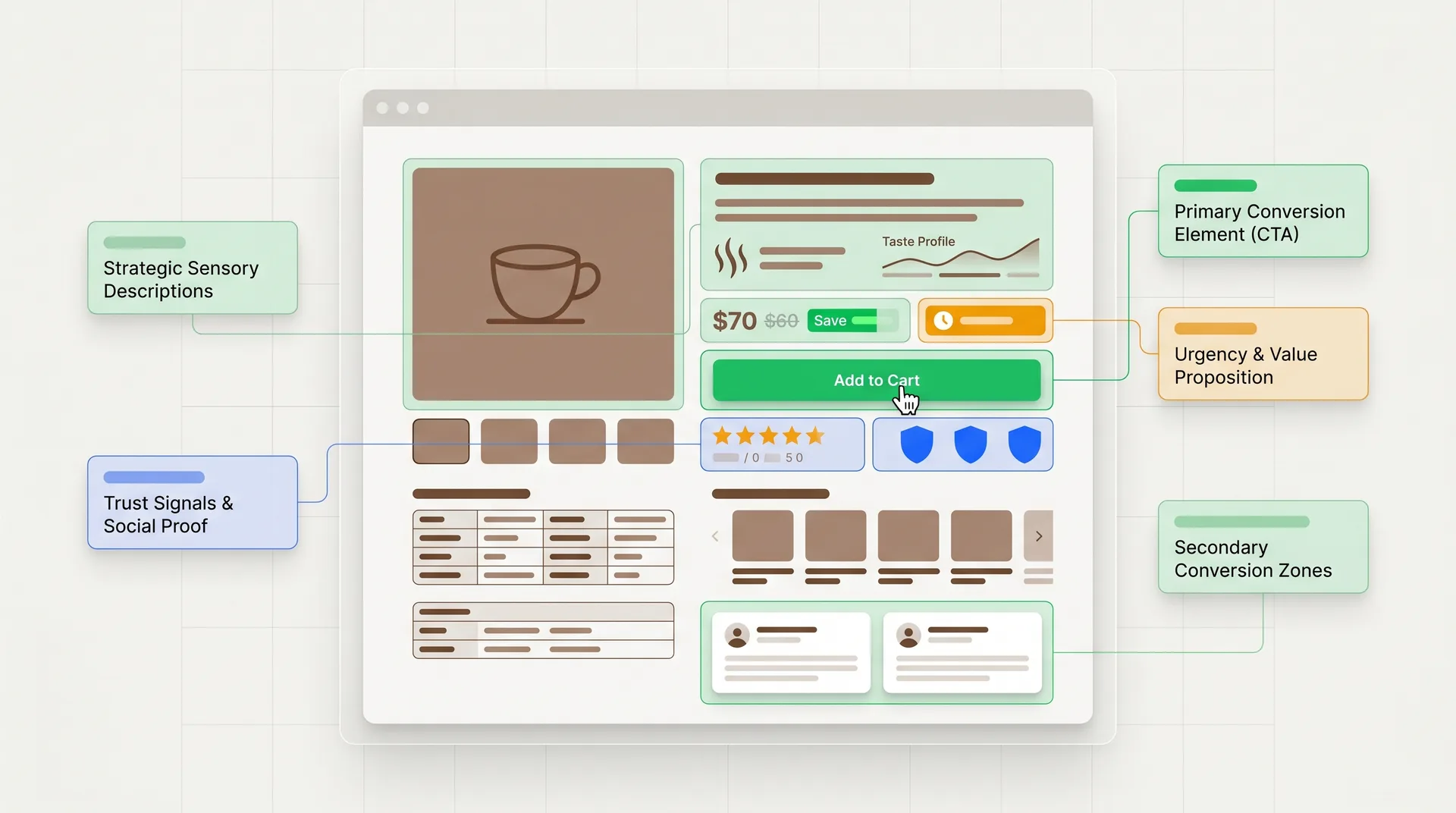
Coffee is a sensory product. You can't let people smell or taste it online. So your product pages need to do something harder: make people imagine the experience so vividly they're willing to buy.
The best coffee brands do this with specific, sensory language. Not 'smooth and balanced'. That means nothing. 'Dark chocolate and toasted hazelnut with a bright citrus finish.' Now I can taste it.
Pros
Subscriptions provide predictable recurring revenue and higher customer lifetime value
Lower customer acquisition cost when spread across multiple orders
Builds habit and loyalty, reducing churn to competitors
Allows for personalization and relationship building over time
Cons
Requires different messaging and value proposition than one-time purchases
Higher initial friction, people hesitant to commit to recurring charges
Churn management becomes critical, need retention strategies
Checkout flow must clearly communicate subscription terms to avoid negative surprises
Subscription models need their own playbook. The brands getting this right offer flexible options (skip, pause, change frequency), make cancellation easy (counterintuitive but it builds trust), and communicate value beyond just 'save 10%'. The real value is convenience and never running out of coffee.
Product imagery needs to be high-quality but fast-loading (show the bag, show the beans, show it being brewed)
Sensory descriptions should be specific enough that someone can imagine the taste profile
Social proof matters more for coffee than almost any other product (display reviews prominently, show real customer photos)
Clear pricing for subscriptions (show per-bag cost and total, explain how billing works, make terms crystal clear)
Trust signals like certifications (organic, fair trade, direct trade) should be visible but not overwhelming
Cart abandonment is brutal in coffee ecommerce. 42% of people add to cart and never complete checkout. The fix isn't complicated: simplify your checkout, offer guest checkout, show shipping costs upfront, add trust badges near the payment button, and send abandoned cart emails within 2 hours.
The coffee brands winning at Conversion Rate Optimization aren't doing anything magical. They're obsessing over details, testing relentlessly, and removing friction at every step. That's it.
User Experience Design That Drives Both SEO and Conversions
Your website's user experience affects both how well you rank and how well you convert. Google tracks engagement metrics. If people land on your site and immediately bounce, your rankings suffer. If they can't find what they're looking for, they don't buy.
Mobile-first design isn't a nice-to-have anymore. It's the baseline. Most coffee purchases happen on phones. If your site doesn't work perfectly on mobile, you're losing half your potential customers before they even see your products.
UX Elements That Impact SEO and CRO
Navigation that makes sense: main categories visible, search bar prominent, filters that actually work
Page speed under 2 seconds on mobile (use lazy loading for images, minimize JavaScript, leverage browser caching)
Clear information architecture: products organized by roast level, origin, or use case
Sticky add-to-cart button on mobile so users don't have to scroll back up
Breadcrumb navigation for SEO and user orientation
Related products and upsells positioned strategically without being pushy
Landing pages deserve special attention. If you're running ads or targeting specific keywords, generic product category pages won't cut it. Build dedicated landing pages that match the search intent exactly. Someone searching for 'organic coffee subscription' should land on a page specifically about your organic coffee subscription, not your homepage.
The best coffee sites feel effortless. You land on them, immediately understand what they offer, find exactly what you're looking for in two clicks, and checkout is so smooth you barely notice it happened. That's the goal.
Content Marketing That Fuels SEO and CRO for Coffee Brands
Content marketing for coffee brands isn't about pumping out blog posts. It's about creating assets that attract the right traffic and move people toward a purchase.
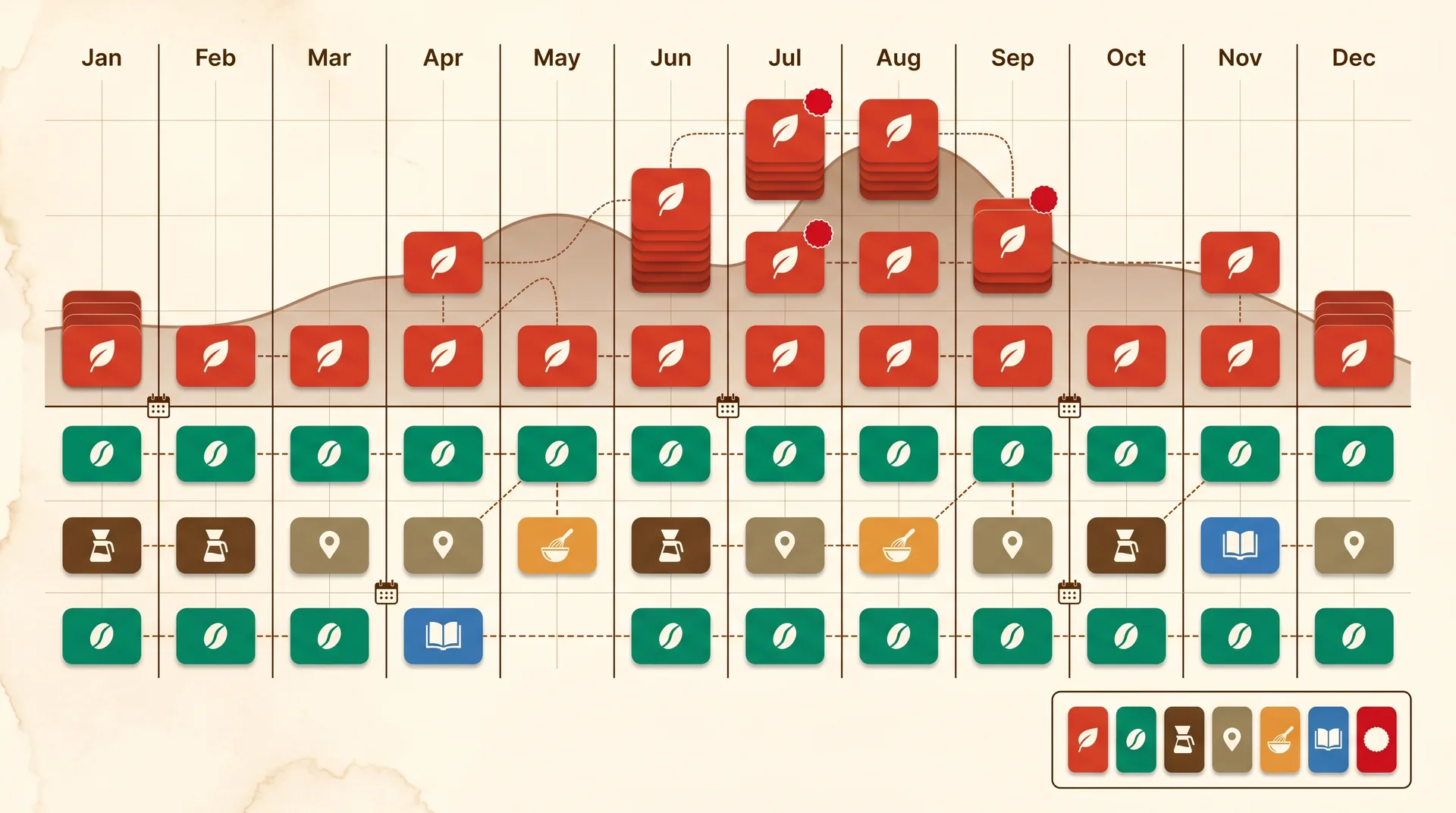
The coffee brands doing this right have a content calendar that aligns with how people actually buy coffee. Cold brew content in April and May before summer hits. Holiday gift guides in October and November. Brewing method tutorials year-round because that's evergreen.
Educational Blog Content
Brewing guides, origin stories, roast level explanations, coffee science. Content that builds trust and captures informational search traffic.
Video Content Strategy
Product demos, brewing tutorials, behind-the-scenes roasting footage, customer testimonials. Video increases engagement and time on site.
Email Marketing Integration
Nurture sequences that educate new subscribers, re-engagement campaigns for inactive customers, content that drives people back to new blog posts.
AI-Assisted Content Creation
Use AI to speed up research and first drafts, but always edit for brand voice and accuracy. AI helps you scale, but humans make it good.
Here's what works: brewing method guides that rank for 'how to make [brewing method] coffee' and naturally link to your products. Origin stories that explain why your Ethiopian Yirgacheffe is special and include a CTA to buy it. Comparison posts that help people choose between options and reduce decision paralysis.
Video content is underrated in the coffee space. Most brands aren't doing it well, which means there's opportunity. A 2-minute video showing how to dial in your grinder for pour over will get more engagement than a 1,500-word article on the same topic. And it helps with SEO because Google loves video content.
Content without strategy is just noise. Every piece should have a purpose: attract a specific audience, answer a specific question, move someone closer to a purchase decision.
Prithvi Jadwani, TechDevs Content Strategy Framework
Email marketing ties everything together. Someone reads your blog post about cold brew, you capture their email with a brewing guide download, you send them a sequence that educates them about your coffee and eventually offers a first-purchase discount. That's how you turn blog traffic into revenue.
Measuring Success: Analytics and Continuous Optimization
If you're not measuring, you're guessing. And guessing is expensive.
The coffee brands that consistently grow are obsessive about their metrics. They know exactly which traffic sources convert best. They know which product pages need work. They know when to double down and when to kill a strategy that isn't working.
SEO metrics that matter: Organic traffic growth month-over-month, keyword rankings in top 10 positions, pages indexed, backlink profile quality, organic traffic conversion rate
CRO metrics that matter: Overall conversion rate, conversion rate by traffic source, average order value, cart abandonment rate, time from first visit to purchase
Revenue metrics that matter: Customer acquisition cost, customer lifetime value, revenue per visitor, subscription retention rate, repeat purchase rate
Engagement metrics that matter: Pages per session, average session duration, bounce rate by page type, scroll depth on key pages
Set up a dashboard that shows these metrics at a glance. Review it weekly. Look for patterns. If organic traffic is up but conversions are flat, you have a CRO problem. If conversions are great but traffic is stagnant, you need more SEO work.
Automation is your friend here. Set up alerts for ranking drops, traffic anomalies, and conversion rate changes. Use AI tools to identify patterns you might miss manually. But don't automate everything. The insights that drive real growth come from humans looking at data and asking 'why?'
The brands that win are the ones that iterate faster than their competitors. They test, learn, and adapt. They kill what doesn't work and scale what does. They don't fall in love with strategies. They fall in love with results.
Frequently Asked Questions
What is the average conversion rate for coffee ecommerce websites in 2026?
The industry average for specialty coffee ecommerce sites sits around 2-3%. But that average includes a lot of poorly optimized sites. The top-performing coffee brands we work with are converting at 4-6% for one-time purchases and 2-3% for subscription sign-ups. If you're below 2%, you have significant room for improvement.
How long does it take to see SEO results for a new coffee brand?
For a brand-new domain, expect 4-6 months before you see meaningful organic traffic. If you're optimizing an existing site with some authority, you can see improvements in 2-3 months. Long-tail keywords and low-competition terms will rank faster. High-volume competitive terms take longer. The key is starting now because your competitors aren't waiting.
What are the most important ranking factors for coffee product pages?
Product page SEO comes down to a few critical elements: unique, detailed product descriptions with specific tasting notes and origin information, high-quality images with proper alt text, structured data markup for products and reviews, customer reviews (quantity and recency matter), internal links from relevant blog content, and page speed. Get these right and your product pages will rank.
Should coffee brands focus more on SEO or CRO first?
This is the wrong question. You need both. But if I had to pick, fix your conversion rate first. There's no point driving traffic to a site that converts at 0.8%. Get your product pages, checkout flow, and core user experience solid. Then scale traffic through SEO. Otherwise you're just paying to show people a broken experience.
How can small coffee roasters compete with large brands in search results?
Small roasters have advantages that big brands don't: authenticity, story, and the ability to move fast. Focus on long-tail keywords the big brands ignore. Build content around your specific origin relationships and roasting philosophy. Dominate local SEO if you have a physical location. Create educational content that showcases your expertise. You won't outrank the giants for 'coffee beans', but you can own 'single origin ethiopian natural process coffee' and a hundred other specific terms.
What CRO tactics work best for coffee subscription models?
Make the value proposition crystal clear beyond just price savings. Emphasize convenience and never running out. Offer flexible options (skip, pause, change frequency) prominently. Show exactly how billing works and when charges happen. Make cancellation easy, which counterintuitively reduces churn because it builds trust. Use customer testimonials specifically about the subscription experience. Offer a satisfaction guarantee. Remove as much friction and uncertainty as possible.
How is AI changing SEO and CRO strategies for coffee brands?
AI search tools like ChatGPT and Perplexity are becoming primary discovery channels. Coffee brands need to structure their content for AI citation, use clear definitive statements, and implement proper structured data. On the CRO side, AI enables better personalization, predictive analytics for what products to show which visitors, and automated testing at scale. The brands adapting to AI search visibility now are building advantages that compound. The ones waiting are falling behind.
Ready to Dominate Coffee Search and Convert Like Crazy?
We've helped specialty coffee brands 3x their organic revenue in under 6 months. No fluff, no theories. Just SEO and CRO strategies that actually work. Book a discovery call and let's figure out if we're a fit.