The Ultimate SEO & CRO Checklist to Scale Your Protein Brand in India (2026 Edition)
Master SEO & CRO for your protein brand in India. Complete 2026 checklist with proven strategies to scale, boost conversions, and dominate the market.
 Written byPrithvi Jadwani
Table of contents
Summarize this article with AI
TL;DR
The Indian protein supplements market is exploding, projected to be part of a global surge from USD 32.89 billion in 2026 to USD 66.23 billion by 2034. But here's the thing: most brands will fail because they're treating SEO and CRO like checkboxes instead of growth engines. This checklist gives you the exact playbook to dominate search rankings, convert price-conscious Indian consumers, and scale profitably in 2026.
- Mobile-First is Non-Negotiable. India's internet users are mobile-first. Your site speed and mobile UX will make or break your rankings and conversions.
- Local Language SEO is Your Edge. Hindi, Tamil, Telugu content unlocks tier 2/3 cities where competition is lower and demand is growing fast.
- Trust Signals Sell Supplements. FSSAI badges, lab reports, and COD options aren't nice-to-haves. They're conversion requirements in India.
- Technical SEO Comes First. Fix your Core Web Vitals, schema markup, and site architecture before you write a single blog post.
- Content Beats Ads Long-Term. Educational content about Indian diets, vegetarian protein, and fitness myths builds authority that paid ads can't buy.
Why 2026 is the Breakthrough Year for Protein Brands in India
The Indian protein market isn't just growing. It's about to explode. According to Fortune Business Insights, the global protein supplements market is projected to jump from USD 32.89 billion in 2026 to USD 66.23 billion by 2034, growing at a 9.14% CAGR. India's slice of that pie is getting bigger every quarter.
But here's what most brands miss: growth isn't automatic. The fitness-conscious middle class is expanding. Disposable income is rising. Gym memberships in tier 2 and tier 3 cities are surging. Yet most protein brands are still running 2019 playbooks in a 2026 market.
Digital-first behavior is the default now. Indian consumers research protein powders on Google, compare prices on Amazon and Flipkart, read reviews in WhatsApp groups, and make purchase decisions based on Instagram influencers. If your SEO and CRO aren't dialed in, you're invisible.

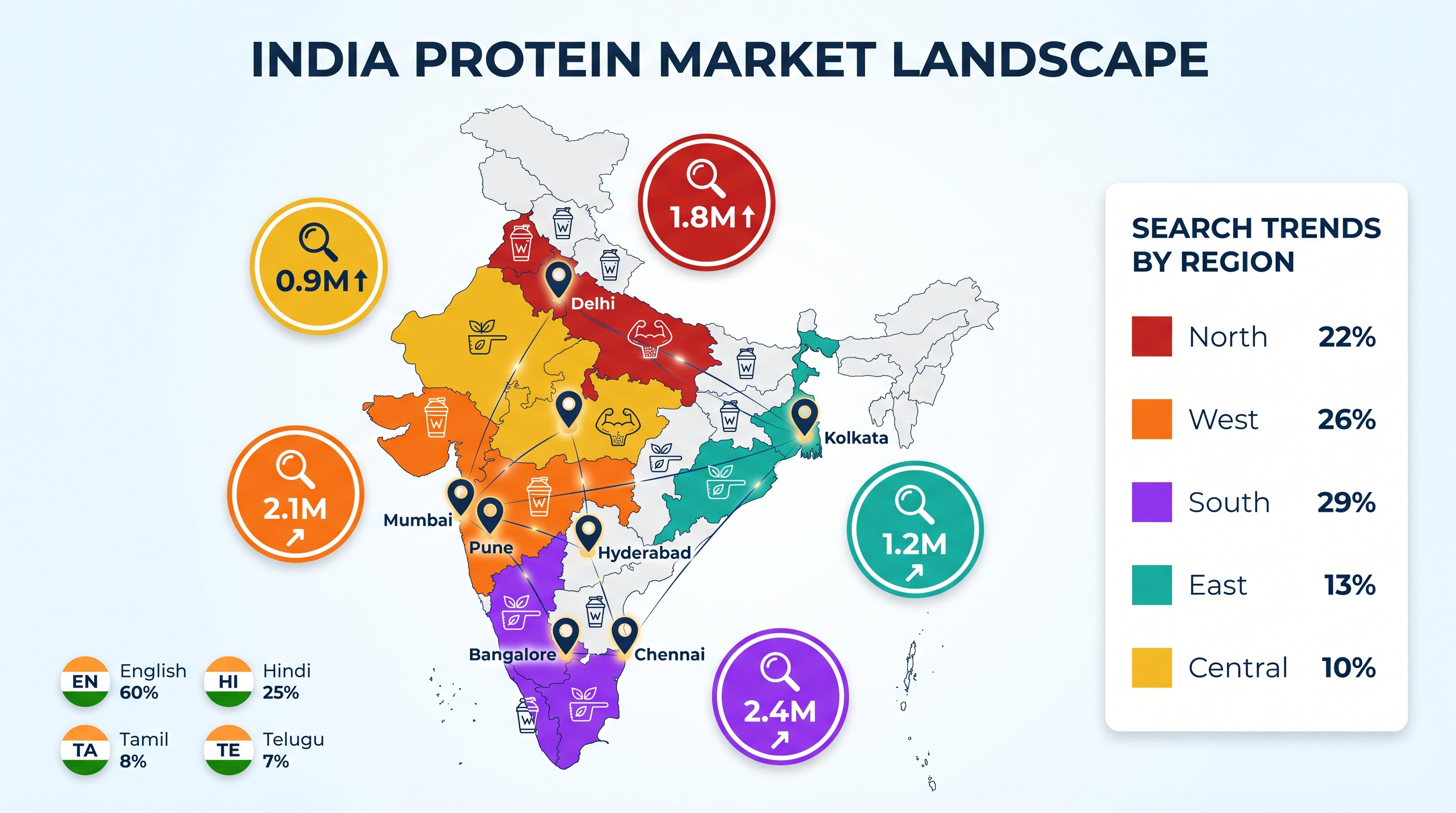
Understanding the India Protein Market Landscape for SEO Success
You can't optimize for a market you don't understand. India's protein landscape has unique quirks that Western brands consistently underestimate.
First, the product split matters. Plant-based proteins (soy, rice, pea) are growing faster than animal-based options in many regions because of cultural and dietary preferences. Whey still dominates the serious lifter segment, but vegetarian bodybuilders are a real and growing demographic. Your SEO strategy needs to account for both.
Consumer Segments
Performance athletes want fast-absorbing whey. Weight management seekers prefer casein. General wellness buyers look for plant-based options with clean labels.
Distribution Channels
Online retail is exploding, but pharmacies and supermarkets still matter in smaller cities. Your SEO needs to support both e-commerce and local discovery.
Regional Variations
Mumbai searches for premium imported brands. Tier 2 cities search for 'best budget protein powder.' Your keyword strategy must reflect this.
Language Preferences
English dominates in metros, but Hindi, Tamil, Telugu, and Bengali content unlocks millions of potential customers in growing markets.
Search intent varies wildly by region. Someone in Bangalore searching 'whey protein' is probably comparing premium brands and looking at detailed amino acid profiles. Someone in Patna searching the same term might be trying to understand what whey protein even is and whether it's safe.
Metro cities: High intent, comparison-focused searches, price less sensitive
Tier 2 cities: Educational queries, budget-conscious, need more trust signals
Tier 3 cities: Basic awareness content, local language preference, COD required
Regional languages: Massive untapped opportunity with lower competition
Mobile searches: Shorter queries, voice search growing, need fast-loading pages
Technical SEO Checklist for Protein Brand SEO India
Most brands want to jump straight to content. That's backwards. Technical SEO is the foundation. If your site is slow, broken, or confusing to search engines, your content won't rank no matter how good it is.
India's internet infrastructure is improving, but it's still inconsistent. A site that loads in 2 seconds on fiber in Bangalore might take 8 seconds on 4G in Indore. Google knows this. Your Core Web Vitals need to be optimized for the slowest common denominator, not the fastest.
Essential Technical SEO Tasks
Mobile-first design: Test on actual budget Android devices, not just iPhones
Page speed optimization: Compress images, lazy load, use CDN for India-specific hosting
Schema markup: Product schema, review schema, nutritional information schema
Hreflang tags: Set up for English, Hindi, and any regional languages you target
Core Web Vitals: LCP under 2.5s, FID under 100ms, CLS under 0.1
SSL certificate: Mandatory for e-commerce, builds trust, required for rankings
XML sitemap: Separate sitemaps for products, blogs, and category pages
Robots.txt: Block duplicate content, staging sites, and filter pages
Technical SEO Deep Dives
Why does mobile-first matter so much in India?
Over 70% of Indian internet users access the web primarily through mobile devices. Google's mobile-first indexing means your mobile site IS your site. If it's slow or broken on mobile, you won't rank, period.
What schema markup should protein brands prioritize?
Start with Product schema (name, price, availability), Review schema (aggregate ratings), and Nutrition schema (protein content, serving size). These help you appear in rich snippets and answer boxes.
How do I optimize for slower internet speeds in tier 2/3 cities?
Use image compression (WebP format), implement lazy loading, minimize JavaScript, use a CDN with Indian server locations, and test on 3G connections, not just 4G or 5G.
On-Page SEO Strategy: Content That Converts Indian Consumers
Technical SEO gets you in the game. Content wins the game. But most protein brands write content for search engines, not humans. That's why their bounce rates are 70% and their conversions are in the toilet.
Keyword research for India is different. 'Best protein powder' is obvious. But 'vegetarian protein powder for muscle gain' or 'whey protein price 1kg India' are where the real traffic hides. Long-tail keywords with local intent convert 3x better than generic head terms.
Comparison content: Plant-based vs whey for Indian diets, budget vs premium brands
Educational posts: Protein myths in Indian fitness culture, how much protein do Indians actually need
Product-focused: Detailed reviews with nutritional breakdowns, FSSAI certification info
Lifestyle content: Indian meal prep with protein, vegetarian bodybuilding guides, workout routines
Local success stories: Testimonials from Indian athletes, transformation stories with real names and cities
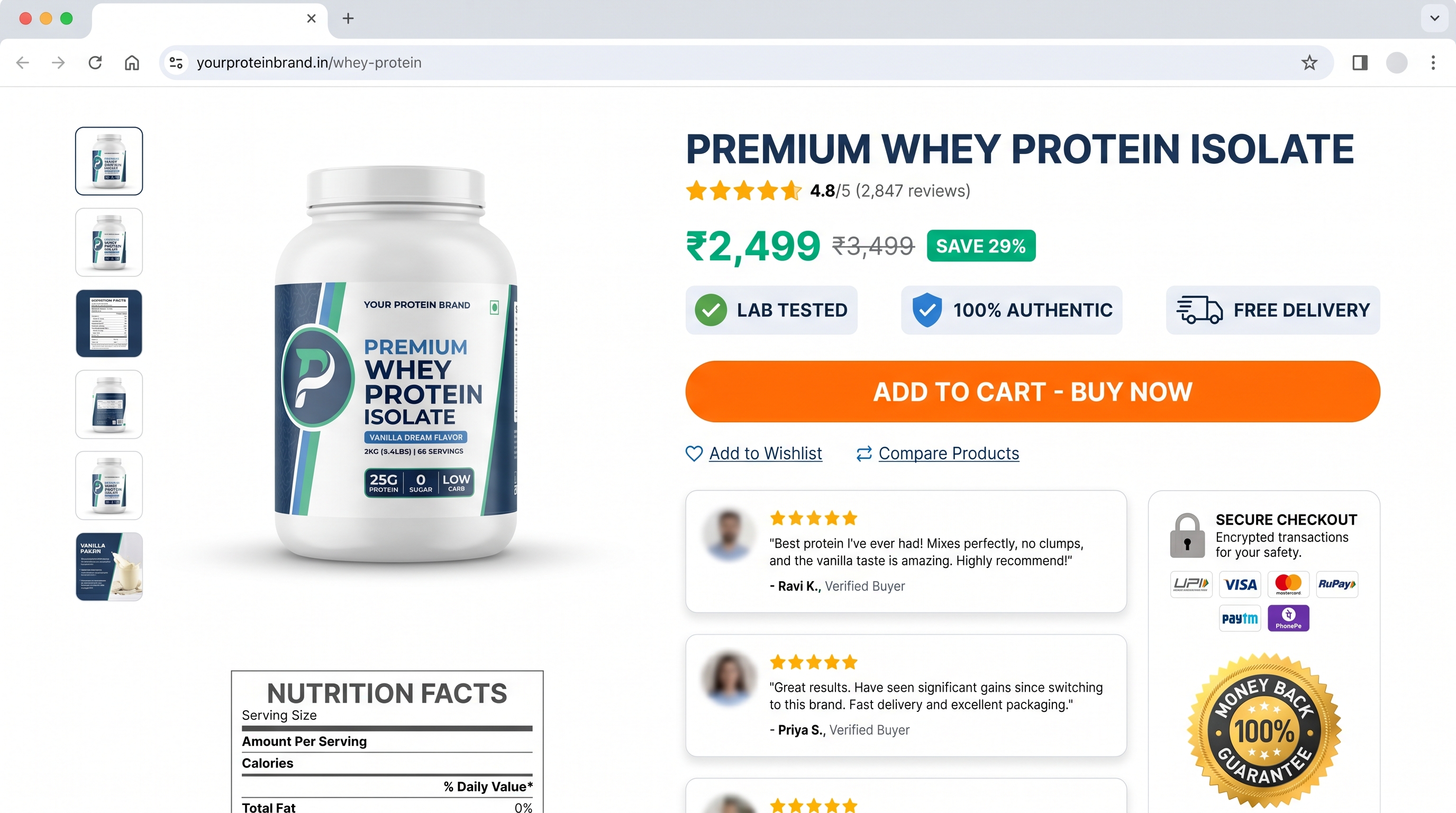
Product pages need more than a description and price. Indian consumers want to see nutritional facts, ingredient sourcing, FSSAI certification, usage instructions in Hindi and English, and social proof. A good product page answers every objection before the customer even thinks of it.
Pros
Localized content ranks faster in regional searches
Builds trust with culturally relevant examples
Lower competition for Hindi and regional language keywords
Higher conversion rates from targeted traffic
Cons
Generic content is easier to produce at scale
English-only content works fine for metro audiences
And here's something most brands ignore: Indian consumers are skeptical of supplements. There's a cultural bias that 'natural food is better than powders.' Your content needs to educate, not just sell. Address the myths. Explain the science. Show real people getting real results.
Off-Page SEO & Authority Building for Supplement Brands
Backlinks are still the currency of SEO. But buying links from sketchy directories won't help you. Google is smarter than that, and Indian consumers can smell fake authority from a mile away.
The brands winning in India are building real relationships with real publishers. Fitness blogs, nutrition websites, health magazines. These aren't transactional link buys. They're collaborations, guest posts, and earned media.
Guest posting: Write for popular Indian fitness blogs, contribute to health sections of major publications
Influencer collaborations: Work with micro-influencers who have engaged audiences, not just follower counts
Roundup features: Get included in 'Best Protein Supplements in India' articles on review sites
PR and media: Launch stories, founder interviews, brand narratives in Indian business media
Directory listings: Health supplement aggregators, review platforms, comparison sites
Gym partnerships: Local tie-ups that result in backlinks from gym websites and local directories
Micro-influencers are underrated. A fitness coach in Pune with 15,000 engaged followers will drive more qualified traffic than a celebrity with 2 million followers who've never heard of your brand. Plus, their backlinks from blog posts and YouTube descriptions carry real SEO weight.
Conversion Rate Optimization (CRO) Checklist for Protein E-commerce
Getting traffic is half the battle. Converting that traffic is where most brands fail. Indian e-commerce has unique friction points that Western CRO playbooks don't address.
Price sensitivity is real. But it's not just about being cheap. It's about showing value. EMI options, bulk discounts, first-time buyer offers. These aren't gimmicks. They're psychological triggers that work.
CRO Essentials for Protein Brands
Clear value proposition: Why your protein is better, stated in the first 3 seconds
Trust badges: FSSAI certification, lab test reports, money-back guarantee prominently displayed
High-quality visuals: Product images, mixing videos, before-after transformations
Detailed ingredient breakdown: Transparency builds trust, especially for supplements
Pricing psychology: Show per-serving cost, offer EMI, highlight bulk savings
Social proof: Reviews in Hindi and English, video testimonials, expert endorsements
Simplified checkout: COD option, UPI, Paytm, multiple payment gateways
Exit-intent popups: First-time discounts, free shipping thresholds
WhatsApp integration: Instant support, order tracking, quick queries
WhatsApp isn't optional. It's expected. Indian consumers want to ask questions before buying supplements. They want reassurance. A WhatsApp button with a real person responding in under 5 minutes converts better than any chatbot.
CRO Questions Answered
What's the average conversion rate for protein e-commerce in India?
Industry average is 1.5-2.5%. Top performers hit 4-6% through aggressive CRO, strong trust signals, and localized checkout experiences. If you're under 2%, you're leaving money on the table.
Should I offer EMI for protein supplements?
Yes, especially for premium products above ₹3,000. EMI options reduce sticker shock and increase average order value. Partner with Razorpay or Paytm for easy integration.
How important are product videos for conversions?
Critical. A 30-second mixing demo or usage video can increase conversions by 15-25%. Indian consumers want to see the product in action before buying.
Local SEO Tactics for Multi-City Protein Brand Expansion
If you have physical retail locations or partner with gyms and stores, local SEO is your secret weapon. Most protein brands ignore it. That's a mistake.
'Protein powder near me' and 'supplement store in [city]' searches are high-intent. Someone searching for these terms wants to buy today, not next week. If your Google Business Profile isn't optimized, you're invisible.
Google Business Profile: Complete every field, add photos, respond to reviews, post updates weekly
City-specific landing pages: Create pages for 'Best Protein Powder in Mumbai,' 'Whey Protein Delhi,' etc.
Gym partnerships: Get backlinks from local gym websites, sponsor fitness events, co-create content
Local directories: List on JustDial, Sulekha, and regional business directories
Review management: Actively collect and respond to reviews on Google, Amazon India, Flipkart
Geo-targeted PPC: Run location-specific ads to complement organic local rankings
City-specific content works. A blog post titled 'Best Gyms in Bangalore for Serious Lifters' that mentions your retail partners will rank locally and drive foot traffic. It's SEO and offline sales in one move.
AI & Automation Tools to Scale Your Protein Brand SEO
You can't scale SEO manually. The brands dominating in 2026 are using AI and automation to do in hours what used to take weeks.
Keyword research used to mean spending days in spreadsheets. Now, AI tools analyze competitor rankings, identify content gaps, and suggest topics with search volume and difficulty scores in minutes. But here's the thing: AI finds opportunities. Humans still need to execute.
Keyword Research
AI tools identify high-opportunity keywords in regional languages and niche segments faster than manual research ever could.
Rank Tracking
Automated dashboards track keyword positions across cities and languages, alerting you to drops before they become problems.
Chatbots & Support
AI chatbots handle 80% of basic queries, freeing your team for complex customer issues and conversion optimization.
Personalization
AI-powered product recommendations based on browsing behavior and fitness goals increase average order value by 15-30%.
Content gap analysis: AI identifies topics your competitors rank for that you don't
Automated reporting: Daily dashboards showing SEO performance, traffic sources, and conversion metrics
Email automation: Triggered sequences based on cart abandonment, first purchase, repeat orders
A/B testing automation: Continuously test headlines, CTAs, and page layouts without manual intervention
Inventory-based SEO: Automatically pause ads and update meta descriptions when products go out of stock
But don't let AI write your content. It's obvious, it's generic, and it doesn't convert. Use AI for research, outlines, and data analysis. Humans write the actual content that builds trust and drives sales.
Measuring Success: KPIs and Analytics for Protein Brand Growth
You can't improve what you don't measure. Most brands track vanity metrics like total traffic and ignore the numbers that actually matter.
Organic traffic is great. But if it's not converting, it's worthless. Focus on metrics tied to revenue: conversion rate, average order value, customer acquisition cost, and lifetime value.
Essential KPIs to Track Monthly
Organic traffic growth: Month-over-month increase in non-paid search traffic
Keyword rankings: Track top 20 target keywords across regions and languages
Domain authority: Monitor backlink growth and overall site authority score
Conversion rate: Percentage of visitors who complete a purchase
Average order value: Revenue per transaction (track by traffic source)
Cart abandonment rate: Identify checkout friction points
Product page performance: Time on page, bounce rate, add-to-cart rate
Content engagement: Pages per session, time on site, scroll depth
Set up Google Analytics 4 and Search Console properly. Most brands have broken tracking or don't segment their data. You need to know which cities, keywords, and content types drive actual revenue, not just clicks.
Run monthly SEO audits. Check for broken links, crawl errors, duplicate content, and ranking drops. Small technical issues compound fast. Catch them early.
Common Mistakes Protein Brands Make (And How to Avoid Them)
We've audited dozens of protein brands. The same mistakes show up again and again.
First, they copy Western brands without localizing. What works in the US doesn't work in India. Your pricing, messaging, and content need to reflect Indian consumer behavior, not Silicon Valley assumptions.
Ignoring mobile performance: Your site loads fast on your MacBook but takes 10 seconds on a budget Android phone
Skipping local languages: Hindi content alone could double your addressable market
Weak trust signals: No FSSAI badge, no reviews, no certifications equals no conversions
Generic content: Writing 'What is whey protein' for the 10,000th time won't rank or convert
No COD option: You're excluding 60% of potential customers who don't trust online payments
Overlooking local SEO: Missing out on high-intent 'near me' searches in cities where you have presence
Buying backlinks: Google penalizes this. Build real relationships instead.
Another big one: treating SEO and CRO as separate projects. They're not. SEO gets people to your site. CRO converts them. If you optimize one without the other, you're wasting half your effort.
Frequently Asked Questions
What are the best SEO keywords for protein brands targeting Indian consumers?
Focus on long-tail, intent-driven keywords like 'best whey protein for beginners India,' 'vegetarian protein powder for muscle gain,' 'protein powder price comparison India,' and 'FSSAI approved protein supplements.' Regional language keywords in Hindi, Tamil, and Telugu have lower competition and high conversion potential.
How long does it take to rank for competitive protein supplement keywords in India?
For moderately competitive keywords, expect 3-6 months with consistent effort. Highly competitive terms like 'best protein powder' can take 8-12 months. But long-tail keywords and regional language terms can rank in 4-8 weeks if your technical SEO is solid.
Should protein brands focus on Hindi content for SEO in India?
Absolutely. Hindi content unlocks tier 2 and tier 3 cities where competition is lower and demand is growing. Start with high-intent pages (product pages, buying guides) in Hindi, then expand to Tamil, Telugu, and Bengali based on your target markets.
What are the most important trust signals for selling supplements online in India?
FSSAI certification badge, third-party lab test reports, customer reviews with photos, money-back guarantee, secure payment icons, and COD option. Indian consumers are skeptical of supplements. Over-communicate safety and quality.
How can small protein brands compete with established players like MuscleBlaze and Optimum Nutrition?
Focus on niches they ignore: regional language content, tier 2/3 city targeting, plant-based protein for vegetarians, budget-friendly options. Use local influencers, create hyper-localized content, and build community through WhatsApp groups and local gym partnerships.
What are the FSSAI requirements for selling protein supplements online in India?
You need FSSAI registration or license depending on your turnover. Display FSSAI license number on packaging and website. Ensure accurate nutritional labeling, ingredient disclosure, and compliance with food safety standards. Non-compliance can result in fines and product seizures.
What's a realistic SEO budget for a protein brand looking to scale in India in 2026?
For serious growth, budget ₹2-5 lakhs per month for a comprehensive SEO and CRO program including technical optimization, content creation, link building, and conversion optimization. Smaller brands can start with ₹50,000-1 lakh monthly and scale as they see ROI.
Ready to Dominate the Indian Protein Market in 2026?
Most protein brands are still figuring out basic SEO while their competitors capture market share. You don't have time to learn through trial and error. We've scaled supplement brands from zero to 50,000+ monthly organic visitors. Let's build your growth strategy.