Should You Do SEO in 2026? (Honest Decision Tree)
Unsure about SEO in 2026? Use our honest decision tree to determine if SEO investment makes sense for your business. Data-driven insights included.
 Written byPrasad Iyer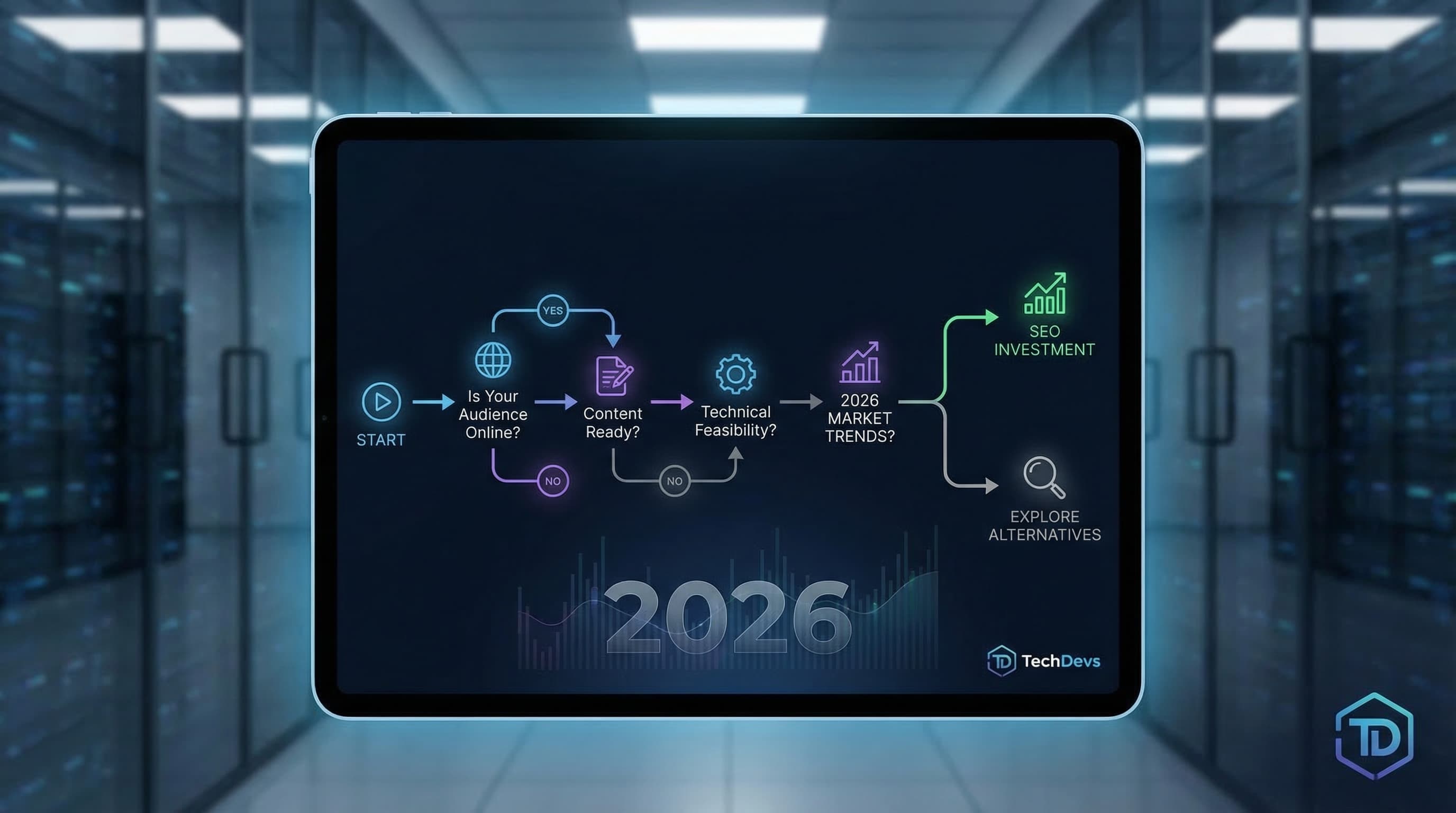
Table of contents
Summarize this article with AI
TL;DR
SEO in 2026 isn't dead, but it's fundamentally different. Search has splintered across AI platforms, social media, and traditional engines. The question isn't whether SEO works anymore. It's whether it works for your business model, timeline, and competitive reality. Here's how to decide.
- Search Has Fragmented. Users now search across ChatGPT, social platforms, forums, and video, not just Google. Your strategy needs to follow them.
- Traffic Down, Value Up. Overall clicks are declining, but branded search and high-intent visitors are becoming more valuable than ever.
- Brand Reputation is a Ranking Signal. Entity clarity and brand mentions across platforms now influence AI recommendations and search visibility.
- Decision Framework Over Hype. Use a practical decision tree based on your business model, market maturity, and competitive landscape to determine if SEO makes sense.
The SEO Landscape in 2026: What's Actually Changed
Let me be blunt: if you're still thinking about SEO the way you did in 2023, you're already behind.
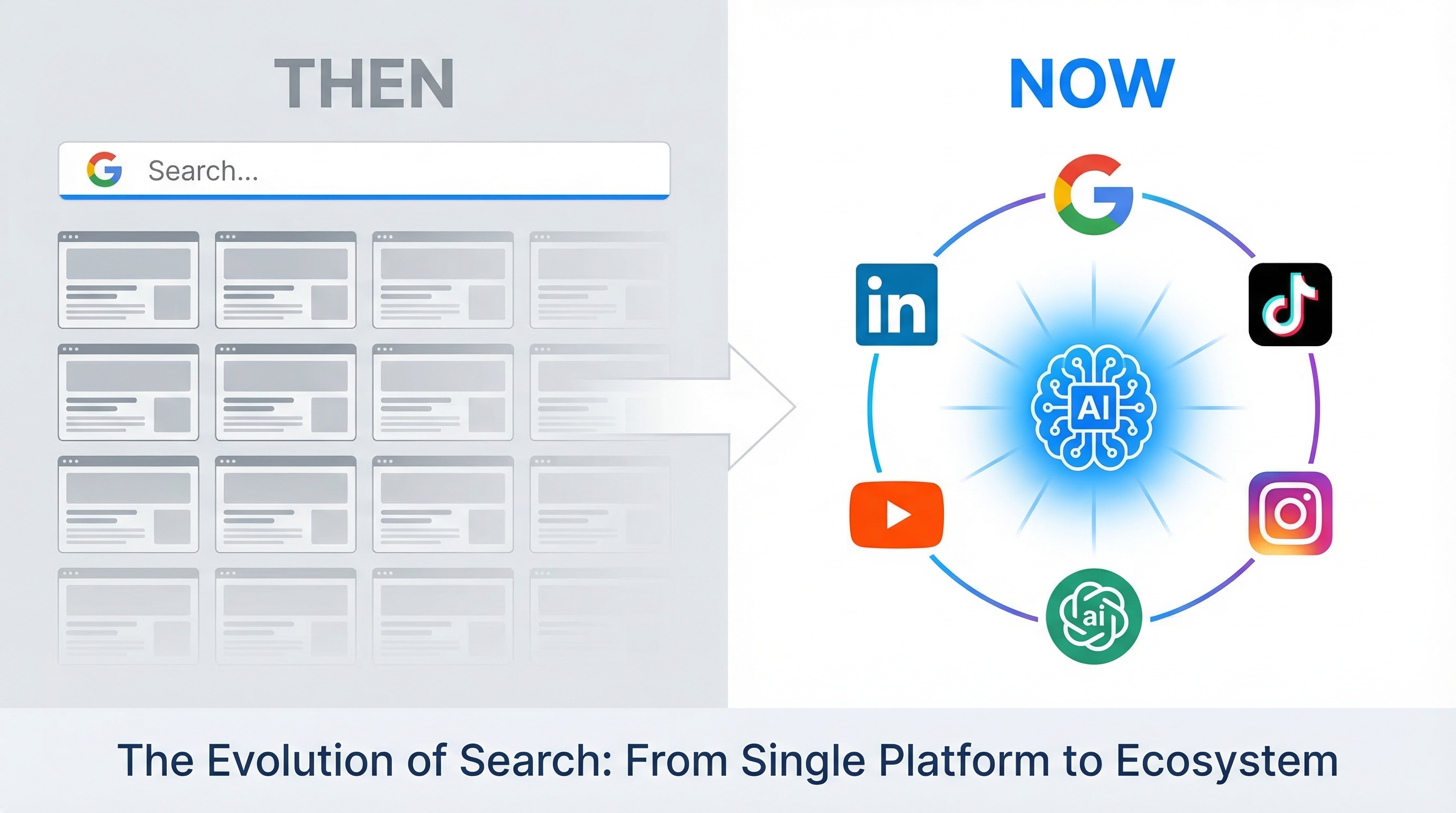
The ground shifted in 2025 when AI overviews expanded across Google and ChatGPT integrated search capabilities. But the real change wasn't technical. It was behavioral. People stopped defaulting to Google for everything. They started asking ChatGPT. They searched on TikTok. They scrolled Reddit threads. They trusted AI summaries over blue links.
This isn't a trend. It's the new baseline.
What does this mean practically? Your potential customers are no longer following a linear path from search query to your website. They're getting answers from AI overviews that never send them to you. They're watching YouTube tutorials instead of reading your blog. They're asking ChatGPT to compare options and the AI is making recommendations based on data you may not control.
And here's the part most guides won't tell you: overall traffic is down. Clicks are down. But that doesn't mean SEO is dead. It means the game has changed. Branded search volume matters more than ever. High-intent visitors who actually convert matter more than vanity traffic metrics. Entity clarity (how well AI systems understand what your brand does and stands for) is now a ranking signal.
The Honest Decision Tree: Is SEO Worth It for Your Business?
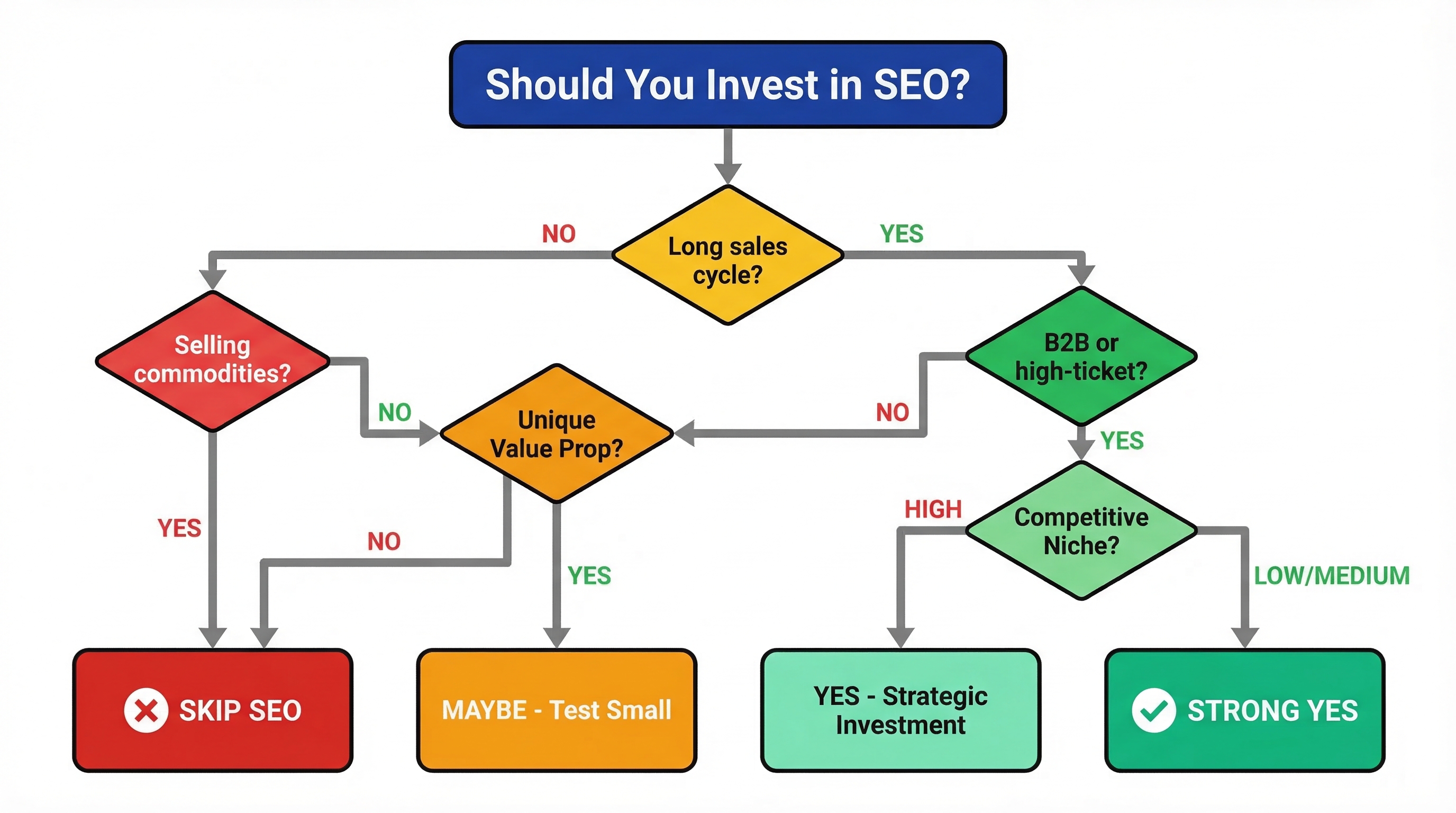
Most SEO advice treats every business the same. It doesn't work that way. A local plumber and a SaaS startup have completely different SEO equations. So let's build a real decision framework.
SaaS & B2B Tech
High customer lifetime value, long sales cycles. SEO pays off if you can wait 6-12 months and your market searches for solutions (not just brands).
E-Commerce
Product-focused SEO works if you're not competing on price alone. Invest heavily in product content, visual search, and review optimization.
Local Services
Local SEO still delivers. Google Business Profile optimization and local citations matter more than blog content for most service businesses.
Content Publishers
Tough spot in 2026. AI overviews steal clicks. Diversify into video, newsletters, and proprietary data that AI can't easily replicate.
Now let's talk timelines. Because this is where most businesses get burned.
SEO Investment Timeline by Business Stage
Early Stage Startup (Pre-Product-Market Fit)
Skip heavy SEO investment. You don't know your ICP yet. Your messaging will change. Your product will pivot. Focus on paid channels for fast feedback loops. Maintain basic technical SEO (crawlability, mobile optimization) but don't build a content engine until you've validated your market.
Growth Stage (Clear PMF, Scaling)
This is your SEO window. You know who you're targeting. Your messaging is stable. You have customer data to inform content strategy. Invest in SEO now and you'll see compounding returns in 12-18 months. But pair it with paid ads for near-term pipeline.
Mature Business (Established Brand)
SEO is brand defense. You're already ranking for your brand terms. Now it's about protecting that position, optimizing for AI recommendations, and expanding into adjacent categories. Focus on entity clarity and multi-platform presence over traditional link building.
Hyper-Competitive Market
Do the math first. If the top 3 results are dominated by billion-dollar brands with massive content teams, your ROI timeline extends to 18-24 months minimum. Consider niche positioning, long-tail strategies, or alternative channels. Sometimes the honest answer is: don't compete here.
So when should you skip SEO entirely? When your target audience doesn't search for solutions online. When your sales cycle is relationship-driven (think enterprise deals closed through direct outreach). When you're in a market where paid ads deliver faster, more predictable ROI and you don't have the patience or budget for a 12-month ramp.
SEO Makes Sense If You Can Check These Boxes
Your target customers actively search for solutions (not just your brand name)
You can commit to 12+ months of consistent investment before expecting meaningful ROI
You have (or can create) genuinely useful content, not just keyword-stuffed pages
Your business model supports longer sales cycles and content-driven lead generation
You're willing to optimize across multiple platforms, not just Google
What Still Works: SEO Fundamentals That Haven't Changed
Here's what hasn't changed: the basics still matter. Actually, they matter more now because AI systems need clean, structured data to understand and recommend your content.
Technical SEO isn't sexy. But it's the foundation. If your site isn't crawlable, isn't indexed properly, loads slowly, or breaks on mobile, nothing else matters. AI agents can't recommend content they can't access or understand.
Non-Negotiable Technical Foundations
Clean site architecture with logical URL structure and internal linking
Mobile-first design (not just responsive, actually mobile-first)
Core Web Vitals optimization: LCP under 2.5s, FID under 100ms, CLS under 0.1
Structured data markup (Schema.org) so AI systems understand your entities
XML sitemaps and robots.txt configured correctly
HTTPS everywhere, no mixed content warnings
Content strategy has evolved, but not in the way most people think. Keyword stuffing never worked. Now it actively hurts you. What works is content precision: answering the specific question a user has, with the exact depth they need, in a format they prefer.
And freshness matters more than ever. AI systems favor recent, updated content. A 2023 blog post that hasn't been touched since publication is dead weight. Update your cornerstone content quarterly. Add new data. Refresh examples. Show that a human is maintaining this.
Pros
Still useful for understanding user intent and content gaps
Helps structure content around topics, not just individual keywords
Informs multi-platform content strategy (video titles, social posts, etc.)
Cons
Exact-match keyword optimization is less important than topical authority
AI overviews often answer queries without clicks, reducing keyword-specific traffic
Search volume data is increasingly unreliable as search fragments across platforms
Human expertise is now a ranking signal. Google's E-E-A-T (Experience, Expertise, Authoritativeness, Trustworthiness) guidelines aren't suggestions. They're how AI systems evaluate content quality. Transparent authorship matters. Real credentials matter. Demonstrated experience matters.
Beyond Google: Multi-Platform Search Strategy for 2026
If you're only optimizing for Google, you're missing half the game. Maybe more than half.
Social platforms are search engines now. People search TikTok for product reviews. They search LinkedIn for B2B solutions. They search Reddit for honest opinions. And these platforms have their own algorithms, their own ranking factors, their own version of SEO.
Video SEO: YouTube is the second-largest search engine. Optimize titles, descriptions, and transcripts. Create video content that answers common questions in your niche.
Social Search: TikTok and Instagram search are growing fast. Use relevant hashtags, write descriptive captions, and create content that matches search intent on each platform.
Forum Visibility: Reddit, Quora, and niche forums rank well in Google and influence AI recommendations. Participate authentically, don't spam links.
Visual Search: Pinterest and Google Lens are gaining traction. Optimize product images with descriptive filenames, alt text, and structured data.
But here's where it gets interesting: influencing AI recommendations. ChatGPT, Claude, Perplexity, and other AI systems pull from diverse sources. They favor content that's cited frequently, that comes from authoritative domains, and that's part of a strong entity graph.
Digital PR matters more now than traditional link building. Getting mentioned in industry publications, being cited in research reports, having your executives quoted in articles. These signals tell AI systems you're a legitimate authority.
Proprietary Data
Original research, surveys, and unique datasets that AI systems can't find elsewhere. This is how you become a cited source.
Expert Profiles
Build personal brands for your executives and subject matter experts. AI systems associate individual expertise with company authority.
Thought Leadership
Publish perspectives, not just how-to guides. AI systems favor content that demonstrates original thinking and expertise.
Entity Relationships
Get mentioned alongside established brands and authorities in your space. Association builds credibility in AI systems.
And then there are emerging channels like ChatGPT ads. We're in early days here. The targeting is limited. The ROI is unclear. But if your audience uses ChatGPT for research (and many B2B buyers do), it's worth testing small budgets to understand the mechanics.
Measuring SEO Success in 2026: Attribution Beyond Clicks
The old metrics are broken. Organic traffic is down across the board. Click-through rates are declining. But that doesn't mean SEO isn't working. It means you're measuring the wrong things.
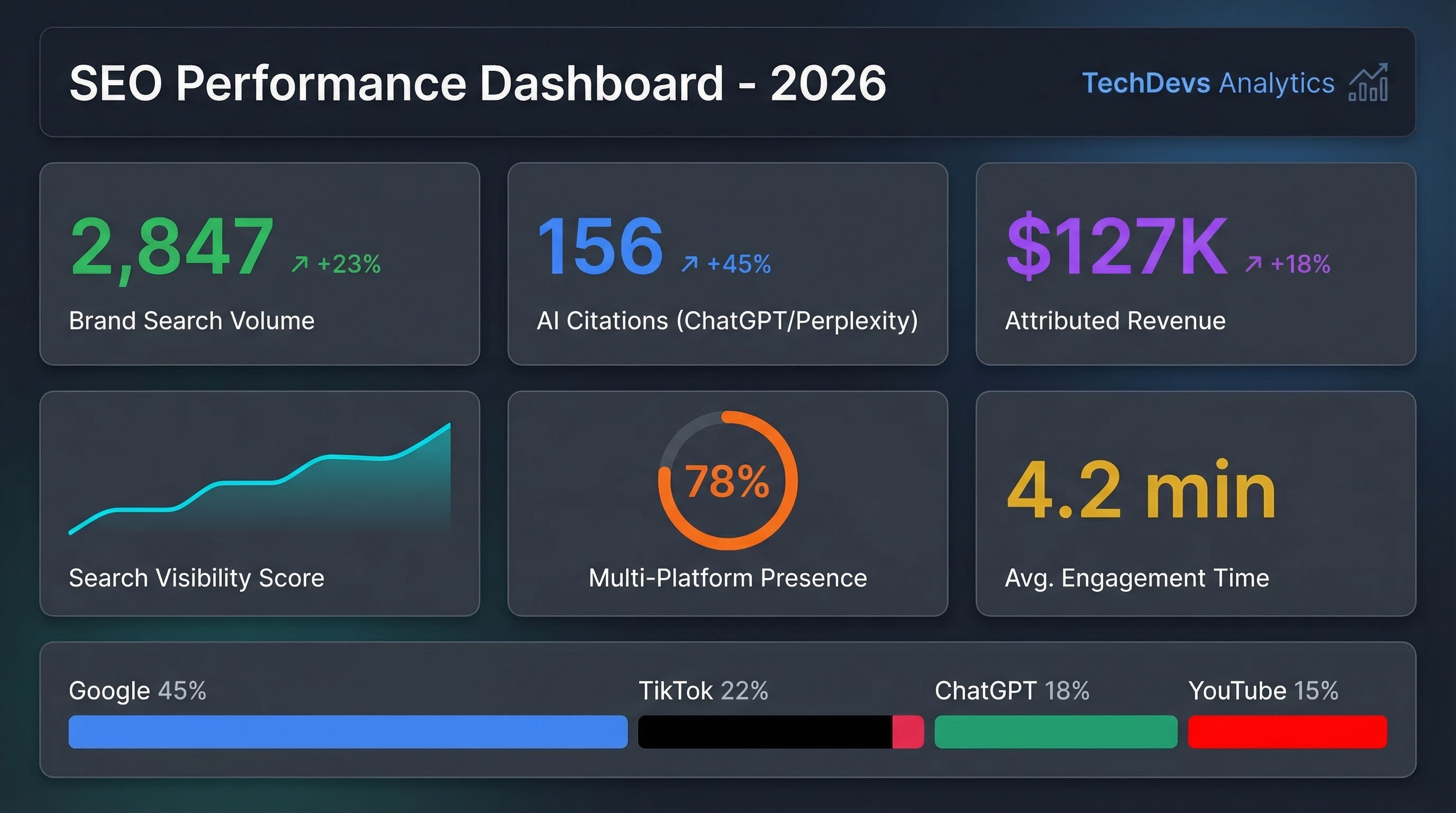
Here's what to track instead. Brand search volume: are more people searching for your company name, your product names, your executives' names? That's brand awareness. That's SEO working even if they don't click through from a SERP.
AI mention frequency: set up monitoring to track how often ChatGPT, Claude, and other AI systems mention your brand when users ask about your category. This is your new share of voice.
Entity association strength: who are you mentioned alongside? If AI systems group you with industry leaders, that's a win. If you're associated with low-quality or irrelevant brands, that's a problem.
Track assisted conversions in Google Analytics. SEO often touches users early in the journey but doesn't get last-click credit.
Monitor time to conversion for organic traffic vs. other channels. Organic often has longer cycles but higher quality leads.
Measure content engagement: scroll depth, time on page, pages per session. Quality matters more than quantity now.
Watch branded vs. non-branded traffic ratios. A healthy SEO strategy builds both, but branded growth is a leading indicator.
For businesses with longer sales cycles, integrate SEO data with your CRM. Track which organic keywords and content pieces are associated with closed deals. This is harder to set up but gives you actual revenue attribution, not just vanity metrics.
TechDevs' Approach: Integrating SEO with AI and Automation
At TechDevs, we don't do SEO in isolation. That's a recipe for mediocre results. We integrate it with automation, product development, and data strategy.
Here's our framework: proprietary data first. We help clients create unique datasets, original research, and insights that AI systems can't find anywhere else. This becomes the foundation for content that gets cited, shared, and recommended.
Automated Technical Audits: We use custom scripts to monitor crawlability, indexation, and Core Web Vitals continuously. No manual checks. Alerts when something breaks.
AI-Powered Content Scaling: We use AI tools to research, outline, and draft content. But humans with real expertise edit, add examples, and inject personality. The result reads human because a human finished it.
Integrated PR and Social Strategy: We don't separate SEO from content marketing from PR. It's one strategy: build authority, get mentioned, influence AI systems, drive high-intent traffic.
Product-Led SEO: For SaaS clients, we optimize the product itself for search. In-app content, API documentation, integration guides. These rank well and convert better than blog posts.
The best SEO strategy in 2026 doesn't look like SEO. It looks like building a brand that AI systems trust and users want to find.
Prasad Iyer, CTO at TechDevs
We also automate the boring stuff. Technical monitoring. Rank tracking. Competitor analysis. This frees up time for the work that actually moves the needle: creating genuinely useful content, building relationships, and influencing the platforms where your audience actually searches.
Ethical and Regulatory Considerations in Modern SEO
Let's talk about the stuff most SEO guides skip: the ethical and legal minefield of modern search optimization.
Data privacy is a big one. If you're tracking user behavior to inform your SEO strategy (and you should be), you need to comply with GDPR, CCPA, and whatever new regulations are coming. Cookie consent isn't optional. Transparent data collection isn't optional.
Regulatory compliance varies wildly by industry. Healthcare, finance, legal services. These sectors have strict rules about claims, endorsements, and data handling. Your SEO strategy needs to account for this. Sometimes the most SEO-friendly approach violates industry regulations. Compliance wins every time.
Ethical SEO Checklist
Transparent about AI involvement in content creation
Real author credentials and expertise clearly displayed
Data collection practices disclosed and compliant with regulations
No manipulative dark patterns to inflate engagement metrics
Industry-specific compliance requirements met (healthcare, finance, etc.)
Accessible to users with disabilities (WCAG compliance)
And here's something nobody talks about: the environmental cost of SEO. Training AI models, running constant crawls, hosting massive content libraries. It adds up. We're not saying don't do SEO. We're saying be intentional. Create less, higher-quality content instead of churning out hundreds of mediocre posts.
Your Action Plan: Next Steps Based on Your Decision
So you've read this far. You've thought through the decision framework. Now what?
Action Plans by Decision
If YES to SEO: Immediate Priorities for 2026
Start with technical foundations. Audit your site for crawlability, mobile optimization, and Core Web Vitals. Fix what's broken before creating new content. Then identify your 3-5 highest-value topic clusters based on search intent and business goals. Create comprehensive, expert-level content for these clusters. Set up multi-platform distribution: repurpose for video, social, and forums. Monitor brand search volume and AI citations, not just organic traffic. Budget for 12-18 months before expecting significant ROI.
If MAYBE: Minimal Viable SEO Strategy
Maintain basic hygiene without heavy investment. Ensure technical fundamentals are solid (mobile-friendly, fast loading, crawlable). Claim and optimize your Google Business Profile and other directory listings. Create content only when you have genuine expertise to share, not on a publishing schedule. Focus on branded search optimization and entity clarity. Monitor competitors and reassess quarterly. This keeps you in the game without betting the farm.
If NO: Alternative Channels to Prioritize
Focus on channels with faster feedback loops. Paid ads (Google, LinkedIn, Facebook) for immediate traffic and conversion data. Email marketing and newsletters for owned audience building. Community building in relevant forums and social platforms. Direct outreach and partnerships for B2B. Influencer collaborations for consumer brands. Event marketing and speaking engagements for thought leadership. These channels often deliver faster ROI and more predictable results than SEO.
But here's the key: don't set it and forget it. SEO in 2026 changes fast. What works today might not work in six months. Set up a quarterly review process.
Quarterly SEO Review Framework
Review brand search volume trends. Is awareness growing?
Check AI citation frequency. Are you being mentioned more or less?
Analyze traffic quality, not just quantity. Are visitors converting?
Audit top-performing content. What's working and why?
Monitor competitor strategies. What are they doing differently?
Reassess channel mix. Should you invest more or less in SEO vs. other channels?
Update your decision framework based on new data and market changes
And be honest with yourself. If SEO isn't delivering after 12-18 months, it's okay to pivot. Sunk cost fallacy kills businesses. The best marketing strategy is the one that actually works for your business, not the one everyone says you should be doing.
Start Small
Don't overcommit. Test with a limited budget and timeline before scaling up.
Measure What Matters
Track business outcomes (leads, revenue) not vanity metrics (traffic, rankings).
Stay Flexible
Be ready to pivot based on data. The landscape changes fast in 2026.
Need Help Deciding if SEO Makes Sense for Your Business?
We've helped dozens of companies navigate this exact decision. We'll audit your current situation, analyze your competitive landscape, and give you an honest recommendation (even if that recommendation is to skip SEO). No sales pitch, just strategic clarity.