The Hidden Truths: What SEO Agencies Won't Tell You as a Brand Owner
Uncover what SEO agencies keep hidden from brand owners. Learn insider secrets to make smarter SEO decisions and protect your marketing investment. Read now.
 Written byPrasad Iyer
Table of contents
Summarize this article with AI
TL;DR
Most SEO agencies operate on information asymmetry. They sell cookie-cutter strategies, hide behind vanity metrics, and avoid the hard conversations about what actually drives revenue. After working with dozens of brands who've been burned by agencies, we've seen the same patterns repeat. Here's what you need to know before signing another contract.
- Cookie-Cutter Strategies Are the Default. Agencies push standardized deliverables because they're easier to scale and bill for, not because they work for your business
- You're Probably Not Getting Dedicated Support. Account rotation and shared resources are common, leading to inconsistent strategy and lack of business understanding
- Technical SEO Gets Ignored. Agencies focus on content volume over technical foundations because it's easier to report on and bill for
- Rankings Don't Equal Revenue. Most agencies optimize for traffic metrics while ignoring conversion rate optimization and actual business impact
- Reporting Frameworks Hide What Matters. Monthly reports highlight vanity metrics while burying or omitting revenue attribution and ROI data
Introduction: Why SEO Agencies Keep Secrets (And What It Costs You)
Here's the uncomfortable truth: most SEO agencies have a vested interest in keeping you just informed enough to sign the contract, but not informed enough to ask hard questions.
The information asymmetry is intentional. You're told about rankings, impressions, and "organic growth." You're not told that the strategy they're selling you is the same template they sold to twenty other clients last month. You're not told that the "dedicated specialist" on your account is juggling fifteen other brands. And you're definitely not told that the metrics in your monthly report have almost nothing to do with whether your business is actually making money.
I've been building and fixing SEO strategies for tech companies for over a decade. The same patterns show up every time a brand owner comes to us after wasting six months and $30K+ with an agency. The deliverables looked good. The reports had charts. But revenue didn't move.
This isn't about demonizing agencies. Some do excellent work. But the industry has structural incentives that don't align with your success. Agencies get paid for deliverables, not outcomes. They get paid for looking busy, not for moving your revenue needle.
So let's talk about what they're not telling you.

Secret #1: Cookie-Cutter Strategies Don't Work (But They're Easier to Sell)
Walk into any SEO agency pitch and you'll hear the same offer: four blog posts per month, monthly rank tracking reports, some backlink outreach, maybe a technical audit if you're lucky. Sounds reasonable, right?
Wrong.
These standardized packages exist because they're easy to productize and scale. An agency can hire mid-level writers, plug your keywords into a template, and pump out content that looks like SEO. But foundational planning gets skipped because it's hard, time-intensive, and doesn't fit neatly into a monthly retainer model.
Real SEO strategy starts with understanding your audience, your business model, and your competitive landscape. It requires building a content calendar that aligns with your sales cycle. It means developing an earned media strategy that positions your executives as industry experts. These aren't line items you can automate or delegate to a junior writer in the Philippines.
I've seen this play out dozens of times. A SaaS company signs with an agency. The agency starts publishing blog posts about "top 10 tips" and "beginner's guides" because that's what the template says to do. Six months later, traffic is up 20% but demo requests haven't budged. Why? Because the content isn't aligned with buyer intent. It's not addressing the specific problems your prospects are researching before they evaluate solutions.
Pros
Custom audience research and buyer persona development
Content calendar aligned with your sales funnel stages
Earned media strategy for executive thought leadership
Integration with product marketing and sales enablement
Continuous optimization based on conversion data, not just traffic
Cons
Generic blog posts based on keyword volume alone
Automated monthly reports with no strategic context
No involvement in strategy after initial kickoff
Same deliverables regardless of your business model or goals
Optimization for rankings, not revenue
Sustainable growth doesn't come from churning out content. It comes from understanding what your prospects need at each stage of their journey and creating the exact assets that move them forward. That requires custom strategy, not templates.
Secret #2: You're Probably Not Getting a Dedicated SEO Specialist
Here's what the sales pitch sounds like: "You'll have a dedicated SEO specialist who becomes an extension of your team, deeply understands your business, and drives your strategy forward."
Here's what actually happens: Your "dedicated specialist" is managing 8-12 other accounts. When they leave the agency (average tenure: 18 months), your account gets reassigned to whoever has capacity. The new person spends two weeks getting up to speed, which really means they skim your old reports and keep doing whatever the previous person was doing.
SEO is complex. It requires understanding your product, your competitors, your market positioning, and how your prospects make buying decisions. A dedicated expert who knows your business can make strategic calls in real-time. Someone juggling twelve accounts just executes the checklist.
Account rotation kills institutional knowledge. Every time your specialist changes, you lose context about what's been tried, what worked, and what failed.
Shared resources mean lowest-common-denominator strategy. When one person manages multiple accounts, they default to the approaches that work generally, not the tactics that work specifically for your business model.
Response time suffers. Need a quick decision on whether to pivot your content strategy based on a competitor move? Good luck getting a response when your specialist is in back-to-back calls with their other eleven clients.
Strategic thinking gets replaced with task execution. A stretched specialist doesn't have time to think deeply about your business. They have time to check boxes and file reports.
The difference between an SEO specialist who knows your business and one who's just executing tasks is the difference between strategy and busywork. One drives revenue. The other drives activity.
Prasad Iyer, CTO at TechDevs
Ask agencies direct questions: How many accounts does the person assigned to us manage? What's your average employee tenure? What happens if our specialist leaves? How much time will they spend on our account each week? If they dodge these questions, you have your answer.
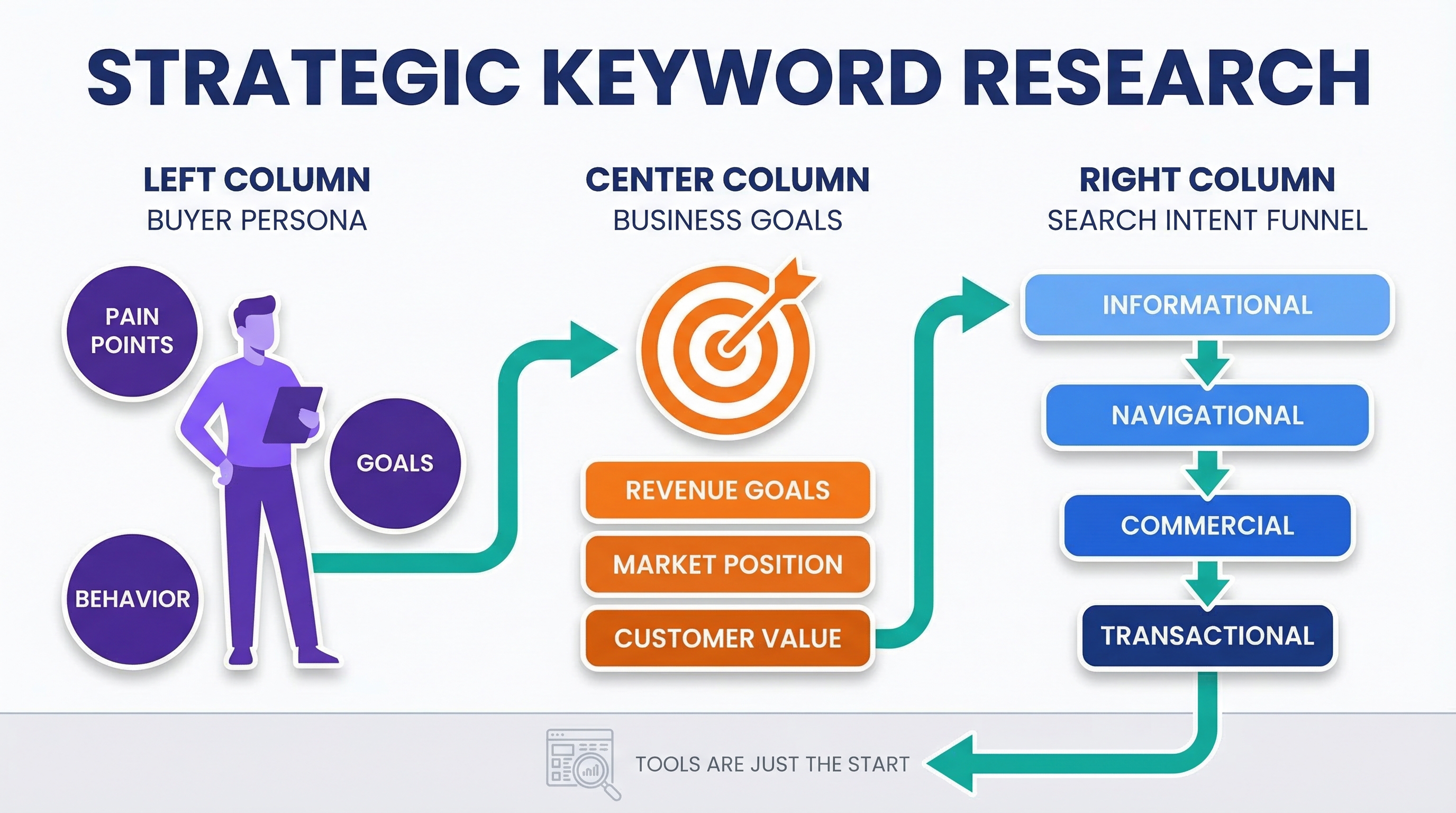
Secret #3: Keyword Research Is More Than Tools - It's About Your Business Goals
Most agencies start keyword research by plugging your industry into Ahrefs or SEMrush and pulling a list of high-volume terms. Then they sort by difficulty score and pick the ones that look achievable. This is lazy and backwards.
Keyword research should start with understanding your target audience, not search volume. Who are your ideal customers? What problems are they trying to solve? What language do they use when they're researching solutions? What questions do they ask your sales team during demos?
But agencies don't do this because it's hard. It requires talking to your sales team. It requires analyzing your CRM data to see which content actually influences deals. It requires building buyer personas and mapping the customer journey. Much easier to just export a keyword list and call it strategy.
Here's what this looks like in practice. A B2B SaaS company selling API infrastructure might get pitched on ranking for "API management" (high volume, high difficulty). Sounds great, right? Except their actual buyers aren't searching for that. They're searching for "how to handle webhook retries at scale" or "API rate limiting best practices for SaaS." These long-tail, high-intent searches have lower volume but infinitely higher conversion rates.
Common Keyword Research Mistakes Agencies Make
Prioritizing search volume over buyer intent
A keyword with 10,000 monthly searches sounds impressive in a pitch deck. But if those searchers aren't your target buyers, the traffic is worthless. A 200-search keyword that your exact ICP uses when they're evaluating solutions is infinitely more valuable.
Ignoring the full customer journey
Most agencies focus on top-of-funnel awareness content because it's easier to rank for and generates traffic quickly. But your prospects also need middle and bottom-funnel content: comparison guides, implementation tutorials, ROI calculators. Neglecting these stages kills conversions.
Not analyzing competitor keyword gaps
Your competitors are ranking for keywords you're not. Some of those keywords drive their business. Agencies should identify these gaps and prioritize them, but most just focus on the obvious high-volume terms everyone is chasing.
Failing to track keyword performance against business metrics
Rankings go up, traffic increases, but which keywords actually drive demos, trials, or sales? Most agencies never connect keyword performance to revenue because it requires integration with your CRM and attribution modeling. Easier to just report on rankings.
One-and-done keyword research
Markets evolve. Your product changes. Competitor positioning shifts. Keyword research should be ongoing, not a one-time deliverable at the start of the engagement. But ongoing research doesn't fit neatly into a monthly retainer model.
The best keyword strategy isn't about finding the highest-volume terms you can rank for. It's about finding the exact searches your ideal customers make when they're ready to buy, and building content that answers those searches better than anyone else. That requires business understanding, not just SEO tools.
Secret #4: Technical SEO and Site Architecture Matter More Than Content Volume
Agencies love talking about content. "We'll publish 16 blog posts per month!" "We'll create comprehensive guides and resources!" "Content is king!"
You know what they don't love talking about? The fact that your site architecture is a mess, your page speed is terrible, half your pages aren't even getting crawled, and your internal linking structure makes no sense.
Why? Because fixing technical SEO is hard. It requires working with your engineering team. It means having uncomfortable conversations about technical debt. It doesn't produce pretty deliverables for monthly reports. Much easier to just write more blog posts and hope Google figures it out.
But here's the reality: if your technical foundation is broken, all that content is like building a skyscraper on quicksand. You can publish a hundred articles, but if Google can't crawl them efficiently, if they load slowly, if your site structure doesn't signal topical authority, you're wasting money.
Technical SEO Foundations Agencies Often Ignore
Site architecture and URL structure - Logical hierarchy that signals topical relationships and makes crawling efficient
Crawl budget optimization - Ensuring Google spends its crawl budget on your important pages, not infinite pagination or duplicate content
Core Web Vitals - Page speed, interactivity, and visual stability that directly impact rankings and conversions
Mobile-first optimization - Not just responsive design, but truly optimized mobile experiences
Structured data implementation - Schema markup that helps search engines understand your content and enables rich results
Internal linking strategy - Distributing authority and establishing topical clusters through strategic internal links
JavaScript rendering - Ensuring your single-page app or React site is actually crawlable and indexable
International SEO - Proper hreflang implementation if you serve multiple markets or languages
For tech companies especially, technical SEO should be integrated into your product development workflow. When your engineering team ships a new feature, is anyone thinking about how that impacts crawlability? When you redesign your docs site, is SEO at the table? When you launch a new product line, does your site architecture support it?
We've seen companies spend $50K on content in six months with minimal results, then spend $15K fixing technical issues and 3x their organic traffic in three months. The technical stuff isn't sexy. It doesn't produce weekly deliverables. But it's what actually makes SEO work.
Secret #5: Backlink Quality Trumps Quantity (And Most Agencies Build Low-Quality Links)
Your monthly SEO report shows 47 new backlinks acquired this month. Sounds great. But here's what the report doesn't tell you: 43 of those links are from low-authority blogs, directory submissions, and comment spam. Three are from marginally relevant sites with Domain Authority in the 20s. And one is actually valuable.
Agencies report link numbers because numbers look good. They don't report link quality because quality is subjective and harder to scale. Building one high-authority, relevant backlink from an industry publication requires relationship building, expert positioning, and genuine value creation. Building fifty low-quality links just requires a VA and a list of blog comment sections.
And here's the thing: Google knows the difference. One link from TechCrunch or your industry's leading publication is worth more than a thousand links from random blogs. But agencies optimize for the metric they're reporting (link count), not the outcome that matters (authority and relevance).
Pros
Digital PR and expert positioning - Getting your executives quoted in industry publications, contributing expert commentary, building genuine media relationships
Strategic partnerships - Co-marketing with complementary companies, integration partnerships that result in natural backlinks from their docs and resources
Original research and data - Publishing studies, surveys, or data analysis that journalists and bloggers naturally want to cite
Product-led content - Tools, calculators, or resources so valuable that people link to them organically
Guest contributions on high-authority sites - Not spammy guest posting, but genuine thought leadership on respected platforms
Cons
Directory submissions - Low-value, easy to scale, mostly worthless for modern SEO
Comment spam and forum links - Actively harmful, can trigger manual penalties
Private blog networks (PBNs) - Risky, violates Google guidelines, can result in severe penalties
Low-quality guest posting - Generic posts on low-authority sites just to get a link
Purchased links - Expensive, risky, and increasingly detectable by Google's algorithms
The agencies that do link building right don't call it link building. They call it digital PR, brand building, or strategic partnerships. Because that's what it actually is. You're not trying to trick Google into thinking you're authoritative. You're actually becoming authoritative.
Ask where the links are coming from. Demand a list of actual domains, not just a number. Then check those domains yourself. Are they relevant to your industry? Do they have real traffic? Would your target customers actually read them?
Look for earned vs. built vs. bought. Earned links come from people naturally linking to your content because it's valuable. Built links come from outreach and relationship building. Bought links are exactly what they sound like. Earned is best, built is fine, bought is risky.
Check for link velocity red flags. If an agency promises 50+ links per month from day one, they're either using spammy tactics or they're lying. Quality link building takes time.
Evaluate the anchor text strategy. Natural link profiles have varied anchor text. If every link uses your exact-match keyword, that's a red flag.
Authority building is a long game. It requires positioning your brand and your people as genuine experts, creating content worth linking to, and building real relationships in your industry. Agencies that understand this don't promise 50 links per month. They promise to make you the kind of company people want to link to.
Secret #6: Local SEO and Google Business Profile Optimization Are Often Neglected
If your business has physical locations, regional sales teams, or serves specific geographic markets, local SEO should be a core part of your strategy. But most agencies treat it as an afterthought or ignore it entirely.
Why? Because local SEO is tedious. It requires managing Google Business Profile listings for multiple locations. It means building local citations across dozens of directories. It involves review management, local content creation, and location-specific optimization. None of this fits neatly into the "four blog posts per month" model.
But for many businesses, local search is where the money is. Someone searching "enterprise software consulting Boston" or "API integration services San Francisco" is often further along in the buying process than someone searching generic industry terms. They're looking for a provider they can meet with. They're ready to talk.
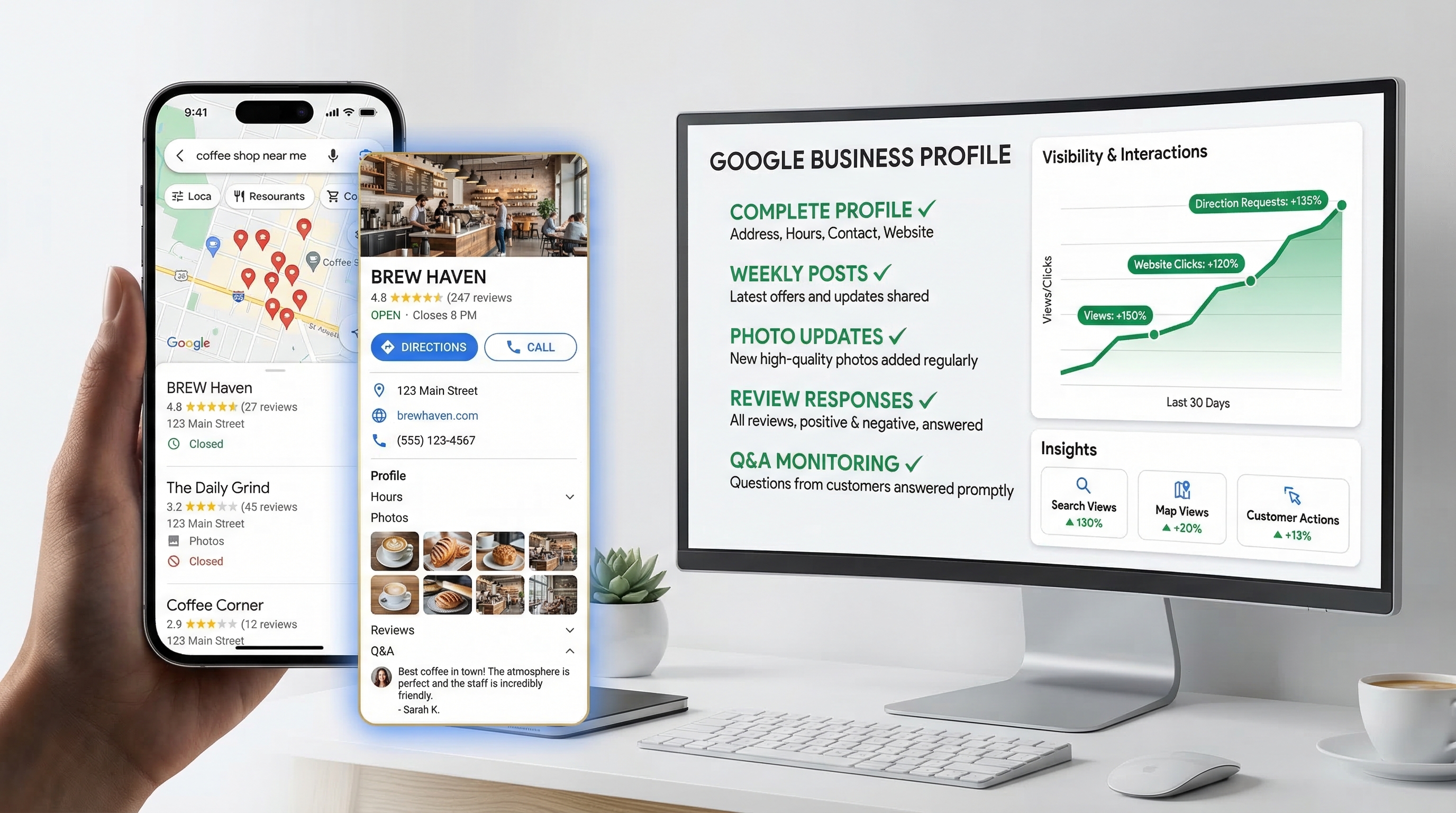
Google Business Profile Optimization
Complete profiles with accurate NAP data, relevant categories, high-quality photos, regular posts, and active review management
Local Citation Building
Consistent business information across local directories, industry-specific platforms, and review sites to build local authority signals
Location-Specific Content
Pages optimized for each location or region you serve, addressing local market needs and including local keywords
Review Generation and Management
Systematic process for generating reviews, responding to feedback, and leveraging social proof in local search
Even B2B tech companies benefit from local SEO if they have multiple offices or regional sales teams. When a prospect searches for "cloud infrastructure consulting" plus their city, you want to show up. When they're looking for "DevOps consulting near me" after a conference, you want to be there.
Local SEO Checklist for Multi-Location Businesses
Claimed and optimized Google Business Profile for every location
Consistent NAP (Name, Address, Phone) across all online properties
Location-specific landing pages with unique, valuable content
Local citation building on relevant directories and platforms
Review generation strategy with regular monitoring and responses
Local link building from chambers of commerce, local business associations, and community organizations
Schema markup for local business information
The agencies that skip local SEO are leaving money on the table. For businesses that serve specific geographic markets, local search often converts at higher rates than generic organic traffic because the intent is clearer and the proximity matters.
Secret #7: SEO Without CRO Is Just Expensive Traffic
Your organic traffic is up 150%. Your rankings improved for twelve target keywords. The agency sends you a chart showing your progress. Everyone's happy.
Except your demo requests are flat. Your trial signups barely moved. Revenue from organic is up maybe 10%. What happened?
SEO agencies optimize for traffic. They're not responsible for what happens after someone lands on your site. If your landing pages are mediocre, if your calls-to-action are weak, if your conversion funnel has leaks, that's not their problem. They delivered the traffic. Job done.
This is backwards. Traffic without conversions is just a vanity metric. The goal isn't to get more visitors. The goal is to get more customers.
Proper SEO strategy integrates with conversion rate optimization from day one. That means analyzing your conversion funnel and identifying where prospects drop off. It means A/B testing landing pages for your target keywords. It means tracking which content actually influences deals, not just which pages get traffic.
We've worked with companies that cut their SEO content production in half and doubled their results by focusing on conversion optimization. Fewer blog posts, but each one had clear conversion paths. Better landing pages for target keywords. Smarter internal linking to guide prospects through the funnel. Same traffic, radically better outcomes.
The agencies that get this right don't just report on traffic and rankings. They report on conversion rate by traffic source, cost per acquisition from organic, and revenue attribution. They work with your product and marketing teams to optimize the full customer journey, not just the first click.
Secret #8: AI and Automation Are Changing SEO (But Agencies Are Slow to Adapt)
AI has changed how we research keywords, analyze competitors, optimize content, and identify technical issues. Tools that used to require hours of manual work now take minutes. Insights that were impossible to extract from large datasets are now accessible to anyone with the right tools.
So why are most agencies still doing SEO like it's 2015?
Because their business model depends on billable hours. If they can automate keyword research that used to take twenty hours, they can't charge you for twenty hours anymore. If they can use AI to identify technical issues in minutes instead of days, that's less time they can bill. Their incentive is to keep processes manual and time-intensive.
But smart brand owners should demand the opposite. You should want your SEO partner using every efficiency tool available because it means your budget goes further. You should want automation for repetitive tasks so human expertise can focus on strategy, not data entry.
AI-powered keyword research - Tools that analyze search intent, identify content gaps, and predict keyword performance based on your site's authority profile
Automated technical audits - Continuous monitoring of site health, crawlability, and performance issues instead of quarterly manual audits
Content optimization - AI analysis of top-ranking content to identify semantic relationships, content depth, and optimization opportunities
Competitive intelligence - Automated tracking of competitor content, backlinks, and ranking changes with alerts for strategic opportunities
Performance forecasting - Predictive modeling of SEO outcomes based on historical data and planned initiatives
The future of SEO isn't about replacing human expertise with AI. It's about using AI to handle the tedious work so experts can focus on strategy, creativity, and business alignment. Agencies that resist this are protecting their billable hours, not your results.
Prasad Iyer, CTO at TechDevs
At TechDevs, we use automation to make SEO more efficient and effective. AI handles data analysis, technical monitoring, and content research. Our team focuses on strategy, business alignment, and creative execution. This means clients get better results at lower cost because we're not billing for work that should be automated.
Ask your agency what tools they're using and how they're leveraging AI. If the answer is vague or defensive, they're stuck in the past. The best agencies embrace efficiency because it lets them deliver more value, not less.
Secret #9: Reporting Frameworks Hide What Really Matters
Open your monthly SEO report. What do you see? Rankings for your target keywords. Organic traffic trends. Impressions and click-through rates. Maybe some backlink counts. Lots of charts. Looks professional.
Now answer this: How much revenue did organic search generate last month? Which content assets influenced closed deals? What's your cost per acquisition from organic compared to paid channels? How many of your organic leads are actually qualified?
Can't answer those questions from your SEO report? That's the point.
Agencies report on metrics they can control and that make them look good. Rankings go up, traffic increases, everyone's happy. But these are activity metrics, not outcome metrics. They tell you what happened, not whether it mattered.
Pros
Revenue attribution - How much revenue came from organic search, broken down by content type and customer segment
Cost per acquisition - What it costs to acquire a customer through organic vs. other channels
Conversion rate by landing page - Which pages convert visitors to leads and which ones waste traffic
Deal influence - Which content assets prospects engaged with before becoming customers
Customer lifetime value by source - Whether organic customers are more or less valuable than other acquisition channels
Cons
Keyword rankings - Useful context, but rankings don't pay the bills
Organic traffic - Means nothing if the traffic doesn't convert
Impressions - You can't deposit impressions in your bank account
Backlink counts - Quality matters infinitely more than quantity
Pages indexed - Having more pages indexed is irrelevant if they don't serve a business purpose
The best SEO reporting connects search performance directly to business outcomes. That requires integration with your CRM, attribution modeling, and a willingness to be held accountable for results, not just activity. Most agencies avoid this because it's harder and because it makes their performance more transparent.
Questions Your SEO Report Should Answer
How much revenue did organic search generate this period?
This requires tracking organic visitors through your funnel and attributing closed deals back to their first touch or last touch from organic search. Most agencies don't do this because it requires CRM integration and attribution modeling.
What's the conversion rate for organic traffic vs. other channels?
If your organic traffic converts at 0.5% but paid search converts at 3%, you have a quality problem. Your SEO strategy is attracting the wrong visitors. But most reports never compare conversion rates across channels.
Which content assets influenced closed deals?
Your CRM should track which blog posts, guides, or resources prospects engaged with before converting. This tells you what content actually drives revenue vs. what just generates traffic.
What's the trend in qualified lead generation from organic?
Traffic and leads can both go up while qualified leads go down if you're attracting the wrong audience. Most reports don't distinguish between total leads and qualified leads.
How does organic CAC compare to other channels?
Customer acquisition cost from organic should decrease over time as your content library compounds. If it's not, your strategy isn't sustainable. But agencies rarely calculate CAC because it makes them accountable for efficiency.
What's the payback period for our SEO investment?
When will the revenue from organic search exceed what we've spent on SEO? This is a basic business question that most SEO reports never address.
Demand reporting that connects to your business metrics. If your agency pushes back or says it's not their responsibility, find a new agency. SEO is a business investment. It should be measured like one.
Taking Control: How to Build an SEO Strategy That Actually Works
So what do you do with all this? How do you find an SEO partner who actually aligns with your business goals instead of just selling you a template and hoping you don't ask hard questions?
Start by changing how you evaluate agencies. Stop accepting the standard pitch. Start asking questions that reveal whether they understand your business or just want to sell you their package.
Questions to Ask Before Hiring an SEO Agency
How will you learn about our business, our customers, and our sales process before proposing a strategy?
Who specifically will work on our account, how many other accounts do they manage, and what happens if they leave?
What does your foundational planning process look like, and how long does it take?
How will you integrate with our sales, product, and engineering teams?
What metrics will you report on, and how do they connect to our business goals?
How do you approach technical SEO vs. content production, and what's the balance?
What's your link building strategy, and can you show examples of links you've built for other clients?
How do you use AI and automation in your process?
What happens if we're not seeing results after six months?
Pay attention to how they answer. Vague responses, deflection, or falling back on industry jargon are red flags. Good agencies answer directly, give specific examples, and aren't afraid to say "that's not how we work" if you ask about tactics they don't believe in.
Consider whether you even need a full-service agency. For some companies, a hybrid model works better: in-house SEO leadership with specialized contractors for technical work, content production, or link building. For others, a consulting arrangement where you build internal capability makes more sense than an ongoing retainer.
The key is alignment. Your SEO partner should be incentivized by your success, not by billable hours. They should be transparent about what's working and what's not. They should treat your budget like it's their own money and focus on high-impact initiatives instead of busywork.
And if you're currently working with an agency that exhibits the red flags we've discussed? It might be time for a difficult conversation. Or a new partner.
Ready for an SEO Strategy That Actually Drives Revenue?
Stop wasting money on cookie-cutter SEO. At TechDevs, we build custom strategies aligned with your business goals, integrate with your team, and measure success by outcomes, not activity. Book a free discovery call to see how we're different.