This Is Exactly Why Your Blog Has Zero Readers in 2026
Your blog isn't getting readers because you're ignoring search intent. Learn how to decode what users really want and transform your content strategy in 2026.
 Written byPrithvi Jadwani
Table of contents
Summarize this article with AI
TL;DR
Your blog has zero readers because you're writing content you want to create instead of content that matches what users are actually searching for. Search intent is the reason behind every query, and in 2026, AI-powered search engines prioritize intent alignment over everything else. If your content doesn't match the user's goal, you're invisible.
- Intent Beats Keywords. Search engines now prioritize understanding why someone searches, not just what they type
- Most Blogs Fail Here. Writing transactional content for informational queries kills your traffic before it starts
- Four Intent Types. Informational, navigational, transactional, and commercial investigation each need different content
- Fix It With Data. Use Search Console, SERP analysis, and competitor research to decode what users actually want
The Harsh Truth: Why Nobody's Reading Your Blog
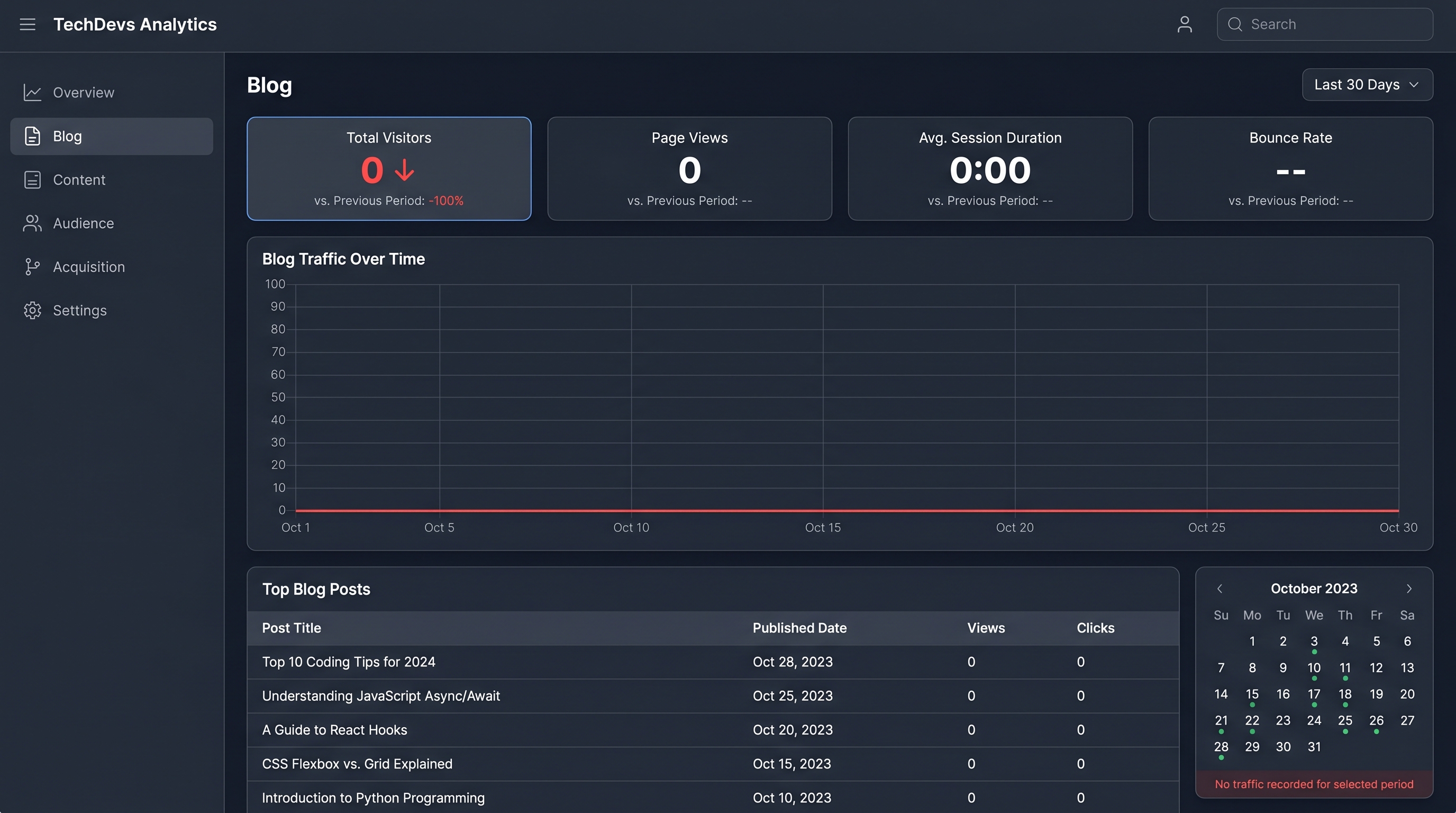
You published 50 blog posts this year. You followed every SEO checklist. You sprinkled keywords like confetti. And your traffic? Still flatlined at zero.
Here's what happened: you created content you wanted to write, not content your audience needed to read. And in 2026, that's a death sentence.
Search engines don't care about your clever headlines or your perfectly optimized meta descriptions if the content doesn't match what the user is actually looking for. They've gotten scary good at understanding intent, the why behind every search query. If your blog post answers a question nobody asked, it doesn't matter how well-written it is.
What is Search Intent (And Why It's Make-or-Break in 2026)
Search intent is the reason someone types a query into Google. It's their goal. Their underlying need. The problem they're trying to solve or the answer they're hunting for.
And here's the thing: search behavior is shifting faster than ever. What worked last year might not work this year. What works today might be obsolete by next quarter.
Traditionally, intent falls into three buckets: informational (someone wants to learn), navigational (someone wants a specific site), and transactional (someone's ready to buy). But in 2026, AI search engines have added layers of sophistication that make these categories feel almost quaint.
Informational Intent
Users seeking knowledge, answers, or how-to guidance. Queries start with 'how,' 'what,' 'why.'
Navigational Intent
Users looking for a specific website, brand, or page. They know where they want to go.
Transactional Intent
Users ready to take action: buy, sign up, download. Includes words like 'buy,' 'price,' 'demo.'
Commercial Investigation
Users comparing options before purchasing. They're in research mode but close to conversion.
AI-powered search engines now prioritize intent alignment over traditional SEO signals. Google's algorithm has evolved to understand conversational queries, context, and even implied needs. Voice search and ChatGPT-style interfaces have accelerated this shift. If your content doesn't match the intent, you're not ranking. Period.
The 4 Types of Search Intent (And How to Spot Each One)
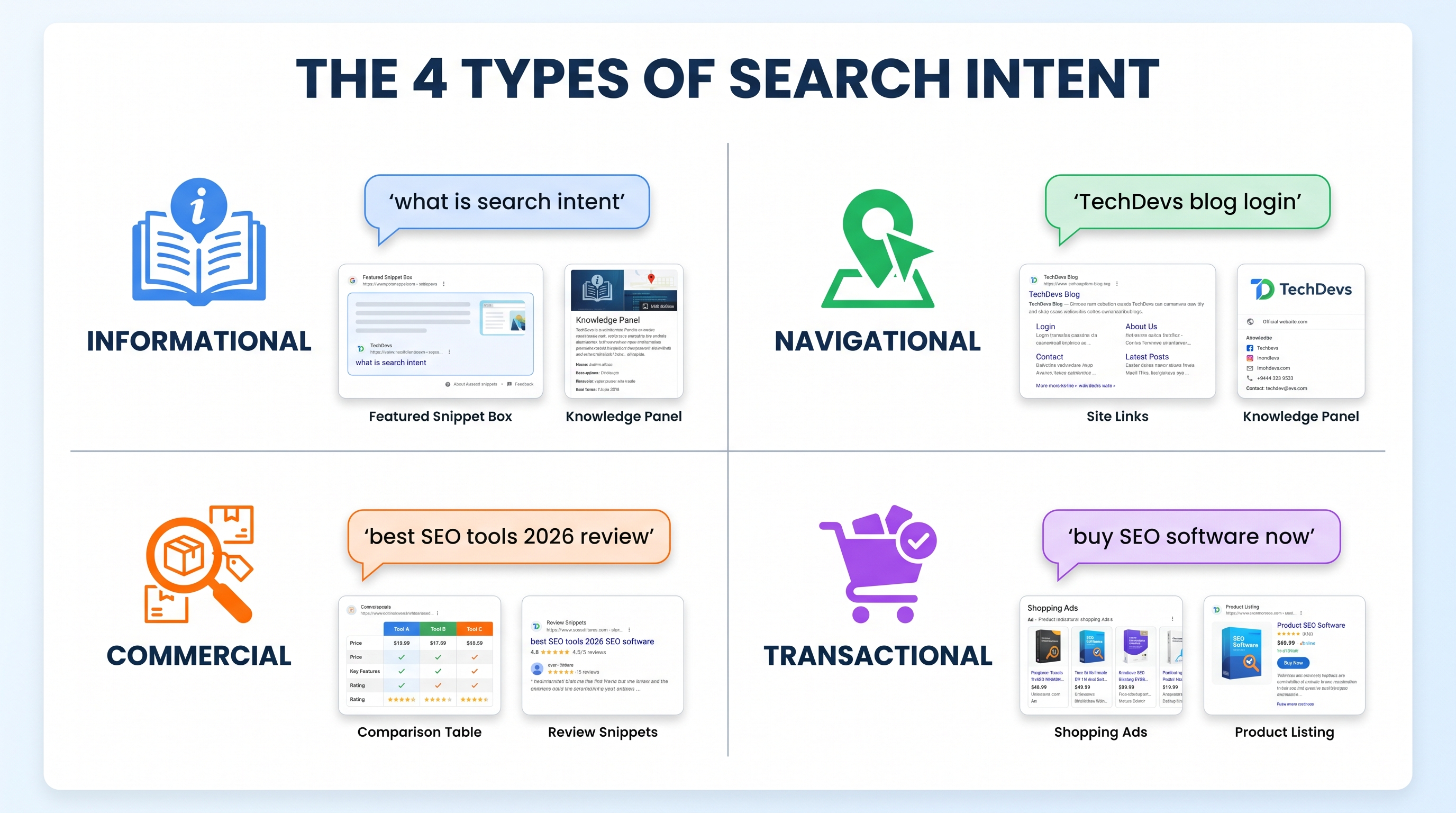
Understanding the four intent types isn't academic. It's practical. Each type demands a different content approach, format, and tone. Get it wrong and you're writing for an audience that doesn't exist.
What is informational intent and how do I spot it?
Informational intent means the user wants to learn something. Queries include 'how to optimize a website for SEO' or 'what is search intent.' SERP features include featured snippets, People Also Ask boxes, and long-form articles. Your content should be educational, thorough, and answer the question directly.
What is navigational intent and when does it matter?
Navigational intent means the user is looking for a specific site or brand. Examples: 'HubSpot login' or 'Nike official site.' These queries are dominated by branded results. If you're not the brand they're searching for, you won't rank. Focus your efforts elsewhere.
What is transactional intent and how should I write for it?
Transactional intent means the user is ready to act. Queries include 'buy noise-canceling headphones' or 'book discovery call.' SERPs show product pages, pricing tables, and call-to-action buttons. Your content should be conversion-focused with clear next steps and minimal friction.
What is commercial investigation intent?
Commercial investigation sits between informational and transactional. The user is researching options before buying. Queries like 'best CRM software for startups' or 'Shopify vs WooCommerce' signal this intent. SERPs feature comparison articles, reviews, and listicles. Your content should compare options objectively and guide decision-making.
Can one keyword have multiple intents?
Yes, and this is where most bloggers mess up. A query like 'running shoes' could be informational (what are the best running shoes?), commercial (comparing brands), or transactional (ready to buy). Google shows mixed results to cover all bases. You need to pick the dominant intent based on SERP analysis.
The fastest way to identify intent? Look at what's already ranking. Google has already done the work of figuring out what users want when they type that query. If the top 10 results are all how-to guides, that's informational intent. If they're all product pages, that's transactional.
Featured snippets and People Also Ask boxes signal informational intent
Shopping ads and product carousels indicate transactional intent
Comparison articles and review sites point to commercial investigation
Branded results dominate navigational queries
How to Decode What Your Audience Actually Wants
Stop guessing. Start analyzing.
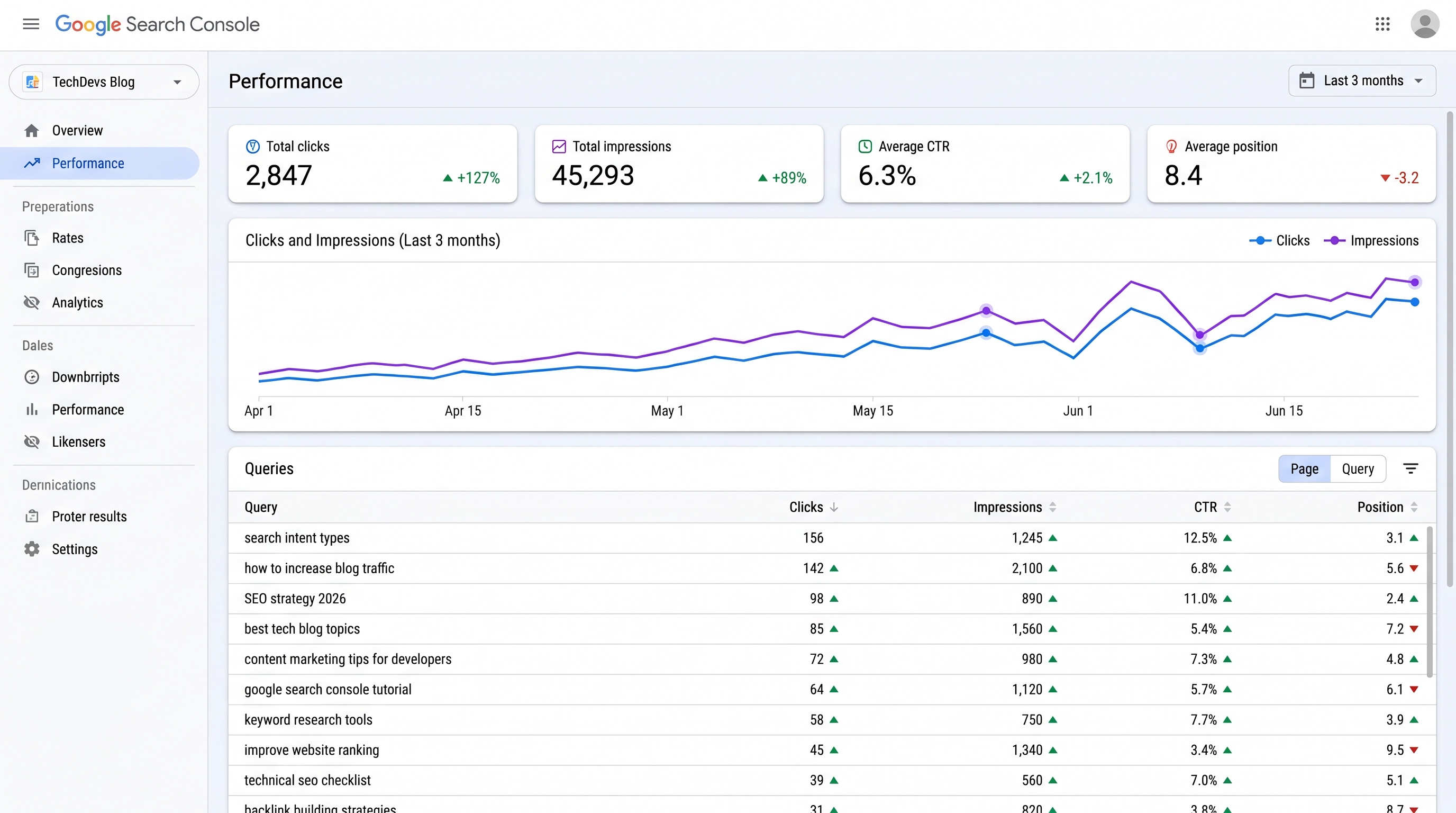
Google Search Console is your best friend here. Pull your query data and look for patterns. Which queries are getting impressions but no clicks? That's a sign your title and meta description don't match intent. Which queries are getting clicks but high bounce rates? Your content isn't delivering what the user expected.
But Search Console only tells you what happened. To understand why, you need to study the SERPs. Type your target keyword into Google and look at the top 10 results. What format are they using? Blog posts? Product pages? Videos? What questions are they answering? What CTAs do they include?
Your Intent Analysis Checklist
Pull Search Console data for your target keywords
Analyze SERP features (snippets, PAA, shopping ads) for each query
Review top 10 ranking pages: format, length, structure, CTAs
Map each keyword to one of the four intent types
Identify content gaps where competitors are weak
Match your content format to the dominant intent
AI tools can help you map content to funnel stages by analyzing query patterns at scale. But the core insight comes from understanding your audience's journey. What problem are they trying to solve? What stage of awareness are they in? What action do they need to take next?
The Search Intent Mismatch: Where Most Blogs Fail
Most content fails because of intent mismatch. You write a 2,000-word thought leadership piece for a query where users just want a quick answer. Or you create a surface-level listicle when users are looking for deep expertise.
Here's a real example: a SaaS company wrote a detailed product comparison guide targeting the keyword 'project management software.' Sounds smart, right? Except the top-ranking results were all informational articles about how to choose project management software, not direct product comparisons. The intent was educational, not commercial. Their guide got zero traffic.
Pros
Content format matches what's already ranking
Depth and detail align with user expectations
CTAs match the user's stage in the buying journey
Content answers the actual question being asked
Cons
Writing transactional content for informational queries
Creating shallow content when users want depth
Ignoring SERP signals about content format
Pushing a sale when users are still learning
Another common mistake: failing to adapt to 2026's AI-first search landscape. Conversational queries are exploding. Voice search is mainstream. Users are asking full questions, not typing keyword fragments. If your content still reads like it was optimized for 2015's exact-match keywords, you're already behind.
Search intent operationalizes how prospects progress from learning to transacting and into post-purchase engagement. It's not just an SEO tactic. It's your entire content strategy.
Enterprise SEO Research, Siteimprove 2025
Your 5-Step Framework to Align Content with Search Intent
Enough theory. Here's how to fix your blog's intent problem.
Research and classify your target keywords by intent type. Use Search Console, keyword tools, and SERP analysis to bucket your keywords into informational, navigational, transactional, or commercial investigation. Don't skip this step. It's the foundation.
Map intents to specific content archetypes and formats. Informational queries need how-to guides, tutorials, and explainer articles. Commercial queries need comparison posts, reviews, and case studies. Transactional queries need product pages, landing pages, and clear CTAs. Match the format to the intent.
Analyze top-ranking content for your target queries. What's working for your competitors? What format are they using? How long is their content? What structure do they follow? What CTAs do they include? Steal what works, improve what doesn't.
Create content that matches both intent and user journey stage. A user searching 'what is SEO' is at the awareness stage. They need education, not a sales pitch. A user searching 'SEO agency pricing' is at the decision stage. They need pricing, case studies, and a clear next step. Don't confuse the two.
Measure and optimize based on engagement and conversion data. Track bounce rate, time on page, scroll depth, and conversion rate. If users are bouncing fast, your content doesn't match their intent. If they're reading but not converting, your CTA might be misaligned with their stage in the journey.
At TechDevs, we use AI automation to scale this process. Our SEO service includes intent analysis, content mapping, and continuous optimization based on real performance data. We've seen clients go from zero traffic to thousands of monthly visitors by fixing intent misalignment alone.
Your Action Plan
Export your top 50 keywords from Search Console
Classify each keyword by intent type
Audit your existing content for intent alignment
Prioritize fixes based on traffic potential and effort
Create a content calendar organized by intent and funnel stage
Set up tracking to measure intent-match success
How AI and Automation Are Changing Search Intent Strategy
AI has changed the game. Search engines now understand context and nuance at a level that was impossible five years ago. Conversational search is the norm. Voice queries are exploding. And users expect instant, accurate answers.
This means your content strategy needs to evolve. You can't just optimize for keywords anymore. You need to optimize for questions, for context, for the entire user journey. And doing that manually at scale? Not happening.
Automation tools can help you identify and classify intent at scale. They can analyze thousands of queries, map them to intent types, and suggest content formats. They can even generate intent-optimized content briefs that tell your writers exactly what to create.
AI-Powered Intent Classification
Tools that analyze SERPs and classify queries by intent automatically, saving hours of manual work.
Conversational Search Optimization
Adapting content for voice search and ChatGPT-style queries that expect direct, conversational answers.
Predictive User Needs
Machine learning models that predict what users will search for next based on behavior patterns.
But here's the catch: automation only works if you understand the fundamentals. AI can speed up the process, but it can't replace strategic thinking. You still need to understand your audience, your funnel, and your business goals. The tools just make it faster to execute.
Turn Zero Readers Into Consistent Traffic: Your Action Plan
You know the problem. You know the solution. Now it's time to execute.
Start by auditing your existing content. Pull your blog posts, classify the target keyword for each one, and identify the intent. Then compare that to what's actually ranking for those keywords. Where's the mismatch? That's your priority list.
Your 30-Day Intent Optimization Plan
Week 1: Audit your top 20 blog posts for intent alignment
Week 2: Rewrite or restructure the 5 biggest mismatches
Week 3: Create a content calendar organized by intent type
Week 4: Set up tracking and measure results
Prioritize high-impact opportunities. Use Search Console data to find keywords with high impressions but low clicks. Those are your quick wins. Fix the intent mismatch and you'll see traffic jump.
Create a content calendar that's organized by intent type and funnel stage. Don't just write whatever you feel like. Plan your content strategically. Map each piece to a specific intent, a specific audience, and a specific goal.
And if you want help? TechDevs specializes in intent-driven content strategy. We use automation to scale the analysis, AI to generate optimized briefs, and human expertise to make sure the strategy actually works. We've helped companies go from zero blog traffic to tens of thousands of monthly visitors by fixing this exact problem.
Ready to Fix Your Blog's Intent Problem?
Stop wasting time creating content nobody reads. Let's build an intent-driven content strategy that actually drives traffic and conversions. Book a free discovery call and we'll audit your top keywords, identify intent mismatches, and show you exactly how to fix them.