How to Create a Profitable Skincare Brand: The Ultimate SEO & CRO Optimization Guide
Learn how to build and optimize your skincare brand with proven SEO & CRO strategies. Real examples from top Indian brands like Mamaearth, Minimalist & more.
 Written byPrithvi Jadwani
Table of contents
Summarize this article with AI
TL;DR
The Indian skincare market is growing fast, projected to hit $9.65bn by 2026. But building a brand isn't just about having great products. You need to be found (SEO) and you need to convert visitors into buyers (CRO). This guide walks you through both, with real examples from Indian brands that got it right.
- Market Timing Is Perfect. India's skincare market is the fifth largest globally, fueled by young consumers and D2C accessibility
- SEO Builds Compounding Growth. Brands like Minimalist and The Ordinary grew by ranking for ingredient-focused searches, not just product names
- CRO Turns Traffic Into Revenue. Optimizing your site's conversion rate can double revenue without spending more on ads
- Educational Content Wins Trust. Consumers research ingredients before buying. Educate them, and they'll trust you enough to purchase
Why Now Is the Perfect Time to Create a Skincare Brand (Especially in India)
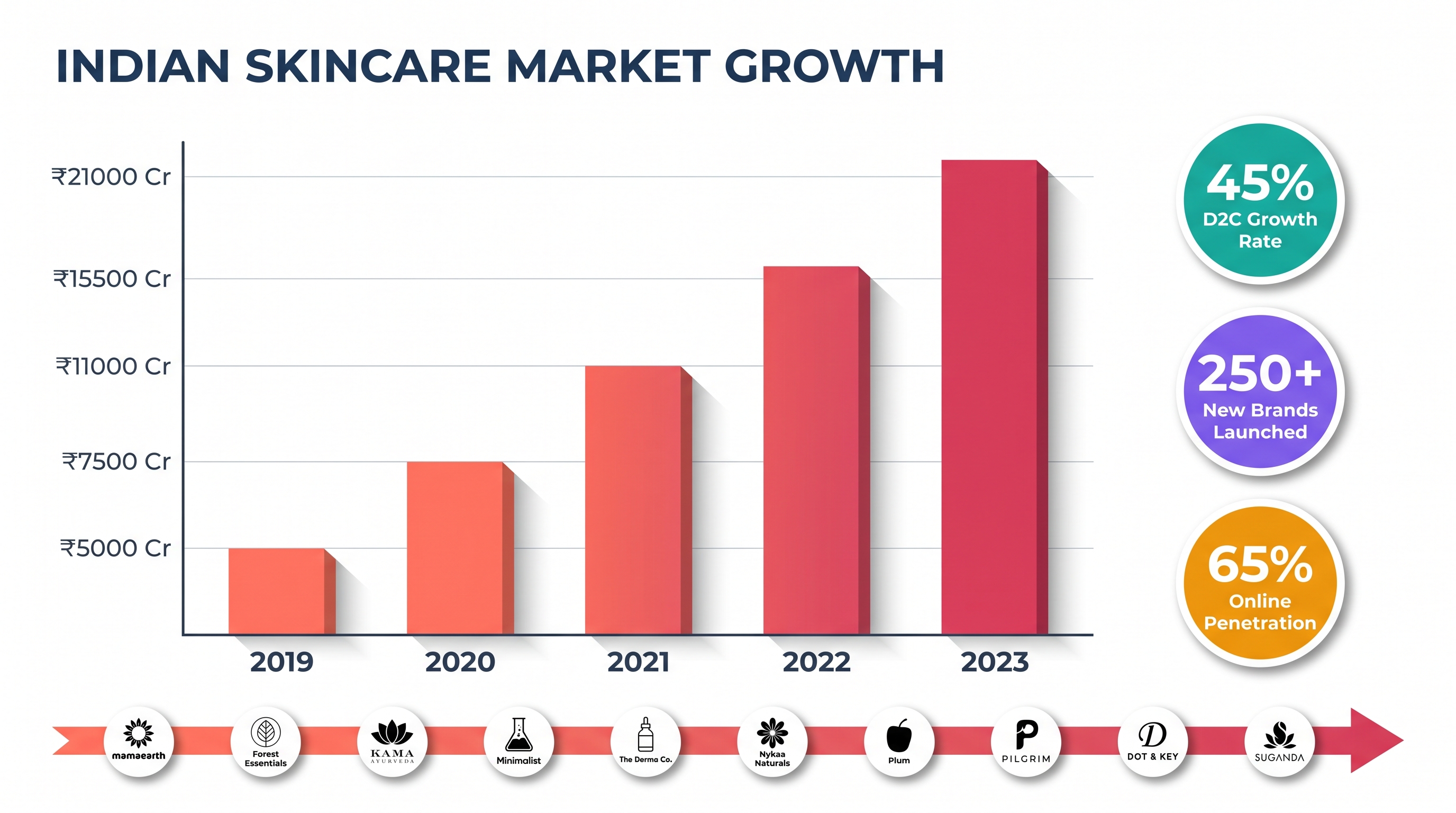
Ten years ago, if you walked into an Indian store looking for sunscreen, you'd find maybe three options. All from legacy brands. All pretty much the same. Fast forward to today, and the Indian skincare market is worth $7.65bn, making it the fifth largest in the world. And it's projected to add another $2bn by 2026.
What changed? Two things: a young demographic willing to spend money on skincare, and startups that figured out how to reach them directly.
Brands like Mamaearth, Minimalist, and Nykaa didn't just disrupt the market. They proved that you don't need decades of brand equity to win. You need to understand what consumers actually want, show up where they're searching, and make it easy for them to buy.
The shift from legacy players like Hindustan Unilever and Himalaya to D2C startups happened because of accessibility. Ecommerce platforms, express delivery, and social media made it possible for small brands to compete without massive distribution networks. If you've been thinking about launching a skincare brand, the infrastructure is already there. You just need to use it right.
The Foundation: How to Create a Skincare Brand That Actually Sells
Before you think about SEO or conversion rates, you need a brand that people want to buy. And that starts with clarity.
Most founders make the mistake of trying to appeal to everyone. "Our moisturizer works for all skin types!" Sure. But so do a hundred other moisturizers. The brands winning right now are the ones that picked a specific niche and owned it.
Minimalist went all-in on ingredient transparency and formulation science. Mamaearth built their entire brand around toxin-free, natural products for parents. Both carved out a specific audience and spoke directly to them.
Brand Foundation Checklist
Define your target audience with specificity (not 'women 18-35', but 'working professionals with acne-prone skin looking for clean ingredients')
Choose 3-5 core products to start with instead of launching a full catalog
Develop formulations that solve a real problem, not just another 'me too' product
Get your products tested and certified (BIS, FSSAI, or dermatologist-approved claims)
Decide on your distribution model: pure D2C, marketplace (Amazon, Nykaa), or hybrid
Build a brand identity that resonates with your audience's values and aesthetics
Legal requirements matter more in skincare than most industries. You need proper certifications, ingredient disclosures, and manufacturing compliance. Cutting corners here will bite you later. Get a cosmetic license, register with the Bureau of Indian Standards if applicable, and make sure your labels meet regulatory standards. Not glamorous, but necessary.
SEO Strategy for Skincare Brands: Building Discoverability That Compounds
Here's what most skincare founders get wrong about SEO: they think it's about stuffing keywords into product pages and hoping Google notices. It's not.
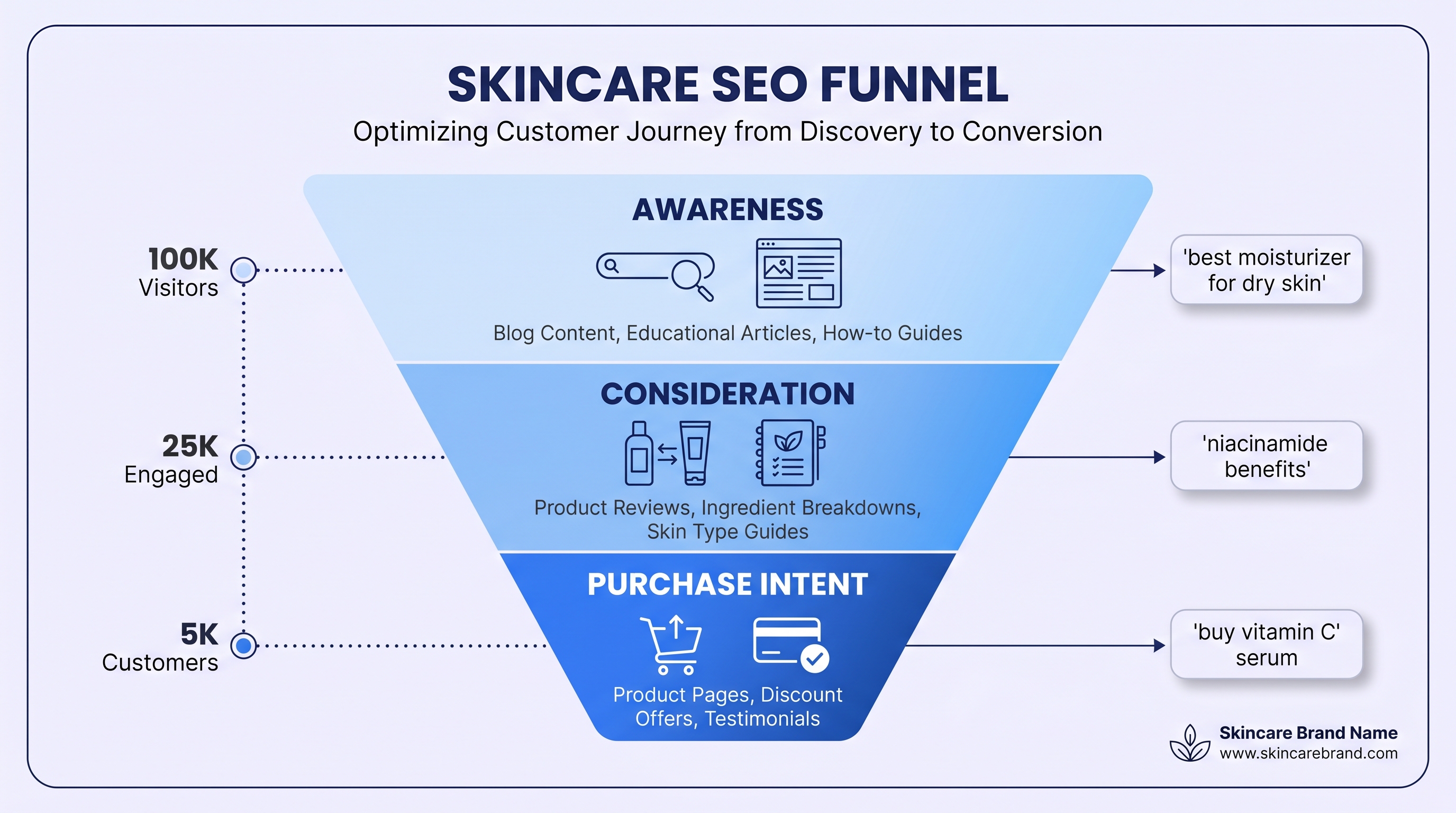
SEO for beauty brands is about positioning your brand where buyers are already looking. And they're looking in three different modes: learning, comparing, and buying.
When someone searches 'what is niacinamide,' they're learning. When they search 'best niacinamide serum for acne,' they're comparing. When they search 'buy niacinamide serum online,' they're ready to purchase. Your content needs to cover all three stages, or you're leaving money on the table.
Brands like The Ordinary built massive authority by ranking for ingredient-focused queries and educating customers deeply. In India, Minimalist followed a similar playbook. They didn't just sell serums. They taught people what serums actually do, which ingredients matter, and how to use them. That educational content ranked, brought traffic, and converted.
Ingredient-based keywords: 'niacinamide serum', 'hyaluronic acid for dry skin', 'retinol for beginners'
Problem-based keywords: 'how to reduce acne scars', 'best moisturizer for oily skin', 'dark circles treatment'
Category-level keywords: 'Korean skincare routine', 'clean beauty brands India', 'dermatologist-recommended sunscreen'
Comparison keywords: 'niacinamide vs vitamin C', 'chemical vs physical sunscreen', 'serum vs essence'
Don't chase broad keywords like 'face serum' or 'moisturizer.' They're too competitive and too vague. Go specific. Target long-tail keywords that show real intent. 'Best vitamin C serum for pigmentation under 1000 rupees' is a much better keyword than 'vitamin C serum' because it tells you exactly what the searcher wants.
Technical SEO & On-Page Optimization for Skincare Websites
Technical SEO sounds boring. It is. But it's also the difference between a site that ranks and one that doesn't.
Your site structure needs to be clean. Categories should be logical. URLs should be readable. If your product page URL looks like 'yoursite.com/product?id=12345', you're doing it wrong. It should look like 'yoursite.com/niacinamide-serum-for-acne'. Descriptive, keyword-rich, and human-readable.
Technical SEO Essentials
Mobile-first design (most Indian consumers browse on mobile)
Page speed under 3 seconds (use tools like Google PageSpeed Insights)
Clean URL structure with keywords (no random IDs or parameters)
Schema markup for products (price, availability, reviews)
XML sitemap submitted to Google Search Console
HTTPS enabled (SSL certificate)
Optimized images (compressed, with descriptive alt text)
Product pages need to be optimized for both search engines and humans. That means clear titles with your primary keyword, meta descriptions that make people want to click, and structured data that tells Google exactly what you're selling. Add schema markup for product price, availability, and reviews. It helps you show up in rich snippets, which get more clicks.
Pros
Mobile-first captures the majority of Indian traffic
Google prioritizes mobile indexing
Faster load times on mobile improve rankings
Better user experience for your primary audience
Cons
Desktop users may feel the design is too simplified
Some advanced features work better on larger screens
Requires more testing across different devices
Page speed is critical. Indian internet speeds vary wildly, and if your site takes 10 seconds to load, you've already lost the customer. Compress images, use lazy loading, minimize JavaScript, and host on a fast server. These aren't nice-to-haves. They're requirements.
Content Marketing That Educates and Converts: Learning from Indian Success Stories
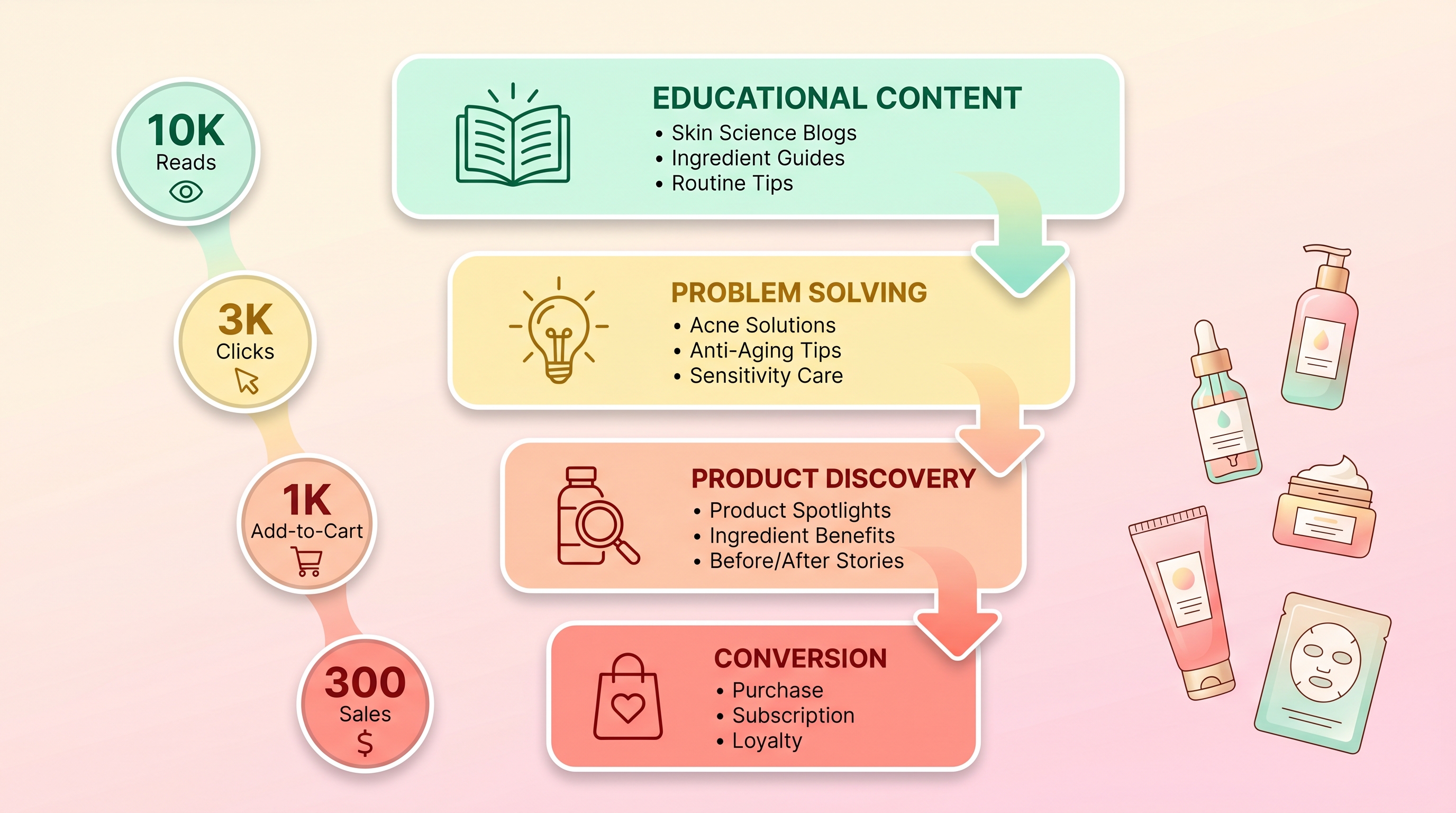
Content marketing for skincare isn't about writing fluff. It's about educating your audience so well that they trust you enough to buy from you.
Mamaearth built their brand on addressing one specific concern: toxin-free products for parents. Their content revolves around ingredient safety, natural formulations, and why certain chemicals should be avoided. That's not generic blog content. That's a clear point of view backed by education.
Minimalist took a different approach. They went deep on ingredient science. Their blog reads like a skincare textbook, but in a good way. They explain what niacinamide does at a molecular level, why certain percentages matter, and how to layer actives. That level of detail builds authority.
Educational Blog Content
Write guides that answer real questions: 'How to build a skincare routine for oily skin' or 'What percentage of retinol should beginners use?'
User-Generated Content
Encourage reviews, before-and-after photos, and testimonials. Real results from real people build trust faster than any ad.
Video Tutorials
Short how-to videos and ingredient breakdowns perform well on YouTube and Instagram. They also rank in search.
Topical Authority
Cover every angle of a topic (e.g., niacinamide: what it is, how to use it, best products, side effects). Google rewards depth.
Communities matter. The Reddit group r/IndianSkincareAddicts has nearly 45,000 members discussing products, ingredients, and routines. Brands that engage authentically in these spaces (without being spammy) build credibility. And when someone asks for a product recommendation, your brand comes up because you've been helpful, not because you paid for placement.
The primary reason for this sudden boost is ease of accessibility of brands and products through channels like direct-to-consumer and ecommerce, along with express deliveries.
Varun Alagh, Co-founder and CEO of Honasa (Mamaearth's parent company)
Video content is underrated in skincare SEO. A well-optimized YouTube video on 'how to use niacinamide serum' can rank on Google's first page and bring consistent traffic. Plus, video keeps people engaged longer, which signals to Google that your content is valuable.
Conversion Rate Optimization (CRO): Turning Traffic Into Customers
You can drive all the traffic in the world, but if your site doesn't convert, you're just burning money.
Conversion rate optimization is the process of improving the percentage of visitors who take a desired action. For ecommerce, that action is usually 'add to cart' or 'complete purchase.' And small improvements here can double your revenue without spending more on ads.
Start with your homepage. Is it immediately clear what you sell and who it's for? Or do visitors have to scroll and guess? Your value proposition should be obvious within three seconds. 'Toxin-free skincare for sensitive skin' is clear. 'Premium beauty products' is not.
Product pages: High-quality images, ingredient lists, usage instructions, and real customer reviews
Trust signals: Dermatologist approvals, certifications, cruelty-free badges, and secure payment icons
Before-and-after photos: Real results from real customers (with permission)
Clear CTAs: 'Add to Cart' buttons should be visible, high-contrast, and above the fold
Transparent pricing: No hidden fees or surprise shipping costs at checkout
Checkout friction kills conversions. If your checkout process has five steps, multiple form fields, and requires account creation, you're losing customers. Simplify it. Offer guest checkout. Pre-fill fields where possible. Show a progress indicator. And for the love of all that is holy, don't surprise people with shipping costs at the last step.
Trust signals matter more in skincare than almost any other category. People are putting these products on their skin. They need to know it's safe, tested, and backed by real science. Display certifications prominently. Show dermatologist endorsements. Highlight ingredient sourcing. Make it easy to trust you.
Advanced CRO Tactics: Personalization, Testing & Analytics
Once you've nailed the basics, it's time to get surgical with your optimization.
A/B testing is how you figure out what actually works. But most brands test the wrong things. Don't start by testing button colors. Start by testing things that move the needle: your headline, your product images, your pricing display, your CTA copy.
Common CRO Questions for Skincare Brands
How much does it cost to create a skincare brand in India?
It depends on your approach. A basic D2C brand with 3-5 products, contract manufacturing, and a simple Shopify site can start around ₹5-10 lakhs. That includes formulation, packaging, website, and initial inventory. If you want custom formulations, in-house manufacturing, and a full product line, you're looking at ₹50 lakhs or more. Most successful brands start lean and scale as revenue comes in.
What are the legal requirements for launching a skincare brand?
You need a cosmetic manufacturing license if you're producing in-house, or you can work with a licensed contract manufacturer. Products must comply with the Drugs and Cosmetics Act, and labels need to meet BIS standards. If you make specific claims (like 'dermatologist-tested' or 'clinically proven'), you need documentation to back them up. Get a good regulatory consultant. It's worth the investment.
How long does it take to see results from SEO for a new skincare brand?
SEO is a long game. You'll start seeing some traffic in 3-4 months if you're publishing quality content consistently. Meaningful rankings and traffic that drive revenue? 6-12 months. But here's the thing: once you rank, that traffic keeps coming without paying for ads. It compounds. Paid ads stop the second you stop paying. SEO keeps working.
What's the difference between SEO and paid ads for skincare brands?
Paid ads give you immediate visibility but cost money every time someone clicks. SEO takes longer to build but brings free, ongoing traffic once you rank. Most successful brands use both: paid ads for quick wins and testing, SEO for long-term growth and lower customer acquisition costs. If you can only pick one, start with SEO. It's the better investment over time.
Which platform is best for selling skincare products: Shopify, Amazon, or Nykaa?
It depends on your goals. Shopify gives you full control and better margins, but you have to drive all the traffic. Amazon and Nykaa bring built-in audiences but take a cut (15-30%) and limit your brand control. Most Indian brands start with a Shopify site for brand building and add marketplaces for volume. Nykaa is particularly strong for beauty-focused audiences in India.
How do I compete with established brands like Mamaearth and Minimalist?
You don't compete head-to-head. You find a niche they're not serving well and own it. Maybe it's skincare for men, or products for specific skin conditions, or a particular ingredient focus. Mamaearth went after toxin-free for parents. Minimalist focused on ingredient science. What's your angle? Find it, own it, and speak directly to that audience.
What are the most important CRO metrics for skincare ecommerce sites?
Watch your conversion rate (visitors to purchases), average order value, cart abandonment rate, and customer lifetime value. Also track product page engagement: how many people add to cart vs how many actually complete checkout. If you see high add-to-cart rates but low checkout completion, you have a checkout friction problem. If you see low add-to-cart rates, your product pages need work.
Heatmaps and session recordings show you where people get stuck. You might think your product page is perfect, but then you watch a recording and see that people scroll right past your ingredient list because it's buried below the fold. Or they click on an image expecting a zoom feature that doesn't exist. These insights are gold.
Personalization works when it's done right. Show different homepage content based on whether someone is a first-time visitor or a returning customer. Recommend products based on browsing history or skin concerns they've indicated. But don't overdo it. Creepy personalization (like showing someone an ad for a product they just looked at five minutes ago) backfires.
Email capture is underrated. Most visitors won't buy on their first visit. Capture their email with a small discount or a free skincare guide, then nurture them with educational content and product recommendations. A good email sequence can turn a one-time visitor into a loyal customer.
Putting It All Together: Your 90-Day Action Plan to Launch and Optimize
You've got the strategy. Now here's how to execute it in 90 days.
Month one is about foundation. Finalize your brand identity, lock in your first 3-5 products, build your website, and set up basic SEO infrastructure. This includes keyword research, site structure, and creating your first batch of educational content. Don't aim for perfection. Aim for launch-ready.
Month 1: Foundation
Finalize brand name, logo, and visual identity
Complete product formulations and get samples tested
Build website on Shopify or similar platform
Set up Google Analytics, Search Console, and basic tracking
Conduct keyword research and map content to search intent
Write and publish 5-7 foundational blog posts
Month two is about content and technical optimization. Publish more educational content, optimize your product pages, build backlinks through outreach and partnerships, and start testing your checkout flow. This is also when you should set up email capture and create your first nurture sequence.
Month 2: Content & Optimization
Publish 8-10 more blog posts covering all funnel stages
Optimize product pages with schema markup and rich snippets
Build 10-15 quality backlinks through guest posts and partnerships
Set up email capture pop-ups and lead magnets
Create 3-5 email nurture sequences
Run initial A/B tests on homepage and product pages
Month three is launch and iteration. Go live, drive initial traffic through a mix of paid ads and organic channels, monitor your analytics obsessively, and start making data-driven improvements. This is when you'll see what works and what doesn't. Be ready to pivot.
Common pitfalls to avoid: trying to do everything at once, chasing vanity metrics instead of revenue, ignoring mobile optimization, and giving up on SEO after two months because you're not ranking yet. SEO takes time. CRO takes testing. Growth takes patience. But if you stick with it, the compounding effects are massive.
Ready to Build a Skincare Brand That Actually Grows?
We've helped dozens of D2C brands implement SEO and CRO strategies that drive real revenue. If you want to skip the trial-and-error phase and work with a team that's done this before, let's talk.