The Ultimate SEO and CRO Guide for Jewelry Brands That Want to Dominate Sales
Master SEO and CRO for jewelry brands with our comprehensive guide. Learn proven strategies to boost visibility, traffic, and sales for your jewelry business.
 Written byPrithvi Jadwani
Table of contents
Summarize this article with AI
TL;DR
Jewelry brands face a unique challenge: customers spend weeks researching before buying a single high-value piece. SEO gets you in front of those buyers early. CRO makes sure they actually buy from you instead of your competitor. Most jewelry brands nail one or the other. The winners do both.
- Buyer Intent Keywords Win. Target transactional searches like 'buy diamond engagement rings online' and long-tail queries like 'custom gold necklace for weddings' to capture ready-to-buy customers
- Technical SEO Kills Conversions. Slow load times and poor mobile experience cost you sales on high-value purchases where customers compare multiple options
- Trust Signals Are Everything. Reviews, certifications, security badges, and transparent policies reduce anxiety on purchases that often exceed $1,000
- Track the Full Journey. Multi-touch attribution reveals how SEO contributes to sales that take 20+ touchpoints to close
Why SEO and CRO Are Non-Negotiable for Jewelry Brands in 2025
Your potential customer just searched 'lab-grown diamond engagement rings.' They opened eight tabs. Yours is one of them. They'll spend the next three weeks reading reviews, comparing specs, and looking for reasons to trust someone with $3,000.
If your site loads slowly, your product pages look generic, or your checkout feels sketchy, they'll buy from tab number four instead.
That's the jewelry game. High-intent buyers take their time, comparing designs and hunting for trust signals before committing to a high-value purchase. SEO gets you into their consideration set. CRO gets you their credit card number.
Building Your Jewelry SEO Foundation: Keyword Research and Buyer Intent
Most jewelry brands chase the wrong keywords. They optimize for 'diamond rings' (impossible to rank, vague intent) instead of 'buy 2-carat round diamond engagement ring white gold' (winnable, clear intent).
Here's what actually works: transactional keywords that target ready-to-purchase customers. Someone searching 'buy diamond engagement rings online' isn't browsing. They're shopping.
Transactional keywords: 'buy diamond engagement rings online', 'custom jewelry design services', 'order gold necklace' target people ready to purchase
Long-tail keywords: 'custom gold necklace for weddings', 'ethically sourced diamond rings under $5000' capture niche searches with serious intent
Local keywords: 'jewelry shop in Mumbai', 'best gold jeweler near me' drive foot traffic if you have physical locations
Comparison keywords: 'lab-grown vs natural diamonds', 'platinum vs white gold engagement rings' catch people in the consideration phase
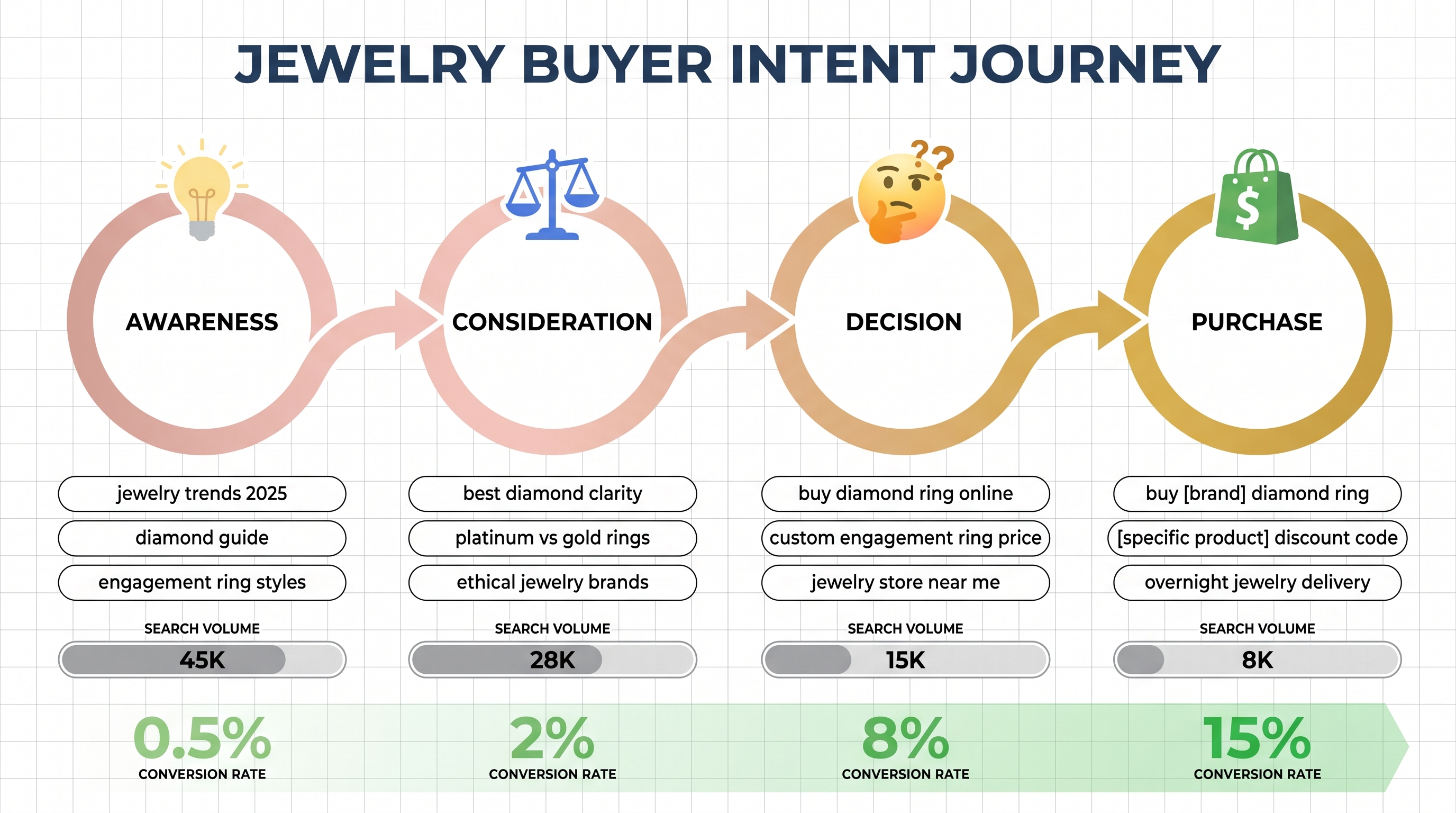
But here's what nobody tells you: buyer intent isn't static. The same person searches differently at different stages. Early on, they're reading 'how to choose an engagement ring.' Two weeks later, they're searching your brand name plus 'reviews.' Three weeks in, they're typing specific product SKUs.
Awareness Stage
Educational content: 'engagement ring styles guide', 'understanding diamond certifications', 'what is a good diamond clarity'
Consideration Stage
Comparison content: 'best online jewelry stores', 'lab-grown vs natural diamonds cost', 'custom vs ready-made rings'
Decision Stage
Product pages: '18k gold diamond pendant handmade', '[your brand] reviews', 'buy [specific product]'
Map your content to these stages. Write guides for awareness. Create comparison pages for consideration. Optimize product pages for decision. That's how you capture the full journey.
On-Page SEO Optimization: Making Every Product Page Shine
Your product page titles matter more than you think. 'Pendant 001' tells Google nothing. '18k Gold Diamond Pendant with Sapphire Accents, Handmade' tells Google exactly what you're selling and captures long-tail searches.
And schema markup? It's not optional anymore. Structured data gets you rich snippets in search results showing price, availability, ratings, and product details. Those rich snippets drive clicks. More clicks mean more revenue.
Product Page Optimization Checklist
Descriptive titles with metal type, stone, style, and craftsmanship details
Schema markup implemented for Product, Review, Offer, and Breadcrumb
Unique meta descriptions that address buyer questions and include target keywords
High-quality product descriptions explaining materials, craftsmanship, sizing, and care
Optimized image alt text describing the piece in detail
Internal linking to related products and category pages
Write product descriptions that answer real questions. Not 'This beautiful ring features stunning craftsmanship.' Try 'This 14k white gold engagement ring features a 1.5-carat round brilliant diamond (G color, VS2 clarity) in a classic six-prong setting. The band measures 2mm wide and includes matching side stones totaling 0.25 carats. Handmade in our New York studio with conflict-free diamonds certified by GIA.'
See the difference? The second version gives search engines context and gives buyers confidence.
Common Product Page SEO Questions
Should I create separate pages for each product variation?
It depends on search volume. If people search 'rose gold engagement ring' separately from 'white gold engagement ring', create separate pages. If variations are just size or minor details, use a single page with selectors and canonical tags pointing to the main version.
How do I optimize for Google Shopping?
Set up Google Merchant Center with a product feed that includes titles, descriptions, prices, availability, images, and GTINs. Use schema markup on your site to match the feed data. Keep inventory synchronized in real-time to avoid disapprovals.
What's the ideal product description length?
Aim for 300-500 words minimum for high-value items. Include materials, dimensions, weight, craftsmanship details, care instructions, and what makes the piece unique. More content gives you more keyword opportunities and builds buyer confidence.
How important are customer reviews for SEO?
Critical. Reviews add fresh, unique content to your pages, include natural keyword variations, and generate review schema that displays star ratings in search results. Pages with reviews convert better and rank higher.
Technical SEO and Performance: The Hidden Conversion Killers
Site speed isn't just an SEO factor. It's a revenue factor. A jewelry customer comparing five different $2,000 rings isn't going to wait four seconds for your product images to load. They'll close the tab and buy from someone faster.
Mobile optimization is even more critical. Your buyers are browsing on their phones during lunch breaks, showing options to their partners, comparing prices while standing in a competitor's store. If your mobile experience is clunky, you're out.
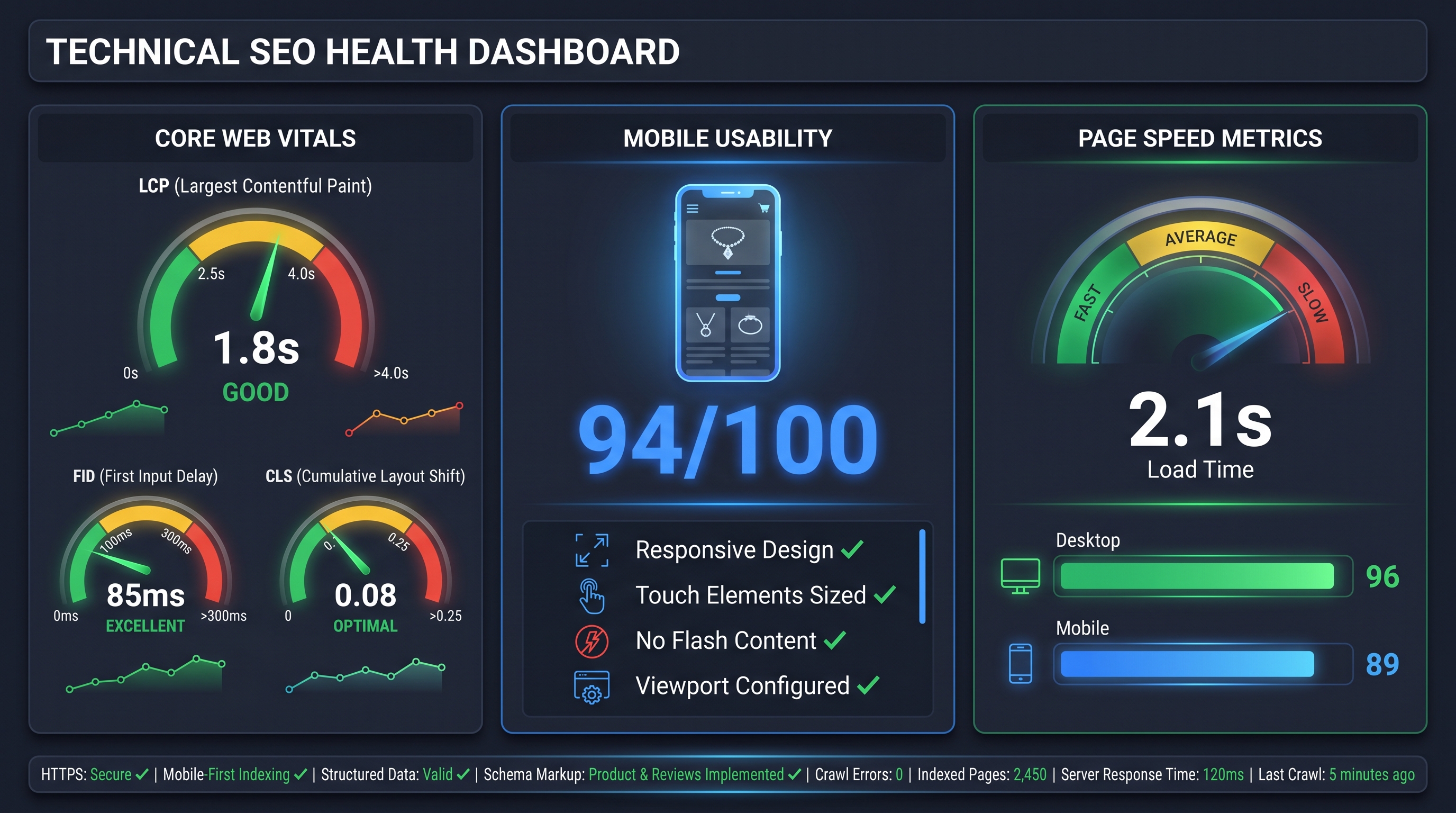
Optimize images: Use WebP format, lazy loading, and responsive images. Your high-res product photos should look stunning but load in under 2 seconds
Implement CDN: Serve images and assets from edge locations close to your customers for faster load times globally
Minimize JavaScript: Heavy frameworks slow everything down. Use progressive enhancement and defer non-critical scripts
Fix crawl efficiency: Large inventories need XML sitemaps, proper pagination, and strategic use of noindex to help search engines focus on your best pages
Automate inventory feeds: Keep product availability, pricing, and specs synchronized across your site and Google Merchant Center in real-time
Secure everything: SSL certificates, HTTPS everywhere, secure payment gateways. Trust signals start with technical security
And monitor continuously. Set up alerts for Core Web Vitals degradation, crawl errors, broken product pages, and inventory sync failures. Catching technical issues before they tank your rankings saves you from weeks of recovery work.
CRO Fundamentals: Converting Visitors into Jewelry Buyers
You've got the traffic. Now what? CRO for jewelry is different because the purchase decision takes longer, costs more, and requires more trust than almost any other ecommerce category.
Your product pages need to do heavy lifting. High-quality images from multiple angles. Zoom functionality so buyers can inspect settings and stones. 360-degree views. Video showing the piece in different lighting. These aren't nice-to-haves. They're table stakes.
Pros
Reduces friction for first-time buyers who don't want to create an account
Speeds up checkout for customers in a hurry
Lowers abandonment rates at the account creation step
Cons
Harder to build customer profiles and personalize future experiences
Limits your ability to send abandoned cart emails effectively
Makes order tracking and customer support more complicated
But here's what moves the needle most: trust signals. Reviews with photos from real customers. Security badges from Norton or McAfee. Clear return policies. Authenticity certificates. Lifetime warranties. Payment options from trusted providers like PayPal and Affirm.
Display Trust Everywhere
Show security badges, certifications, and guarantees on product pages, cart, and checkout. Make them visible without being intrusive.
Leverage Social Proof
Customer reviews with photos, testimonials, and user-generated content on Instagram. Real people wearing your jewelry builds confidence.
Offer Expert Guidance
Live chat with jewelry consultants, virtual appointments, and detailed buying guides. Help customers make informed decisions.
Simplify Returns
Clear, generous return policies reduce purchase anxiety. 30-day returns with free shipping removes the biggest objection to buying expensive jewelry online.
Strategic CTAs matter too. Don't just have 'Add to Cart.' Offer 'Add to Wishlist' for browsers. 'Request Custom Design' for people who want modifications. 'Schedule Consultation' for high-value pieces where customers want to talk to a human first.
And fix your checkout. Multiple payment options including buy-now-pay-later. Progress indicators so customers know how many steps remain. Guest checkout for people who don't want accounts. Mobile-optimized forms that don't require zooming and scrolling.
Content Strategy: Creating Assets That Rank and Convert
Content marketing for jewelry isn't about pumping out blog posts. It's about creating resources that answer real questions at every stage of the buyer journey.
Early stage buyers need education. Write comprehensive guides: 'How to Choose an Engagement Ring: Complete Guide for First-Time Buyers.' 'Understanding Diamond Certifications: GIA vs IGI vs AGS.' 'Lab-Grown vs Natural Diamonds: An Honest Comparison.'
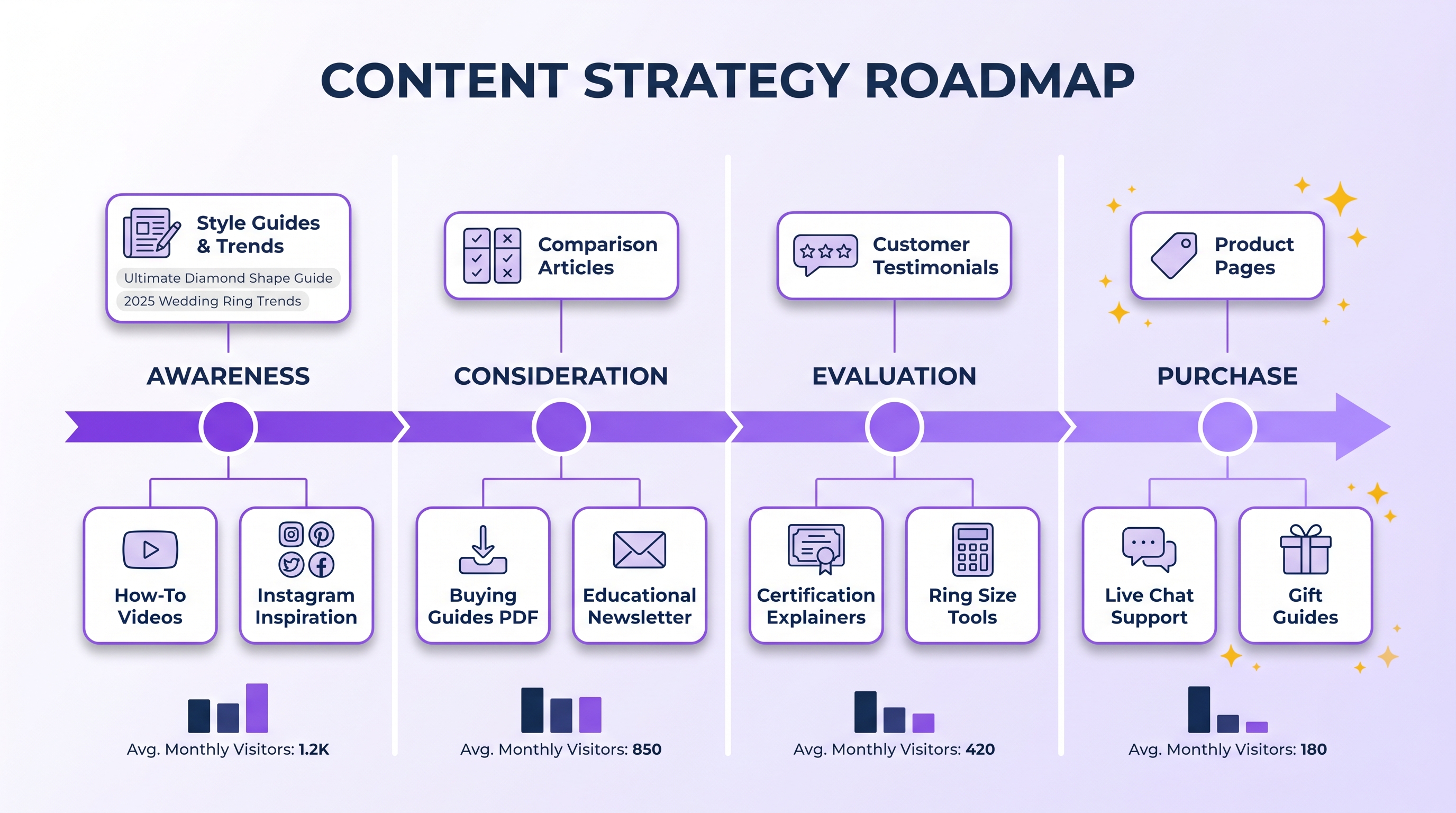
Educational guides for awareness stage: diamond education, metal comparisons, style guides, care instructions
Comparison content for consideration stage: brand comparisons, price range guides, custom vs ready-made, online vs in-store
Seasonal content that captures timely demand: Valentine's Day gift guides, holiday jewelry trends, wedding season collections
Behind-the-scenes content that builds trust: craftsmanship videos, sourcing stories, meet-the-maker profiles
User-generated content from customers: unboxing videos, styling tips, real wedding photos featuring your jewelry
Collaborate with influencers who actually wear jewelry, not just anyone with followers. A micro-influencer in the wedding space with 20,000 engaged followers beats a generic lifestyle influencer with 200,000 disengaged ones.
The brands winning in jewelry ecommerce aren't just selling products. They're creating content ecosystems that educate, inspire, and build trust across multiple touchpoints before asking for the sale.
TechDevs Strategy Team
And distribute strategically. SEO brings organic traffic. Email nurtures leads over weeks. Social media builds brand awareness. Paid ads retarget people who visited but didn't buy. Every channel plays a role.
Building Trust and Authority for High-Value Purchases
Nobody impulse-buys a $4,000 engagement ring from a website they've never heard of. Trust is everything in jewelry ecommerce. Build it systematically.
Trust-Building Tactics That Actually Work
How do I get more customer reviews?
Send automated review requests 2-3 weeks after delivery when customers have worn the piece. Offer a small incentive like 10% off their next purchase. Make leaving a review easy with direct links. Respond to every review, positive or negative, to show you care.
What certifications should I display?
GIA or AGS diamond certifications for stones. Membership in jewelry trade associations. SSL certificates and PCI compliance badges for security. Better Business Bureau accreditation. Industry awards or press mentions. Any third-party validation builds credibility.
Should I show my manufacturing process?
Absolutely. Behind-the-scenes content showing how pieces are made, quality control processes, and your workshop humanizes your brand. It proves you're not dropshipping cheap jewelry from unknown suppliers. Transparency builds trust.
How important is live chat for jewelry sales?
Critical for high-value purchases. Customers have questions about sizing, customization, shipping times, and return policies. Being able to ask a real person in real-time removes friction. Just make sure your chat team actually knows jewelry, not just copy-paste responses.
What should my return policy look like?
At minimum: 30-day returns, free return shipping, full refunds (not just store credit). Consider extending to 60 days for engagement rings. Be clear about what's returnable and what isn't (custom pieces, engraved items). The more generous you can be, the less purchase anxiety customers feel.
Security matters more in jewelry than almost any other category. Display SSL certificates prominently. Show accepted payment methods from trusted providers. Explain how you protect customer data. Link to your privacy policy. Use secure payment gateways with recognizable logos.
Showcase Reviews
Display customer reviews with photos on product pages. Implement review schema for star ratings in search results. Respond to all reviews promptly.
Highlight Security
SSL certificates, PCI compliance, secure payment gateways, and data protection policies. Make security visible and understandable.
Display Credentials
Industry memberships, certifications, awards, press mentions, and years in business. Third-party validation builds instant credibility.
Video content works particularly well for trust-building. Customer testimonials. Unboxing videos. Behind-the-scenes tours of your workshop. Interviews with your designers. Anything that puts real faces and voices to your brand.
Measuring Success: Analytics, Attribution, and Continuous Optimization
If you're not tracking the full customer journey, you're flying blind. Jewelry buyers don't see an ad and buy. They research for weeks, visit your site multiple times, read reviews on third-party sites, and compare options before converting.
Multi-touch attribution reveals the real story. Maybe organic search brought them in initially. They left, saw a retargeting ad, came back and read reviews, left again, searched your brand name directly, and finally purchased. If you're using last-click attribution, you'd credit that final branded search. But SEO actually started the journey.
Essential Metrics to Track
Organic traffic by landing page type (category, product, content)
Keyword rankings for target transactional and long-tail terms
Conversion rate by traffic source and landing page
Average order value for organic vs paid vs direct traffic
Revenue per visitor segmented by device and location
Core Web Vitals and page speed metrics
Cart abandonment rate and reasons (exit surveys)
Time to conversion and number of sessions before purchase
Run A/B tests continuously. Test product page layouts, CTA copy, trust badge placement, checkout flows, and pricing displays. But test one thing at a time and give tests enough time to reach statistical significance. Jewelry has longer sales cycles, so you need more data than fashion or electronics.
Create feedback loops. Use CRO insights to inform your SEO strategy. If a particular product category converts well, create more content around it. If customers ask the same questions repeatedly in chat, write FAQ content that ranks for those questions. Let data guide your priorities.
Ready to Turn Your Jewelry Traffic Into Revenue?
We've helped jewelry brands build SEO and CRO systems that generate consistent, scalable growth. No fluff, no generic strategies. Just proven tactics that work for high-value ecommerce. Let's talk about what's holding your site back and how to fix it.