AI Search vs Google Traffic in 2026: Why SEO Still Wins
A 2026 traffic study breakdown: AI referrals are growing but still small, while Google sends most buyers. Learn what to fix in SEO to win both.
 Written byPrithvi Jadwani
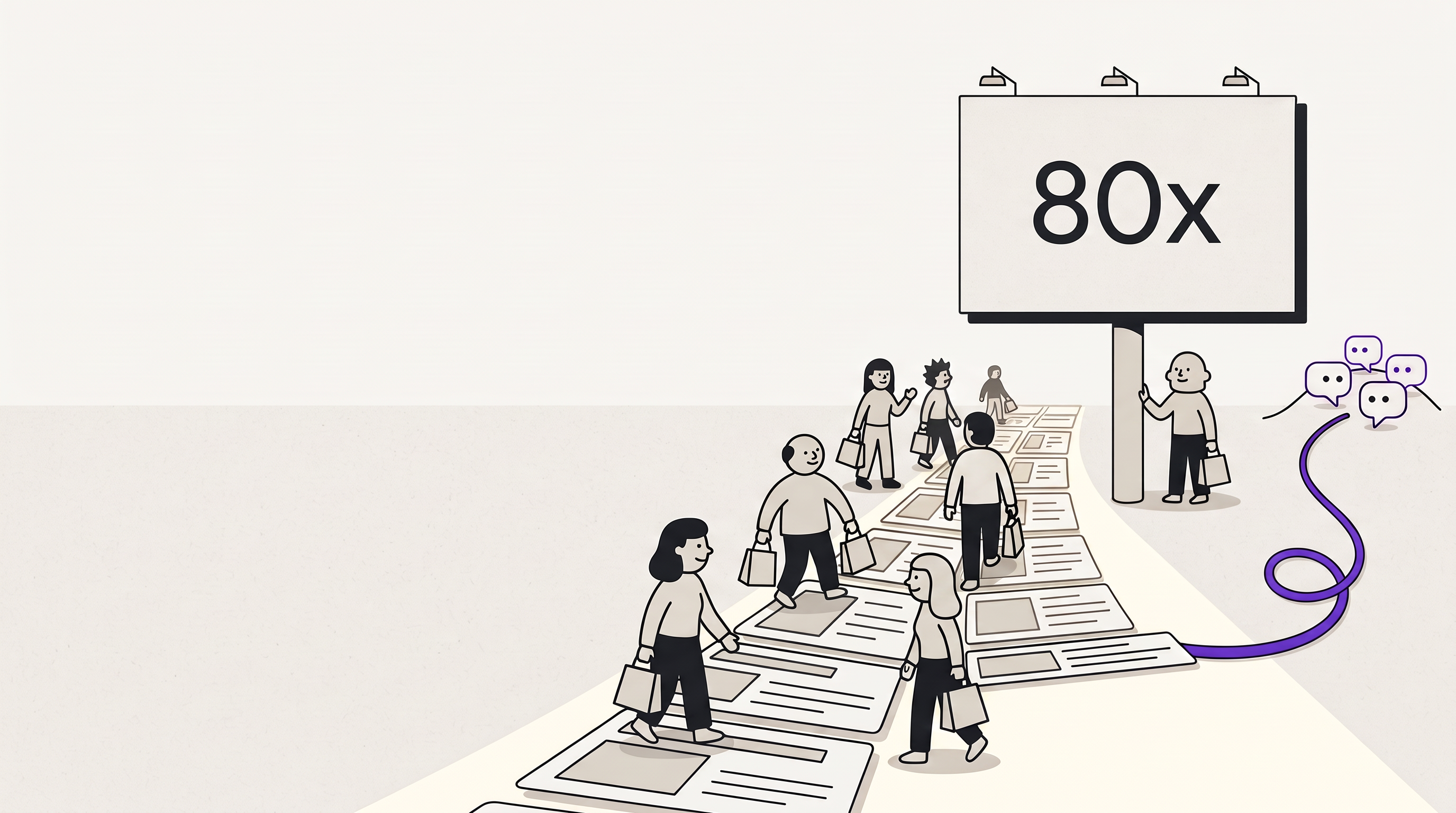
Table of contents
Summarize this article with AI
TL;DR
AI search is not replacing Google traffic. Google organic still sends roughly 80 times more visits than all AI assistants combined, and AI referrals are best treated as a citation layer that feeds branded search, not a standalone channel. Fix SEO first, then earn citations as a second, cheaper win.
- Google is still about 80x bigger. Even after 44.6% year-on-year growth in AI referrals, the base is tiny.
- AI visitors convert better, mostly. 1.18x organic overall, 1.51x for B2C, but only 0.62x for B2B Products.
- Every AI traffic number is a floor. App visits land in direct and AI Overview clicks look like organic.
- Think citation layer, not channel. The branded-search effect is plausible but untested, so treat it as a hypothesis.
- SEO and speed first. A 5% organic gain beats doubling AI referral traffic on conversions.
AI Search vs Google Traffic in 2026: The Short Answer
In the AI search vs Google traffic 2026 numbers, AI search is not replacing Google. Google organic still sends roughly 80 times more visits than all AI assistants combined, according to SEOcrawl's study of 16,000+ sites from March to August 2026. If someone on your team wants to move budget out of SEO because "everyone is using ChatGPT now", the data says slow down.
Start with the study most people quote. Marie Haynes analysed 100 websites, 12 months of GA4 data and more than 145 million sessions. ChatGPT drove just 0.62% as many sessions as Google organic. Add every other LLM and you get 0.73%.
Two more datasets say the same. Ahrefs' benchmark has Search at 331.6M sessions (27.55% share) against AI Assistants at 5.4M sessions (0.46% share). And chatgpt-vs-google.com, tracking 74,752 sites, found all chatbots combined sent 3.5M visitors in March 2026, or 0.28% of web traffic. Google sent 345.2M, a 28.12% share.
So why the panic? Because AI referral sessions grew 44.6% year on year. That is a great-looking line on a slide. But growth off a tiny base is a trend line, not a channel.
Every Big Study Says the Same Thing (And No, They Do Not Agree on Much Else)
Five different datasets, five different methods, one conclusion: Google organic dwarfs AI referrals. The sample sizes and time windows vary wildly, so don't read across the rows as if they were one experiment.
How big is AI referral traffic next to Google? Five studies
| Study | Sample | What it found |
|---|---|---|
| Marie Haynes | 100 sites, 145M+ sessions | ChatGPT = 0.62% of Google organic sessions |
| Ahrefs traffic benchmark | Cross-site benchmark | AI assistants 0.46% share vs Search 27.55% |
| chatgpt-vs-google.com | 74,752 sites, March 2026 | Chatbots 0.28% of web traffic vs Google 28.12% |
| SEOcrawl | 3,949 sites (3,099 with full history) | 1.25 AI visits per 100 Google organic sessions |
| Zenodo 12-month benchmark | 95 sites, Sep 2025 to Aug 2026 | AI referrals = 2.6% of organic (72,095 vs 2,825,594 sessions) |
Look at the Zenodo row. Organic delivered 39 times more sessions than AI assistants across those 95 sites. Different method, same shape.
The Conversion Rate Story Is Real, and Almost Everyone Misreads It
You've probably seen the screenshot. Among the 55 sites in Haynes' sample that tracked conversions, 13.8% of ChatGPT visitors converted against 3.02% of Google organic visitors. That is roughly a 4.5x gap, and it gets passed around as proof that AI traffic is gold.
The line people skip comes right after it. Google organic still drove 27 times as many conversions as all LLMs combined. A better rate on a sliver of volume is still a sliver.
Overall: the Zenodo benchmark found AI sessions converted 1.18x as well as organic (7.18% vs 6.08%).
By customer type: B2C 1.51x, Mixed 1.46x, B2B Services 1.21x, and B2B Products just 0.62x. If you sell B2B products, AI referrals underperform organic.
Lead data: TheoryRoad's 90-day sample showed a 5.2% lead rate for AI referrals against 2.4% for Google organic. Tiny sample, directionally consistent.
Landing behaviour: only 15 of 77 AI-referred landings hit the homepage, and about 20 landed on pages answering a single question.
That last point explains the gap. AI referrals skip the homepage. The visitor arrives mid-funnel with a specific question already half answered, so of course they convert more often than someone who typed a vague query and is still browsing.
Pros
AI-referred visitors tend to convert at equal or higher rates in B2C, Mixed and B2B Services.
They land on specific answer pages, which points to high intent.
Three independent sources (Haynes, Zenodo, TheoryRoad) lean the same way.
Cons
Intent is inferred from last-click conversion rate. Nobody measures it directly.
No study segments AI referrals by funnel stage or tracks the assisted path.
B2B Products sees AI underperform organic at 0.62x.
Total conversions still sit overwhelmingly with Google organic.
The Trend Line: Real Growth, Tiny Base, and It Already Plateaued Once
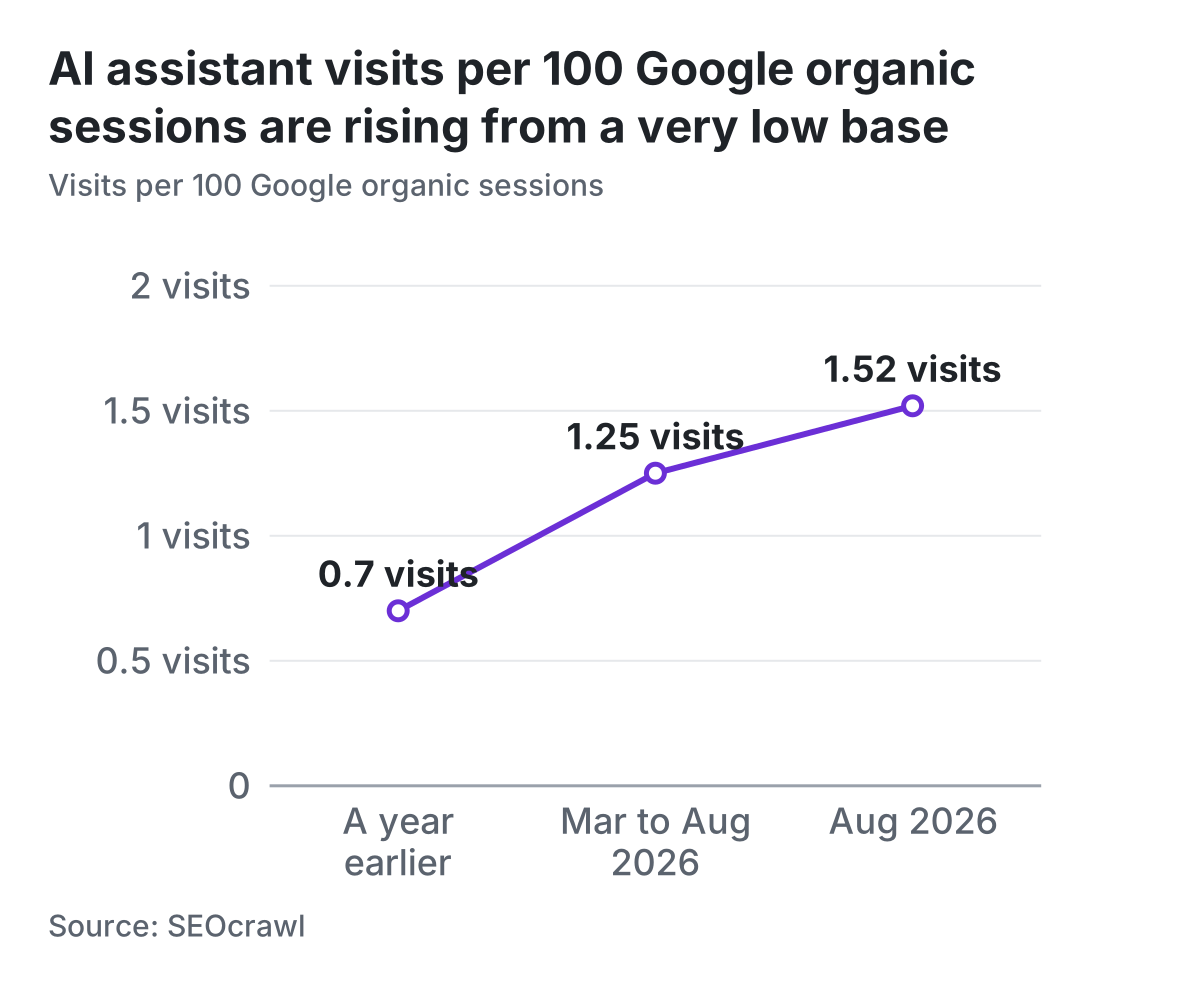
AI referrals are growing. I'm not going to pretend otherwise. SEOcrawl found AI assistants sent 0.70 visits per 100 Google organic sessions a year earlier, 1.25 across the main window and 1.52 in August 2026.
AI assistant visits per 100 Google organic sessions are rising from a very low base
See the data
| Category | AI visits per 100 Google organic sessions |
|---|---|
| A year earlier | 0.70 visits |
| Mar to Aug 2026 | 1.25 visits |
| Aug 2026 | 1.52 visits |
AI's share of all website sessions went from 0.23% to 0.36%, reaching 0.42% in August 2026. Across 3,949 sites, AI-referred sessions grew 44.6%. In the strict cohort of 3,099 sites with complete history, growth was 41.1%, from 2.13M to 3.00M sessions.
But growth is not a straight line. Haynes found ChatGPT referrals stopped growing exponentially in August 2025 and declined afterward.
Then May 2026 happened. ChatGPT began showing brands as clickable inline links, and AI referral volume rose 36 to 39% across customer segments in the Zenodo benchmark. The channel moved because the product changed, not because buyer behaviour did. That should make you cautious about building a plan on one platform's UI decisions.
The AI search that is actually sending people to businesses today isn't ChatGPT. It's Google.
Marie Haynes, Search Engine Land analysis of 100 websites
Half Your AI Traffic Is Hiding in Direct and Organic Reports
Here is the part that makes every "AI sends almost no traffic" stat a floor, not a measurement. Visits from the ChatGPT apps often lose their referral information, so GA4 files them under direct. Clicks from AI Overviews and AI Mode land in Search Console as ordinary organic clicks, and there is no filter to separate them. SEOcrawl says as much in its own study.
The scale of the leak is big. In a Bocconi University study using Comscore US desktop clickstream, ChatGPT produced a clean referral in only 5.2% of sessions, against 31.1% of Google queries. And 74.4% of 56,578 ChatGPT-active households never produced a single clean ChatGPT referral in ten months. For Google, that figure was 9.6% of 291,747 households.
Cheap ways to see the path anyway
Add a self-reported attribution field to every lead form: "How did you first hear about us?"
Add "ChatGPT", "Perplexity" and "Google AI answer" as explicit options, plus a free-text box
Watch branded search volume in Search Console every month
Compare direct traffic trends against your branded query trend, not in isolation
Ask sales to log "where did you hear of us" on every first call
None of this is precise. It is the closest you get to observing the citation path today.
Treat AI Answers as a Citation Layer, Not a Channel
An AI answer does not need to send a click to work for you. It plants your brand name in front of a buyer at the moment they ask a question. Later, that name gets typed into Google or the URL bar. That is a citation layer, and it feeds SEO instead of competing with it.
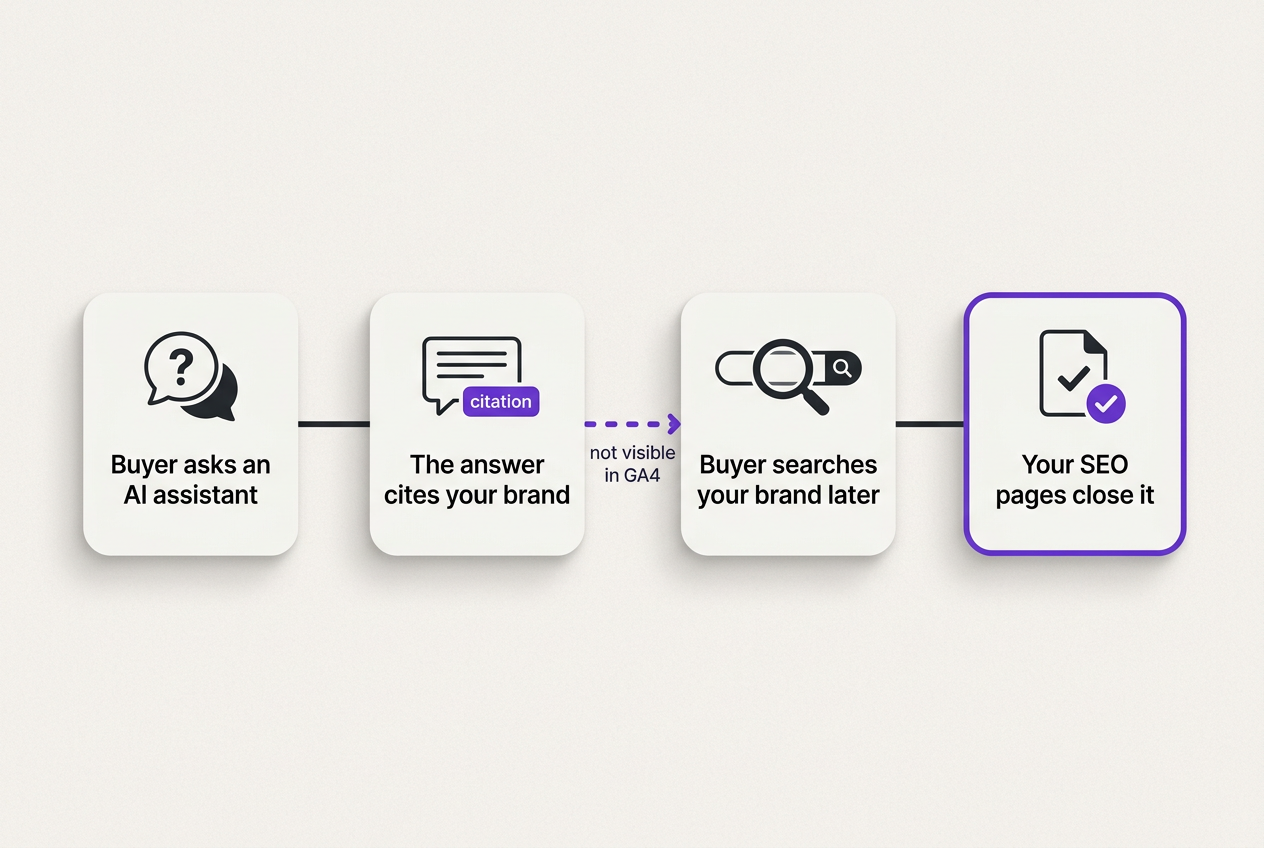
The citation-to-lead path
- Step 1Buyer asks an AI assistant
A specific question, often mid-evaluation.
- Step 2The answer cites your brand
Maybe with a link, maybe just a name.
- Step 3Buyer searches your brand later
Branded search lift in Google or a direct visit. This hop is the unmeasured one.
- Step 4Your SEO pages close it
Pricing, comparison and proof pages turn the visit into a lead.
What the data does support: growth in AI referrals correlated with growth in organic traffic (r = +0.53 after controls) in that same benchmark. Citations and SEO move together. They are not rivals.
Now the cost reality check nobody runs. A 5% improvement in organic performance adds more conversions than doubling AI referral traffic. Doubling 72,095 sessions is easy to say and hard to fund. That is why we still put SEO first for most clients.
Where AI does dent you: the Bocconi researchers found wider ChatGPT Search access cuts search use by 9.4%, with search-referral losses largest in informational categories. If your organic traffic is built on definition posts and basic how-tos, that is your exposure. Your money pages are far less at risk.
What to Actually Do With This in 2026
I'd rather give you a plan than a prediction. Here is how I'd spend the next quarter.
Your 2026 priorities, in order
Fix the SEO fundamentals and page speed first, because a 5% organic gain beats doubling AI referrals
Segment reporting by customer type before believing any AI conversion stat
Track branded search volume monthly and add self-reported attribution to forms
Stop routing everything to the homepage, since AI referrals land on answer pages
Re-audit informational content for the 9.4% search-use haircut
Run a 90-day citation test on 10 real buyer questions
Click pages
Commercial, comparison, pricing and local pages. These earn revenue from Google, so build them to rank and convert.
Citation pages
Single-question answer pages, definitions and data pages with named sources. These earn mentions inside AI answers. Our GEO service is built around this page type.
Segmented reporting
B2B Products at 0.62x is a different conversation from B2C at 1.51x. Split before you decide.
Platform risk
The May 2026 inline-links change gave a 36 to 39% bump nobody earned. Don't build a plan on someone else's UI decision.
Do not abandon informational content. But don't fund it as if 2026 traffic still looks like 2019, either, especially where ChatGPT Search is widely adopted.
Then run the cheap test before the big bet. Pick 10 questions buyers ask in your sales calls. Publish real answers with data and named sources. Measure branded search and form fills for 90 days. That tells you more than any benchmark, including the ones in this post. If you want the page-level playbook, our post on why ChatGPT never recommends you walks through it.
Frequently asked questions
Is AI search replacing Google in 2026?
Not on the traffic numbers. Google organic still sends roughly 80 times more visits than all AI assistants combined, per SEOcrawl's study of 16,000+ sites. AI referrals are growing quickly (44.6% year on year), but from a very small base.
How much traffic does ChatGPT actually send to websites?
Very little compared with Google. Marie Haynes found ChatGPT drove 0.62% as many sessions as Google organic across 100 sites, and chatgpt-vs-google.com found all chatbots combined sent 0.28% of web traffic in March 2026. Real figures are higher, because app visits get filed as direct traffic.
Why do ChatGPT visitors convert better than Google organic visitors?
Likely because they arrive mid-funnel with a specific question already partly answered. In TheoryRoad's sample, only 15 of 77 AI-referred landings hit the homepage. Haynes saw 13.8% vs 3.02% conversion, but intent is inferred from last-click conversion, not measured.
Will AI search replace SEO?
The evidence says no. Growth in AI referrals correlated with growth in organic traffic (r = +0.53 after controls), and a 5% organic improvement adds more conversions than doubling AI referral traffic. AI answers work best as a citation layer that supports SEO.
Does AI search drive qualified leads for B2B companies?
It depends on what you sell. In the Zenodo benchmark, AI sessions converted 1.21x organic for B2B Services but only 0.62x for B2B Products. So B2B product companies should be cautious about shifting spend.
How do I measure AI search traffic if GA4 shows it as direct?
You can't measure it cleanly. Add a self-reported attribution field to every lead form, include AI assistants as options, and watch branded search volume in Search Console. Together those give you a rough view of the citation path.
Should I reduce my SEO budget and spend on AI search optimisation instead?
No. The numbers favour doing SEO first, then earning citations as a cheaper second win. Run a 90-day test on 10 real buyer questions before moving any meaningful budget.
Sources
- ChatGPT sends less than 1% of Google's traffic: Data · Search Engine Land
- AI vs Search Traffic Analysis · Ahrefs
- AI Traffic vs Google Organic: 2026 Study of 16,000+ Sites · SEOcrawl
- AI Chatbot Traffic: What It Is, and How to Get More · Ahrefs
- Answering Without Referring: How AI Search Rewrites the Web's Economic Bargain · arXiv
- AI Assistant Referral Traffic and Conversion Performance Relative to Organic Search: A 12-Month Multi-Site Benchmark, 2025-2026 · Zenodo
- ChatGPT Visitors vs Google: What 90 Days of Lead Data Shows · TheoryRoad
Want to know where your next 100 leads actually come from?
We'll look at your Search Console, your lead forms and your answer pages, and tell you plainly whether your next rupee belongs in SEO, in AI citations or in fixing the site you already have.