Grok for SEO Competitor Research: 2026 Prompt Playbook
Learn how to use Grok in 2026 to mine competitor SERP gaps, pricing pages, reviews and X chatter, plus copy-ready prompts that turn raw insights into SEO actions.
 Written byPrithvi Jadwani
Table of contents
Summarize this article with AI
TL;DR
Grok for SEO competitor research works as a signal finder, not a rank checker. Use live X search and keyword overlap to find complaints, pricing moves and gaps, then verify every claim in a second session before it touches your plan.
- Signal finder, not a rank checker. Grok reads X and the open web but has no ranking data of your own.
- Filter false competitors. Keyword overlap surfaces irrelevant domains, so check product and buyer job first.
- Split prompts by task. Grok cited X 24 times on sentiment questions and 0 times across 170 buying and fact-check citations.
- Verify in a second session. 213 of 236 stored URLs in one study were recall, not real references.
- Close the loop. Record a baseline ranking, a change date and fixed check dates after publishing.
How does Grok for SEO competitor research work in 2026?
Grok for SEO competitor research works best as a signal finder, not a rank checker. It reads live X posts and the open web, so it can surface complaints, pricing chatter and launches before they show up in a keyword tool. It can't tell you where anyone ranks, so every insight needs a second check before it touches your strategy.
Most people start by typing 'who are my SEO competitors' into Grok. That's the wrong first move. ContextBolt puts it well: a model has a fuzzy memory of rankings from training, frozen at a date and never complete. Ask with no data attached and you get a guess shaped like a report. It reads confidently, and that's the problem.
Here's what the tool gives you. xAI's X search documentation lists keyword search sorted by Top or Latest, user search, thread fetch, a date range, and up to 20 accounts to include or exclude. In Grok chat there are no dropdowns for these, so you write the limits into the prompt. And here's what you owe it in return, using the rules from GrokIndex.dev: require a source with every claim, keep volume separate from truth (a loud complaint is not a common one), and make it flag contradictions instead of resolving them quietly.
The rest of this playbook follows that order: discover, listen, understand what Grok will and won't cite, verify, then measure.
Start with keyword overlap, then throw out the false competitors
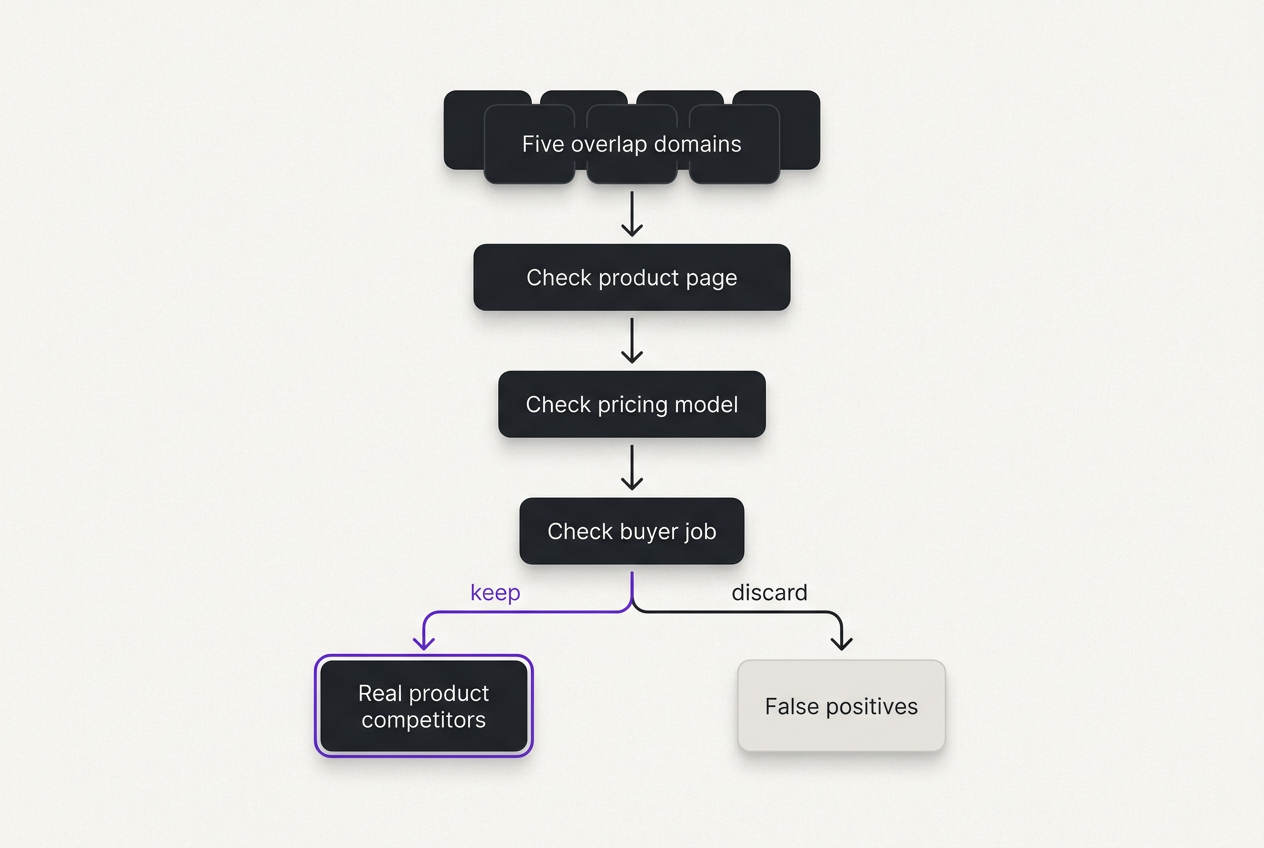
Keyword overlap will hand you a competitor list that looks great and is mostly wrong. ContextBolt ran a discovery check for contextbolt.com in the US on 13 October 2026, and the first five sites came back with hundreds of shared keywords each. None of the five sells a bookmark tool.
Keyword overlap returned five sites, none of them product competitors
| Domain | Shared keywords | Average position | Sells a bookmark tool? |
|---|---|---|---|
| justanswer.com | 423 | 12 | No |
| microsoft.com | 388 | 10 | No |
| easeus.com | 300 | 15 | No |
| geeksforgeeks.org | 296 | 10 | No |
| minitool.com | 280 | 27 | No |
Those five do compete with you for attention in search. They don't compete for the sale. That's a real difference, and a model can't see it from keyword counts alone. So treat the overlap table as a discovery net, not a market map. If you want the full playbook on ranking against the right rivals once you've got the list, our guide on ranking against competitor keywords picks up from here.
I'd go further: if you skip the discard step, everything downstream is polluted. You'll mine X for complaints about Microsoft and wonder why nothing applies to your pricing page.
The discard rule: run it on every overlap domain
Open the product page. Does it sell what you sell?
Check the pricing model. Subscription, one-off, free? A mismatch usually means a different buyer.
Name the buyer job. Would someone hire this firm for the same job as yours?
Ask the shortlist question: would a buyer put this firm next to you in a comparison?
Keep only the domains that pass all four. Log the rest as 'search-only rivals' for content ideas.
Use X search to find complaints, pricing moves and early signals
X is where customers say the quiet part out loud. Pricing grumbles, broken onboarding and 'does anyone know an alternative to...' threads show up there weeks before they show up in your keyword tool. AR Writer AI puts it neatly: X is the only large social platform whose live feed is natively searchable by a mainstream AI assistant.
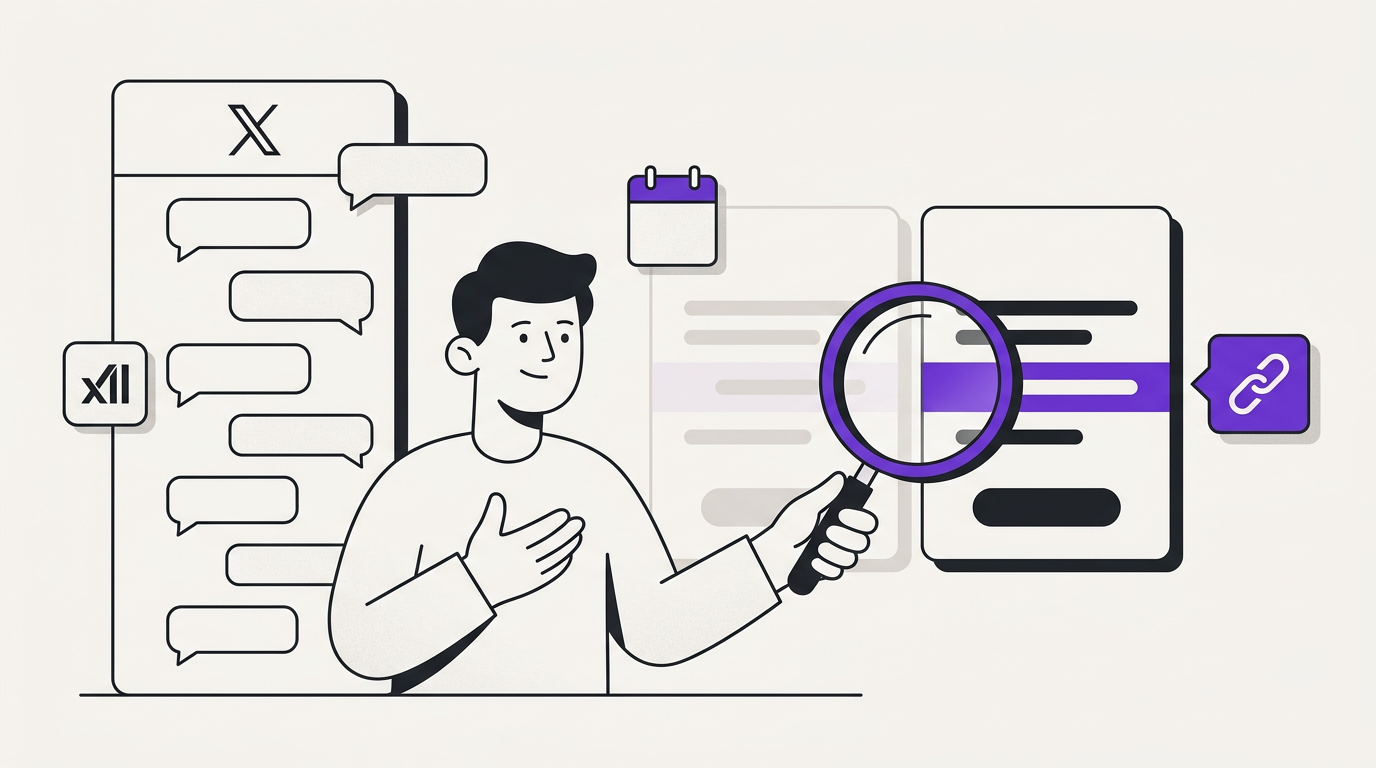
The trick is making the sweep auditable. Put the xAI limits straight into the prompt: keyword or user search, Top or Latest, a fixed date range, and the accounts to include or exclude (up to 20). AR Writer AI publishes an 'X trend mining' prompt that searches roughly 30 days of posts for recurring questions, complaints, pain points, recent subtopics and high-engagement posts, then proposes a content angle for each. It's a good template. Run it per competitor, not per market.
What every X sweep prompt should contain
Competitor handle and product name, plus up to 20 accounts to include or exclude
A date range (30 days is a sensible default)
Sort order stated: Top for what resonated, Latest for what's breaking
Output sections: recurring complaints, recurring questions, new subtopics, launch or pricing mentions
A link or quote for every line, with unsourced lines dropped
Pricing moves need a different habit. Asking for 'a summary of their pricing' once tells you nothing about change. Use a fixed prompt, save each output, and diff it against the last version:
Pricing diff prompt (run on a schedule, save every output)
Role: competitor pricing monitor.
Pages: [paste up to 10 pricing page URLs]
For each page return: URL, plan names, observed price,
currency, billing period, date you observed it.
Compare with the saved version below. If anything changed,
give the change date if the page or an archive shows one.
If no date is findable, write UNKNOWN.
Every line needs a link or a quote. Drop lines without one.
Saved version: [paste last run's output]Complaints: feed the best ones into comparison pages and objection-handling sections.
Pricing moves: a changed page plus a promo post is a cue to review your own offer.
Questions: recurring ones become FAQ and article briefs.
Launch chatter: map each promoted page to a target keyword, then check that results page.
What Grok will not cite: the X signal collapse on buying and fact-check prompts
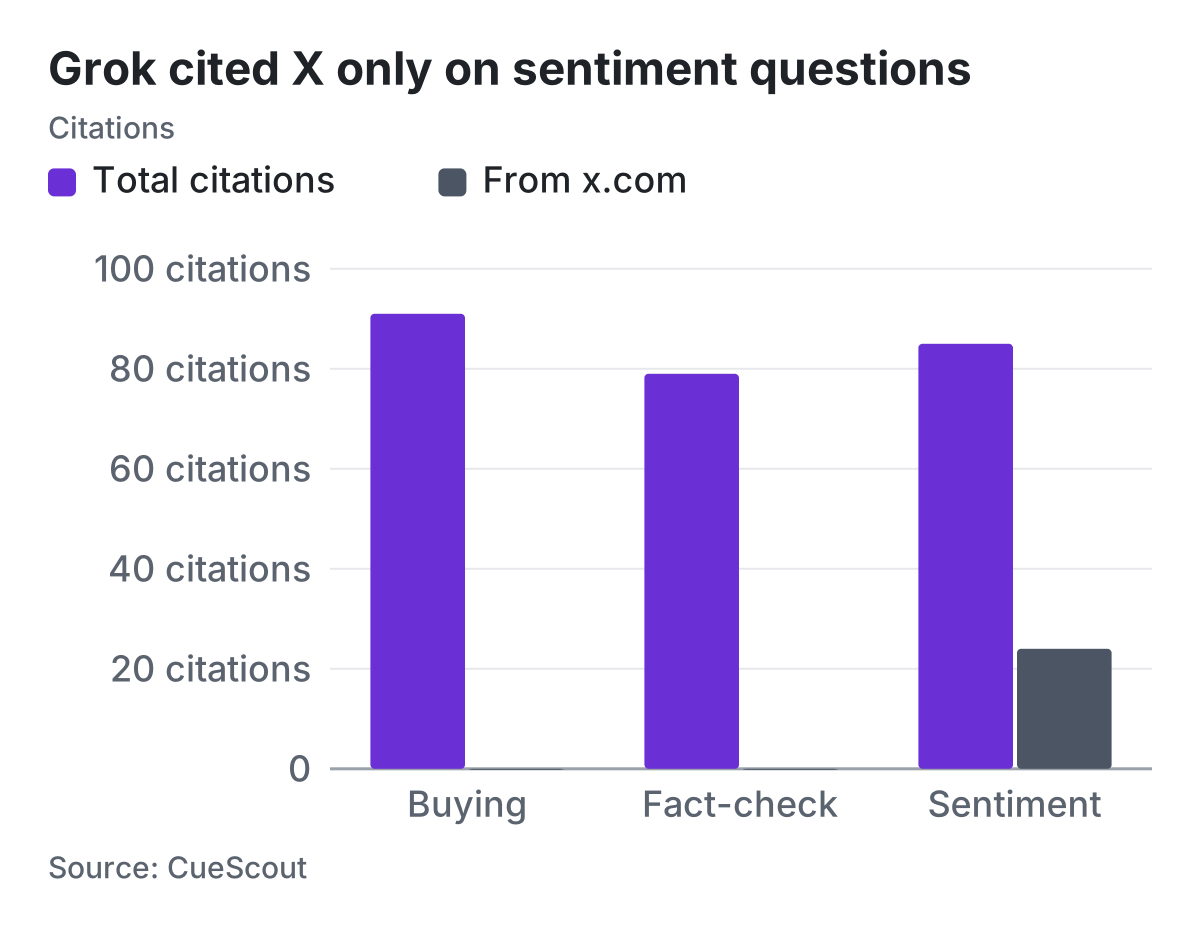
Here's the part most Grok SEO guides skip. Grok can search X, but that doesn't mean it cites X when you ask the wrong kind of question. CueScout ran 36 questions on 20 August 2026 against three engines (108 answers) for $3.33 with no failed calls. They counted only citations returned in API annotations, never URLs written into the answer text.
Grok cited X only on sentiment questions
See the data
| Category | Total citations | From x.com |
|---|---|---|
| Buying | 91 citations | 0 citations |
| Fact-check | 79 citations | 0 citations |
| Sentiment | 85 citations | 24 citations |
Read that chart twice. All 24 of Grok's X citations sat in the sentiment group, and 10 of those 12 sentiment questions produced at least one. Across the 170 buying and fact-check citations it cited X zero times. So a prompt that mixes 'what are they launching on X' with 'which one should I buy' will quietly lose the X signal. You won't get an error. You'll get a confident answer built from the ordinary web.
Perplexity: 346 citations across all 36 questions, 1 from x.com (0.3%).
ChatGPT: 139 citations, 0 from x.com (0%).
All three engines: 740 citations in total.
Grok on buying questions: its most-cited domains were zapier.com, then reddit.com, then ventureharbour.com. CueScout called it the ordinary web, read in the ordinary way.
The 213 of 236 figure matters just as much. Fake references written into prose are indistinguishable from real ones by eye. If you've been trusting a link because it looked plausible, stop.
Verify in a second pass, with a cost model for human review
Verification is where most Grok workflows quietly fail. GrokIndex.dev recommends splitting collection from checking: run the automated research persona, then paste the digest into a fresh Grok session and have it independently check each claim before anyone acts. Their argument is that a single combined pass waves through its own confidence-tagging errors. I agree. A model grading its own homework in the same session is not a review.
The second-pass routine
Open a fresh session. No shared context with the collection run.
Paste the digest and ask for an independent check of each claim.
Drop every line without an attributable link or quote.
Flag contradictions instead of resolving them.
Open the links yourself on a sample. Model-written URLs can look real and be recall.
Now the gap nobody fills: what does this cost in people-hours? No competitor article gives a number, and I won't invent one. What I can give you is the model. For a 10-competitor, 30-day sweep, count the claims in the digest. Sample a fixed share of the links by hand. Time one independent check pass on a single competitor. Then multiply across all ten. After one pilot competitor you'll have your own figure, which beats a borrowed one.
Pros
Catches unsourced and recalled claims before they reach a brief
Contradictions get flagged instead of buried
Gives you an audit trail when someone asks where a claim came from
Cons
Adds human review time on every sweep
A second Grok session can still miss errors, so link sampling stays manual
Slows the path from signal to published page
Which check fits which claim?
A pricing claim
Open the pricing page yourself and compare it with your saved version. Note the date you checked.
A complaint pattern
Open the cited posts and count how many are separate people. Volume is not the same as truth.
A launch or new page
Visit the URL, confirm it exists, then run a results page check for the keyword it targets.
A ranking or traffic figure
Reject it. Grok has no ranking data of your own. Pull it from Search Console or a keyword tool.
One last habit. Store every citation with the claim, the date and the session it came from, and re-check before you reuse it. A claim you can't trace back in six months is a claim you shouldn't repeat.
Close the loop from X signal to ranking movement
Most Grok SEO guides end with 'run a SERP check.' None of them gives you a baseline, a cadence or a before and after record. Without those, you can't say whether the competitor-inspired page you shipped did anything. That's the gap I'd close first.
A before-and-after record for one target keyword
- Baseline dateRecord where you rank today
Note your current position for the target keyword and the page that holds it, from Search Console or your rank tool, not from Grok.
- Signal dateLog the X-promoted competitor page
Run a prompt that pulls 14 days of their X posts and maps promoted pages back to target keywords (ContextBolt documents one). Save the URL, the post and the keyword.
- Change dateRecord what you published or updated
Write down the page, the edit and the date it went live.
- Check datesRe-check at a fixed cadence
My default is the same weekday at weeks 2, 4 and 8. Pick yours and don't change it mid-test. Log position, page and any SERP feature changes.
For the gap work itself, BotPages analysed page-1 results from 344 real searches across niches like flooring, roofing and injury law, then built a free Grok bot that compares your page with three competitor pages. It's a useful starting point. Whether it's accurate enough for your niche is a separate question, and you need to answer it before you trust it.
Data freshness: how recent is the SERP snapshot the tool compares against?
Keyword coverage: does it cover your market and language, including Indian-language and local queries?
Page-level accuracy: run Grok's page comparison on five pages you know well and score it against a human review.
Export format: can you get the output into your record without retyping?
has a fuzzy memory of rankings from training, frozen at a date and never complete
ContextBolt, SEO Competitor Analysis With Grok: Who Outranks You, and Why
Austin Heaton's guide to Grok Bot for SEO and AEO lands in the same place: no ranking data, recency bias and volatility, so every figure needs independent verification. Read it as a use-case guide, not a measurement tool. If you want a team to run this loop alongside your SEO work, that's exactly what we do at TechDevs. But the loop itself costs you nothing except discipline.
Sources
- SEO Competitor Analysis With Grok: Who Outranks You, and Why · ContextBolt
- Does Grok Cite X Posts? 740 Citations, Measured · CueScout
- How to Automate Research With Grok: Competitive Intelligence and Trend Discovery Using Real-Time Data · GrokIndex.dev
- Compare your page to the top 3 for a keyword with a Grok Bot gap finder · BotPages
- How to Use Grok for SEO in 2026: Keyword Research, Content Optimization, and SERP Analysis · AR Writer AI
- How to Use Grok Bot for SEO and AEO: Best Use Cases · Austin Heaton
Want a competitor research loop that survives a fact-check?
We build X-signal sweeps, verification routines and before-and-after ranking records for SEO teams that want insights they can defend. Tell us your market and we'll show you where your competitor list is wrong.