SEO Audience Targeting Playbook 2026: Reach Real Buyers
Learn how SEO audience targeting works in 2026: find real buyers, fix wasted traffic, and build a search plan you can ship this quarter without guesswork.
 Written byPrithvi Jadwani

Table of contents
Summarize this article with AI
TL;DR
SEO audience targeting in 2026 means defining the buyer's job, urgency and exclusion rules first, then mapping queries, pages and proof to that segment. Volume comes last. Measure the result in pipeline and closed-won revenue, not sessions.
- Start with the buyer job. Segment by the problem and its urgency, not by role or company size.
- Add exclusion filters. Encode ICP disqualifiers so vanity traffic stays out of your numbers.
- Use first-party data. Join GA4 behaviour to CRM pipeline. It is your most durable targeting asset.
- Map segments to AI answers. Track citation-worthiness next to rankings, because many users won't click.
- Measure revenue and consent. Report closed-won revenue, respect DPDP obligations and refresh segments quarterly.
SEO audience targeting in 2026 means chasing buyer jobs, not keyword volume
SEO audience targeting in 2026 starts with the buyer's job, how urgent it is and who you refuse to serve. Only then do you map queries, pages and proof to that segment. Flip the order and you get a traffic report your sales team never opens.
Here's the problem with most playbooks. They start at a keyword tool, sort by volume and call the top of the list "the audience". But AAMAX makes a point I agree with: role and company size are useful filters but poor predictors of search behaviour. What decides the queries someone types is the problem they're trying to solve and how urgently they need it solved.
Think of keyword volume as footfall at a mall. Forty thousand people walk past your shop. A handful walk in holding a list. Buyer jobs tell you who carries the list, and that's the only crowd worth designing your shop window for.
The second shift is data ownership. Search Blueprint calls first-party data the most durable targeting asset, and I'd go further: it's the only one you fully control. Your CRM notes, sales calls, support tickets and site search are a better audience brief than any third-party tool. In audits, the page with the most traffic is rarely the one sales mentions in a closed deal. That gap is the whole story.
Start with jobs to be done and build one or two SEO buyer personas
Start by writing the job, not the job title. "Replace our spreadsheet before the next audit" is a job. "Operations manager at a mid-size company" is a costume. Founder.best suggests mapping each segment to keywords and search intent, then building one or two SEO buyer personas. Two is enough. Ten personas means you're targeting everyone again.
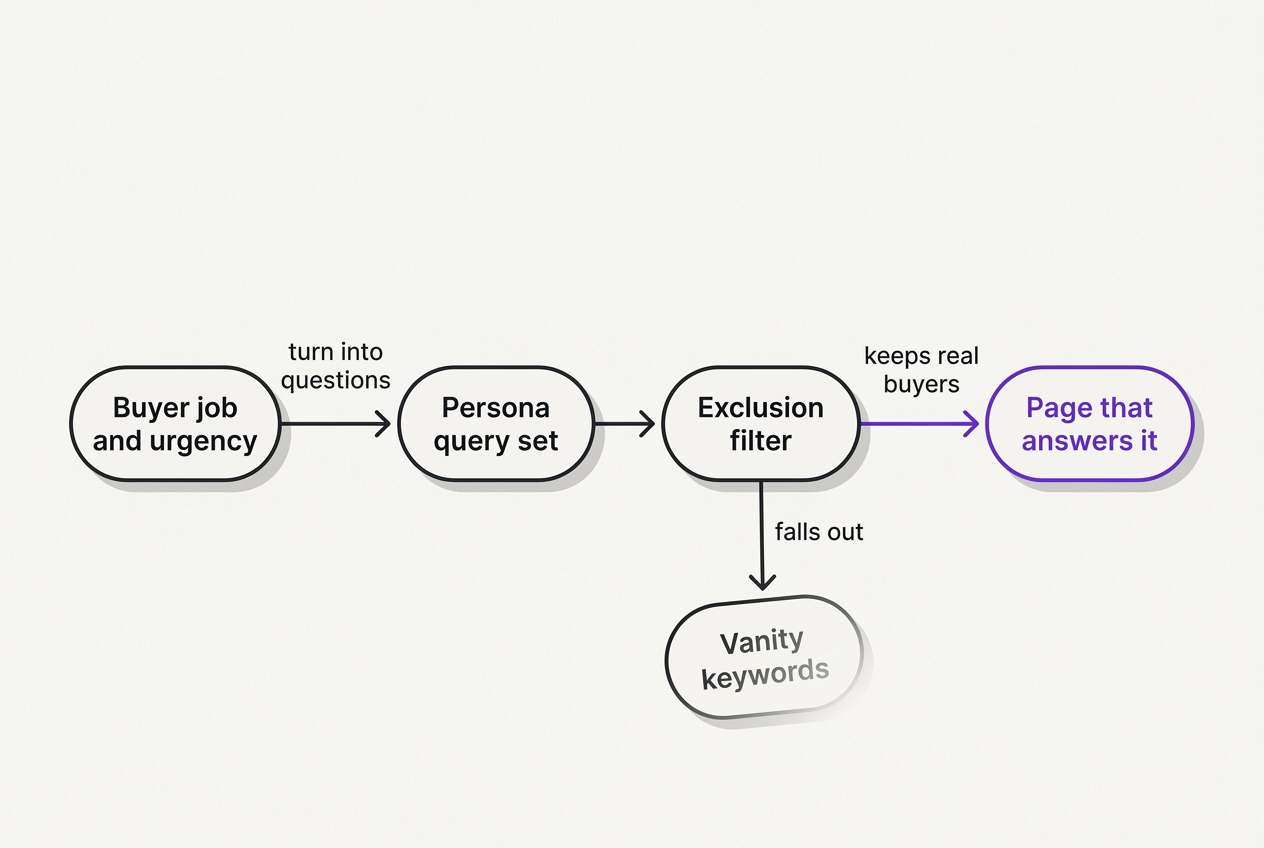
Then flip the usual research order. 97th Floor's audience-first method writes the real questions each persona asks at each journey stage, pairs each with a representative keyword, and only then scores volume, traffic potential, difficulty and CPC. Volume becomes a tiebreaker, not the starting gun. Pull your questions from places where buyers talk without a search box:
Sales and discovery calls: the exact words buyers use when money is on the line.
Support tickets: problems people hit after buying, which are often the same ones they search before buying.
Site search: what visitors couldn't find on your own pages.
Forums such as Reddit and LinkedIn threads: the unpolished version of the question.
Google Search Console: queries you already almost rank for.
The problem they are trying to solve and how urgently they need to solve it.
AAMAX, How to Do SEO Target Audience
One warning from competitor guides that I'd repeat: don't narrow too early. Cut the audience to a sliver on day one and you'll starve your own data. Start with one or two jobs, let a quarter of real behaviour show you which one is paying, and only then tighten.
Add exclusion filters so SEO audience targeting keeps vanity traffic out
Targeting is as much about who you keep out as who you invite in. Most teams write a persona and never write the disqualifiers. So students, job seekers, competitors and visitors from regions you can't serve all get counted as "audience".
Vanity traffic versus real buyer signals
| Measure | Vanity traffic | Real buyer signal |
|---|---|---|
| Query | Broad definitional term, such as "what is CRM" | Problem plus context, such as "CRM for small distribution business India pricing" |
| Intent | Learning, no live problem | A live problem with a deadline |
| Exclusion filter | Students, job seekers and out-of-region visitors pass straight through | Negative modifiers, geography and company-size rules screen them out |
| Pipeline signal | Sessions and rankings | Demo requests, qualified opportunities, closed-won revenue |
Where do the filters come from? Two places, and both have limits. According to Bargaon, Google Search Console reveals page-2 opportunities, but it only shows queries where you already appear and hides some. Sales and discovery calls are the closest to commercial intent as a keyword source, but the sample is small and someone has to record and tag every call. Use Search Console for breadth and calls for truth.
Exclusion rules to write before you publish
Negative modifiers per persona (for example free, jobs, salary, course, template) and the pages they should never trigger
Geography limits: the cities, states or countries you actually serve
Company-size exclusions: who is too small or too large to be a fit
Job-title exclusions: students, interns, agencies and competitors
A one-line definition of a real buyer, shared with sales
A monthly check of form fills against those rules
Use first-party data and search intent to find real buyers with SEO
Your analytics already know which pages buyers respect. In GA4, iMark Infotech suggests looking at the pages with the highest engagement and the ones that are the last stop before a conversion. Those two lists show what different segments actually respond to, and they're usually not the pages you're proudest of.
Next, connect that behaviour to the CRM. A page that converts to leads that never close is vanity wearing a suit. The same logic applies in ecommerce: Growthpolis notes that segmenting Shopify orders by average order value, repeat purchase rate and category usually shows the biggest segment by traffic isn't the most profitable one.
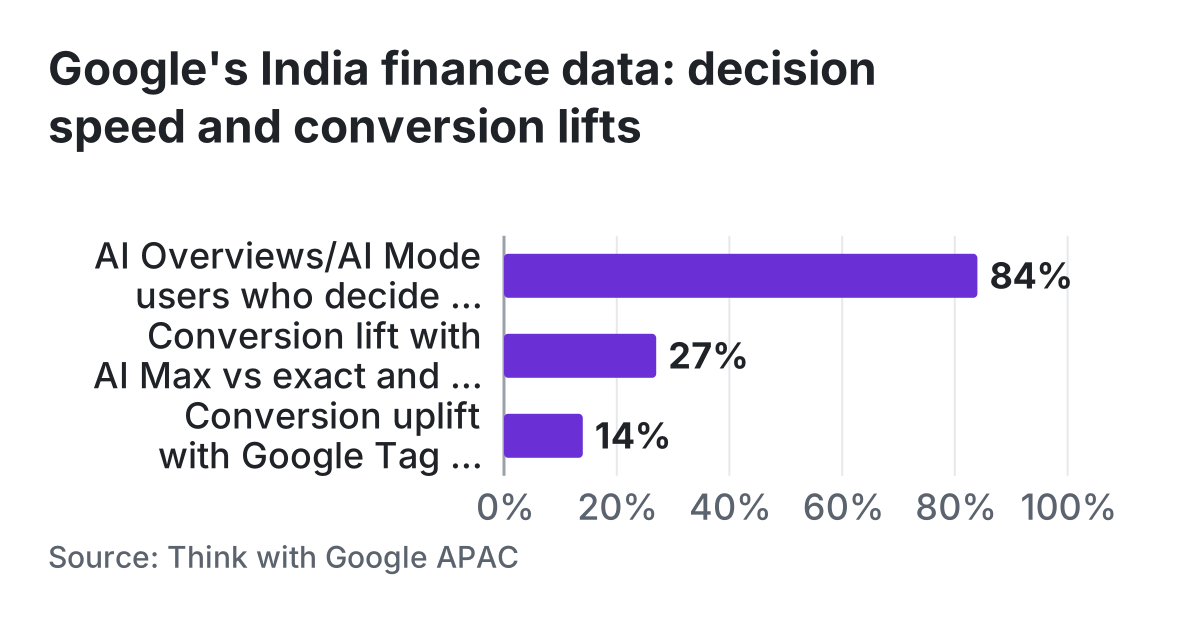
Buyers in a long journey touch many queries before they convert, so a single keyword per persona misses most of the path. The figures below come from Google's own finance research for India, so read them as direction, not as a universal benchmark.
Google's India finance data: decision speed and conversion lifts
See the data
| Category | Percent |
|---|---|
| AI Overviews/AI Mode users who decide faster | 84% |
| Conversion lift with AI Max vs exact and phrase match | 27% |
| Conversion uplift with Google Tag Gateway | 14% |
One honest limit: this evidence comes from the finance vertical and from large advertisers. It tells you the direction of travel, not what your Pune SaaS startup will see.
Common pushbacks on audience-first research
A prompt has weak keyword signals. Should I drop it?
Not automatically. 97th Floor treats it as a risk signal and says it may still be worth building for AI visibility, because search volume is evidence of demand, not the boundary of demand. I'd build it only if a real persona asks it in sales calls.
Doesn't low volume mean low value?
No. A query with a handful of searches can come from exactly the buyer you want. Judge it by the persona, urgency and the pipeline it touches, then use volume as a tiebreaker.
Is GA4 enough on its own?
It shows behaviour, not revenue. Until you join it to CRM outcomes, you're only guessing which engaged pages make money.
Map segments to AI answers and prove it with named examples
Ranking first no longer guarantees a click. Search Blueprint says it plainly: authority and citation-worthiness matter as much as ranking position, because users may not click at all. So for each persona, ask where the answer will be assembled and whether your page is the source worth citing. If you want the hands-on version, our Generative Engine Optimization work starts from exactly this question.
The clearest Indian proof sits in paid search, not SEO. I'll flag that upfront. But the lesson transfers: these brands won by matching buyer intent and first-party signals, not by bidding on a fixed list of keywords. All four are reported in Google's APAC finance research.
PolicyBazaar
Used AI Max for Search to capture high-intent demand in vernacular languages. Health insurance sales rose 28% while cost-per-sale fell 23%.
Acko General Insurance
Ran AI Max on queries like "best insurance for bike" and "compare two-wheeler insurance". Bike insurance leads rose 21% and car insurance leads 8%.
HDFC Ergo
Moved to a keywordless, asset-based framework with demand-led budget pacing, built to catch long-tail queries and new-to-market audiences.
Kotak Mutual Fund
Fed first-party data into its AI Max campaign, captured broader market intent and turned generic search interest into higher sales.
Authority and citation-worthiness matter as much as ranking position.
Search Blueprint, AI Audience Targeting Strategies for More Organic Traffic
On the organic side, 97th Floor says its persona-question method grew one client's AI search results 261%. That's the company's own claim for one client, so treat it as a signal, not a promise. What I'd copy is the habit: write the question each persona asks per journey stage, and flag weak-signal prompts instead of deleting them. If you're new to this, our post on why ChatGPT never recommends you covers the citation side.
Measure pipeline, consent and cadence, not sessions
Tag every SEO segment to what happens after the click: CRM pipeline, closed-won revenue and an attribution window your sales cycle can live with. A segment that drives sessions but no opportunities isn't an audience. It's a hobby. Our SEO reporting is built on this rule.
I should be upfront about what nobody can tell you yet. There is no public benchmark for how accurate automated intent labels are against human review. There's no published conversion benchmark for ChatGPT or other AI-assistant referrals. And the India data we have is mostly finance and large advertisers. So keep a human in the loop on intent tagging, and run your own numbers.
A cadence a small team can actually keep
- Month 1Connect the basics
Wire Search Console, GA4 and your CRM together. Write the real-buyer definition and exclusion rules.
- Month 2Start tagging calls
Name one owner for recording and tagging sales calls. Set a minimum number of calls per segment before anyone acts on a pattern, and write it down. Start conservative, since no public benchmark exists.
- Month 3First segment review
A second person reviews segments against closed-won revenue and signs off on changes.
- Next quarterAdd server-side tagging
Only after the CRM link works. Google reports a 14% average conversion uplift for Tag Gateway adopters, but your result will vary.
- After thatConsider AI Max
Add paid automation once you have clean first-party data to feed it. Refresh segments every quarter.
Pros
Fewer, sharper pages tied to revenue
Reports your CEO and sales lead will believe
First-party data you keep when platforms change
Cons
Slower to show up in traffic charts
Small call samples need careful reading
Needs named owners and consent work from day one
Sequence matters more than ambition. Get Search Console, GA4 and the CRM talking first, then server-side tagging, then AI Max. Don't run all three at once without an owner for each. I've watched teams buy three tools and fix none of the three problems.
Sources
- How to Do SEO Target Audience · AAMAX
- AI Audience Targeting Strategies for More Organic Traffic · Search Blueprint
- Keyword Research & Search Intent Guide · Bargaon
- AI search for finance customer journeys · Think with Google APAC
- Keyword Research Is No Longer Step One. Here's the Process Behind Audience First. · 97th Floor
- SEO Target Audience: Guide for SaaS Founders · Founder.best
- How to Analyze Behavioral Data to Define Your SEO Target Audience · iMark Infotech
- Audience-First SEO: Stop Chasing Keywords in 2026 · Growthpolis
Want traffic your sales team actually recognises?
We'll look at your Search Console, GA4 and CRM, define your real-buyer rules and show you which pages are pulling pipeline and which are pulling applause. Thirty minutes, no slide deck.