How Content Consolidation Can Transform Your SEO Performance
Discover how content consolidation improves SEO performance by merging redundant pages, strengthening value propositions, and aligning with Google's quality standards.
 Written byPrithvi Jadwani

Table of contents
Summarize this article with AI
TL;DR
Most websites bleed SEO value by spreading thin content across dozens of overlapping pages. Content consolidation fixes this by merging redundant pages into authoritative hubs that align with Google's quality standards and actually rank. We've seen sites recover 30-40% of lost organic traffic just by cleaning up their content architecture.
- Stop Competing With Yourself. Multiple pages targeting the same topic cannibalize each other's rankings instead of building authority
- Google Rewards Beneficial Purpose. Consolidated pages with strong value propositions outperform scattered content in modern SERPs
- Measurable ROI in 60-90 Days. Track improvements in organic traffic, rankings, and conversion rates with proper consolidation
- Strategic Redirects Preserve Equity. 301 redirects transfer link authority and ranking signals to your consolidated pages
What Is Content Consolidation SEO and Why It Matters Now
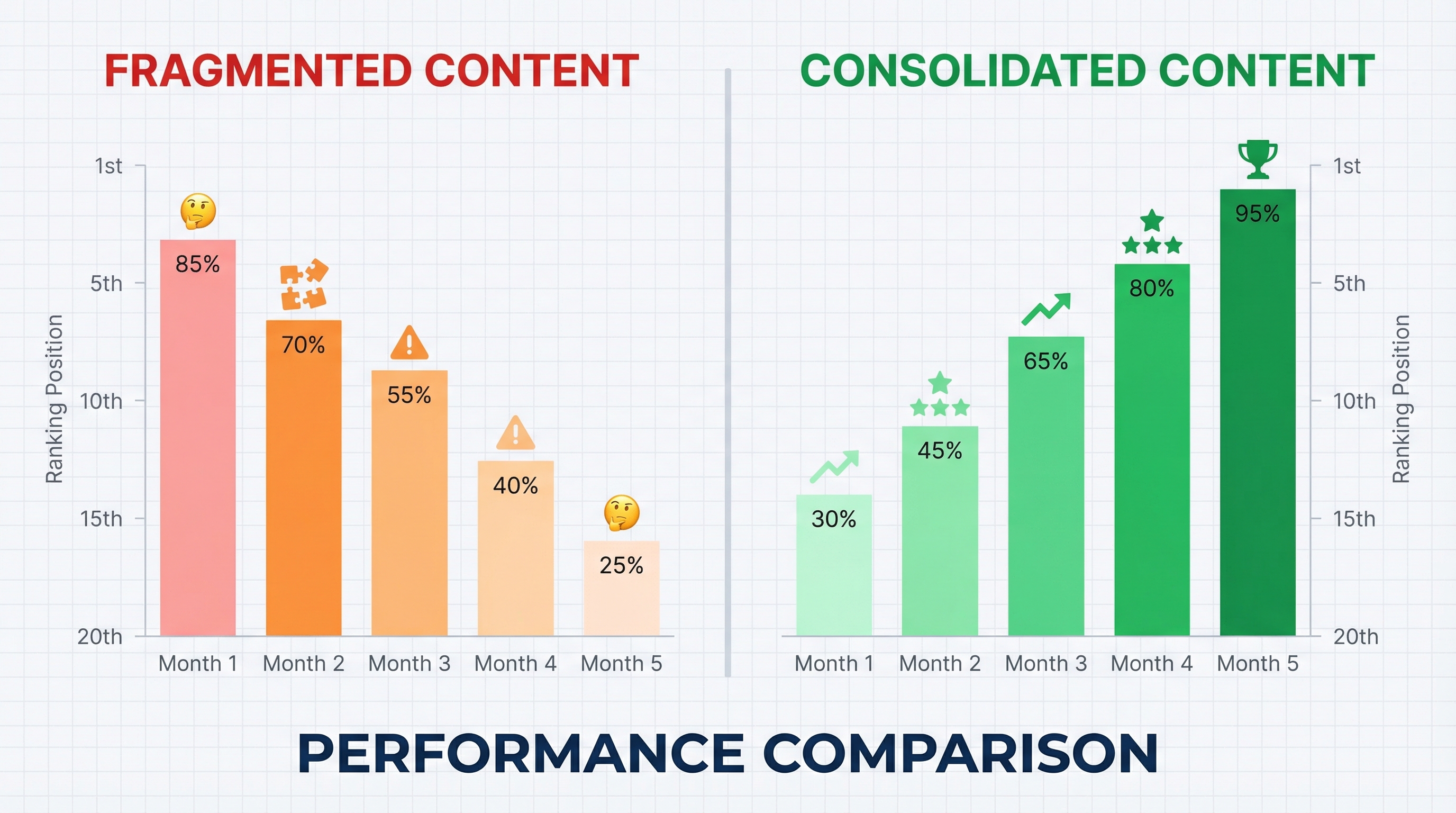
Here's a pattern we see constantly: a company publishes 15 blog posts about "email marketing tips," each targeting slightly different long-tail keywords. They rank on page 3 for everything and page 1 for nothing. Then they consolidate those 15 posts into one authoritative guide. Six weeks later, they're ranking in the top 5 for their primary keyword and pulling 3x the organic traffic.
Content consolidation is the process of merging overlapping pages (blog posts, landing pages, articles) into single, cohesive pieces that deliver real value. You're not just combining text. You're building a comprehensive resource with strong main content and strategic internal links to supporting material.
The search landscape shifted. SERPs now favor comprehensive value propositions over keyword-stuffed multiple pages. When we audit sites with declining rankings, the diagnosis is usually the same: they spread topical authority too thin. Instead of one strong page that Google trusts, they've got ten weak ones competing against each other.
The Hidden Cost of Content Fragmentation on Your SEO Performance
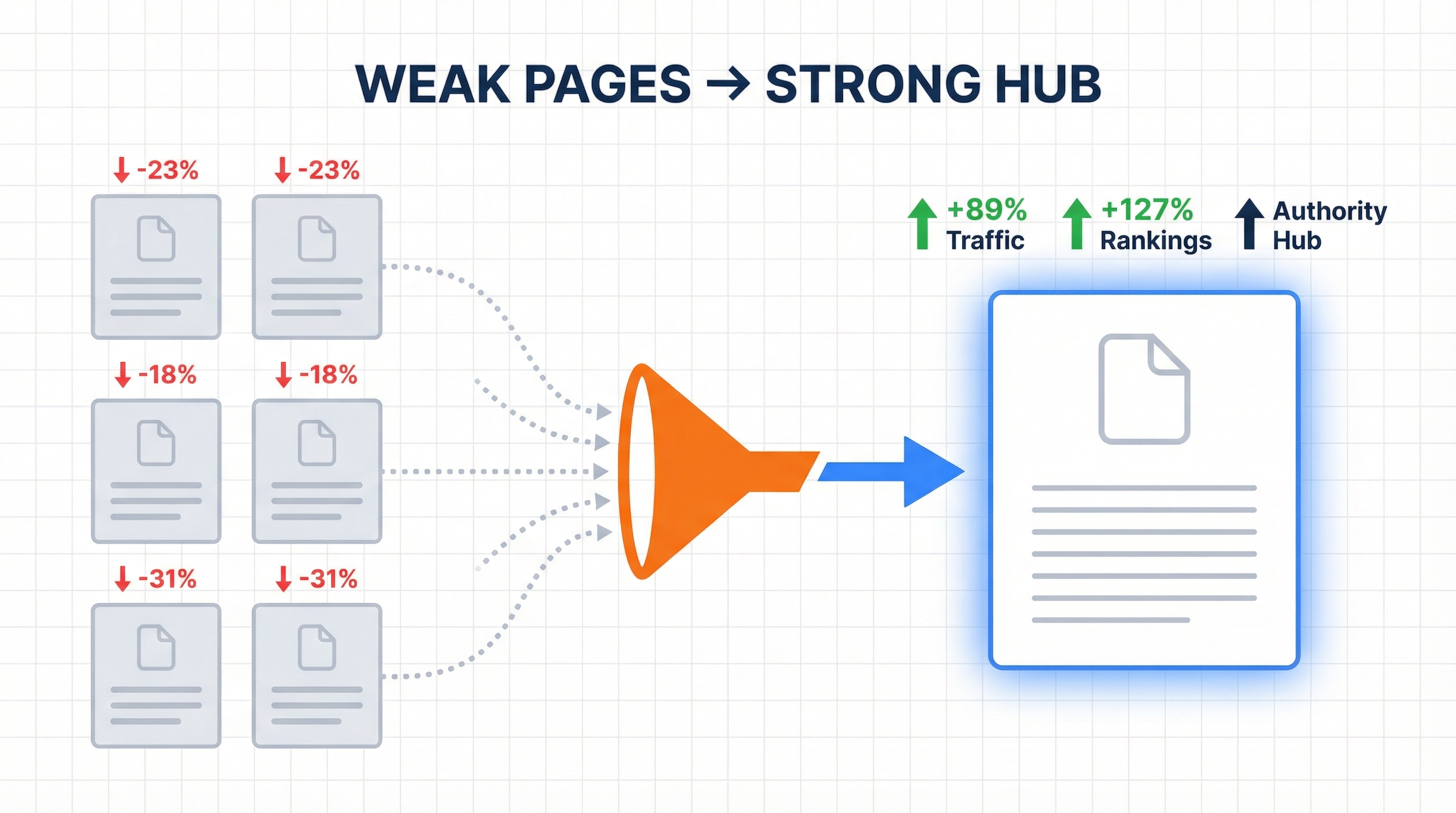
Content fragmentation doesn't just waste your time. It actively damages your rankings. When you publish five posts about "CRM software features," Google sees five signals competing for the same intent. None of them get enough authority to break through. Your competitors publish one killer guide and own the SERP.
This is keyword cannibalization in action. Your pages fight each other instead of fighting the competition. We've seen cases where a company's top three organic results for a valuable keyword were all their own pages, but none ranked higher than position 12. They were literally blocking themselves from page 1.
Diluted backlink equity: External links get spread across multiple URLs instead of strengthening one authoritative page
Confused crawl budget: Google wastes resources indexing near-duplicate content instead of your valuable pages
Lower engagement metrics: Users bounce when they land on thin content, signaling poor quality to search engines
Weakened internal linking: You can't effectively link to five different pages about the same topic without looking spammy
Pros
One authoritative page builds concentrated ranking signals
Clear user journey with focused conversion paths
Easier to maintain and update single comprehensive resource
Better alignment with Google's people-first content guidelines
Cons
Multiple thin pages split ranking authority
Users get confused choosing between similar content
Maintenance nightmare updating scattered information
Violates beneficial purpose by not clearly solving user problems
When websites experiencing performance declines, it's because the SERPs have changed and now present users with different value propositions, or the site has spread value around a specific topic across too many URLs.
Dan Taylor, Search Engine Land
AI-Powered Content Audit: Identifying Consolidation Opportunities
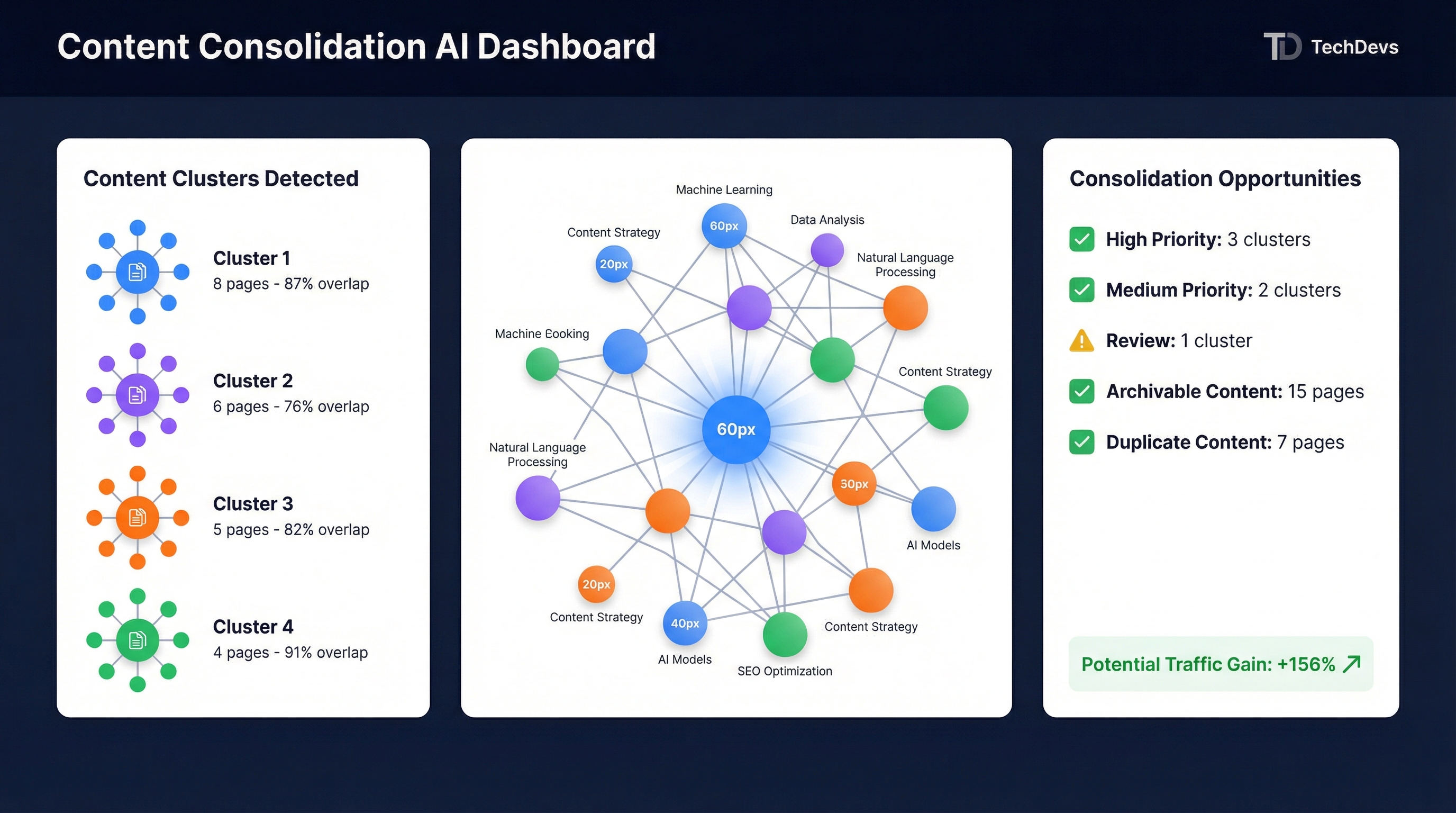
You can't consolidate effectively without knowing what you have. Manual content audits take weeks. AI-powered clustering tools do it in hours. Tools like MarketMuse, Clearscope, and Surfer SEO analyze semantic relevance across your entire site and surface overlapping content automatically.
Start with Google Search Console. Export your top 500 pages by impressions. Look for clusters where multiple URLs rank for nearly identical queries. If you've got three pages all showing up for "project management software comparison," that's a consolidation opportunity screaming at you.
Content Audit Checklist
Export Search Console data for pages with 100+ impressions in last 90 days
Group URLs by primary keyword intent using clustering tools
Identify pages with >70% topical overlap using semantic analysis
Map content to customer journey stages (awareness, consideration, decision)
Analyze backlink profiles to identify which URLs have the most link equity
Review engagement metrics (time on page, bounce rate) to spot weak performers
Semantic Clustering
AI tools analyze word relationships and context to identify content that targets the same user intent, even with different keywords.
Performance Mapping
Overlay traffic, rankings, and conversion data to determine which pages should become consolidation targets versus supporting content.
Intent Classification
Categorize content by search intent (informational, navigational, transactional) to avoid consolidating pages serving different purposes.
Backlink Analysis
Identify which URLs have the strongest link profiles to determine consolidation targets that preserve SEO equity.
The goal isn't to consolidate everything. It's to merge pages where the overlap creates internal competition. If you've got one page targeting "email marketing for SaaS" and another targeting "SaaS email automation," those probably need to merge. But "email marketing for SaaS" and "SaaS customer onboarding emails" serve different intents. Keep them separate.
The Strategic Content Consolidation Process: A Step-by-Step Framework
Consolidation isn't just copy-pasting content into one document. Done wrong, you'll tank your rankings. Done right, you'll build pages that dominate SERPs for years. Here's the framework we use at TechDevs when consolidating content for clients.
The 5-Step Consolidation Framework
Step 1: Audit and Categorize by Topic Clusters
Export all your content into a spreadsheet. Group pages by primary topic and search intent. Use tools like Ahrefs or SEMrush to see which keywords each page ranks for. If multiple pages rank for the same keyword cluster, flag them for consolidation. Pay attention to cannibalization reports in your SEO tools.
Step 2: Analyze Value Proposition Strength
For each group of overlapping pages, identify which one has the strongest value proposition. Look at word count, depth of coverage, backlinks, current rankings, and traffic. This becomes your consolidation target. The others will be merged into it or redirected. Ask: which page best satisfies beneficial purpose?
Step 3: Map Primary vs. Supporting Content
Not everything should consolidate. Some pages serve as supporting content for different stages of the buyer journey. Create a content hierarchy: pillar pages (comprehensive guides), cluster pages (specific subtopics), and supporting pages (related resources). Only consolidate pages at the same hierarchy level with overlapping intent.
Step 4: Merge Content While Preserving SEO Equity
Take the best sections from each page and combine them into your target URL. Rewrite for flow, remove redundancy, update outdated information. Then set up 301 redirects from the old URLs to the consolidated page. This transfers link equity and ranking signals. Update internal links across your site to point to the new consolidated URL.
Step 5: Optimize Structure with Internal Linking
Your consolidated page should have clear sections with H2/H3 headings, a table of contents for long content, and strategic internal links to related resources. Add a "Related Articles" section linking to supporting content. This creates a hub-and-spoke model where your pillar page links to specific subtopic pages that provide additional depth.
Use 301 redirects, not 302s: Permanent redirects pass full link equity to the target page
Avoid redirect chains: Point old URLs directly to the final consolidated page, not through multiple hops
Update your XML sitemap: Remove old URLs and ensure the consolidated page is included
Preserve valuable long-tail rankings: If an old page ranked well for a specific long-tail query, make sure that content is incorporated into the consolidated version
Monitor Search Console: Watch for 404 errors and indexing issues after implementing redirects
Avoiding Common Pitfalls: Cross-Domain vs. Intra-Domain Consolidation
Google talks about content consolidation mostly in the context of merging entire domains or subdomains. But the same principles apply within a single domain. The difference is scale and complexity.
Cross-domain consolidation (moving blog.yoursite.com to yoursite.com/blog) is a major migration. You're dealing with DNS changes, SSL certificates, and potentially thousands of redirects. Intra-domain consolidation is simpler: you're just merging pages within your existing site architecture. But both require the same strategic thinking about value proposition and user intent.
Pros
Pages serve distinct user intents (comparison vs. tutorial vs. case study)
Content targets different funnel stages (awareness vs. decision)
Unique value propositions that would be diluted if merged
Strong individual rankings that would be at risk
Cons
Near-duplicate content with 70%+ overlap
Multiple pages competing for the same keyword
Thin content that doesn't satisfy beneficial purpose alone
Outdated pages that cannibalize newer, better content
Mistake: Consolidating too fast without analyzing traffic patterns. Give yourself 2-3 weeks to audit properly.
Mistake: Ignoring long-tail rankings. That low-traffic page might rank #1 for a high-intent query. Check before deleting.
Mistake: Breaking user journeys. If your email sequences link to specific pages, update those links before redirecting.
Mistake: Creating redirect chains. Always redirect to the final destination, not through multiple hops.
Mistake: Not updating internal links. Search and replace old URLs across your entire site after consolidating.
By applying the logic of value proposition and beneficial purpose to consolidation, we can strengthen individual pages within a single domain just as effectively as consolidating entire domains.
TechDevs SEO Team
Measuring ROI: Building Your Content Consolidation Dashboard
You can't improve what you don't measure. And you can't justify consolidation efforts to stakeholders without showing ROI. Here's how to build a dashboard that tracks the metrics that matter.
Start with baseline data. Before consolidating anything, export current performance for all affected URLs: organic traffic, impressions, average position, click-through rate, backlinks, and conversion rate. You'll compare against this baseline 30, 60, and 90 days post-consolidation.
Traffic & Visibility Metrics
Track organic sessions, impressions, and click-through rate for consolidated URLs. Compare against the combined performance of old pages.
Ranking Improvements
Monitor average position for target keywords. Look for movement from page 2-3 to page 1 within 60 days of consolidation.
Engagement Signals
Measure time on page, bounce rate, and pages per session. Consolidated content should show better engagement than fragmented pages.
Link Equity Retention
Verify that backlinks from redirected pages transfer to the consolidated URL. Use Ahrefs or Moz to confirm.
The best consolidation projects tie directly to revenue. If you're consolidating product comparison pages, track how many leads or sales come from the new consolidated page versus the old fragmented ones. We've seen clients double their conversion rate just by giving users one clear, comprehensive resource instead of forcing them to navigate five confusing alternatives.
For our SEO clients at TechDevs, we build custom dashboards in Google Data Studio (Looker Studio) that pull from Search Console, Analytics, and their CRM. This gives a complete picture: from rankings to traffic to actual revenue impact.
Integrating Consolidation with Your Overall Digital Experience Strategy
Content consolidation doesn't exist in a vacuum. It's part of your broader content strategy, site architecture, and customer journey design. The best consolidation projects improve SEO and user experience simultaneously.
Map your consolidated pages to specific stages of the buyer journey. Top-of-funnel awareness content should be comprehensive guides that answer broad questions. Middle-of-funnel consideration content should be detailed comparisons and case studies. Bottom-of-funnel decision content should be product pages and landing pages optimized for conversion.
Awareness stage: Consolidate educational blog posts into pillar guides that rank for broad informational queries
Consideration stage: Merge product comparison posts into comprehensive buyer's guides with clear CTAs
Decision stage: Combine overlapping landing pages into focused conversion paths with high-converting landing page design
Retention stage: Create consolidated resource hubs for existing customers (documentation, tutorials, best practices)
At TechDevs, we integrate content consolidation with our clients' marketing automation platforms. When someone reads a consolidated guide on "B2B lead generation strategies," we can trigger email sequences tailored to their specific interests based on which sections they engaged with. This turns SEO traffic into qualified leads automatically.
Think of your consolidated content as hubs in a hub-and-spoke model. The hub (pillar page) provides comprehensive coverage of a broad topic. The spokes (cluster pages) dive deep into specific subtopics and link back to the hub. This architecture helps both users and search engines understand your topical authority.
Long-Term Maintenance: Keeping Your Consolidated Content Optimized
Consolidation isn't a one-and-done project. Your consolidated pages need ongoing maintenance to stay competitive. Search intent evolves. Competitors publish better content. Your own products and services change. Plan for this.
Set up a quarterly content refresh schedule. Review your top-performing consolidated pages every 90 days. Update statistics, add new examples, remove outdated information, and optimize for new keyword opportunities. This is easier than maintaining 10 separate pages, and it keeps your content fresh in Google's eyes.
Quarterly Maintenance Checklist
Review Search Console performance for consolidated URLs and identify declining rankings
Update statistics and data points with the latest available information
Add new examples, case studies, or tools that have emerged since last update
Audit and fix any broken internal or external links
Refresh meta titles and descriptions based on current CTR performance
Check for new consolidation opportunities as you publish new content
Analyze top-ranking competitor content and identify gaps to fill
Common Maintenance Scenarios
What if a consolidated page starts losing rankings?
First, check Search Console for technical issues (crawl errors, mobile usability problems). Then analyze the current top-ranking pages for your target keyword. Has search intent shifted? Are competitors providing more comprehensive coverage? Update your content to match what's currently ranking, or consider splitting the page if intent has diverged significantly.
How do I prevent future content fragmentation?
Implement a content governance framework. Before publishing new content, check if you already have a page targeting that topic. If yes, update the existing page instead of creating a new one. Use a content calendar that maps to your topic clusters, not just individual keywords. Train your content team on the consolidation strategy so they understand why you're doing this.
Should I consolidate content across different formats?
Sometimes. If you have a blog post, a PDF guide, and a video tutorial all covering the same topic, consider consolidating them into one multimedia resource page. But if each format serves a different audience preference, keep them separate and cross-link them. The key is whether they're competing for the same search intent or serving complementary purposes.
How do I scale consolidation across a large content library?
Prioritize based on impact. Start with your highest-traffic topic clusters where you have the most overlap. Use AI-powered tools to identify consolidation opportunities at scale. Then work through them in batches: 5-10 consolidations per month. Monitor results before moving to the next batch. This prevents overwhelming your team and lets you refine your process based on what works.
What tools automate ongoing consolidation monitoring?
Tools like MarketMuse and Clearscope offer ongoing content gap analysis and will alert you to new overlap as you publish. Ahrefs and SEMrush have cannibalization reports that identify when multiple pages compete for the same keywords. Set up custom alerts in Google Search Console for ranking drops on consolidated pages. According to strategic consolidation research, businesses that use automated monitoring see 40% faster identification of new consolidation opportunities.
The sites that win at SEO long-term treat content as a living asset, not a publish-and-forget archive. Your consolidated pages should get better every quarter. That's how you maintain rankings as competition increases and search intent evolves.
Ready to Consolidate Your Content and Boost Rankings?
We've helped dozens of companies recover lost organic traffic and improve rankings through strategic content consolidation. Let's audit your site and identify your biggest consolidation opportunities.